
 Русский





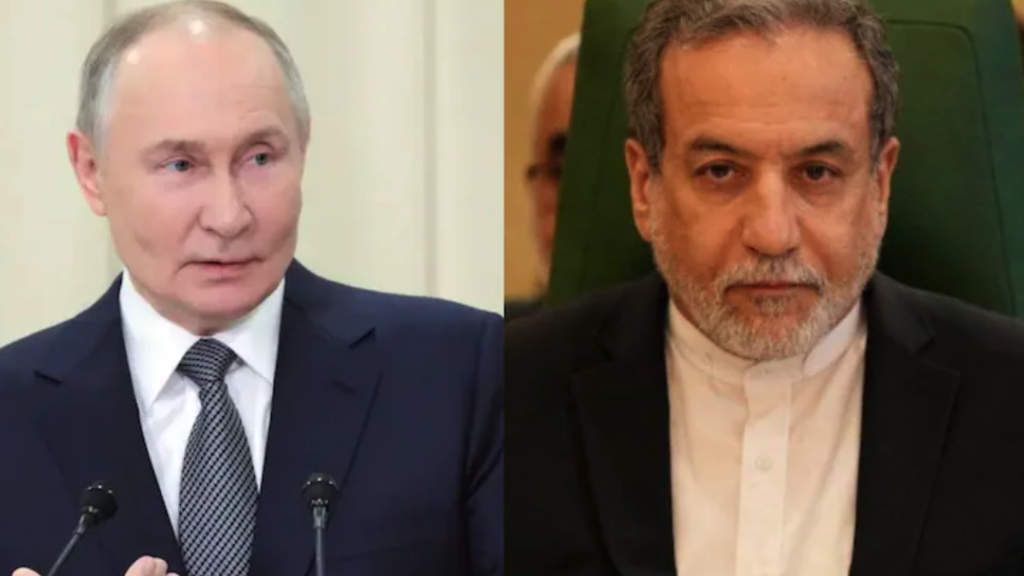

Iran’s Foreign Minister, Abbas Araghchi, has arrived in Russia today (Monday 27 April) and is expected to meet with President Vladimir Putin. Reports said that the top Iranian diplomat planned to discuss ways to resolve the conflict in the Middle East. A Russian Foreign Ministry official confirmed that Araghchi was visiting Russia “for talks.” Kremlin Spokesman Dmitry Peskov, in turn, said that the Russian president was scheduled to meet with the Iranian minister. Tehran’s Ambassador to Moscow, Kazem Jalali also stated that Araghchi planned “to hold consultations with the Russian authorities.”
Araghchi stated last week that he was not prepared to meet with a planned US delegation in Islamabad until Washington ceased issuing threats. He visited Pakistan before heading to Russia, and said that the talks he had with Pakistani officials in Islamabad touched upon a new legal regime for the Strait of Hormuz, the lifting of the United States’ blockade on Iranian ports, compensation payments and guarantees of no further attacks on Iran.
Iranian Foreign Ministry Spokesperson Esmaeil Baghaei pointed out that Araghchi had planned to communicate only with senior Pakistan officials with regard to Islamabad’s mediation efforts aimed at ending the conflict in the Middle East and that no meetings with US officials had been on his agenda. Araghchi also said that he would continue instead to discuss the situation with Pakistan, Russia and China.
US President Trump meanwhile has made numerous, conflicting statements concerning Iran, saying that the Strait of Hormuz was open for shipping – when it was not – that he would ‘bomb Iran back to the Stone age’ and that the Iranian leadership were in complete disarray.
That latter point has been contradicted by Alexey Pushkov, chairman of the Russian Federation Council, who has stated that “Two months into the war, there is no sign of a rift in Iranian society.” The fact that the Iranian Foreign Minister is able to fly to international meetings representing the country also appears strongly suggestive that the Iranian government is still functioning normally, although it cannot be ruled out that there may well be pending senior leadership changes in Iran.
Russia and Iran have maintained communication since the start of the US-Israeli aggression against Tehran, with the two countries’ presidents and foreign ministers holding regular telephone conversations.
Jalali also said that “Given bilateral relations between the two countries and the fact that Iran and Russia, as neighbors, (via the Caspian Sea) see eye-to-eye on a number of regional and international issues, we have seen regular communication at the high and top levels.”
He highlighted effective cooperation between Tehran and Moscow on the international stage. “This cooperation became clear during discussions of a recent United Nations Security Council resolution on the Strait of Hormuz, initiated by the US, which was unbalanced and irrational. Russia and China spoke out against it and used their veto right,” the envoy added.
Meanwhile, the Fars news agency reported that the Iranian foreign minister had handed a document over to Pakistan to be conveyed to the US, which was not part of the negotiation process. Fars claimed that the document clarified Iran’s key red lines, which particularly concern control of the Strait of Hormuz and the country’s nuclear energy sector.
Trump meanwhile seems caught up in both Iran and domestically, with shots fired during a Press Conference being held on Sunday. The developments with Iran appear likely to indicate that Putin will be discussing with Washington how to obtain a deescalation for the United States in Iran. A price would need to be paid for that – meaning the US would probably be asked to lean on Europe to withdraw support for Ukraine and for an agreement to be made on Moscow’s terms, in return for Russian assistance to defuse the situation in the Middle East. President Putin, it seems, is the actual power broker behind the thrones in these conflicts, although neither the United States nor Europe will want to politically accept this as being the case.