
 Русский










The situation in the Middle East has also impacted the Russian petroleum products market. The largest increase in the wholesale price was for fuel oil, which in one trading day became more expensive by 27.1%, to a maximum since November 2025. However, analysts note that part of the Iranian volumes of fuel oil can be replaced by Russian ones.
The cost of fuel oil on the St. Petersburg Exchange on March 3 grew by 27.1% to ₽19,910 (US$249) per tonne. This is the largest increase in quotes since mid-June 2025. To compare, the price in Europe for the same product has risen to US$793 per tonne.
Growth in Russian wholesale prices at the end of Friday’s (March 6) trades was also observed for all petroleum products. The cost of AI-92 gasoline grew by 2.65%, to ₽61,790 rubles (US$772) per tonne; AI-95 by 2.60% to ₽65,040 (US$813) per tonne; and diesel fuel became more expensive by 0.70–1.81%, depending on the class.
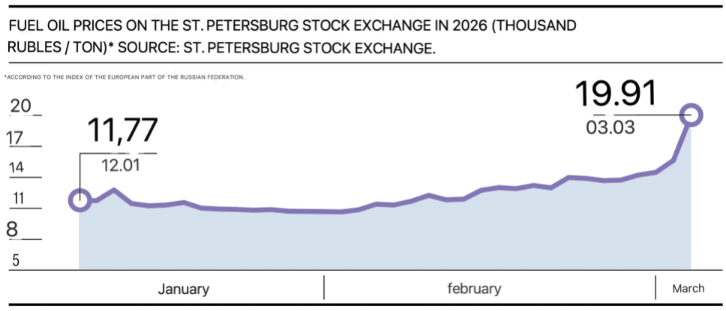
Petroleum product quotes moved toward growth after the start of the military operation by the United States and Israel against Iran, which has led to a sharp increase in global oil prices. The cost of Brent has grown to US$108.4 as of Monday morning (March 9) per barrel, the highest since July 2024. In response to the attacks, Iran has blocked the Strait of Hormuz—one of the key routes for supplying hydrocarbons. The volume of oil and petroleum products transportation is estimated at almost 20 million barrels per day (bpd), equivalent to 20% of global demand.
The Centre for Price Indices (CPI) notes that the jump in domestic quotes is related to the active replacement of Iranian volumes at Fujairah Port in the UAE—a key bunkering hub of the Gulf of Oman. According to Kpler, the suspension of fuel oil exports from Iran (about 256,000 bpd in 2025) can expand demand for the Russian product and lead to a greater increase in wholesale prices. The escalation of the conflict provoked global growth in quotes and laid a risk premium for transit through the Strait of Hormuz, which has been reflected in the Russian market, says NEFT Research.
The driver for the growth of wholesale fuel oil prices in Russia was also the attacks on the oil infrastructure of Saudi Arabia, according to Kirill Bakhtin, head of the centre for Russian stock analysis at BCS. This led to an increase in global oil prices and an increase in the margin of petroleum products against the background of risks of regular supply disruption, he adds. Bakhtin also points out that there are no damper mechanisms linked to indicative prices for fuel oil. The cost of fuel oil in Russia, he explains, is formed on the basis of an export netback while taking into account transportation inside the country. This means that a significant overweight in favor of any sales channel is not precisely fixed.
Fuel oil among export goods is distinguished by the greatest volatility due to the low liquidity of exchange trades and the absence of state sales standards on the exchange, as for gasoline and diesel fuel, according to Vladimir Chernov of Freedom Finance Global. The current supply on the Astana exchange, in his assessment, is limited and unable to satisfy the increased demand, which also spurs the growth of prices.
Andrey Dyachenko, chief analyst for oil, petroleum products, and macroeconomics at Proleum, in Dubai says that the growth of quotes is primarily related to internal factors — a reduction in supply on the exchange and the seasonal structure of demand. Fuel oil as a “residual” product is sensitive to refinery loading and changes in the processing structure, since during repairs the supply quickly shrinks, causing price jumps.
According to Russian Consumer Price Index data, in February Russia reduced the maritime export of fuel oil by 23%, to 2 million tonnes.
The freight market, analysts add, has not yet responded to the violent situation in the Middle East: the cost of transporting dark petroleum products in the last week of February decreased by US$1–2. That can be expected to radically change.
S&P Global meanwhile has stated that the decrease in shipments of petroleum products from Russia in February is associated with unplanned refinery shutdowns, which led to a decrease in processing for the month to 5.15 million bpd. In January, according to the International Energy Agency report, Russian petroleum product exports reached peak values.