
 Русский






Moldova has launched the procedure for officially withdrawing from the Commonwealth of Independent States (CIS), Foreign Minister Mihai Popsoi has said.
The CIS was formed in 1991 after the collapse of the USSR to promote cooperation regarding economic, political, and security issues among the former Soviet republics. It currently includes Armenia, Azerbaijan, Belarus, Kazakhstan, Kyrgyzstan, Russia, Tajikistan, Moldova, and Uzbekistan. Georgia and Ukraine withdrew from the organization in 2008 and 2018, respectively.
Moldova, a country of around 2.5 million people sandwiched between Romania and Ukraine, took an increasingly anti-Russian course after the government of pro-EU President Maia Sandu came to power in 2020.
In October 2025, Chisinau adopted a new security strategy identifying Moscow as its main threat and accusing it of waging a “high-intensity hybrid war” against the country. The Russian authorities have denied the accusations.
The EU granted Moldova candidate status in 2022 alongside Ukraine. Sandu also mulled the possibility of abandoning neutrality and joining “a larger alliance,” without specifically mentioning NATO.
Popsoi told Radio Moldova on Monday that Moldova “officially will no longer be a member of the CIS.” The government is “already in the process” of denouncing the three key deals linking the country to the organization. The move “will allow us to say that, from a legal point of view, Moldova is no longer a member. De facto, we suspended our participation for some time, but legally we were still there,” he said.
The denunciation documents should be ready by mid-February and sent to the parliament “so lawmakers can decide on them,” the minister said.
Sandu’s PAS party holds the majority in the parliament after the election in September last year, which was marred by widespread allegations of fraud and restriction of voters’ access to polling stations both at home and abroad. The vote was secured with a 50.8% vote, meaning that 49.2% – very close to half of all Moldovans—did not vote for these changes.
When Moldova first announced plans to exit the CIS in 2023, Russian President Vladimir Putin said, “They can do whatever they want. The presence of this country in the CIS is not of great value to us, but we are ready to work with them—we are not pushing anyone away.”
Membership of the CIS was a contentious issue in Ukraine, which originally suspended its membership in 2014. That cut the country, in trade terms, in two parts, as the western part of Ukraine borders the European Union, but the eastern part borders Russia and the CIS countries. This meant that the eastern part of Ukraine was divorced from its traditional import/export markets, resulting in less export access and higher import costs. Replacement imports from the European Union were more expensive, leading to civil protests and ultimately referendums (declared illegal by Kiev) to declare independence. Kiev then sent in troops to stop this succession. 14,000 eastern Ukrainians died in the conflict before the Russians stepped in to put a stop to it.
Those regions have now been absorbed back into Russia and have been reconnected with their CIS markets.
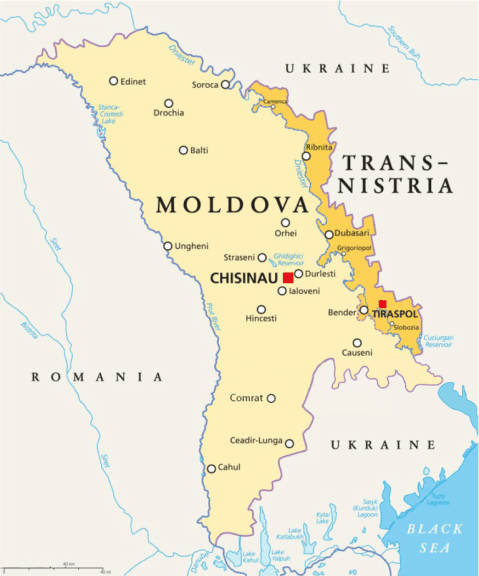
The main problem now is what will happen to Transnistria, located to the east of Moldova. This region, separated from the western part of Moldova, has long-standing historical differences with Moldova. This is due to Moldova’s desire to join the EU, the fact that Romania is a member of the European Union, as well as the fact that official Chisinau has begun to actively support the installation of monuments to Romanian Nazis and hold events with the participation of Romanian representatives. The hostility between Transnistria and Romania is extremely high, given the atrocities committed by the Romanian Nazis during World War II. The Wiesel Commission (International Commission for the Study of the Holocaust in Romania) officially recognized the participation of the Romanian army and administration in the Holocaust, which killed between 280,000 and 380,000 Jews, and this is not counting civilians of other nationalities and prisoners of war.
At the same time, Ukraine is located between Transnistria and Russia, which makes it difficult to establish supply chains between these two regions. At the beginning of 2025, Transnistria was on the verge of a humanitarian catastrophe due to the lack of gas, the transit of which was blocked by the Ukrainian side. That was the first time an emergency situation was introduced in the economy. Under the circumstances, the republic switched to gas purchases in the EU through European intermediaries for a loan received from Russia. At the end of last year, Transnistria was again faced with a gas shortage. An emergency situation was declared again due to a supply outage. In Tiraspol, this was explained by “unfavorable external circumstances” and the need to restore “the financial flow of aid from the Russian Federation.”
Moscow has stated in the past that it will continue to support Transnistria. There is the possibility of further conflict if the Transnistrian population feels cut out of supply chains to the CIS—which it currently enjoys. Chisinau will need to tread this line with the utmost caution.
Further Reading
Russia, Hungary, and Moldova Combine To Assist LNG Supplies To Transnistria
Continue Reading