
 Русский





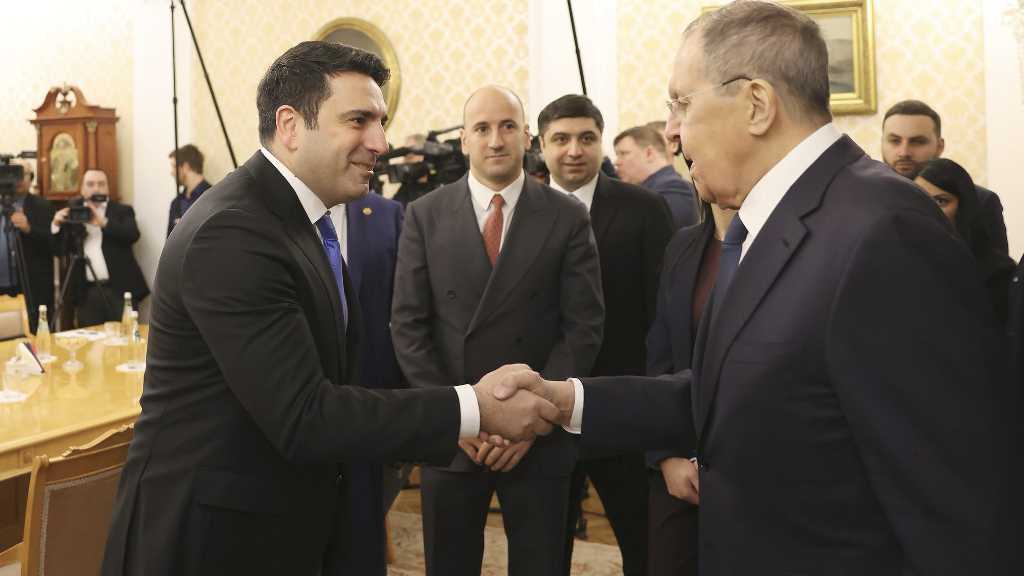

The Russian Foreign Minister Sergey Lavrov held meetings in Moscow with Alen Simonyan, the President of the National Assembly of Armenia, on Thursday (February 5).
The discussions have taken place during a period when Armenia has been looking to limit its engagement with Russia. Yerevan has suspended cooperation with the Collective Security Treaty Organization (CSTO), the regional security bloc, and has stated it wishes to join the European Union. Armenia is currently a member of the Eurasian Economic Union and cannot be a member of both.
Lavrov noted that Moscow sees Yerevan as an ally and strategic partner and is interested in Armenia being a strong, self-sufficient country. The key points discussed during the meeting are as follows:
Membership in EAEU and EU
Lavrov stated that the European Union constantly presents post-Soviet countries with “Us vs. Them” rhetoric: “This is their logic, which has been applied in the post-Soviet space for more than 20 years now.”
Membership in the Eurasian Economic Union (EAEU) cannot be compatible with joining the European Union (EU), but Russia will “fully respect” Armenia’s choice: “You know our position. It is not driven by any ideological motives but flows from realities. Over the past 10 years since Armenia became a full member of the EAEU in 2015, Armenia’s GDP originally stood at US$10.5 billion; in 2025 it reached US$26 billion. We want to expand this cooperation in every possible way to advance major infrastructure projects and initiatives, taking into account the existing experience reflected in Armenia’s economy. Russia continues to be Armenia’s primary trade and economic partner, and Moscow is committed to expanding this cooperation. We take this role very seriously.”
Bilateral trade with Russia has shown significant growth, with trade turnover increasing from US$2.6 billion in 2021 to US$15 billion in 2024. Bilateral trade hit record highs in 2024, with Lavrov stating that “This is over a third of Armenia’s total foreign trade turnover, and Russia remains Armenia’s largest trade and investment partner.”
However, 2025 bilateral trade dropped by nearly 50% to reach just US$6.7 billion. This decline was largely driven by a reduction in Armenia’s role as a conduit for Russian gold and diamond exports, particularly to the United Arab Emirates (UAE), while continued tension between Moscow and Yerevan caused Russian firms to become more cautious regarding trade.
Moscow-Yerevan Relations
“Russia is interested in Armenia being a sovereign and self-sufficient country: “We have repeatedly stated that Armenia has its own sovereign choice.”
European Provocations
“Moscow is surprised to hear signals from the West about Russia’s alleged possible interference in Armenia’s upcoming parliamentary elections: “Your election campaign for the parliamentary elections is beginning. And I can simply assure you that when signals are heard from abroad that someone is planning to interfere, with a clear hint at Russia, and when calls appear from Yerevan to the European Union—help us prevent such interference—it is odd for us.
Responsible politicians in Yerevan understand that these statements are made for provocative purposes: I have no doubt whatsoever that responsible politicians in Yerevan are fully aware that these approaches are being made for purely provocative purposes.”
It should be noted in this context that the United States has recently issued a report concerning elections in Romania, which found that the EU, not Russia, had been interfering in the ballot to ensure a pro-EU candidate won.
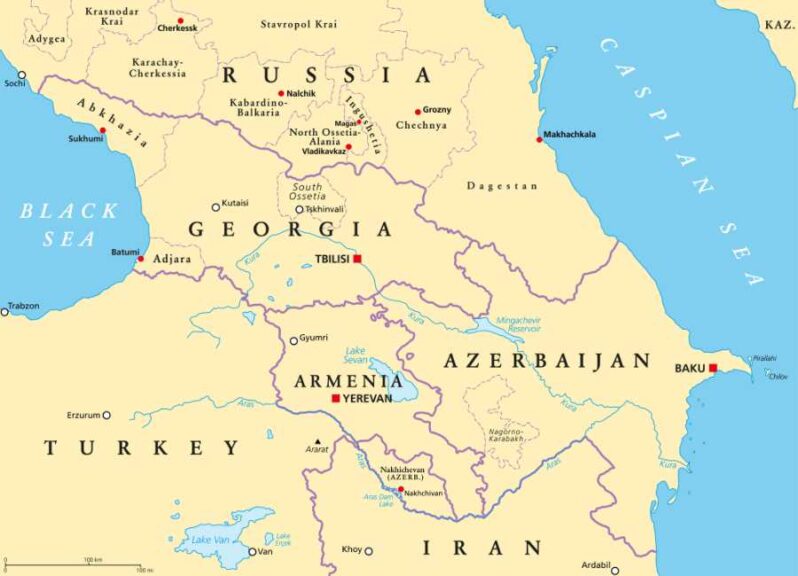
South Caucasus Geopolitics
Russia views Armenia as an ally and strategic partner, despite the ongoing complex situation in the South Caucasus: “Armenia is our ally, a strategic partner. We see how complex the situation is developing in the South Caucasus.”
This is a reference to the recent Armenia-Azerbaijan war, with Lavrov stating that “The previously reached tripartite agreements between the leaders of Russia, Azerbaijan, and Armenia remain relevant and allow for the resolution of all economic, transport, and logistical issues in the South Caucasus. All obstacles to the normal functioning of the entire region as a unified whole must be removed. We are ready for this.”
Summary
Armenia has placed itself in an awkward position, instigating a conflict with Azerbaijan in 2023—and losing territory. It has also failed to adequately address infrastructure issues related to its position as a landlocked country, requiring good neighbourly relations to ensure supply chains remain viable. This switching between physical realities and attempts to win local favour by encouraging conflicts with neighbours have also turned off potential investors such as China, which had been looking into expanding transport infrastructure in Armenia as part of its Belt & Road Initiative.
Russia has helped following the cessation of the Armenian conflict with Azerbaijan by helping develop railway routes between Azerbaijan and Armenia and pressuring Baku to assist.
Various Armenian officials have also been swayed by American and European interests that their future lies with the European Union rather than with Eurasia. The success of this would depend very much on the political situation in Georgia, which has also been facing similar approaches. Yet neither country shares borders with any European Union member state.
At best, the situation as concerns Armenia can be viewed as Yerevan using the EU political card to extract improved trade concessions from the Eurasian Economic Union. However, in doing so, they appear to have overplayed their hand—trade with Russia nearly halved last year as Russian businesses became concerned about the political situation in Armenia and slowed trade and investment into the Armenian market.
At worst, Armenia will go it alone and seek to join the European Union and possibly NATO. How this would work in practical terms for the benefit of Armenia is difficult to see due to its location. The NATO position may also be a red line for Moscow.
It appears that Yerevan is now caught between two chairs and has to make a choice. As Lavrov noted, parliamentary elections are now beginning in Armenia, after which a referendum on the new constitution is planned. It is still unclear whether Armenia’s outcome will be pro-European or pro-Eurasian. However, discussions on this issue will only increase in the first half of this year.