 Русский







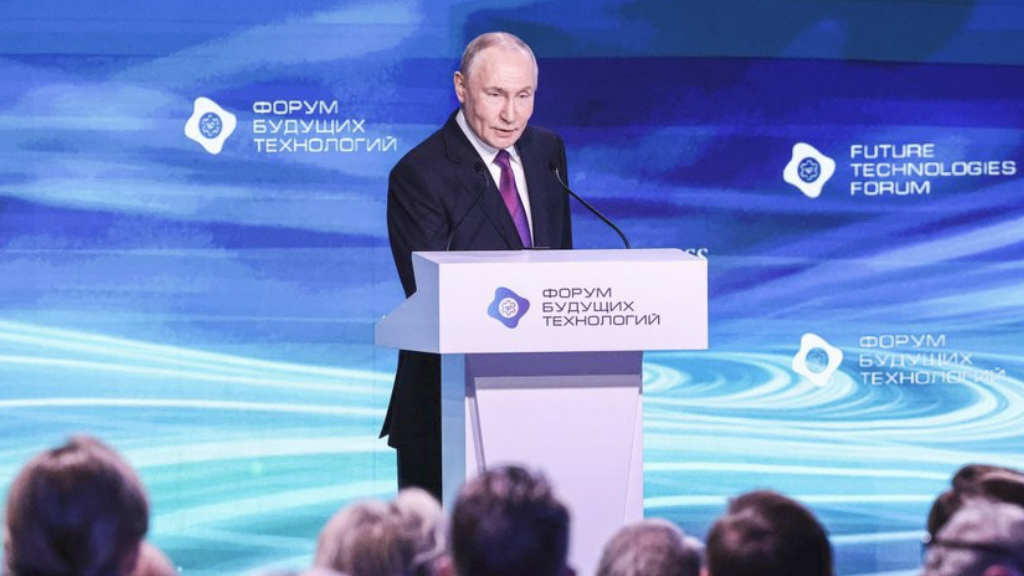

The Future Technologies Forum has been taking place in Moscow, a premium annual event that showcases and discusses the technologies of tomorrow, the impacts these may have and how to adapt to them. President Putin usually gives the Plenary speech, a signal of how important these issues are to Russia’s development. This year’s theme was the Russian Bioeconomy, a rapidly developing field with significant implications both in food security and human health and medicine.
Bioeconomy is the commercial development of biotechnology, being the use of living systems, organisms, or biological processes to develop products and technology, spanning from ancient practices like brewing to modern genetic engineering. It is a multidisciplinary field applied in healthcare, agriculture, and industry to improve lives and the environment. Key areas include red (medical)green (agricultural), and white (industrial) biotech.
We provide Putin’s speech in full. It is worth examination to appreciate the deep level and wide-ranging work being carried out throughout Russia to help take the country to the next technical and scientific levels. Note the request to be joined in this progression by Putin’s reach out to the BRICS economies.
VP: “This year, the Future Technologies Forum is dedicated to bioeconomy. I will elaborate on the steps that Russia is taking to develop this vital sphere. As today’s audience are not just experts but also the broader public, I would like to elaborate on issues that may be well known to specialists yet could be something new to a wider audience.
I will outline what the bioeconomy entails and what practical prospects and opportunities it offers for Russia, the economy, agriculture, and healthcare, as well as the role it plays in enhancing the country’s industrial and technological sovereignty and ensuring environmental safety.
By drawing on the principles and wisdom of nature and unlocking its immense creative potential, researchers and manufacturers are developing solutions that support quality of life, health, and active longevity. These include healthy foods – high-quality food products are all good for health anyway – as well as vitamins, supplements, and vaccines. The Healthcare Minister is not here today to specify this, but I very much hope that the relevant certification procedures and technical clarifications will be completed without unnecessary delays or red tape, so that these important health innovations can become available as soon as possible.
These are medicinal products. And even tissues, blood vessels, and – something that is no longer fantastical – individual human organs. While the creation of a living heart has yet to be achieved, but progress is being made in this direction.
Biotechnologies have a wide range of applications in industry, where natural microorganisms and other living systems are used instead of chemical reagents. They serve as catalysts for complex technological processes and initiate closed cycles, where waste from one production process becomes raw material for another. These technologies are applied in bioenergy, environmental solutions, and agriculture – enhancing soil fertility, aiding in plant protection, and purifying water, soil, and air. After purification, I observe fish swimming there, which require clean water – so it works.
This means that the bioeconomy is far more than just a field of scientific knowledge. Through their bold ideas, scientists and engineers are, in essence, shaping a new reality and an industrial paradigm, applying breakthroughs in biology and genetics to improve people’s lives and preserve our planet and its fragile ecosystem.
In Russia, we take pride in the fact that our contributions to the life sciences have been significant, thanks to the discoveries and philosophical and scientific teachings of Vernadsky, Mechnikov, Timiryazev, Koltsov, Vavilov, Engelhardt, and other outstanding domestic scientists, including our contemporaries.
We will continue to expand our capabilities and move forward. Especially since biotechnologies, bolstered by the power of computational systems and artificial intelligence, are advancing at an unprecedented pace, helping to address key challenges of our time – such as climate change, food shortages, and the depletion of renewable resources – and can serve to implement projects both on Earth and in space.
I have repeatedly emphasised: equal access to future technologies, rather than privileges for the chosen few, is an indispensable condition for the equitable development of our civilisation. Therefore, on the platforms of BRICS and other groups, as well as within the framework of bilateral cooperation, we are ready to implement joint scientific, educational, and investment programmes in biotechnology for the benefit of all humanity.
For our part, we intend to harness the colossal potential of bioeconomy to strengthen the nation’s health, address other priority tasks, and accelerate technological and industrial development without compromising the unique natural potential of our country.
This year, we launched a national bioeconomy project. Its overarching objective is to secure our sovereignty in several critical areas within this field and, where we already have the potential and groundwork done, to achieve leadership positions.
I would also ask the Government to step up the development of a long-term vision – a national strategy for bioeconomy up to the mid 21st century. Its provisions should be integrated into the policy documents that shape our responses to challenges in Russia’s food and bio-security, as well as the systemic development of healthcare, energy, agriculture, industry, and other key sectors.
To reiterate, we are discussing the development and implementation of truly cross-cutting, universal technologies and products that impact virtually every area of our economy. It is therefore critically important to establish effective cross-sectoral and supra-departmental governance for bioeconomy and to focus our efforts on significantly increasing its contribution to the nation’s GDP. The relevance of this was clear from the exhibition we just visited. Representatives from a wide range of fields are, in effect, articulating the same need – solving common challenges.
A primary implication of this is a substantial increase in funding, not only for the respective national project but also for other bio-industry initiatives, with the central focus on attracting private investment.
We must also remove the barriers that hinder active business participation in shaping bioeconomy. Existing support measures need to be focused on accelerating its development, and we should introduce additional instruments to encourage private investment by providing tax incentives and other benefits to companies that develop and introduce such technologies. These and other tools must be applied consistently at every stage – from scientific research right through to the launch of breakthrough solutions and competitive bio-based products.
To enable our domestic biotech companies to pursue long-term plans and recoup their investments more quickly, I ask the Government to propose effective mechanisms for cultivating and protecting domestic biotechnology market and develop clear scenarios for their practical application across various sectors of our economy and social sphere.
When I speak of maintaining our competitiveness, I am also referring to what I have just witnessed: how our competitors are faring and the scale of their investment in developing these technologies. But we must certainly protect our domestic market – using only modern, market-based mechanisms, of course – but this effort is absolutely essential.
It is important for us to create domestic demand for such innovations on the system level. And, of course, we need to expand the output and to secure a strong position on global biotechnology markets. Therefore, we must establish an effective system to support high value-added bioproduct exports, as well as promote our standards, technological platforms, and competencies in other countries.
And of course, my colleagues, especially the Russian audience, will understand what I am saying. We need to work with our closest neighbours, with whom we already have strong and friendly relations and enjoy decades-long cooperation across many areas.
A crucial issue is the availability of our own instruments, equipment, enzymes, and biocatalysts, as well as other critically important components. In these key areas, we must speed up the transition from import substitution objectives to production of globally competitive products based on our own platforms and solutions. Please supplement the national bioeconomy project with specific decisions in this regard.
To accelerate the development of bioeconomy, it is necessary to create a modern legal and regulatory framework, as well as a system of standards and rules to access the market of bio-based solutions.
Regulation should support and stimulate the creation and rapid implementation of innovations, while at the same time guarantee safety and quality of products for individuals and society. I emphasise that this applies to all areas from biopolymers for packaging purposes to artificially grown organs and tissues. Everything is important.
It is essential from the beginning to set clear ethical boundaries for the application of biotechnology, to prevent potential threats, primarily to human health and life, and to ensure the protection of personal data.
At the same time, I repeat, as in any advanced field, we must create conditions for scientific breakthroughs. For example, in the field of unmanned systems and artificial intelligence, the experimental legal regimes have proven effective. I propose extending such regimes to individual areas of the life sciences. Our innovation-driven scientific, technological, and educational centres can serve as platforms to develop and to conduct controlled testing of innovative biotechnologies and products, including the facilities at Sirius.”
(Ed: Sirius is a premier Russian institution focused on training the next generation of scientific and technological leaders. Launched in 2020 and featuring a massive laboratory complex, it specializes in life sciences, genetics, AI, and IT).
“I am also asking the Russian Science Foundation to award this year’s grants to create innovative solutions for the agro-industrial sector, biotechnological production facilities, the pharmaceutical industry, healthcare, and other sectors. Such technologies should be developed using bioinformatics and artificial intelligence, among other methods.
I would like to invite scientific teams to actively participate in the Russian Science Foundation’s competition. Its winners will, over five years – and, I believe, with an additional three-year extension – be able to receive up to ₽500 million (US$6.5 million) from the state for research, as well as co-financing from leading domestic companies.
To develop new biotechnologies, we will also utilise Mega-Science-class research. This year, the Siberian Circular Photon Source in Koltsovo, Novosibirsk Region, will undergo a technical launch. It will soon operate at full capacity. I believe that by 2027, our scientists should finally gain full access to this facility. We are ready to implement international scientific programmes in the life sciences, and in biology, medicine, and pharmaceuticals using this unique installation.”
(Ed: The Siberian Circular Photon Source (SKIF) is a cutting-edge 4+ generation synchrotron radiation facility under construction in Koltsovo, Novosibirsk Region, Russia, designed to produce ultra-high brightness X-ray beams. Scheduled for commissioning around 2026, the 3 GeV, 476-meter circumference ring will support up to 30 experimental stations for research in biology, medicine, and material sciences).
“At the same time, it is crucial that research and development in bioeconomy are not only fundamental but also applied in nature. They should enhance the economic and technological potential of the regions and thus serve the objectives of spatial development in Russia, with our vast territory.
For example, in the country’s northwest, we need to set up recycling of timber industry waste; in the Far East – the production of bio-based products derived from aquatic bioresources; and in Siberia and southern Russia – the deep processing of grain.
I reiterate, these are just individual components of major regional programmes in the sphere of bioeconomy. They must, without a doubt, take into account the unique requirements of such territories, their resource base, and economic specialisation. Naturally, regions must have the necessary personnel and appropriate technologies for such projects.
In this regard, I propose creating a broad network of engineering development centres for bioeconomy in the constituent entities of the Russian Federation, at universities and research institutes. These centres are intended to shorten the path from laboratory research to full-scale industrial production, providing access to equipment and computational resources for scientific and student teams, as well as for small technology companies from across the country. And they – I want to emphasise this particularly – must become full-fledged participants in the national bioeconomy project. Let me stress this once again.
I would like to address what is most important – and I think you will all agree with me – what is most important? What is the most crucial element? It is the specialists, people like you, whose expertise is the foundation of building a bioeconomy. We must acknowledge that, for now, the competencies and knowledge of graduates from many universities and colleges do not align – moreover, they significantly lag behind even the current level of biotechnology development. But this is understandable; much here is new, and thus much remains to be done. The personnel challenge in this sphere is one of the most complex and systemic, and of course, we must respond to it.
In this regard, we must first ensure the training of senior and mid-level specialists with strong interdisciplinary expertise at the intersection of biology, chemistry, engineering, and artificial intelligence. To achieve this, it is essential to work closely with businesses so as to significantly update vocational and higher education curricula and to expand practical training for students directly at enterprises.
This work must take into account cutting-edge trends in microbiology, genetics, and bioinformatics. I therefore propose establishing new advanced engineering schools at universities and colleges and extending the professional elite into educational projects for these areas.
Second, I would like to ask the Government, together with regional authorities and businesses, to carefully review the workforce forecast for biotechnology, taking into account the demand for specialists to implement major regional projects in this field. If necessary, decisions should be made to increase the number of state-funded places in bioeconomy programmes at universities and colleges across the constituent entities of the Russian Federation.
Third, it is important to use this new foundation to adopt a more focused approach to career guidance for schoolchildren, aligning it with the needs of the biotechnology sector, and to expand specialised education in the natural sciences. Overall, I propose launching a comprehensive programme to promote bioeconomy. This effort should actively engage the media and leading digital platforms. The earlier people become familiar with this field, the better, as it is complex and multifaceted.
I would also like to use this opportunity to thank Russian biotech companies, scientists, philanthropists, and enthusiasts for their significant educational efforts. Let me repeat: this work must undoubtedly be expanded, opening new horizons and career opportunities for young people and for citizens overall. Public outreach in this area is extremely important and must be carried out in a systematic and timely manner.
At this forum, we traditionally discuss the trends and innovations shaping the future of humanity. Advances in biology, genetics, and other life sciences are rightly referred to as the technologies of the 21st century. Together with the IT sector and artificial intelligence, they are transforming the economy and society, creating new opportunities for millions of people.
I propose dedicating the next Future Technologies Forum to the creation and implementation of digital platforms. These platforms are already enabling scientists to carry out research projects more efficiently, connecting entrepreneurs from small towns with customers in major cities, allowing residents to participate in managing their homes and communities, and analysing medical data in record time, thus helping doctors save lives. This is only a small share of what the platform economy can do. In Moscow, such solutions are already being successfully implemented. For example, we have recently discussed that when an ambulance is dispatched, doctors receive their patient’s medical history on screen in advance, enabling them to prepare the necessary equipment and make informed decisions even before arriving. This is just one illustration, just one example of such platform services.
In this field, Russia is developing world-class solutions and is ready to share its experience and expertise for the benefit of all humanity.
Thank you for your attention. I wish you all the best.”