
 Русский










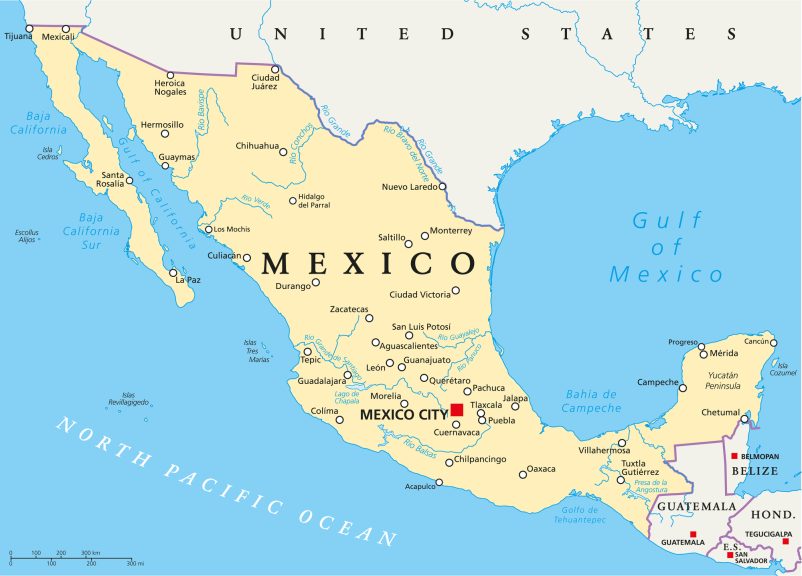
Russia is ready to increase wheat exports to Mexico and is capable of quickly meeting local demand, Russian diplomats have stated, with Mexico currently experiencing a grain shortage due to a series of droughts.
There are stumbling blocks: Russian companies remain highly interested in the Mexican market, but the development of these trade relations is largely constrained by the United States, despite the currently tense relations between Washington and Mexico.
The Russian Embassy in Mexico City stated that “Russian companies remain prepared to increase wheat export volumes and are capable of quickly meeting demand in the Mexican market if market conditions improve and economically feasible trade conditions emerge.”
By the end of 2024, Mexico’s purchases of Russian wheat exceeded 700,000 tons. The country maintains strong interest in this crop, and Russian grain is competitive in both quality and price. Mexico relies heavily on grain imports due to recurring droughts and adverse weather conditions, which limit domestic production. However, demand for wheat is growing as the population grows and the food industry develops.
The country has a population of approximately 135 million, and this continues to grow, obliging the country to seek reliable external suppliers. According to the Institute for Agricultural Market Studies, wheat prices in Russia remain stable at the beginning of 2026 due to market oversupply, and this factor is decisive when choosing suppliers from Mexico. This gives Russia an advantage over fluctuating US prices.
However, Russian wheat exports have recently declined. This crop will account for 82.5% of the main agricultural product shipments in 2025—27.9 million tons, compared to 32.5 million tons shipped last season, a 14% increase.
Intense competition in the global market was cited as the main reason for the decline in wheat shipments. According to the Russian Grain Union, wheat was sold at minimal or no discount in the first half of the agricultural year. Under these conditions, realizing the full export potential is difficult. Developing trade cooperation, including with Mexico, could open up new opportunities.
Overall, the two countries have great prospects for expanding cooperation. The Russian Embassy emphasized that Russian companies’ interest in the Mexican market remains high and covers a wide range of industries and areas of cooperation.
The Embassy stated that “Priority areas include pharmaceuticals, information technology, energy, and agriculture, where Russian businesses see potential for mutually beneficial cooperation and are already actively developing potential projects.”
Russian exports include chemical fertilizers, metal products, grain, and rubber, while Mexico supplies Russia with coffee, pepper, pharmaceuticals, and food products.
According to the embassy, active work is currently underway with the Roscongress Foundation and the Russian Trade Mission to explore possible formats for further business cooperation. In particular, bilateral business missions are being considered.
In April 2025, the first Russia-Mexico Business Forum was held in Mexico City. It featured over 150 direct negotiations with companies from the Republic.
However, there are also significant challenges to bilateral cooperation. These include sanction restrictions, logistical difficulties, and existing import duties and tariffs, which in certain segments hinder the expansion and diversification of bilateral trade. The disconnection of Russian banks from the SWIFT system also creates problems for international settlements between Russian and Mexican companies.
Effective January 1, 2026, the Mexican Parliament approved an increase in import duties on a number of goods from countries with which the country does not have free trade agreements, including Russia. The increase ranges from 10% to 50% and applies to textiles, cars, household appliances, motorcycles, soap, perfume, cosmetics, furniture, plastics, and auto parts.
The Mexican government, whose economy is heavily dependent on foreign trade with the United States, justified its actions by citing the need to protect the economy and stimulate domestic production. Despite the fact that a significant portion of trade between the countries is exempt from import duties, the new restrictions significantly limit the prospects for increased cooperation.
At the same time, according to Russian Ambassador to Mexico Nikolai Sofinsky, the country’s leadership, led by President Claudia Sheinbaum, fundamentally opposes restrictions against Moscow. He noted that Russia and Mexico enjoy traditionally friendly relations.
Mexico City’s principled approach could negatively impact its trade relations with the United States. Local companies are forced to balance maintaining access to the American market, as Mexico City is one of the United States’ largest trading partners. According to the Census Bureau, trade between the two countries amounted to US$839.9 billion in 2024.
The United States and Mexico are bound by the USMCA free trade agreement, within which most supply chains are built. However, it is difficult to imagine a significant expansion of trade relations between Russia and Mexico. According to Mexico’s National Institute of Statistics and Geography, trade turnover with Russia from January to September 2025 amounted to only US$988 million.
Meanwhile, relations between Mexico and the United States are quite tense. According to The New York Times, the Trump administration is increasing pressure for permission to conduct operations to dismantle drug labs. Even before the invasion of Venezuela, the White House had raised the possibility of strikes on Mexican territory. There is a possibility that the US will strike a drug cartel camp in a remote area. However, this could provoke an asymmetric response from the same cartels and have negative consequences for the US economy. This, some analysts have stated, is precisely what worries those who say Mexico shouldn’t be “meddled with.” But if relations between Mexico and the United States do deteriorate, Russian exporters may be able to take advantage of an opportunity.
Further Reading
Russia, Mexico, Bilateral Relations: July 2025 Update