 Русский




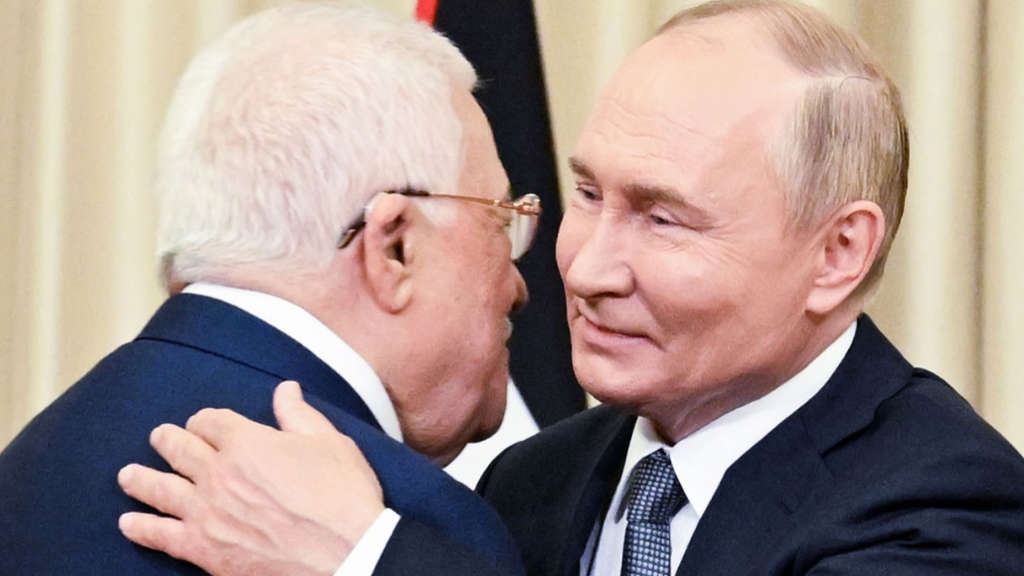

President Putin has met with Mahmoud Abbas, the President of Palestine, in Moscow, to discuss developments in Palestine as well as the larger Middle East picture. Their agenda included the current state and future prospects of bilateral ties in trade and the economy and cultural and humanitarian affairs, as well as the situation in the Middle East, emphasising the state of affairs in the Gaza Strip.
Also taking part in the talks on the Russian side were Foreign Minister Sergei Lavrov, Presidential Press Secretary Dmitry Peskov, Presidential Aide Yury Ushakov, Chairman of the Russian Part of the Intergovernmental Russian-Palestinian Commission on Trade and Economic Cooperation Anton Kotyakov, Central Bank Governor Elvira Nabiullina, and Chief of the Main Directorate of the General Staff and Deputy Chief of the General Staff of the Russian Armed Forces Igor Kostyukov.
This is what they had to say.
Putin: “Relations between Russia and Palestine have deep roots and a special quality. Back in 1988, the Soviet Union recognised the Palestinian state, and we maintain the same position today. Our approach to the issues of Palestine and to a settlement in the Middle East is principled and consistent. We believe that only the establishment and full functioning of the Palestinian state can lead to a lasting settlement of the Middle East conflict.
I would like to note that our relations continue to develop today despite the challenges related to the situation in the region. Of course, in absolute figures, our trade remains rather modest, although a trend for increase is emerging. Our mutual trade has tripled recently.
We continue our humanitarian cooperation—in particular, we continue training workers for Palestine. This year, some 150 young Palestinians are studying and will continue to study in higher education institutions and other educational organisations in Russia.
Security certainly remains one of the vital topics. During the toughest times of the crisis in Gaza, we provided humanitarian aid at your request. We have sent over 800 tonnes of cargo to Gaza through around 32 humanitarian missions. At your request, we have sent wheat directly and via international organisations. We will discuss the current developments in the Gaza Strip and Palestine in general and on the Israeli-Palestinian track.
We will also talk about the US president’s initiative to establish a new body that will mainly focus, judging from what we have seen, on settling the situation in Palestine, in Gaza. You may have heard that we are willing to provide US$1 billion to this new body, the Board of Peace, primarily to support the Palestinian people, assist in the restoration of the Gaza Strip, and address the general resolution of problems facing Palestine, as I have mentioned, from the funds that were frozen in the United States by the former administration. I believe this is possible. We discussed this option earlier with members of the US administration. A meeting and a conversation are scheduled today in Moscow on this matter.”
Abbas: “We are friends of Russia and the Russian people. For over 50 years, our nations have been bound by a strong friendship that has developed over the decades and continues on the correct path. Russia is a great friend and a nation upon which we rely in many spheres.
Historically, Russia has supported and stood by the Palestinian people at the political and diplomatic levels. Your economic and financial support is both significant in scale and crucial in importance. You have referenced only a part of it, yet our people are deeply pleased and grateful to Russia for this aid and support and for Russia’s unwavering stance in support of Palestine.
Mr. President, as you well know, we have suffered greatly on our land under the Israeli occupation, which has led to destruction in the Gaza Strip, the West Bank, and Jerusalem.
I would like to cite some statistics. The number of killed and wounded in the Gaza Strip has reached 260,000. There are also many thousands of wounded in the West Bank. The scale of destruction is catastrophic. The Gaza Strip has been almost entirely destroyed, with 85 percent of infrastructure—schools, universities, mosques, churches, and so forth—lying in ruins.
I would like to assure you, Mr. President, that the Palestinian people are holding onto their land, and we categorically oppose attempts by the Americans and Israelis to expatriate Palestinians beyond Palestinian territory. The Palestinian people are resolved that they will not abandon their land, whatever the cost.
We are now forced to live in tents. These tents are washed away by the rains and subjected to destruction, and the ground is eroded. Yet we will not be displaced from our land.
What we need is peace, and we hope that with your help and support, we can achieve it—a peace built on the basis of international legal resolutions, decisions of the United Nations, and the principles established following the wars of 1967 and 1973.
East Jerusalem remains the capital of Palestine, and we know that Russia has always supported—indeed, was the first to support—Palestine, maintaining a firm stance in support of our people.
Mr. President, we hope to discuss with you today our vision for the future and the details of the current situation. We are ready to work together with your support and assistance, and we hope to reach a solution.
Russia has been our friend for over five decades. Every time we visit your remarkable country—whether in summer or winter, in snow or rain—we feel that a part of our hearts is here, that we are bound by a spiritual connection. We regard Moscow as a second home. We are here among our friends.”
The Strategic Meaning of Abbas’s Moscow Visit
Mahmoud Abbas’s repeated visits to Moscow—over 20 since 2005—underscore Palestine’s perception of Russia as a stabilizing constant rather than a transactional actor. In a fragmented international environment, this consistency carries economic weight. For Moscow, the visit reinforced three strategic messages: Russia remains indispensable to any Middle East settlement architecture; economic engagement will follow political recognition, not precede it; and reconstruction is the only sustainable pathway to peace. By framing Gaza reconstruction as both a humanitarian duty and an economic opportunity, Russia positions itself as a system-builder rather than a donor.
In Russian foreign economic policy, reconstruction is not treated as a postscript to conflict but as an entry point into long-term regional positioning. From Syria to Iraq and now Palestine, Moscow has increasingly approached post-conflict environments not as arenas for short-term political signalling, but as platforms for durable economic presence. The Palestinian track, particularly in the context of Gaza’s future reconstruction, fits squarely into this logic. At first glance, the Palestinian economy appears marginal. A United Nations report suggests that in the space of just two years, Gaza’s economy has shrunk by 87% to just US$362 million. Even before the latest destruction, its GDP barely exceeded US$17 billion, while external trade volumes were constrained by geography and politics. Yet this narrow reading misses the strategic function Palestine plays in Russia’s broader Middle East economic architecture. Moscow does not view Palestine as a standalone market; it sees it as a connective economy, one that links Eastern Mediterranean logistics, Arab development finance, and Eurasian trade frameworks.
Russia’s long-term Middle East strategy is defined by three economic imperatives: diversification of external demand, institutional embedding beyond Western systems, and the creation of politically resilient trade corridors. Palestinian reconstruction intersects with all three.
First, diversification. Under sanctions pressure, Russian exporters have accelerated their pivot toward non-Western markets, particularly in agro-industrial products, metals, fertilizers, and construction materials. Palestinian reconstruction generates structurally predictable demand in precisely these sectors. Unlike commodity spot markets, reconstruction demand is multi-year, project-based, and largely shielded from price volatility. For Russian producers facing excess capacity, Gaza represents not scale but stability, a smaller market with guaranteed absorption over time.
Second, institutional embedding. Russia’s economic strategy in the Middle East increasingly prioritizes participation in governance frameworks rather than bilateral deals alone. Reconstruction mechanisms, whether under UN supervision or new multilateral structures, determine procurement rules, payment systems, and standards. Early engagement allows Russia to influence these rules in ways that normalize the use of non-Western financial instruments, local currencies, or EAEU-linked trade preferences. In this sense, Palestinian reconstruction becomes a testing ground for post-sanctions economic models that Moscow may later apply across the region.
Third, trade corridors. Gaza’s reconstruction is inseparable from the question of logistics: ports, border crossings, warehousing, and transport infrastructure. For Russia, participation in rebuilding these systems offers indirect access to Eastern Mediterranean trade flows without the political risks associated with military basing or exclusive control. It is a civilian, commercially legitimate form of presence that complements Russia’s broader connectivity agenda linking the Black Sea, the Levant, and North Africa.
Equally important is the political economy dimension. Russia’s consistent support for the two-state solution provides Moscow with a rare asset in the Middle East: credibility across rival camps. This credibility reduces transaction risk for Russian businesses operating in sensitive environments. Palestinian partners, unlike many regional actors, do not perceive Russian engagement as conditional or extractive. This lowers barriers to joint ventures, local sourcing, and long-term service contracts—precisely the formats Russia now favors over one-off exports.
Finally, Palestinian reconstruction aligns with Russia’s internal development priorities. Engineering services, infrastructure design, agricultural technologies, and vocational education exports support domestic employment and technological retention. Reconstruction abroad thus feeds directly into economic stabilization at home. In this context, Palestine is not an exception in Russia’s Middle East strategy, but it is a logical extension. Reconstruction is the instrument, trade is the mechanism, and long-term economic presence is the objective.
The above analysis of the Russia-Palestine relationship was provided by Ms. Khatun, an expert on Middle Eastern affairs. Her work has appeared in many distinguished media outlets. She may be reached at info@russiaspivottoasia.com
Further Reading
Putin Ready To Accept Membership Of Trump’s “Board Of Peace” Initiative
Continue Reading