 Русский




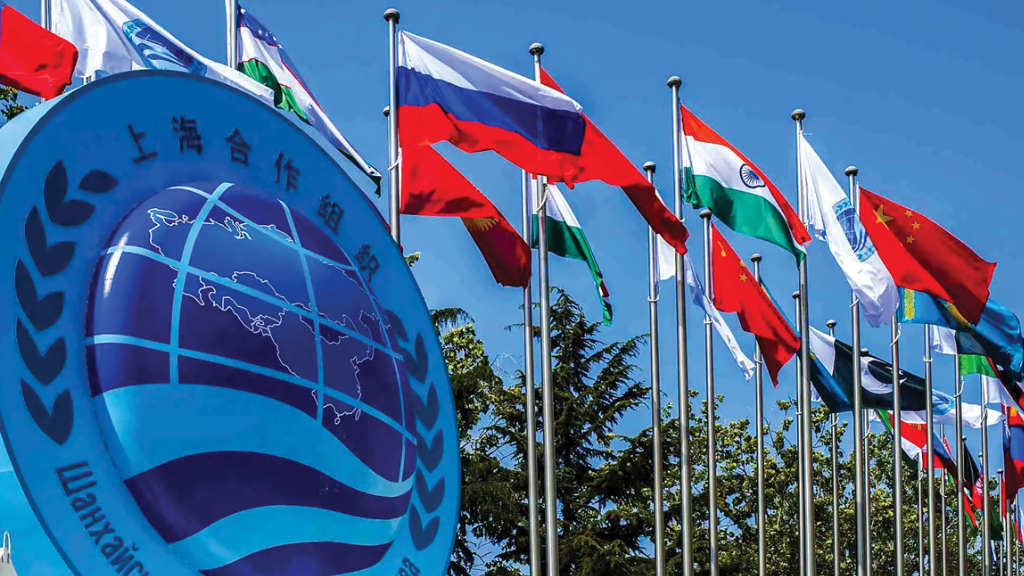

Moscow has been hosting the Shanghai Cooperation Organisation (SCO) Heads of Government Summit, with the Russian President, Vladimir Putin, noting that Russia’s trade with SCO members has reached US$409 billion. He stated, “Russia’s trade turnover with SCO countries reached $409 billion in 2024 and continues to grow. Of course, the lion’s share of this is attributed to our interaction with China, but trade with other SCO member states is also growing. Importantly, the share of national currencies in commercial transactions between the organization’s members is consistently increasing. For example, the figure already exceeds 97% in our country’s trade with SCO partners.”
Russian Prime Minister Mikhail Mishustin also added some statistics, saying that the SCO countries’ share of global GDP is expected to rise to 35% by the end of 2025. He stated, “In 2024, the combined exports of our countries accounted for approximately one-fifth of the global total. And the share of SCO members in global gross domestic product has already reached one-third. By the end of this year, according to forecasts, it will grow even further—to 35%.”
To compare, the United States and the European Union are responsible for about 14.5% each of global GDP, and the G7 for about 30%. This strongly suggests that GDP growth is in the east, not the west.
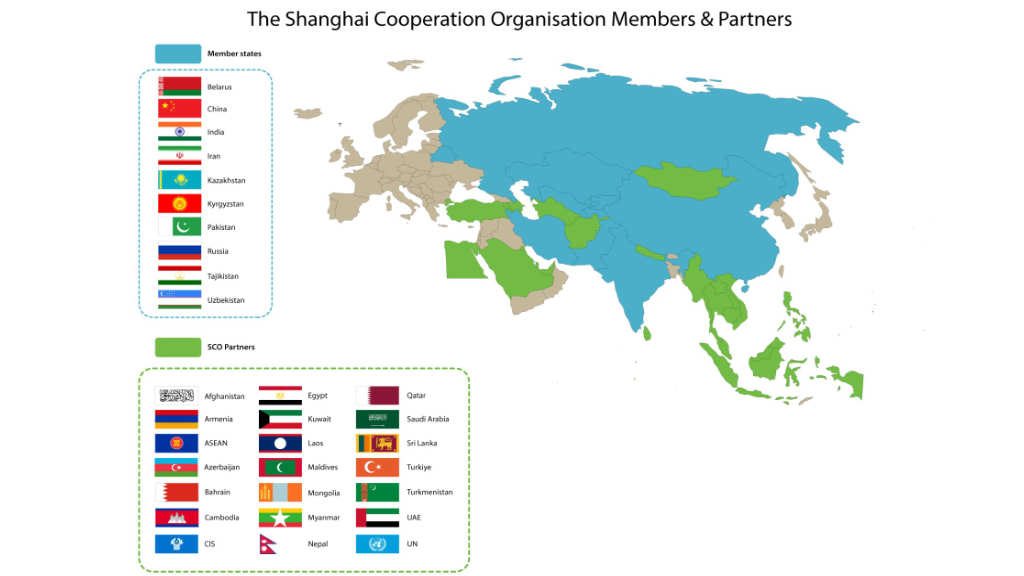
The SCO includes full members such as Belarus, China, India, Iran, Kazakhstan, Kyrgyzstan, Pakistan, Russia, Tajikistan, and Uzbekistan, with SCO partners including Afghanistan, Armenia, ASEAN, Azerbaijan, Bahrain, Cambodia, Egypt, Kuwait, Laos, Maldives, Mongolia, Myanmar, Nepal, Qatar, Saudi Arabia, Sri Lanka, Turkiye, Turkmenistan, the UAE, and the United Nations.
Russia has also initiated the formation of a working group on financial infrastructure within the Shanghai Cooperation Organization, Prime Minister Mikhail Mishustin stated at the event, saying that “A reliable, independent financial infrastructure is required to implement joint plans. A special expert group, which is being formed upon Russia’s initiative, will work on improving it.”
Russia in recent years has been promoting the development of a financial infrastructure independent of Western restrictions within several international organizations, including the SCO, BRICS, the G20, and others.
Putin also said that stable and uninterrupted payment channels are becoming vitally important, saying that “This is especially relevant in the current volatile economic environment amid turbulence in global markets, unilateral sanctions, tariff restrictions, and wars. Steps are being taken to expand the payment, settlement, and depository infrastructure upon the initiative of the Russian side and with the support of partners within the Shanghai Cooperation Organization. The agenda includes consultations on establishing the future SCO Development Bank, as well as mutually recognizing credit ratings and commodity indicator systems.”
These developments can be expected to include an alternative to the global SWIFT payments network, which was designed to create global financial interconnectivity but has instead been used as a trade weapon by the United States controlling the mechanism, and subsequently disconnecting several countries, including Russia and Iran, from its service. China has also been threatened with SWIFT disconnection, resulting in the need to create a Plan B alternative.
SCO countries, as Putin noted, have also been dropping the use of the US dollar in trade and reverting to their own currencies. Also of note is Putin’s reference to credit ratings, which in the past have been mainly US- and UK-based financial support services and are used by governments and international financial institutions to assess credit risks. There have long been questions about their impartiality. All Western-based credit agencies exited Russia in 2022, making it difficult for Russia to access reliable financial analysis in order to assess financial risk for both its sovereign bonds and also for businesses looking to borrow to finance expansion. The response has been the rise of alternative credit ratings agencies, most notably in China, India, Russia, and the Middle East. Our analysis of how these have developed against Western rating agencies can be seen here .
Of additional note in these shifts are the additional trade dynamics, with several members of the SCO also members of or partners with the BRICS. Apart from the SCO members, the BRICS full members also include Brazil, Ethiopia, Indonesia, and South Africa, and partner states Algeria, Bolivia, Cuba, Malaysia, Nigeria, Thailand, Turkiye, Uganda, and Vietnam.
These are all major economies within their respective regions, with many also impacted by the threat of sanctions or tariffs, meaning they too will be supportive of the SCO’s alternative financial architecture plans.
It should be noted that these countries too have strong relations with members within their own regional trade blocs. Algeria is a member of the League of Arab States, Bolivia a member of the Andean Community of Nations, Ethiopia a member of the Common Market for Eastern and Southern Africa, and so on. The reach of the SCO’s potential new plans goes far beyond just the SCO itself and has the potential to radically alter how global transactions and financial settlements are made.
Further Reading
Shanghai Cooperation Organisation Meetings In Moscow: Unlocking Eurasian Trade Potential
Continue Reading