
 Русский







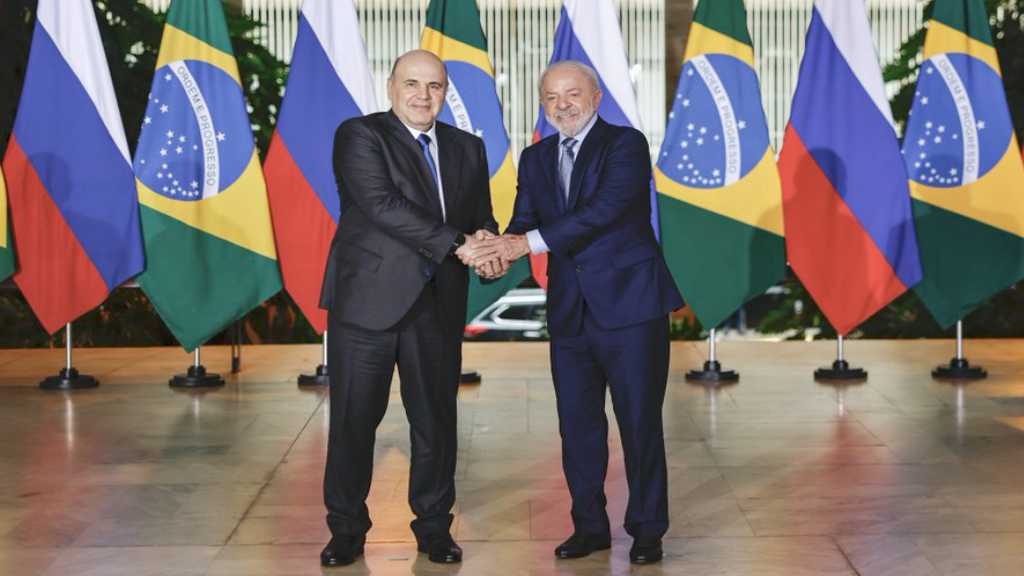

Russia’s Prime Minister Mikhail Mishustin’s visit to Brazil on 5 February 2026 came at a moment when both Russia and Brazil are redefining their economic and geopolitical positioning in an increasingly fragmented world. Against the backdrop of global trade disruption and Western coercive pressure on Russia, together with Latin America and the Caribbean Region’s search for strategic autonomy, the visit signaled a qualitative upgrade in Russia-Brazil relations and a reconfiguration of Russia’s broader role in Latin America.
Brazil is not just Russia’s largest trading partner in Latin America; it is the region’s geopolitical heavyweight. Russian-Brazilian relations are developing as a strategic partnership. The two countries signed a bilateral partnership agreement in 2000, and a strategic partnership action plan in 2010. As a BRICS founding member, G20 stakeholder, and global agricultural and industrial power, Brazil provides Russia with something increasingly scarce in global politics: a large, sovereign, non-aligned partner capable of acting independently of Western pressure.
This visit took place as Russia’s pivot to non-Western partners has moved beyond short-term adjustment and entered a phase of institutional consolidation. Trade flows have stabilized, alternative payment mechanisms are being tested, and long-term industrial cooperation is replacing emergency logistics. Brazil, under President Luiz Inácio Lula da Silva, has simultaneously reaffirmed an independent foreign policy line that prioritizes industrial development, technological sovereignty, and diversified partnerships rather than bloc politics. The convergence of these trajectories explains why Brazil has emerged as a key player in Russia’s Global South strategy.
The visit reaffirmed Brazil’s role as Russia’s key partner in the region and a pillar of its Latin American strategy. By prioritizing trade diversification, industrial cooperation, national-currency settlements, and scientific and technological partnerships, Moscow and Brasilia demonstrated a shared commitment to economic sovereignty and long-term development.
The engagement also strengthened coordination within BRICS and the UN, reinforcing a multipolar vision based on respect for sovereignty and non-interference. As Russia recalibrates its regional approach amid growing constraints on traditional partners such as Venezuela, deeper ties with Brazil provide scale, institutional stability, and strategic legitimacy.
Geopolitically, the visit positioned Russia as a reliable, development-oriented partner capable of contributing to regional and Global South stability. Unlike ideological alliances, the Russia-Brazil partnership is institutionally structured, economically grounded, and politically autonomous. This makes it more resilient and more strategically valuable.
Strategic Partnership

Mishustin’s program combined high-level political talks with President Lula da Silva, the eighth meeting of the Russian-Brazilian High-Level Commission on Cooperation, and the Russian-Brazilian Business Forum.
The scale and composition of the business delegations further highlighted the visit’s economic focus. More than 35 major Russian companies from the banking, fertilizer, transport, logistics, machinery, pharmaceutical, and energy sectors participated in the Business Forum. On the Brazilian side, major agribusiness, chemical, and industrial associations were represented. This signaled a transition from state-centric diplomacy to state-facilitated corporate integration, embedding Russian companies into Brazilian production chains and Brazilian companies into the Russian market.
Mishustin himself, together with Brazilian Vice President and Minister of Development, Industry, Trade, and Services Geraldo Alckmin, took part in the Russian-Brazilian High-Level Commission, culminating in a joint plan defining the key areas of Russian-Brazilian cooperation for the coming years.
This commission, co-chaired by Mishustin and Alckmin, includes the intergovernmental commission on trade, economic, scientific, and technical cooperation, as well as the political affairs commission. It coordinates cooperation across trade, industry, energy, science, space, finance, culture, and military-technical areas, and marks a qualitative upgrade of the Russia-Brazil strategic partnership. It also signals Moscow’s determination to consolidate its role in Latin America at a moment of intensified geopolitical pressure, economic fragmentation, and strategic competition over the Global South.
Bilateral Trade Developments
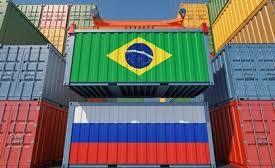
Economic cooperation remains central to this partnership. Bilateral trade reached approximately US$11 billion in 2025, demonstrating renewed growth but reflecting a significant trade imbalance in Russia’s favor, largely due to significant imports of Russian mineral fertilizers, which are vital for Brazil’s agricultural output.
Both sides agreed that their trade has been concentrated in a narrow range of commodities, and they highlighted the need to diversify into higher value-added industrial goods. To achieve this, discussions focused on expanding cooperation in energy, oil and gas, nuclear technology, pharmaceuticals (including cancer, autoimmune, and diabetes medications), industrial manufacturing, digital technologies such as artificial intelligence and cybersecurity, space exploration, logistics, and infrastructure development. Both emphasized the importance of joint long-term projects and technology transfer, as well as establishing local production facilities in Brazil for Russian medicines and industrial goods to strengthen bilateral economic integration.
Russian companies attending included Sber, Russian Railways, PhosAgro, Polyus, Power Machines, and Generium, alongside Brazilian institutions representing businesses such as the Brazilian National Confederation of Industry, BRF S.A., Minerva, and the Brazilian Association of Meat Exporting Industries. They also discussed trade expansion, logistics, investment protection, sustainable agriculture, food security, and innovation in manufacturing, energy, and pharmaceuticals.
Brazil & Russia’s Role in Global Food Security

Trade figures illustrate both the achievements and the limitations of the current relationship. Brazil is by far Russia’s largest trading partner in Latin America, accounting for more than half of Russia’s trade with the region. Russia, in turn, supplies nearly one quarter of Brazil’s fertilizer imports, a strategic input underpinning Brazil’s position as the world’s leading food exporter. The core issue is not the absence of trade but its narrow structure and limited value addition.
While the fertilizer trade is framed as critical to global food security, it is also a one-sided dependency. However, the two sides wish to jointly develop this dual-pronged approach to form a critical input-output axis for global food security, particularly for developing regions in Africa, Asia, and the Middle East.
As we are currently seeing with US actions against Cuba, supply-chain weaponization is a developing theme, while a Russia-Brazil fertilizer-food partnership enhances resilience for the broader Global South. This means that food security issues elsewhere will partially determine the types of agricultural products grown in Brazil and, in turn, impact the type of fertilizer and the volumes that Russia provides.
Moving Up The Value Chain

At the same time, both parties wish to diversify their mutual trade towards higher value-added trade and long-term industrial cooperation. Today’s bilateral trade structure remains narrow.
Russian exports are dominated by fertilizers, energy inputs, and industrial raw materials. Brazilian exports focus on meat, coffee, sugar, soy, and other agricultural products.
While this model has ensured stability, it limits growth potential. The new bilateral 2026 agenda formed during Mishustin’s visit aims to move imports and exports toward high value-added trade in industrial machinery and equipment, chemical and petrochemical products, pharmaceuticals and medical isotopes, transport engineering and logistics services, and digital and technological solutions. There have also been some regulatory hurdles to overcome—Mishustin, for example, highlighting that the registration of Russian pharmaceuticals in Brazil remains a key obstacle to investment.
Brazil’s own development strategy is focused on green industry, digitization, and infrastructure and creates natural entry points for Russian capital and technology, including Brazilian fertilizer production and supply chain logistics, energy equipment and power engineering, nuclear energy and isotope supply (via Rosatom), industrial automation and AI-based solutions, transport infrastructure, and port logistics.
At the same time, Russia offers Brazilian firms access to a large consumer and industrial market; local market opportunities in food processing and agribusiness; manufacturing partnerships in machinery and equipment; and technology collaboration in agriculture, healthcare, and logistics.
Russia-Brazil Bilateral Investment Treaty

Brazilian authorities explicitly committed to legal certainty and investor protection, signifying that a Brazil-Russia bilateral investment treaty is in the pipeline. Such agreements provide greater legal trade and investment guarantees and can also reduce taxes on bilateral services. As and when such an agreement is ratified, bilateral trade—and investment—can be expected to receive a significant boost. Russia typically insists such agreements are in place when negotiating billion-dollar loans as part of its nuclear energy exports. With Moscow and Brasilia also discussing NPP in Brazil with Rosatom’s participation, a Russia-Brazil BIT can be expected to materialize.
Nuclear Energy
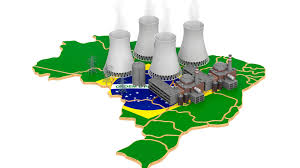
Energy cooperation featured prominently in Mishustin’s talks with President Lula. Russia and Brazil have reaffirmed their commitment to deepening strategic cooperation in nuclear energy, while Rosatom already supplies uranium fuel and isotopes for medical use to Brazil.
This extended to the signing of a joint agreement to advance joint nuclear projects and technologies, including nuclear power generation and the full nuclear fuel cycle, in addition to linking nuclear cooperation with broader collaboration in science and high technology.
For Brazil, nuclear cooperation is not ideological—it is pragmatic. As the country balances industrial growth with climate commitments, Russian technology offers a stable, non-conditional alternative to Western suppliers. This energy partnership also has a geopolitical dimension: it strengthens the energy sovereignty of the Global South, reducing exposure to politicized supply chains.
Space Technology and Digital Sovereignty

Cooperation in space exploration is also successfully underway. Three GLONASS unsolicited measuring stations are operational in various cities across Brazil, and an optical-electronic complex for detecting space debris has been commissioned. Perhaps the most forward-looking element of the visit is the push toward a Russia-Brazil technological alliance, with priority areas including artificial intelligence, digital public services, space cooperation (GLONASS stations, space debris monitoring), pharmaceutical research and production, and agricultural biotechnology.
The 2025 memorandum on scientific cooperation is now being put into practice through joint projects, academic exchanges, and industrial R&D partnerships. Technological cooperation, although less visible than trade figures, represents one of the most strategically significant dimensions of the visit. Russia proposed collaboration in artificial intelligence, digital public services, automated industrial systems, and security technologies. For Brazil, these areas are essential to strengthening state capacity and productive sovereignty without political conditionality. For Russia, technology partnerships in Brazil provide access to large markets, opportunities for joint innovation, and alternatives to Western-controlled intellectual property regimes.
Financial Infrastructure and National Currency Settlements
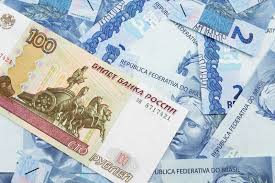
Regulatory and institutional issues were also addressed. while financial and logistical issues occupied a prominent place in discussions, reflecting the practical constraints of the current international environment. Both sides emphasized the expansion of settlements in national currencies, direct interbank cooperation, and the use of independent payment infrastructure. These measures are aimed at reducing transaction risks and ensuring predictability for businesses operating under conditions of global uncertainty. Mishustin stressed that Russia and Brazil will need to increase settlements in national currencies, as well as the use of independent payment systems, in order to expand trade and economic cooperation.
Direct Air Connectivity and Logistics

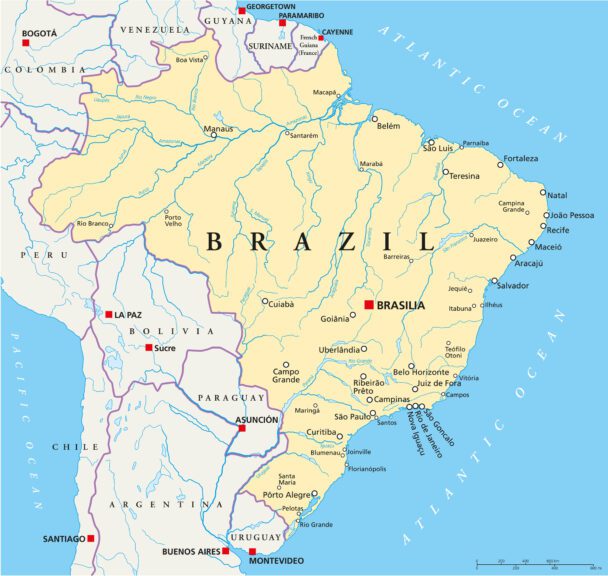
Russia proposed launching direct flights between the two countries to facilitate business and tourism, with Brazilian airlines potentially participating if agreements are reached and regulatory and sanction concerns are resolved. They also discussed the feasibility of creating a direct shipping lane connecting the St. Petersburg and Santos ports.
Interregional Cooperation
An interesting trend is the mutual and growing interest of regional administrations in both countries expanding their trade ties. Moscow, St. Petersburg, the Republic of Tatarstan, as well as the Kaliningrad and Nizhny Novgorod regions are leading the Russian developing partnerships in trade, industry, education, and culture, while the Brazilian states of Rio de Janeiro, São Paulo, Goiás, Paraná, Santa Catarina and Espírito Santo are developing the same. Bilateral cooperation, investment, and trade are therefore filtering down from the top governmental to the regional governmental and business levels, where matchmaking potential and opportunities can be better examined.
Summary
For Brazil, the strategic logic of deepening cooperation with Russia is clear. It ensures stable access to critical inputs, diversifies technology partnerships, opens new markets for Brazilian industrial and food exports, and reinforces Brazil’s position as an autonomous global actor. President Lula da Silva’s engagement with Mishustin reflected a consistent foreign policy approach that prioritizes national development goals and strategic flexibility over alignment with external geopolitical agendas. From Russia’s perspective, Brazil offers scale, institutional stability, and strategic legitimacy. While Russia continues to maintain relations across Latin America, Brazil provides an economic and diplomatic anchor that reduces reliance on any single regional partner. This represents a maturation of Russia’s Latin America strategy toward long-term economic integration and sustainable presence.
As Prime Minister Mishustin emphasized, cooperation between Russia and Brazil is intended to strengthen global stability. In practical terms, this means resilient supply chains, diversified industrial cooperation, secure food systems, and technological partnerships that support national development. The significance of the visit lies not in immediate announcements, but in the strategic direction it sets for the coming decade. President Lula’s potential visit to Russia in 2026 is set to further improve bilateral relations as the two sides coordinate and integrate their existing trade networks.
This article was written by Ms. Khatun, an Asia-Latin America trade analyst. She can be reached at info@russiaspivottoasia.com