
 Русский




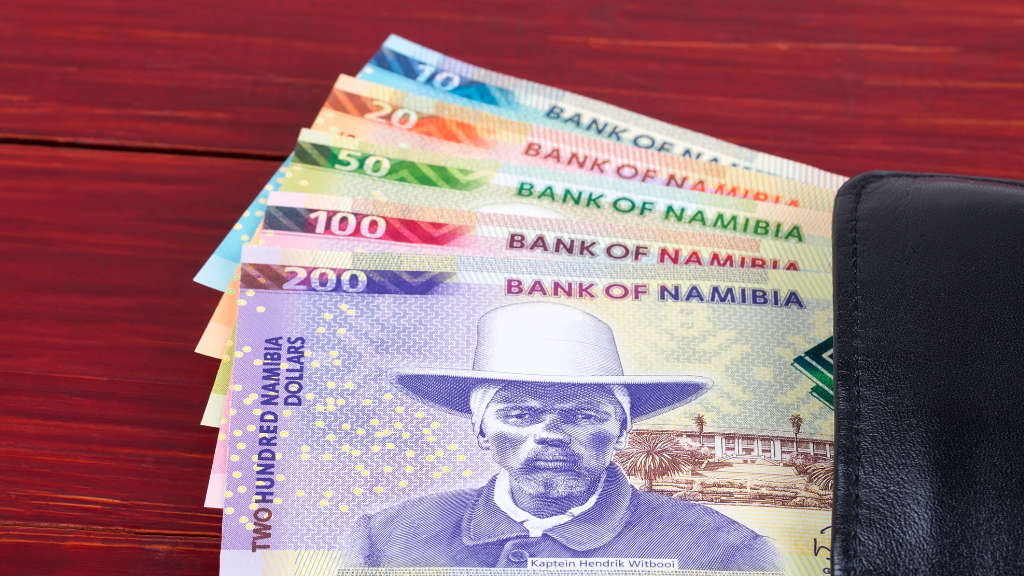

Russia and Namibia have the potential for joint projects in energy, petrochemicals, and other industries, and VEB. RF is ready to finance their implementation in the African country at 5% per annum, Russian Deputy Prime Minister Yuri Trutnev said on the sidelines of the Russia-Namibia business forum taking place in Windhoek, the capital of Namibia, as part of the work of the two countries’ intergovernmental commission.
Trutnev stated that “I am confident that we will be able to find opportunities for interaction in the fields of energy, advanced technology, the mining industry, petrochemicals, and the financial and agricultural sectors. For projects that will be implemented in Africa through our joint efforts, VEB.RF is ready to offer financing on terms attractive to investors—at a rate of 5% per annum.”
That is lower than Namibia’s current domestic interest rate at 6.5% and South Africa’s 6.75%.
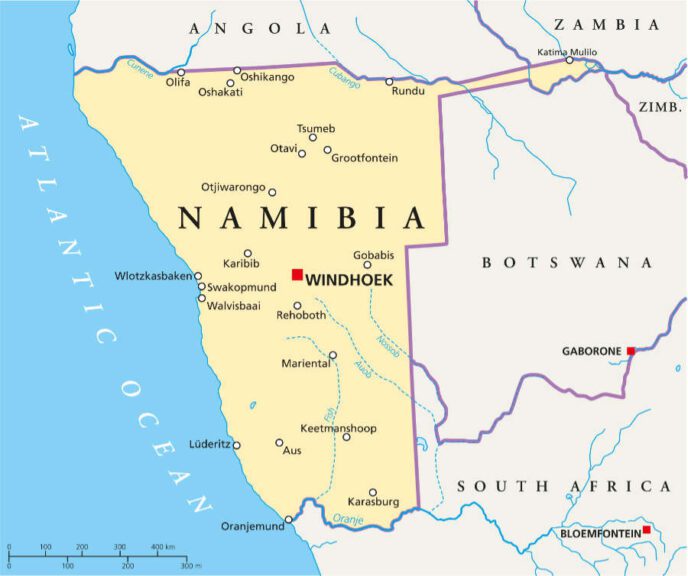
The Russian delegation visiting Windhoek includes companies such as Rosatom, Rostec, Nord Gold, VEB.RF, and Uralkali.
Namibia has a population of about 3 million and a GDP (PPP) of US$30 billion. Namibia’s GDP per capita (PPP) is US$11,000, while GDP growth for 2025 is estimated at 3.9%.
Namibia’s main businesses include agriculture, tourism, fishing, and mining. The primary focus of commercial farming, which is mostly carried out by European settlers, is the production of cattle and sheep for export from Karakul. Although it employs fewer than 10% of the working force, mining is a major economic driver, contributing slightly less than 30% of the GDP. Although mining is dominated by diamonds, uranium oxide, and base metals, gold, natural gas, and oil production (both offshore and in the Etosha basin) are becoming more and more important.
About 30% of the world’s diamond production comes from Namibia, albeit the value of this contribution fluctuates with global prices. The production of uranium is also significant, although the main Tsumeb/Matchless mine complex near Windhoek has trouble accessing new ore formations, and additional mines are required to prevent medium-term output reduction.
Namibia has recently been discussing the possibility of Russian involvement in uranium mining and the potential for developing nuclear power plants in the country. There is also Russian interest in Namibia’s diamond trade—the country is the source of 30% of global gem-quality supplies. Current bilateral trade reached US$18.4 million in 2025, mainly consisting of Russian fertilizer exports. However, if the uranium and diamond mining sectors invest, this could rapidly increase.