
 Русский




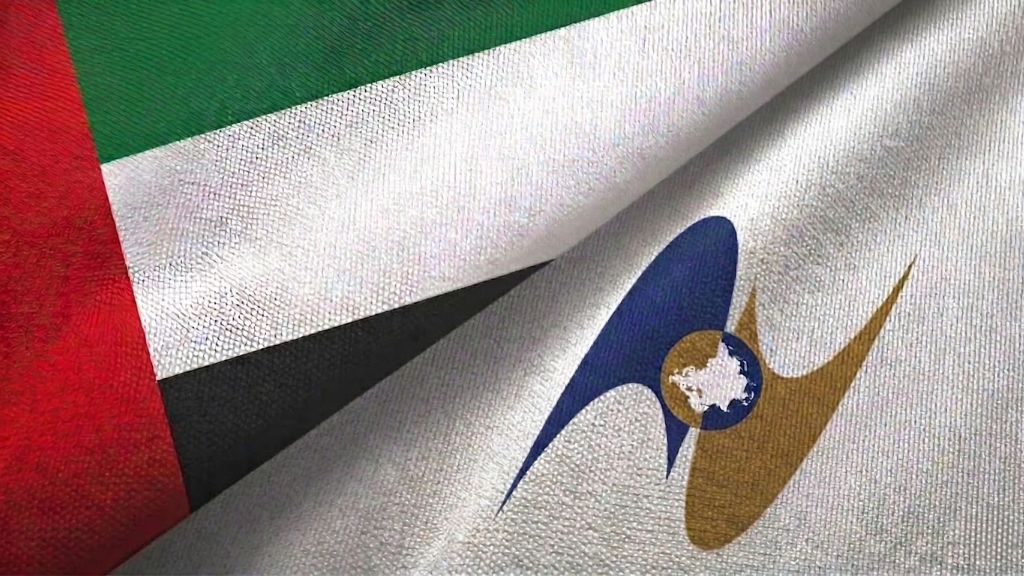

Russian Prime Minister Mikhail Mishustin has stated that the consideration of bills on ratifying trade agreements between Russia and the United Arab Emirates (UAE), as well as between the Eurasian Economic Union (EAEU) and the UAE, should take place shortly.
Bills ratifying the agreement on trade in services and investment between the Russian and UAE governments and on ratifying the agreement on economic partnership between the EAEU and its member states on the one hand and the UAE on the other were submitted for cabinet approval on Thursday (April 9).
Mishustin said, “We will consider a bill on ratifying two agreements with the United Arab Emirates—the first on economic partnership through the Eurasian Economic Union, of which Russia is also a member.” According to it, a free trade regime based on special preferences is introduced for exporters from our countries when entering each other’s markets. The second agreement is bilateral: on trade in services and investment between Russia and the United Arab Emirates. Its implementation will open up additional opportunities for domestic entrepreneurs to operate in the Emirati market in 64 new areas. I expect that the federal bills will be considered by the State Duma as soon as possible, and the entry into force of the agreements will create a reliable legal basis for increasing trade and investment cooperation between Russia and the United Arab Emirates.”
The Russian Economic Development Ministry’s press service subsequently said that the government had approved both bills.
The agreement on establishing a free trade zone (FTZ) between the EAEU and the UAE was signed in Minsk on June 27, 2025. It will affect about 85% of the product range of mutual trade between the EAEU and the UAE, for which customs duties will be reduced or eliminated. Preferential export coverage for the EAEU in value terms will cover more than 98% of current exports, or more than US$12.1 billion, the Eurasian Economic Commission said. As a result of the liberalization of the trade regime, the average rate applied by the UAE to EAEU goods will be reduced from 5% to 0.6%. The annual savings on the payment of import customs duties for exporters from the union countries is estimated at more than US$260 million.
The average duty on Russian products will decrease more than 66%—from 4.7% to 1.4%, the economic development ministry has stated. EAEU duties for the UAE will be reduced from 6.6% to 1.5%. For most categories of goods, the duty will be zero, including poultry meat, fish, dairy products, sunflower oil, fertilizers, ferrous metal products, machinery and equipment (such as refrigerators, pumps, and agricultural machinery), and motor vehicles. The annual savings for Russian businesses after the FTZ agreement enters into force will amount to up to ₽9 billion (US$116 million), according to Maxim Reshetnikov, the Economic Development Minister.
Deputy Prime Minister Alexei Overchuk previously told journalists that he expects the free trade agreement with the UAE to enter into force by the end of 2026.
The bilateral intergovernmental agreement between Russia and the UAE on trade in services and investment was signed in addition to the FTZ agreement in Moscow on August 7 last year. It is aimed at mutual liberalization of conditions for access to the services market and the development of mutual investments.
The implementation of the agreement, in particular, will allow for the establishment of enterprises with 100% Russian capital in certain service sectors in the UAE. The agreement will also help expand bilateral trade in goods within the FTZ between the EAEU and the UAE by simplifying access to related services—financial, transport, logistics, and consulting.
Russian legal entities will be allowed 100% participation in the capital of UAE companies in sectors such as legal services, computer services, research and development, technical testing and analysis, technical consulting for computer reservation systems, repair of sea and aircraft, and passenger and freight rail transportation.
Participation of up to 70% will be allowed in sectors such as comprehensive engineering services, medical and dental services, rental of vessels without crew and other transport equipment, and passenger and maritime transport. In all service sectors for which the UAE undertakes specific commitments, except for financial, telecommunications, travel agency, and tour operator services, Russian companies will have the opportunity to open branches. Russian investors will also have the right to establish companies with 100% Russian capital in certain free economic zones of the UAE, including in the sectors of financial services, medical services, and news agency services.
In total, under the agreement, the UAE undertakes commitments in 64 additional service subsectors compared to the country’s commitments within the WTO.
Russia undertakes commitments in 12 additional subsectors. Emirati companies will have the opportunity of 100% participation in the capital of legal entities in Russia in the sectors of hospital services, repair and maintenance of sea vessels, maritime catering, rental of vessels with crew, certain air transport services, higher education, and other educational services. UAE companies will have the opportunity to open branches in the sectors of retail trade, hotels and restaurants, repair and maintenance of aircraft, as well as the unrestricted provision of architectural services, placement and recruitment services, and cinema services. Trade between Russia and the UAE surpassed $12 billion in 2025, driven by record goods turnover, rapid growth in services, and expanding tourism ties.