 Русский







The future of Greenland has again been placed on the front page news following the success of the United States operation in kidnapping the Venezuelan President, Nicholas Maduro, and forcibly repatriating him to the United States. That brazen operation has a sequel – renewed calls for Greenland to be taken over by the United States as well.
That is despite the issue that Greenland is regarded as a sovereign territory of Denmark, a fellow NATO member. Trump appears to view Greenland as a security risk for the United States, saying it is required for ‘American security’ and that if the United States doesn’t take it, Russia or China will.
That then leads to the questions of Russian and Chinese interests in Greenland, what they are, and especially as Trump mentioned that Greenland was ‘surrounded’ by their ships.
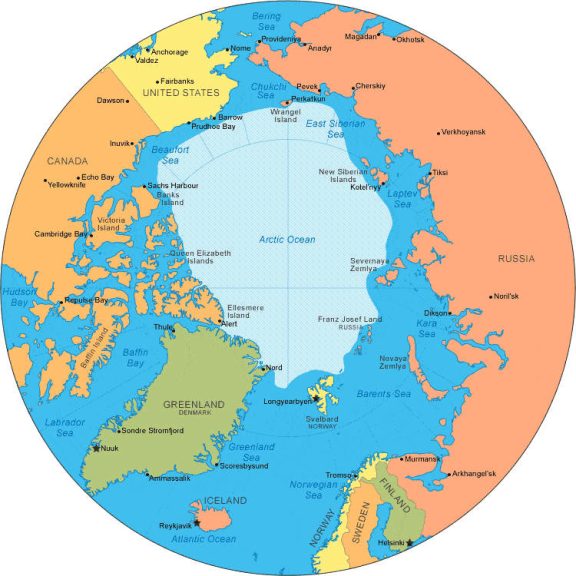
Here is a map of Greenland and its position in the Arctic.
Background
Historically, Greenland’s position as a sovereign part of Denmark is somewhat problematic as it assumes that Denmark ‘discovered’ an empty land devoid of people and it was free to lay claim on. Yet this is incorrect. There is evidence that early Nordic tribes, such as the Vikings, were in regular contact with Greenland and may have even set up camps there. But the land was inhabited – by the Inuits, a North American indigenous people who had become specialised in living in the remote north and had long adapted to the difficult conditions. Those people – the Inuit – today account for 90% of Greenland’s population. If anything is certain it is that Greenland is definitely not European.
Denmark’s claim to Greenland was two-pronged. In 1721 a joint mercantile and clerical expedition led by Dano-Norwegian missionary Hans Egede was sent to Greenland, where he ‘discovered’ that the local Inuit were not Catholic and therefore, in order to save their souls, had to be subjected to religious conversion. The second was the extremely rich whaling grounds that existed around Greenland at that time. Egede then claimed Greenland for the Danish crown before any of Denmark’s competitors could. The Inuits were presumably bemused by it all.
A permanent colony was established in 1737, on the site of the present capital, Nuuk. It has been considered part of Denmark ever since, although recent changes mean that it has been under self-rule since 2009.
Russia’s Interest in Greenland
Russia has never had special interest nor much involvement in Greenland, with a very good reason why – its interests lay to the east. While there are accounts of early Russian whalers travelling to Greenland to try their luck, the Danes were highly protective and would make life difficult. It was far easier and simpler for Russian whalers to achieve their goals in the waters around the Svalbard archipelago, Novaya Zemlya, and the Russian arctic coast.
The distance between Murmansk and Nuuk for example is about 2,500 nautical miles, a long way for early whalers to attempt to fish and hunt off Greenland. From Murmansk to Spitzbergen is about 600 nautical miles. Why sail thousands of miles away from Russia to catch whales when the Russian arctic coastline is literally on your doorstep? Consequently, stories of Russian sailors visiting Greenland are very rare, although there are a handful of exceptions.
Furthermore, Russian adventurers and explorers were looking east, not west – and they were not the only ones. Great rivalry existed between British, Norwegian, Swedish and Russian sailors to find the famed ‘Northern Sea Passage’ that certainly existed between the wealthy Northern European capitals of Moscow, Stockholm, Copenhagen and London – to and from Asia. Then, as is true today, traders and their Kings knew that if such a passage existed – it would make true with China, and the rest of Asia – already well known for their riches via southern ocean and overland routes such as the old Silk Road – far more economically viable. The search for the Northern Sea Passage continued from the mid 1700’s to 1918 when the Russian revolution occurred and the country gradually began to seal itself off and foreigners were expelled.
The early visions of those 18th century explorers and Kingdoms were correct – there was a Northern Sea Passage but it is only through the double-barrelled development of global warming and improved Arctic shipping technologies that it has become viable.
Russia’s historic interest in the Arctic has always been east, not towards Greenland, which in turn has no nearby valuable export markets of its own. It is worth considering that the nearest large city to Nuuk is Reykjavík, in Iceland, and not in North America.
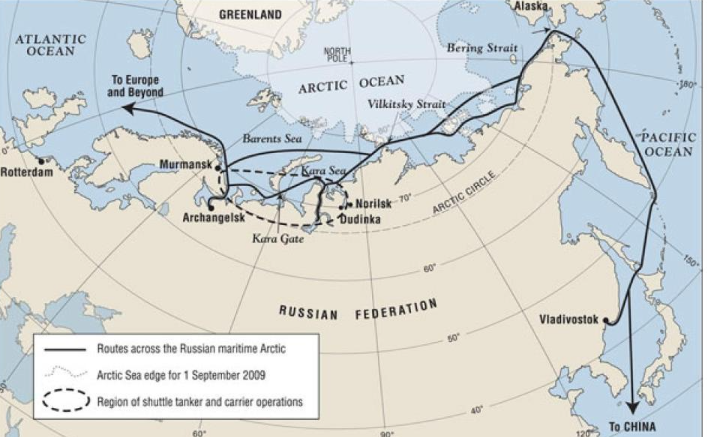
As a footnote, it is worth mentioning that Russia had conquered much of Alaska and even extended their Empire down as far as the Californian coast. Those excursions were generally launched from the Russian Far East, and headed directly east, then south, not further north, around what is now Canada and to Greenland. Why would Russia attempt that when an easier route would be the 2,500 nautical miles from European Russia? The idea of a Russian round-the-Arctic claim was never mooted – it already had plenty of coastline, resources and access to Arctic fisheries and whaling and has simply never needed to add any more territory. It is concentrating on developing the NSR and that is plenty for Russia to be occupied with. Greenland, as far as Russia is concerned, would be a complete white whale and of no use to its export ambitions.
China’s Interest in Greenland
China considers itself a ‘near-Arctic’ region, solely based on its own interests in the Northern Sea Route and the developments in the Yamal fields in Arctic Siberia. The image that Trump tries to plant of China seizing Greenland if he doesn’t is clearly absurd – the nautical distance from Dalian, China’s nearest port to Nuuk is roughly 6,000 to 7,000 nautical miles, traversing the North Pacific and Bering Seas. China simply doesn’t have the capabilities nor equipment to cope with sustaining a permanent takeover of Greenland and has not shown any prior interest in doing so. This scenario is completely without merit.
US intentions
Having stated the obvious – the neither Russia nor China have any interest in Greenland – the issue then rebounds to Trump and the position of the United States. Why does the United States want to take over Greenland if the stated risks of Russia and China do not actually exist?
That is a question we will leave our dear readers to ponder.
Further Reading
Russia – Greenland Bilateral Trade