
 Русский








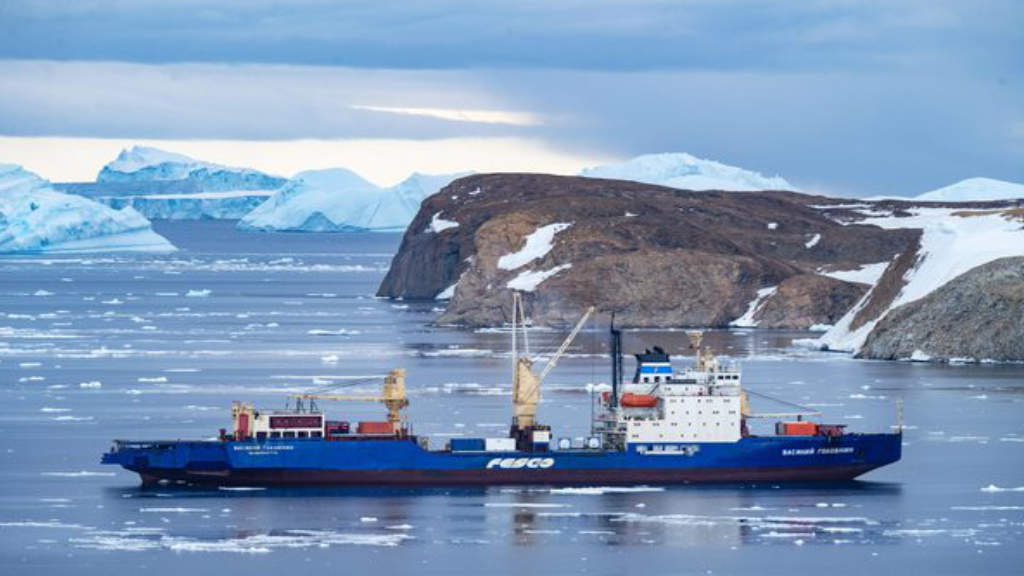

Russia’s FESCO transportation group is demonstrating its long voyage polar capabilities with the Vasily Golovnin diesel-electric ship undertaking its latest voyage to Antarctica to supply the Indian Antarctic stations Bharati and Maitri, delivering fuel, food, and specialized equipment.
FESCO has a contract with the Indian side to maintain deliveries and confirms the company’s role as one of the few global operators with sustainable expertise in polar logistics.
The Vasily Golovnin departed from Cape Town (South Africa) and is now en route to Antarctica.
In addition to cargo, Indian polar explorers are also on board to rotate scientific station personnel. The expedition will last until April 2026, corresponding to the standard Antarctic navigation window.
A key feature of the voyage is the difficult unloading conditions. Antarctic stations do not have full-fledged port infrastructure; therefore, supplies are carried out directly from the ship to the shore.
The Vasily Golovnin is equipped with two ship cranes and a self-propelled barge, allowing for unloading in the coastal zone. Additionally, two helicopters are on board, used for aerial reconnaissance, cargo delivery, and supporting land operations.
This type of multimodal scheme—sea + barge + aviation—is critical for polar projects and requires high coordination of the crew, technical readiness of the vessel, and precise planning of weather windows.
The expedition is conducted under a long-term contract with the National Centre for Polar and Ocean Research of India (NCPOR) under the Ministry of Earth Sciences. FESCO has cooperated with the Indian side for several years, providing regular flights in the interests of the country’s scientific programmes.
According to Nikolay Chvertko, director of the FESCO branch in Vladivostok, the company’s vessels have performed Antarctic expeditions since the 1970s and have participated in international projects to supply scientific stations since the 2000s. For the past seven years, the crew of the Vasily Golovnin has consistently served Indian Antarctic missions.
Antarctic voyages remain a highly specialized segment of maritime transport, where the key competitive advantage is not so much the fleet as the accumulated operational expertise.
For international scientific programmes, it is critical to have partners capable of:
- Working in extreme climate conditions.
- Performing unloading on an unequipped shore.
- Ensuring the safety of crews and scientific personnel.
- Combining maritime and aviation logistics solutions.
Against this background, FESCO’s supply deliverables illustrate that Russian operators maintain positions in international polar logistics despite the general complexity of the foreign economic environment and are an indicator of a specialized logistics model. For FESCO, the project confirms its status as an operator with unique competencies in polar transport, and for international partners, it confirms the presence of a reliable supply infrastructure for scientific stations in one of the most difficult regions of the world.
For the market as a whole, such projects remain an important indicator of which logistics competencies will be in demand in international scientific and infrastructural programmes in the long term, and especially along the Northern Sea Routes and the Russian Arctic coastline.
Further Reading
Russia, China Discuss Mineral Drilling Project In Antarctica
Continue Reading