 Русский






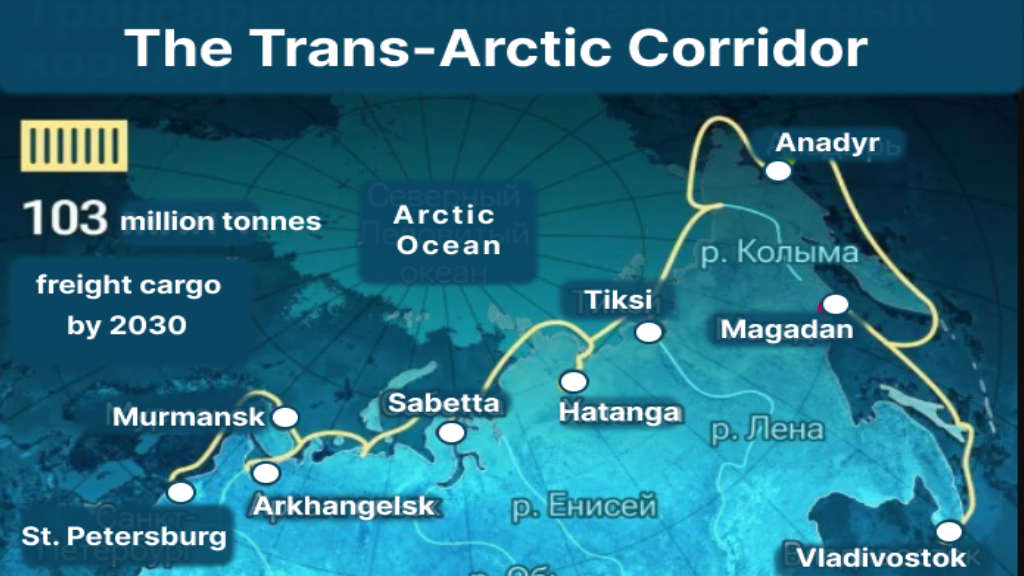

The Russian President, Vladimir Putin, has instructed the Russian government, with the participation of the Maritime Board, to submit proposals to increase the efficiency of cargo delivery from Siberia, the Far East, and the Urals to the route of the Transarctic Transport Corridor (TTC).
This differs from the Northern Sea Route (NSR) in that the TTC also includes the development of additional logistics routes and integrates the NSR into Russia’s domestic logistics network, most notably with Russian rivers, roads, and railways, as well as aviation and the use of digital technologies.
In preparing the proposals, the use of the Ob, Yenisei, and Lena river basins will also need to be assessed. The deadline for the completion of these proposals is 15 February 2026.
Proposals are also due on the same date for the development of domestic competencies required for the construction of container and bulk carriers, gas carriers, supply vessels, and dredging and tugboat fleets for the Transarctic Transport Corridor.
In addition, the government is instructed to take measures for the development of multimodal transport and logistics centers (TLCs) in the Far Eastern Federal District and increase their efficiency.
This includes the areas of the railway bridge crossings at Nizhneleninskoye (the Jewish Autonomous Region)–Tongjiang (the People’s Republic of China) and Blagoveshchensk (the Amur region)–Heihe (the People’s Republic of China), as well as the bridge crossing under construction across the Tumen River (towards the Democratic People’s Republic of Korea). The bridge across the Tumen River must begin operating in 2026, with access roads brought up to standard. The government report on this matter is due by 1 February 2026, and again by 1 February 2027. We previously discussed these issues here.
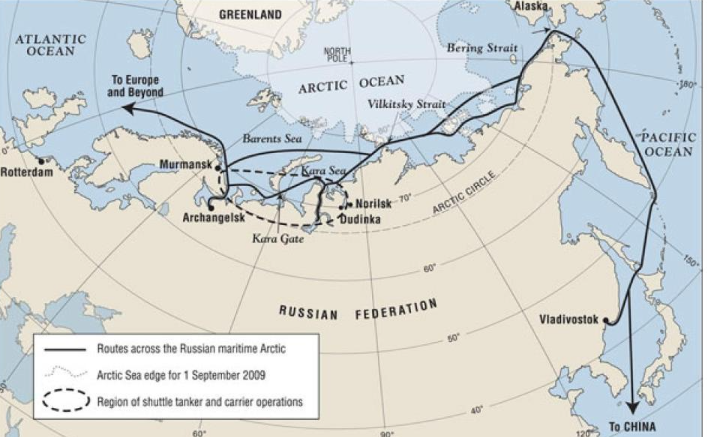
The Transarctic Transport Corridor includes the Saint Petersburg, Murmansk, Arkhangelsk, and Vladivostok ports. The perimeter of the TTC includes the Northern Sea Route (NSR), whose boundaries are defined by the Russian Merchant Shipping Code: from the Novaya Zemlya archipelago in the west to Cape Dezhnev in Chukotka.
Russia aims to build an international transport alternative in the Arctic based on the TTC, emphasizing that the NSR is 30% shorter than the route from Europe to Asia via the Suez Canal.
Further Reading
Russia’s Maritime Board Reconfigures the Transarctic Transport Corridor