Русский









The unprovoked United States attacks on Venezuela – in which 40 Venezuelans are estimated to have died in the kidnapping and removal to the United States of the Venezuelan president—have been followed through with what appears could now be a civil war breaking out in the country. Meanwhile, US President Trump has issued ‘warnings’ to several Latin American countries that they could be next—Colombia, Cuba, and even Mexico (with whom the US is due to host this summer’s World Cup soccer finals) have all been issued with threats against their leaders. Meanwhile, senior United States officials have been talking about the Danish territory of Greenland, which Trump says is required by the United States ‘for security purposes.’ Clearly, we are in a period of redefining global alliances and the apparent merging of countries into different, new entities.
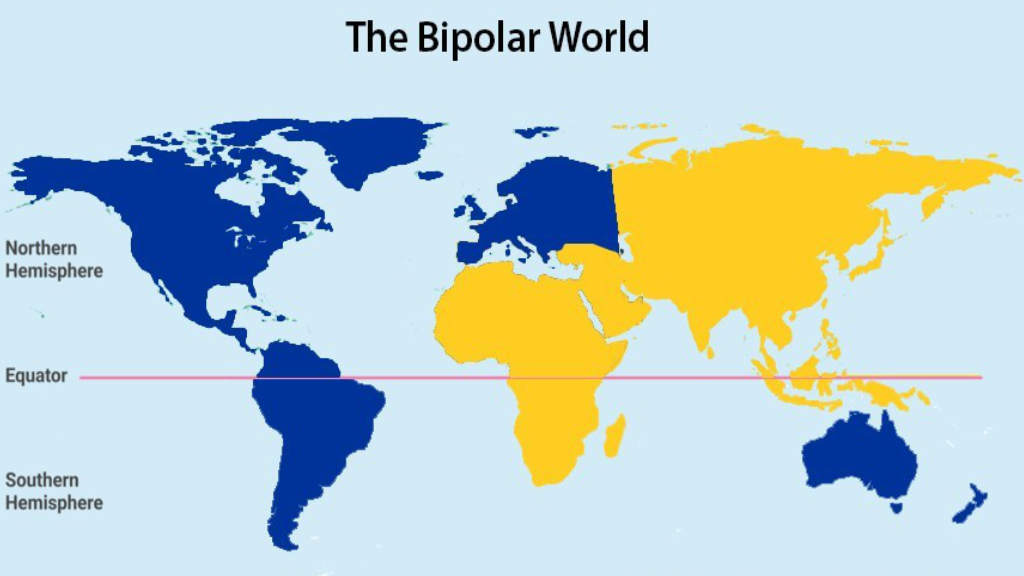
Much has been spoken about the coming of a ‘multi-polar world’; however, we see it more as a move from a ‘unipolar world’—one arguably dominated by the United States—into a bipolar world, where common interests align (Yes, the pun is deliberate. It is a reflection of our views of most Western myopia concerning these changes.
In this bipolar world, we have included the aforementioned Greenland and South America, as the United States has made no secret of their intentions towards them. We also include the European Union, as the entire bloc has effectively handed its economic sovereignty to Washington. It is now dependent upon US energy resources and last year agreed to a trade deal with the United States that provides open access to American products to EU markets yet does not reciprocate. Europe is also becoming militarily dependent upon the US too—despite all the European political braggadocio concerning Ukraine, there is no unified European military, while most of its weapons also need to be purchased from US manufacturers.
We could call this bloc the United States of the Americas and Europe—and while likely to maintain some semblance of regionalised independence, via the holding of elections and pronouncement of democracy—the result remains the same: this group is one half of a bipolar world, if not in word, then certainly in reality. Trump has already referred to the ‘United States in control of the western hemisphere‘.
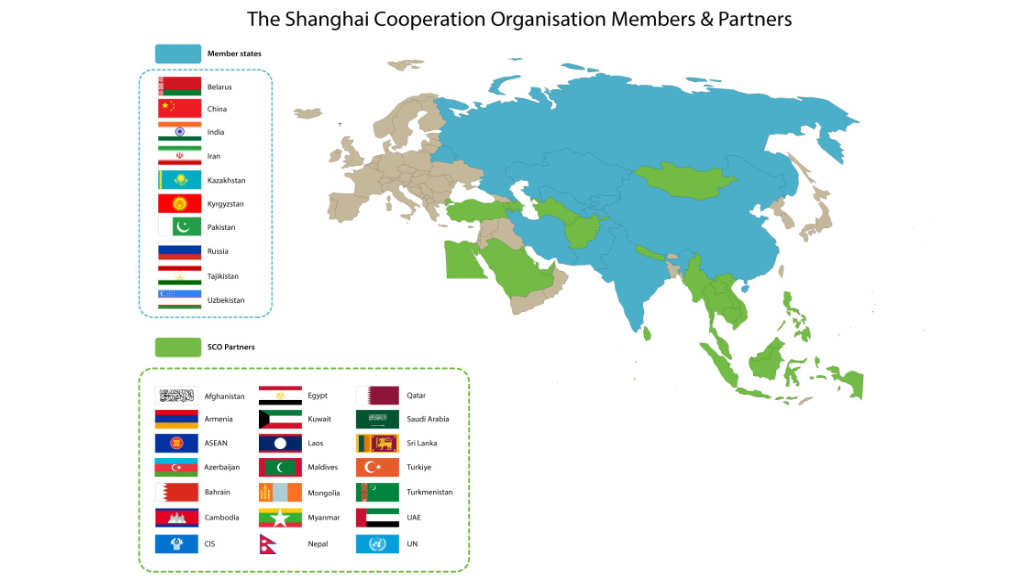
On the other hand is the second half of the equation. That begins on the Western borders of Russia and extends across the rest of Eurasia, as far east as China, and inevitably, Japan—70% of its trade is within Asia. It also includes the Middle East and India in what we could term “The Eurasian Alliance.” In many ways, this already exists in all but name – the Shanghai Cooperation Organisation.
We also include Africa in this, not least because Trump repeatedly shows disdain for the region—referring to it as full of ‘shithole’ countries and pointedly not attending the recent G20 summit held in South Africa. In addition, the African continent remains in the lengthy process of divorcing itself from European powers, and coupled with this is the influential political, trade, and investment mix—the Indian and Chinese diaspora are significant in Africa, while Russia has been making substantial inroads into the region and will be highly influential as, literally, a power broker. Rosatom is involved in numerous nuclear power projects that are set to revolutionize African industry and will create an industry base capable of providing Eurasia with much of its needs—just as LatAm is being marked to do the same for the United States.
These two regions are extremely unlikely to appear as institutionalised blocs. But then again, they don’t need to. With the meaning of the word ‘sovereignty’ increasingly ambiguous and actual real power being economically or militarily stolen away, the words ‘country,’ ‘national,’ and ‘independent’ are ceasing to become as well defined as they once were.
The European Union, in its increasingly noisy ‘federal’ approach in swallowing up other countries’ laws and currencies, seems unaware that it too is increasingly at risk of suffering the same fate. Possibly, it is already a fait accompli, while the noise about Greenland is just that. What happens when the United States decides it “needs Europe” for its security purposes? The answer appears to be clear: it has already done so and has already acted upon it, while no one noticed.
Further Reading
Eurasian Economic Union “Should Include New African & Asian Partners”