Русский










The 24th Plenary Session of the International Coordinating Council on Trans-Eurasian Transportation (CCTT) has been taking place in Dubai, with Vladimir Serpikov, the Director of the Trade Policy Department of the Eurasian Economic Commission (EEC), participating.
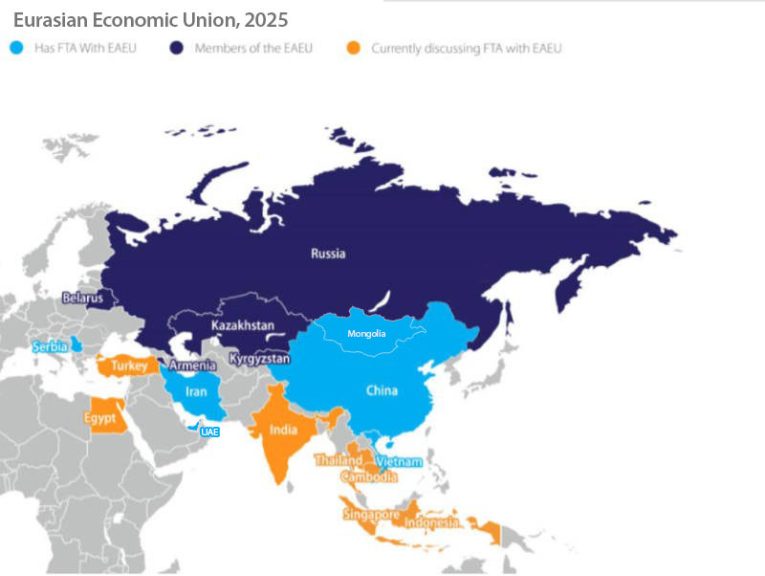
Significant topics included the development of container transportation in Euro-Asian traffic, the simplification of cross-border operations, and ensuring a continuous cold chain for the transportation of temperature-sensitive cargo. Serpikov, in representing the EEC, is also responsible for the development of trade policy for the Eurasian Economic Union (EAEU), which includes Armenia, Azerbaijan, Kazakhstan, Kyrgyzstan, and Russia. However, the EAEU has also entered into several free trade agreements this year, including with the United Arab Emirates and Mongolia.
Serpokov stated that “The EAEU is becoming a significant pole for the digital transformation of the international transport system. Our experience of implementing existing trade agreements shows that the EAEU is successfully forming new sustainable trade routes and providing predictability for businesses. The actively pursued digitization of procedures—from customs administration to the implementation of “smart trade corridors”—only strengthens our position.”
The CCTT is an international association established in 1996. Its members include Russian Railways (RZD), the China International Freight Forwarders Association (CIFA), Polish State Railways (PKP), Rail Cargo Austria, the Ulaanbaatar Railway, and Shanghai International Shipping Agency (ISACO Group), along with 96 member societies from 23 countries. These include CIS and Asian railway operators, leading shipping companies, operators and forwarders, ports and stevedoring companies, state organizations, administrations and academia, telecom and marketing companies, and security services.
One of the CCTT’s main goals is to attract transit and foreign trade cargo to trans-Eurasian routes passing through Russia, including the East-West and North-South International Transport Corridors (ITCs).
Several development topics were discussed, to be coordinated amongst members, including transport connectivity, the interaction of railways and seaports, the simplification of cross-border operations at customs border checkpoints, and the development of transport corridors. Serpokov also spoke about the development of Eurasian economic integration and promising projects in the customs sector, and especially the role of customs clearance digitalization, the need for accelerated development of customs infrastructure, and the use of breakthrough technologies and artificial intelligence. Of note is the directive that the use of navigation seals for tracking road and rail transport across the EAEU becomes effective from February 11, 2026.
That is expected to dovetail with Dubai Customs’s experience in implementing the “single window” concept, using advance declarations to expedite and harmonize customs procedures.
Further Reading
Eurasian Economic Union GDP Growth Projected To Average 6% Between 2025-2030