 Русский






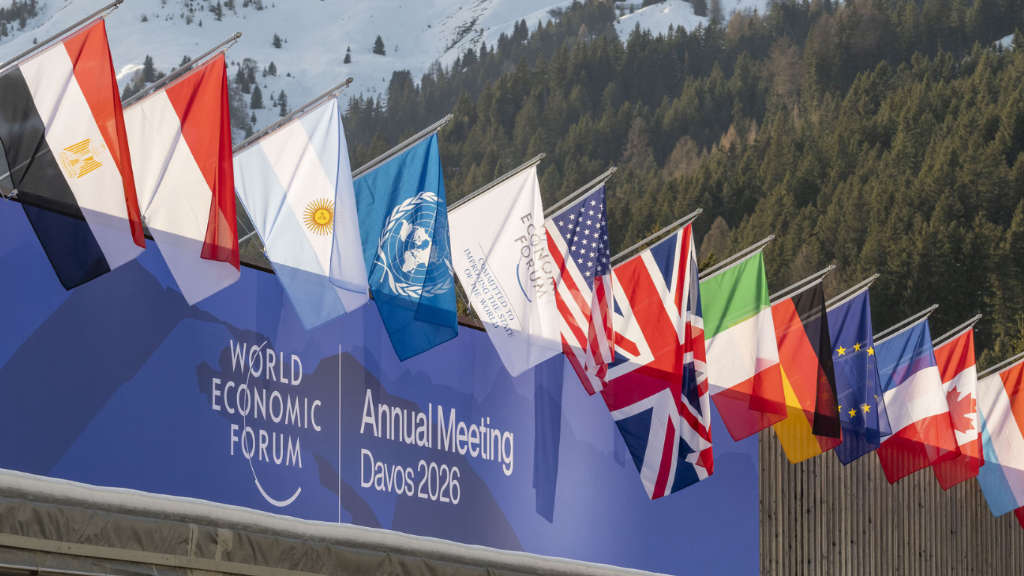

This past week, the small Swiss resort of Davos yet again became the temporary capital of a self-appointed global elite. Under the banner of the World Economic Forum (WEF), political leaders, multinational CEOs, financial institutions, and technology giants gathered behind closed doors to discuss the global economic prosperity. Nearly 65 heads of state and government (including six of the G-7 leaders), together with 850 chief executives and chairs of the world’s largest companies, attended the Davos Forum, representing a gathering overwhelmingly dominated by Western elites.
US President Donald Trump dominated Davos 2026. Officially, the agenda focused on familiar themes: economic uncertainty, climate change, artificial intelligence, global security, and “inclusive growth.” Unofficially, Davos 2026 confirmed what many outside the Western bubble already understand—that the forum is increasingly disconnected from the real problems facing most of humanity.
The World Economic Forum claims to represent global cooperation. In reality, it represents a narrow circle. Attendance remains limited to several thousand participants, overwhelmingly from wealthy Western states and large corporations. According to the WEF itself, corporate leaders and financial institutions dominate the discussions, while representatives from developing countries appear largely as symbolic participants rather than decision-makers.
The contradiction is impossible to ignore. Davos lectures the world on inequality while taking place in one of the most expensive locations on the planet. Private jets crowd nearby airports as speakers warn about carbon emissions. Executives earning millions annually discuss “cost-of-living pressures” faced by ordinary citizens—pressures they will never experience themselves. Equally troubling is the absence of accountability. Each year, Davos produces declarations, initiatives, and “commitments.” Yet there is no mechanism to enforce them. No elections. No responsibility to voters. No consequences for failure. The same figures return year after year regardless of whether their policies have worked or failed spectacularly.
In 2026, technological optimism once again took center stage. Artificial intelligence, digital platforms, and financial innovation were presented as universal solutions. Missing from the conversation was a serious discussion of who controls these technologies, who profits from them, and who bears the social cost when they fail. For millions of workers facing automation, Davos offers reassurance but little protection. Perhaps most revealing is what Davos does not discuss. Sanctions-driven economic fragmentation, energy insecurity caused by political decisions, and the erosion of national sovereignty under “global governance” frameworks remain largely taboo topics. Consensus is enforced not by debate, but by exclusion.
Discussions About The Russian Economy
An example of this is the Davos session held about the Russian economy. Svetlana Tikhanovskaya, an ex-primary school teacher and an unelected, self-proclaimed ‘leader of the opposition for Belarus’ living in exile in Lithuania, chaired the Russian economic session. She was joined by Alexander Gabuev, a journalist who has criticised the Russian government, is a listed ‘Foreign Agent’ in Russia, and also lives in exile in Berlin. Moldovan Prime Minister Alexandru Munteanu was also on the panel, a politician who has overseen the seizure of Russian assets in Moldova and is close to Ukrainian President Vladimir Zelensky. Oana Toiu, a close ally of Munteanu and Moldovan President Maia Sandu and is currently Romania’s foreign minister, also took part, while Dutch Foreign Minister and former NATO Assistant Secretary General David van Weel was also present. He is known for designing EU sanctions packages against Russia.
The two things this panel had in common were an admitted lack of any expertise in the Russian economy and a united political desire to see Russia fail. Not surprisingly, their considered opinion about the Russian economy was that it was deteriorating and would soon collapse, although much of the evidence for this was actually political rhetoric rather than economic data. This session can be seen here.
Given the quality and personalities taking place, this session, instead of any deep dive into properly understanding Russia’s economic position (which had been outlined by President Putin recently here and Russian Foreign Minister Lavrov here) helped instead perpetuate the misunderstandings—or lack of intelligence as regards any aspect of the Russian economy. That alone means that the attendees at Davos—if they take on board this type of propaganda—are being deliberately fed inaccurate information.
Although Russian presidential envoy Kirill Dmitriyev attended the World Economic Forum in Davos to engage with U.S. representatives on the Ukrainian settlement, Russia’s voice on global economic strategy and agenda-setting was absent. Despite being the world’s fourth-largest economy by PPP and a major player in energy markets and technological sectors, Russia had little influence on any of the Davos discussions shaping global economic priorities. This absence highlights the limits of the WEF as a truly global forum, dominated by Western elites and perspectives, where non-Western powers often find their role reduced to observation rather than decision-making.
A Forum That Still Claims to Speak for the World
However, the World Economic Forum likes to describe itself as a place where the world comes together. Davos 2026 instead demonstrated a different reality: a shrinking Western-centric elite speaking mainly to itself, increasingly anxious about a multipolar world it no longer fully controls. For most of humanity, Davos is not a place where decisions are made in their interest. It is a carefully staged performance designed to project relevance, authority, and moral leadership while real economic and political power continues to shift elsewhere.
The stated purpose, though, remains unchanged: to improve the state of the world through dialogue, cooperation, and shared economic vision. Yet Davos 2026 once again demonstrated a growing contradiction between aspiration and reality. At a moment when global economic growth is increasingly generated outside the Western world—in Asia, Africa, Latin America, and Eurasia – the Forum continues to operate primarily within a Western political and ideological framework.
The problem is no longer one of access but of relevance and inclusiveness. Davos 2026 feels less like a place where the world is fixed and more like a place where the powerful reassure each other that they’re still the right people to be in charge despite mounting evidence to the contrary.
Presence Without Weight—China and India as Davos Case Studies
Formally, representatives from major non-Western economies attended Davos. Chinese Vice Premier He Lifeng and India’s Minister for New and Renewable Energy Pralhad Joshi participated in the Forum’s activities. However, their engagement remained cautious and limited. Neither China nor India treated Davos as a platform for strategic agenda-setting. Instead, their approach appeared observational. They listened carefully, delivered measured remarks, and avoided political investment in the Forum’s outcomes. This was not accidental. For both Beijing and New Delhi, Davos has become less a decision-making center and more a venue for monitoring Western political thinking.
A simple search for “Davos 2026” in Western media tells its own story. Headlines fixate on Donald Trump, Europe’s internal anxieties, Greenland, artificial intelligence, geopolitics, Zelensky and Ukraine, and an anti-Russia narrative, packaged together with a steady stream of anti-China framing (often paired with familiar anti-Russia rhetoric), carefully packaged as moral clarity. Without coverage from local Chinese and Indian media outlets, is there any indication that India’s or China’s participation was prioritized? What is far more striking is what is missing.
Where are the Chinese voices shaping the discussion? Where is India—the world’s most populous country and one of its fastest-growing major economies? In a forum that claims to represent the global future, the perspectives of nearly three billion people are either marginalized or filtered through Western interpretation.
China appears mostly as an object of concern, not a participant. India is referenced as a “market” or a “counterweight,” not as an agenda-setter. Their leaders, institutions, and strategic visions are rarely allowed to speak for themselves. Instead, Western commentators speak about them—never with them.
This selective visibility is not accidental. Davos functions best when the conversation stays within acceptable boundaries: Western priorities, Western anxieties, and Western narratives. Countries that do not align neatly with these frameworks are reduced to risks, rivals, or background noise.
Russia, meanwhile, is discussed almost exclusively through a lens of condemnation, stripped of political complexity or legitimate national interest. The tone is not analytical; it is punitive. Debate is replaced by repetition. Consensus is enforced by exclusion. The result is a strangely insular spectacle: a “global” forum dominated by Western media narratives, debating a multipolar world while refusing to genuinely hear from the powers that define it. Davos 2026 did not lack voices. It lacked balance. And in that silence from China, from India, and from much of the non-Western world, the limits of Davos’ global relevance were once again exposed.
The Absence of the Global South
More striking than who attended was who did not meaningfully participate. African representation was fragmented and symbolic. Despite Africa accounting for nearly 18 percent of the world’s population and representing the largest source of future labor growth, the continent’s priorities, such as debt relief, industrial financing, and infrastructure development, remained marginal in high-level discussions.
Instead, Davos 2026 showed Africa mostly as a spectator, excluded from high-level debates on AI, geopolitics, and the global economy. While Western powers set the agenda, African delegates were sidelined to side meetings and photo opportunities. The world listens to strategy, innovation, and power, not complaints about colonialism or poverty. Africa needs global leadership, such as Russia, who understands technology, geopolitics, and global strategy to be taken seriously on the world stage. Trump, meanwhile, reignited claims of ‘white genocide’ against Afrikaners at Davos.
Latin America’s presence was similarly limited. Major regional economies, including Brazil, were largely absent from strategic economic panels, despite their central role in global food security, energy exports, and critical minerals.
Central Asia and Eurasia, despite their importance in transport corridors linking Europe and Asia, were discussed almost exclusively through geopolitical lenses rather than as independent economic actors. ASEAN economies, which collectively represent one of the world’s most dynamic growth regions, received limited visibility in agenda-setting discussions on supply chain restructuring. The result was clear: the Global South was spoken about far more often than it was spoken with.
Davos Without Brazil: Global Misrepresentation
One detail at Davos 2026 was especially revealing, and it was not what was said on stage but who was not there in any meaningful way. Brazil, the largest country in Latin America, one of the world’s biggest economies by GDP, a member of the G20 and BRICS, and a nation of more than 200 million people, was conspicuously absent from the summit’s center of gravity. No presence. No agenda-setting role. No serious voice shaping the conversation about the global economy.
And yet Davos continued, undisturbed, confidently discussing “the future of the world.” This raises an obvious question—and one Davos prefers not to ask: how can a forum claim to speak for the global economy while sidelining entire continental powers?
You cannot meaningfully debate growth, trade, climate, or development while treating the world’s largest countries as optional accessories. Brazil is not a footnote. It is a major agricultural exporter, an industrial power, an energy player, and a geopolitical actor with its own interests—many of them outside the narrow consensus that dominates Western-led forums. It was also part of the much-heralded EU-Mercosur Free Trade Agreement signed off by Brussels just a week earlier. Yet was that lauded or even discussed at Davos? Brazil’s limited visibility at Davos 2026 was not an accident but a signal.
Inclusion, it seems, is conditional. The irony is hard to miss. Panels in Davos spoke passionately about “Global South engagement” and “multipolar cooperation,” while one of the most important countries in the Global South was effectively missing from the room where it supposedly mattered most. This is not a failure of Brazil. It is a failure of Davos. A forum that cannot attract or cannot accommodate the serious participation of countries representing vast territory, population, and economic weight is not global. It is selective. And selection, in this case, looks less like diplomacy and more like gatekeeping. Davos 2026 proved once again that it is entirely possible to talk endlessly about the global economy while excluding much of the world that actually drives it.
A Western-Centered Narrative Environment
Davos 2026 was shaped primarily by Western political concerns. Much of the discussion revolved around the implications of U.S. domestic politics and the expected return of Donald Trump to the center of global decision-making. This focus influenced debates on trade, industrial policy, sanctions, and global governance. The contradiction was evident. A forum that consistently promotes free trade and open markets was increasingly orienting its agenda around political figures and policies historically associated with tariffs, trade wars, and economic pressure mechanisms. This inconsistency was rarely addressed directly. Instead, it was absorbed into the new normal.
Free Trade Rhetoric and the Sanctions Economy
Official Davos discourse continues to emphasize globalization, resilience, and cooperation. Yet the real global economy now operates under very different rules. Western economies increasingly rely on industrial subsidies, export controls, technology restrictions, and unilateral sanctions. According to data from the Global Sanctions Database maintained by Drexel University, the number of active sanctions worldwide has increased more than fivefold since the early 2000s. These measures disproportionately affect developing economies, yet their impact receives limited attention in Davos discussions.
For much of the Global South, sanctions and trade barriers are no longer abstract policy tools, but they are structural constraints on development. This disconnect deepens skepticism toward the Forum’s stated commitment to inclusive globalization.
China’s Warning Against Politicization
Chinese officials and analysts openly criticized what they described as the politicization of economic dialogue at Davos. On January 22 and 23, China Daily ran the headlines ‘Davos Is a Messy Circus’ and ‘US President Pushes “America First” at Davos.’ Beijing has repeatedly emphasized that global economic platforms should not be transformed into ideological arenas. This position aligns with China’s broader advocacy for multipolar economic governance, reflected in institutions such as the BRICS New Development Bank and the Asian Infrastructure Investment Bank. China’s restrained participation at Davos 2026 should therefore be interpreted not as disengagement, but as strategic distance. Dialogue, from Beijing’s perspective, loses meaning when outcomes are predetermined by political alignment.
Geopolitics Takes the Stage
On 22 January, Ukrainian President Volodymyr Zelensky delivered a speech that focused almost entirely on confrontation with Russia. He blasted the EU’s lack of “political will” in countering Russian leader Vladimir Putin in a fiery address criticising all of Kiev’s top allies. The address further confirmed Davos’ transformation from an economic forum into a geopolitical stage. For many countries in Asia, Africa, and Latin America—most of which pursue non-aligned or multi-vector foreign policies—such framing is increasingly detached from their immediate priorities. Their concerns are food prices, energy security, development financing, and currency stability. These issues received far less attention than political messaging.
The West Appears Divided
Davos 2026 also revealed growing fractures within the Western camp itself. Disagreements between the United States and Europe over security responsibilities, economic competition, and strategic autonomy surfaced repeatedly. Discussions related to Arctic security and Greenland exposed tensions beneath official declarations of unity. According to an NBC News report, President Donald Trump said in a speech at Davos that the United States “must have” Greenland. Although he left without ownership, experts say his remarks strained the country’s alliance with Europe. Thus, even as Western voices dominated the Forum, internal coherence appeared fragile. This inward Western focus further reduced space for non-Western perspectives.
An Elite Structure With Structural Limits
The WEF remains an invitation-only institution dominated by political leaders, multinational corporations, financial institutions, and non-governmental organizations drawn largely from similar socioeconomic and ideological backgrounds. This concentration creates efficiency but also fosters intellectual narrowness. Despite the expertise present, Davos’ discussions frequently fail to anticipate major global shifts, including the acceleration of South-South trade, which, according to UNCTAD, now accounts for more than 25% of all global trade flows. The economic world is changing faster than the Forum’s conceptual framework.
Credibility Challenges and Data Disputes
The Forum’s credibility has also faced challenges. In India, significant criticism followed the release of the WEF Global Risks Report, with analysts questioning methodological accuracy in assessments related to misinformation and political stability. Some Indian media outlets and policy experts publicly challenged these rankings, arguing that flawed metrics risk undermining trust in global reports. Such controversies reinforce the perception that global assessments often reflect Western interpretive frameworks rather than balanced empirical analysis.
Protests and Public Perception
Outside Davos, protests again accompanied the Forum. Youth activists criticized wealth concentration and elite insulation from social realities. International media outlets, including the Financial Times and CNN, published commentary describing Davos as increasingly “out of touch” with ordinary economic pressures such as inflation, housing costs, and job insecurity. These critiques no longer come only from political margins, but they now appear within mainstream Western discourse.
The Quiet Shift Away From Davos
Perhaps the most important development is not criticism, but indifference. Major Global South economies are increasingly prioritizing alternative platforms such as BRICS summits, regional development banks, and bilateral investment mechanisms. According to the IMF, emerging and developing economies accounted for over 60 percent of global GDP growth in recent years. Yet their institutional influence within traditional Western-led forums has not kept pace. As a result, attention is shifting elsewhere.
Davos today functions effectively as a Western networking platform and a venue for elite consensus management. What it does not yet function as is a genuinely multipolar forum capable of reflecting the diversity of global economic models and political systems. Until representation is matched by influence, inclusion will remain symbolic.
The Meaning of Silence
Although Davos 2026 was well organized, heavily attended, and widely covered by many Western media outlets, its defining feature was silence. The silence of Africa’s development agenda. The silence of Latin America’s economic priorities. The silence of Eurasian connectivity. The silence of Asia’s strategic restraint. Silence from Russia as regards its actual economic outlook.
In international politics, silence often carries greater meaning than protest. Unless the World Economic Forum adapts to a world no longer centered on a single economic philosophy or geopolitical bloc, its influence will continue to decline, not dramatically, but steadily. The world has moved on. Davos, increasingly, has not.
This article was written by KP Majumdar, a geostrategic and geo-economics analyst whose work has been widely published by prestigious international news organizations and publications. He may be reached at info@russiaspivottoasia.com
Continue Reading