
 Русский






There is a place on the map where American aircraft carriers do not physically enter. Where sanction lists do not reach by definition. Where captains press one button and the vessel literally dissolves for any radar. It is here that one of the most painful stories for Washington in recent years is unfolding today.
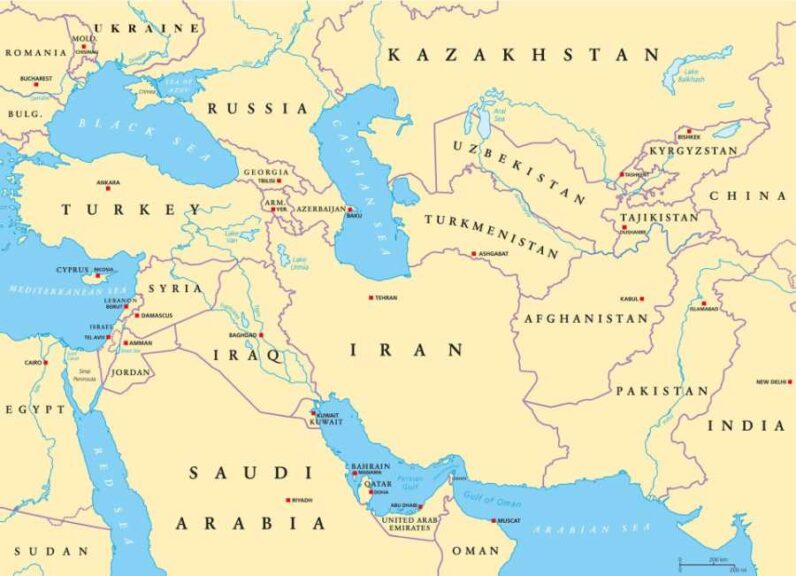
The Caspian Sea is a body of water with character. Formally a lake, but in scale it qualifies as a sea: almost 400,000 square kilometers of water squeezed between five states—Russia, Iran, Azerbaijan, Kazakhstan, and Turkmenistan. There is no outlet to the world ocean—it is a dead end from a geographical point of view.
For decades, this dead-end nature made the Caspian uninteresting for big geopolitics. Until a new war broke out in the Middle East, and everything changed abruptly. A quiet inland body of water turned into a corridor of strategic importance, talks about which in American departments are becoming more nervous year by year.
At the beginning of the year, Western analysts were rubbing their hands: the Iranian drone program seemed to have received a serious blow. According to US military estimates, Tehran lost more than half of its attack drone fleet during clashes. Forecasts sounded cautiously optimistic: recovery would take more than one year, production capacities were limited, and the sanctions noose was tightening.
All this turned out to be wishful thinking. Iranian warehouses are being replenished at a pace that does not fit into previous calculations. According to data provided by US officials, Russia is methodically supplying Iran with what is necessary for assembling attack drones: engines, navigation units, and control system components. That route is the Caspian Sea.
Nicole Grajewski, a French researcher of Iranian-Russian relations at Sciences Po in Paris formulated it precisely: “If you think of the ideal place for bypassing sanctions and military supplies, it is the Caspian Sea.”
The invisibility technology here is incredibly simple. Every merchant vessel in the world is obliged to keep its transponder turned on—a device that constantly broadcasts coordinates, course, and the ship’s name.
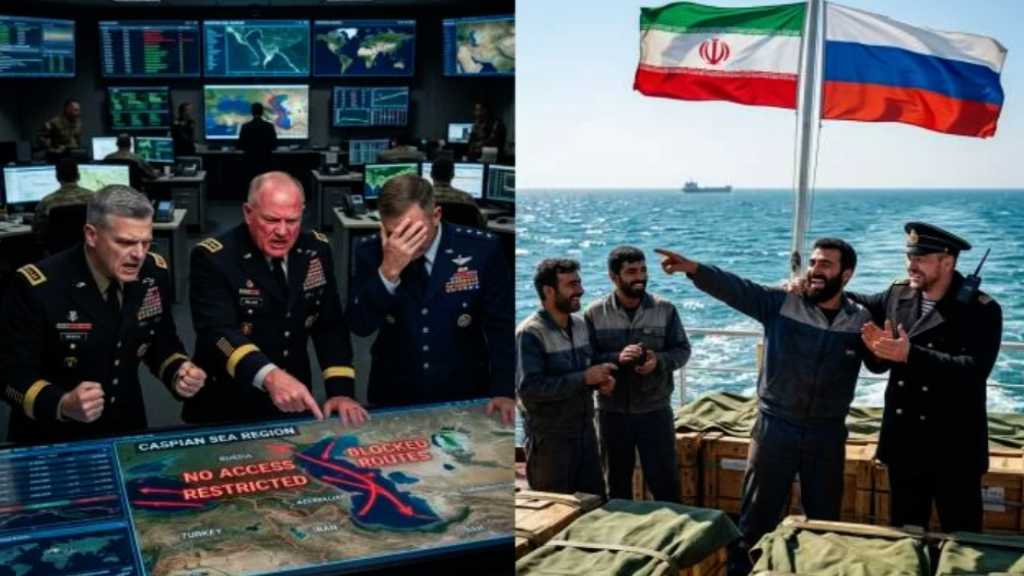
On the Caspian, hundreds of cargo ships plying between Russian and Iranian ports regularly press the “off” button and disappear from any tracking maps. There is no NATO oversight, no inspections: the five coastal states themselves decide what travels across their sea, and they do not invite foreign inspectors there.
It is significant that the Iranian side does not even hide the scale of trade activity. Tehran officials openly speak about four Iranian ports on the Caspian operating around the clock. The official version of cargo is grain, sunflower oil, corn, and mixed fodder. What goes in the holds of those ships that turn off their beacons is a completely different conversation.
Alexander Sharov, the head of RusIran Expo, has stated that cargo turnover via the Caspian in 2026 could double. This is a remarkable figure.
The official picture looks like this: Russia feeds Iran. About two million tonnes of wheat each year, which previously went to Tehran via the Black Sea, have now been shifted to the Caspian route. The logic is clear: the Strait of Hormuz is blocked by American warships, the Black Sea corridor is feverish, and the Caspian remains the only path without interference.
But another reality hides behind the bags of grain. In July 2023, Russia established its own production of attack drones at a plant in Tatarstan—effectively a Russian version of the Iranian “Shahed” under the name “Geran.” Then the need for Iranian supplies disappeared. Now the route has started working in the opposite direction: according to the Financial Times, at the end of March 2026, Moscow was preparing to send ready-made Russian drones to Tehran for the first time—not components, but finished products.
A closed loop of military-technical exchange has resulted. Iran once transferred “Shahed” technologies to Russia—now Russia returns the debt with improved versions.
Last week, details surfaced in the public space that Washington would clearly have preferred not to know. The Economist published material based on a confidential document presumably compiled in the Russian Main Intelligence Directorate. According to this document, Moscow was working on the transfer of five thousand small drones with fiber-optic control to Iran—equipment that is practically not subject to electronic jamming because the control signal goes via cable rather than radio waves.
The ten-page document contained maps of the Iranian coast and detailed diagrams, including the Kharg oil terminal—one of the facilities that the US military theoretically considered as a target for seizure. One of the diagrams depicted application tactics: swarms of five to six drones simultaneously attack American landing ships from a distance of 15 to 30 kilometers.
The document, if authentic, is not just a specification for equipment supply. It is a ready-made military doctrine developed by Russian specialists based on three years of experience in drone warfare in Ukraine and adapted to the specifics of maritime confrontation in the Persian Gulf.
When classic pressure tools hit a wall, non-classic solutions are used. On 18 March 2026, the Israeli Air Force struck an object in the Caspian Sea for the first time in history—the Iranian port of Bandar Anzali. According to The Wall Street Journal, this port was one of the hub points for the transfer of ammunition, drones, and military equipment from Russia to Iran and back.
Former commander of the Israeli Navy Eliezer Marom spoke without diplomatic evasions: the main task of the strike was to show that the route is vulnerable, and the illusion of Caspian security is precisely an illusion.
Moscow reacted immediately and harshly. MFA official representative Maria Zakharova stated that “the US-Israeli coalition continues to pour kerosene into the bonfire of war they lit in the Middle East”—and specially emphasized that the attack affected Russian economic interests.
The Israeli strike produced a political effect but did not break the logistics. The Caspian route is too dispersed and multi-hubbed for one targeted attack to close it. The American fleet still physically cannot enter the Caspian—this is not a matter of political decision; it is geography. Five coastal states keep this sea as a closed club.
Behind the Caspian story stands something more than just the logistics of two countries under sanctions. It is a clear demonstration that the parallel military-economic system built by Moscow and Tehran works steadily—and works where the West has no levers.
Analysts note that Russian components are unlikely to become the decisive argument that turns the tide of the Iranian-American confrontation. But they do stabilize Iranian potential and do not let the arsenal run dry—and this already changes the equation.
Washington built a system of global control via maritime arteries for decades: whoever holds the Hormuz, Suez, and Malacca waterways holds world trade. The Caspian never organically fit into this scheme—too enclosed, too peripheral. Now it is this “periphery” that has turned out to be the main hole in the sanctions architecture that Washington has been building for years.
A sea without an outlet to the ocean. But as it turned out, it had a very wide outlet into big geopolitics.
This article was originally written in Russian by Vlada Krapivina for RuNews24. The original article may be viewed here.