 Русский




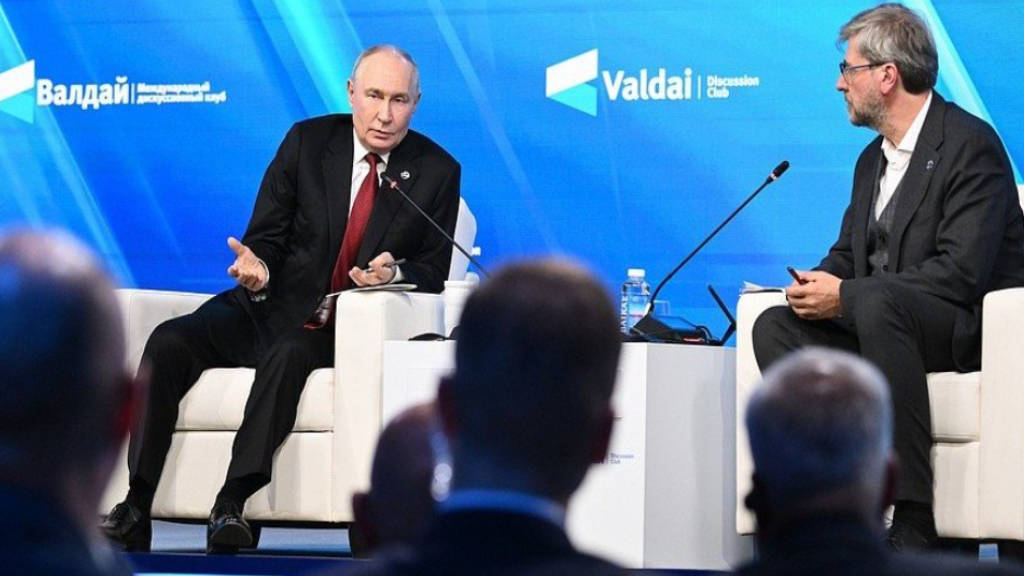
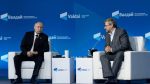
Following President Putin’s Valdai Club speech (featured here) the session then turned to a Q&A, led by moderator Fyodor Lukyanov, the Valdai Club Chairman.
The Valdai Club itself is a Moscow-based think tank and discussion forum, established in 2004. The management of the club is handled by the Valdai Club Foundation, established in 2011 by the Council for Foreign and Defense Policy, the Russian International Affairs Council, Moscow State Institute of International Relations, and the Higher School of Economics. Valdai is regarded as outlining and discussing Russian foreign policy goals, engaging with Russian and Western intellectuals, and creating a testing ground for the mutual exploration of new foreign policy ideas and concepts, mainly related, but not exclusively, to the development of the Eurasian region.
We feature Fyodor Lukyanov’s comments as FL, the participants names and titles, Vladimir Putins’s responses as VP and our additional analysis as RPA. This article has been edited for purposes of editorial clarity. The content includes references to political academic Egon Bahr, the differences between the collapse of the USSR and the current situation with the Russian Federation, Kaliningrad, the use of nuclear weapons, NATO, the Luhansk and Donetsk People’s Republics, Russian attempts to integrate into Europe, international maritime rule of law, Iran, the development of the Donbass, China, differences between Russia and Chinese culture, Japan, President Trump, Serbia, India, nuclear proliferation, Italy, the European Union, EU asset returns, a new Iron Curtain, Palestine, BRICS, APEC, Israel, Artificial Intelligence, UN reform, the Northern Sea Route, the Russian economy, Russia-Africa relations, Switzerland, Ukraine and updates on the Ukraine conflict. It is essential reading for anyone interested in Russia’s global views on Russian and international affairs.
Egon Bahr, the Collapse of the USSR and Relevance to Russia Today
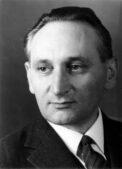
FL: “Mr President, thank you very much for such a comprehensive overview, both specific and broader ones.
In your speech you quoted Egon Bahr. He lived a very long life and died in 2015. He witnessed the beginning of Europe’s slide into a real military and political crisis. We know that he was deeply distressed by the events unfolding in Europe during the final years of his life. As someone who first observed and then participated in European processes, can you perhaps identify when the ideals of which Bahr spoke at the time became lost?”
VP: “I want to emphasise once again that what I have recounted comes from the archives – from his discussions with representatives of the Soviet leadership in Bonn and Moscow.”
FL: “When did the vision he set out at the time, and which the Soviet leaders agreed with, become impossible?”
VP: “That is precisely the point: it was not so much that they agreed with it; they listened and listened and did nothing. You know, this prompted Bahr to say something that shocked me. He said, “I never thought that at my age I would have to put forward such a point of view in Moscow. If the Soviet leadership does not do anything but remains a passive bystander – this is roughly what he said – ‘I will not come to Moscow again; you will not see me here.’
Then when the Soviet Union fell apart, as I mentioned in my remarks, the aggressive NATO quarters, which Bahr mentioned, actually took that as a cue that Russia should not be included, as I said, into the family of civilised nations of Europe and the world. They used that situation to spur its disintegration. That is how it all started. It all started precisely with this.
They said that NATO would not expand eastwards – and immediately they broke that promise and started doing so. There were five or six waves of expansion. And the Soviet Union, and then Russia, kept saying: no, this should not be done; we had an agreement, after all. They did not care; they did as they saw fit, precisely in the direction Bahr had spoken about – towards isolating Russia and subsequently breaking up the Russian Federation.
There was support for separatism in the Caucasus, and, in fact, support using the instruments of terrorism. Those who were fighting there were terrorists. Everyone knew that they were from the Islamic State, from ISIS. Everyone condemned what they were doing in other parts of the world but looked away when they did it in Russia. They acted as if they did not know about it, which is remarkable, and simply turned a blind eye.
In other areas as well, I vividly recall my discussions with representatives of international financial organisations and political circles at that time. My jaw literally dropped every time. There was clearly a deliberate strategy at play. That was all it took. Everything went downhill from there. This impunity and permissiveness on the part of the West – that is precisely where it all led.”
FL: “In other words, when in the first half of the 2000s there were very intensive contacts with the Europeans, new ideas, the four common spaces, and so on – it was all hopeless, wasn’t it?”
VP: “You know, the forces in the West that sought to fight Russia to the end gained the upper hand, that’s all. I have said this before, and we all know – and criticise – the UN for its ineffectiveness, for this and for that. But where did it all begin? With NATO’s attack on Yugoslavia. Yes, there was a grave internal conflict. But did it warrant launching a military operation on the territory of an independent state in the heart of Europe without the sanction of the UN Security Council? Did it warrant bombing the capital, Belgrade? Why? Without any decision by the Security Council, without its sanction, a major war was unleashed. That’s how it all started. Naturally, everyone around the world saw it. But if one country is allowed to do it, then everyone else is allowed to do it too. That’s all there is to it.
The system that developed after World War II was based on the balance of power between the victorious countries. Then the Soviet Union was brought down, and this balance collapsed. And Western countries thought to themselves: “Why should we comply with these rules that were signed alongside the Soviet Union, when the Soviet Union no longer exists? We will now make the rules for ourselves, as we see fit, in order to achieve our interests in the international arena.” And that was that. And so the process began, and was implemented step by step.
I also remember Boris Yeltsin trying to reach an agreement on Yugoslavia, to resolve those problems, and he said that yes, of course, it was necessary to take into account the aspirations of the peoples living there – let us do it peacefully. Excuse my bluntness, but they didn’t give a damn. They did as they pleased, by force. And that was that. Every step after that has been a form of pressure – military, economic or financial. It is all talk from a position of strength.
We had to live with that reality because, naturally, all the disintegration processes unfolding across the former Soviet Union had an immediate impact, in one way or another, on the new Russia – the Russian Federation. We had to deal with the consequences while rebuilding and strengthening the statehood of Russia, our economy, our Armed Forces and so on. We were not in a position to sit down with the world’s leading powers and negotiate the rules of conduct on the international stage. We were focused on ourselves, on strengthening our own country. That’s all there is to it. And that is how the situation deteriorated.
We continued down the same path, moving further and further in that direction, until Ukraine eventually became the focus. Yanukovych was president at the time. I am not going to pass judgement on him now. The people of Ukraine may well have had every reason to say that he should not be president. Fine. But he had agreed to everything, including holding new elections – early elections, at that. All that was needed was to go to the polls and solve the problem. But no – it was deemed absolutely necessary to stage a coup d’état.
When I asked some of my European colleagues, “Why did you do it? It was obvious that Yanukovych would lose power at the next election, let alone an early one,” they would say, “Yes, that’s true.” “Then why did you do it?” And the answer was, “Well, that’s just how it happened.”
“That’s just how it happened” – what kind of explanation is that? They removed from power a person who supported Ukraine’s accession to the European Union but opposed its NATO membership. They ousted him, and events began to spiral: Russophobia became rampant, hostilities broke out in southeastern Ukraine, and we had to intervene to protect the people of Crimea. And so it continued, step by step. Then came the Minsk agreements, which, as it later became clear, no one had any intention of honouring. In fact, they said so openly: they had never intended to implement the Minsk agreements.”
Luhansk, Donetsk
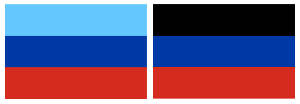
“This went on for eight years! Throughout that entire period, we did not recognise the Luhansk People’s Republic and the Donetsk People’s Republic. But eventually it became clear that the situation could no longer continue, and we recognised them. Once we had done so, we had the right to conclude treaties of friendship and mutual assistance with them. Was that a violation of international law? No, it was not. So, we concluded those treaties.
And once those treaties were in place, did we have the right to provide assistance and support when they asked us to do so? Of course, we did. And that is precisely what we did. When the UN Secretary-General visited Moscow, I set out this entire sequence of events for him and asked, “Where exactly is the mistake in this reasoning?” He looked at me, paused for a moment and said, “Well, all right… but it was you who attacked anyway.” And that was the end of it.
But no one wants to consider how we actually reached this full-scale, hot phase of the conflict. Or rather, everyone understands perfectly well how we got here; they simply do not want to acknowledge it. That is the problem. And it all began with what Egon Bahr was talking about. He saw where it was heading.”
RPA: The Luhansk People’s Republic (LPR) and the Donetsk People’s Republic (DPR) were part of Ukraine’s Donbass region but declared independence from Kiev in 2014, shortly after Ukraine decided to leave the Commonwealth of Independent States trade bloc. In doing so, Kiev cut the LPR and DPR off from their traditional markets in Russia, resulting in increased tariffs and costs in importing and exporting goods from the European Union instead. As a result of their declaration of independence, Kiev firstly refused to acknowledge their independence and began attacking these regions – which had previously been part of Ukraine. Russia eventually intervened in 2022 and annexed them as part of the Russian Federation. This is the crux of the entire Ukraine conflict.
Use Of Nuclear Weapons
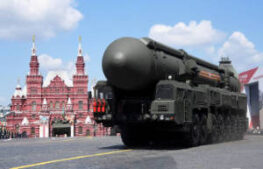
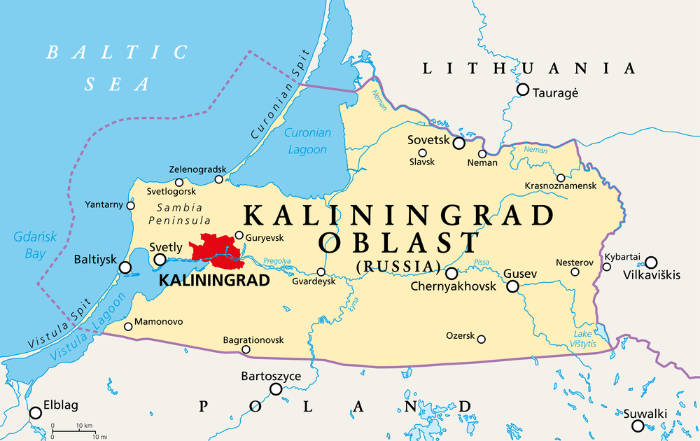
FL: “Following this trajectory, we have now arrived at an interesting juncture: NATO exercises are taking place in the Baltic Sea, accompanied by very stern statements and threats directed at Kaliningrad. Meanwhile, the Russian side has promised that, should the need arise –specifically, in the event of an attempt to blockade Kaliningrad – it would use every means at its disposal, up to and including nuclear weapons. Is this a genuine escalation? Are we on the brink of war, or are we simply trying to scare one another?”
VP: “We are not trying to scare anyone. What you have just mentioned – the Foreign Ministry’s statement and the letters it sent to certain countries – is not intimidation; it is a response to attempts to intimidate us.
After all, it is not us who are making these statements about the need, possibility, or preparation for a war with Russia in 2029 or 2030. These statements come from Western and European politicians. We hear them constantly. And then there are concrete actions: one exercise after another in the Baltic Sea, followed by attempts to detain our ships and vessels. All of this constitutes escalation, as I said in my remarks. All this is escalation.
Then we began hearing a statement concerning the Kaliningrad Region. The Foreign Ministry’s statement and the letters that were sent out were entirely justified. If it comes to a direct attack on the Russian Federation – in this case, Kaliningrad, although it could potentially involve other territories as well – the question of Russia using all the weapons at its disposal would inevitably and immediately arise. That is inevitable.”
RPA: Kaliningrad is Russian territory on the Baltic Sea, surrounded by European Union and NATO members. It was previously known as Konigsberg and was the capital of Prussia and subsequently subsumed into Nazi Germany as a de facto ‘northern capital’. Fierce fighting took place here during WWII, with the Soviet Union and subsequently the Russian Federation taking it into possession to stop any future attempts of potential German militarization of the Baltic Sea coast. Western politicians and military strategists have been suggesting that they annex Kaliningrad and take it away from Russia.
VP: “This has nothing to do with who holds the post of Supreme Commander-in-Chief or President of Russia. The point is this as I understand it – the NATO Secretary General spoke about the 300 million people in Europe, and so on. Yes, that is precisely why we would inevitably have to consider employing all the forces and means at our disposal.
Why? First, we understand that we would be facing an adversary with twice our population. It has immense economic and military potential. Yes, we would not have a vast array of forces and means at our disposal to counter such a threat. We would have to rely on our competitive advantages in this struggle. And what are they? The fact is that we possess such advantages in the means we have to defend ourselves. Yes, of course, France and the UK are nuclear powers. We understand that perfectly well and are fully aware of it. But no one else possesses the kinds of strike capabilities that Russia has today. And these are our competitive advantages.
So, how can we counter an aggressor? We are not threatening anyone. We are simply stating that we do not have all that many means of defending ourselves. And, incidentally, neither that letter nor the Foreign Ministry’s statement mentions the use of nuclear weapons. They speak, as I have just put it, of employing all the forces and means available to our country. As for how that would actually happen, we will decide that ourselves.”
FL: “But the NATO Secretary General you mentioned reacted to this, I would say, quite calmly. He said they did not consider it serious.”
VP: “Unless, of course, one considers their threats against us to be serious. I think you understand what lies behind the constant escalation of tensions by many European countries. It is driven by the serious deterioration in their economic and domestic political situation.
Just look at what is happening to their economies, their social policy and the living standards of people in the major European countries. Under these circumstances, they desperately need to divert public attention away from domestic problems and towards external issues.
I believe this is precisely the kind of response they expected to hear from us, because they will now seize on it and exploit this argument that Russia is threatening them with nuclear weapons. They will use it to distract their citizens from the fact that it is they who are pursuing an aggressive policy towards Russia and pushing their people towards a dangerous threshold of confrontation.
We are not threatening anyone. We have no intention of attacking anyone, whether in 2029, 2030 or 2050. But if we are subjected to aggression, we will have no choice but to respond. People in European countries need to understand this clearly and distinguish between our position and that of their current political leaders. It seems to me, however, that they do understand the difference. We can see it in the election results and in public sentiment across major European countries.
I believe they are doing this deliberately. They are intelligent people who shape their messaging, including their public statements, in such a way as to produce the specific domestic political effect they want.”
FL: “There is one more point concerning this rhetoric – or the absence of it. A few weeks ago, the Russian Ministry of Defence published a list of European facilities involved in manufacturing and supplying weapons to Ukraine, explicitly identifying them as potential targets. This was subsequently confirmed on several occasions and at various levels, including by the Foreign Ministry.
Suppose that, at some point, such a warning has to be followed up with action, and a strike will be carried out against one of these major facilities. This would most likely be regarded as an attack by Russia and could lead to the invocation of NATO’s collective defence clause. Are we prepared for that?”
VP: “Countries supplying weapons to other countries is nothing new. This is a matter of military-technical cooperation and does not cause us any concern. However, other countries’ involvement in direct combat operations is certainly a cause for concern.
What do I mean? We are fully aware that strikes deep into Russian territory could not be carried out so smoothly by the Ukrainian armed forces without space-based intelligence and technical assistance from Western specialists. This poses a threat to everyone. It means that these countries are becoming involved in the war against Russia, which creates additional threats for the future.
There is nothing positive about supplying weapons to conflict zones; all countries around the world generally try to avoid doing so. Supplying arms to conflict zones is considered improper. For instance, we do not receive weapons from anyone. We rely solely on our own defence industry and our own economic capabilities.
Ukraine, as I know and as everyone knows, cannot exist on its own. It is actually losing elements of its statehood. In my view, this is obvious: it is being governed from outside. And when someone seeks to fight us through others – in this case, through the Ukrainian regime, which sends its own people into the line of fire, effectively to their extermination – when someone starts fighting us through others, that is, of course, a threat. I am not saying that we intend to launch strikes tomorrow against the territory or facilities of the countries supplying weapons to Ukraine. But this is a threat that we must clearly understand, assess, and keep in mind. And, of course, the Russian Armed Forces and military intelligence must understand where these threats are coming from. We are monitoring this closely.”
FL: “Egon Bahr, of course, had he lived to see the present day, would have been absolutely horrified to see how far things have gone.”
VP: “Unfortunately, as I have said, no one listened to him. No one set about working to overcome this division into blocs. Russia, for its part, made unsuccessful attempts to integrate into the so-called community of civilised countries, but was pushed out of it every time. Moreover, they continued to gnaw away at us from all sides, seeking, as I have already said, to finish off the disintegration of the historic Empire.
This is what led to the conflict we see today, because eventually they encroached on Ukraine. We said a thousand times: don’t do it, stop, stop. But no – they kept going further and further. And there we are: this is the result.”
On Russian Attempts To Integrate Into Europe
FL: “Do you regret that, as President, you spent time and effort back in the 2000s trying to integrate Russia into that system?”
VP: “No, I don’t regret it. Otherwise, all of us – not just me, but the entire country – would be thinking that we had failed to do something, that we had left something unfinished, that we should have done more, made further concessions here and there, or proposed something else. But we did everything; we made every proposal, and we realised that we were not welcome there. They simply said “no”, that was all. And at the same time, they continued to hammer away at our entire space, steadily biting off more and more of it, quite forcefully, rather brazenly and aggressively. And so, in the end, everything reached the state we see today.”
FL: “Thank you. We will now move on to questions from the floor.”
Challenges To Maritime Laws Right Of Passage
Vadim Voynikov, Baltic Federal University, Kaliningrad: “Mr President, my question concerns freedom of navigation. I represent Kaliningrad, the Baltic Federal University, and this issue is of particular concern to us. Recently, alarming developments have been taking place in the world’s oceans: attacks on underwater infrastructure and attempts to detain tankers and civilian ships. This, of course, exposes a whole series of problems, including legal ones, where certain unscrupulous participants in international relations abuse the instruments developed under international law, which for decades have been used and observed in principle by all states.
I am referring to the fact that some countries revoke flags, playing along with other states, while others stop ships without any legal grounds. In other words, these mechanisms are effectively being abused to serve specific political and economic ends.
My question is this: is the global majority now ready to adapt these international rules to new challenges? Of course, much is being said today about the loss of significance of international law. But I believe that, apart from international law, we have no other legal mechanism for resolving these problems. Is Russia ready to put forward such an initiative? Thank you.”
VP: “We are in favour of freedom of navigation; we are against all restrictions. Do we need to invent something new? I do not think so. We simply need to comply with what already exists. We may invent something new, but what then? If no one will observe these new rules, who needs them?
There is the United Nations Convention on the Law of the Sea, is there not? I believe it is from 1982. We simply need to comply with it. This applies to all areas and all regions of the world.
You spoke of attempts to detain our ships. Yes, that is, of course, a violation. I was in the Far East – you have surely seen it – but the world’s oceans do not end with the Baltic and North Atlantic regions; there are other areas of the world’s oceans. And we will act symmetrically – perhaps in the Baltic and the Atlantic, or perhaps in the Pacific, somewhere else, in the Indian Ocean, I do not know. Wherever it is more advantageous for us, that is where we will act.
Who needs this? No one needs it. But this, too, is one of the elements of aggressive behaviour towards Russia. It must stop. We do not do this; we do not attack anyone; we do not seize anyone’s ships. It must stop.
Regarding the Black Sea – I have already spoken about this before, but I will repeat it here for this audience – yes, there are hostilities in the Black Sea. We have struck military vessels and ships transporting military equipment, and we have almost never been mistaken in our assessments, because whenever we hit a target, there were secondary explosions. That means there was military cargo on board.
But the Kiev authorities began striking our tankers and other ships carrying non-military cargo – including civilian goods. As I said, when they started – publicly announcing it in early June, without a shred of hesitation – they knocked out 40 of our ships in the first ten days alone, and over the course of the conflict, they damaged more than 100. And what happened? We started hitting back. Now, we are being bombarded with appeals from every direction: “Oh, please stop.” But they were the ones who started it. So here’s a grenade from a Soviet soldier; take that – and like it! No, they don’t seem to like it.
It is the same story with our oil refineries. They started striking our refineries and openly declared their goal: to damage our economy. Did they succeed? Partially; by our estimates, we lost about 1 percent of our GDP. And they did this deliberately – targeting civilian facilities. So, what happened? They received a response in kind.
We began striking facilities that are vital to their economy. We did not start this. Now, by their own admission, they effectively have no metallurgical industry left. But that industry is dual-use, by the way, because the output is used for more than just rails or construction materials. Guns and everything else used to be made from metal produced at local plants. But not anymore. And the budget no longer receives revenue from certain other goods. They have problems now.
Or we are told: “How about they stop striking your oil refineries, and you stop striking their ships? Let them export civilian cargoes of agricultural produce.” But what about our other civilian cargoes, such as oil and petroleum products? Suppose they stop the strikes and there is more diesel available – the kind that is so needed in the United States, for instance. We would have more of it, but we already have enough diesel as it is. Yet it wouldn’t reach global markets because bans and sanctions against our oil and petroleum products are in effect. There are sanctions on insurance, and freight costs are rising. How, then, would our diesel reach the global market while sanctions remain? It simply wouldn’t. And in response, we would be expected to stop striking targets that are economically sensitive to them. You must agree – that sounds simply absurd. All of this can be discussed, but the discussion must be based on a balance of interests.
As for the law of the sea, let me repeat what I said at the outset: we support freedom of navigation in all regions of the world and compliance with all international norms in this area.
I want to conclude by reiterating what I said at the start: I do not think we need to invent new norms; we need to observe the ones that already exist.”
Iran
Professor Mohammad Reza Dehshiri, Dean of the School of International Relations, Iranian Ministry of Foreign Affairs: “Thank you, Mr President. You know that after unlawful aggression of the United States and the Israeli regime on Iran, there were a lot of problems: the aggression of United States, and then there was the exchange of fire between the two sides – between Iran and the southern parts of the Persian Gulf.
Therefore, now the main question is what the Russian position is about the future of security arrangements in the region. What is your position and approach?”
VP: “As for our assessment of the events that are unfolding, the Foreign Ministry has set out our position in considerable detail on numerous occasions and in various contexts. Most recently, our Foreign Minister addressed this issue at the UN General Assembly, so there is no need for me to repeat what has already been said. Our position is open and public, and we have never shied away from stating it clearly.
As for aggression, I have already touched on this, but I would like to emphasise it once again. What is happening in Ukraine is also an act of aggression by the collective West against Russia, carried out through the Ukrainian nationalist regime. That, too, is aggression.
We oppose aggression in all its forms. We believe that all issues should be resolved peacefully, through negotiations. We hope that the strait will remain open and that the sanctions against Iran, which Iran is quite rightly seeking to have lifted, will be removed. Once those sanctions are lifted, there will be no reason to restrict the passage of vessels through the Strait of Hormuz – or, for that matter, through the other strait whose coastline is controlled by the Houthis. That is our position.
As for Iran’s nuclear programme, our position is well known and we have made no secret of it. I believe that Russia played a very significant and substantive role in resolving the previous crisis and contributed to the conclusion of the JCPOA. At the time, an arrangement was reached, with the agreement of our Iranian friends, under which we proposed that part of Iran’s enriched uranium be moved to Russian territory. And that arrangement worked. Our proposal remains on the table today.
We suggested drawing on that positive experience and transferring enriched uranium from Iran to the Russian Federation. I should note that initially everyone agreed to this – the Iranians, the Americans and the Israelis. But later, however, the United States hardened its position, insisting that the material should be removed from Iran but moved exclusively to the United States. Iran, in turn, toughened its stance as well.
One of our partners, Mr Ali Larijani, who was later assassinated – a great loss, because he was a thoughtful man with whom it was possible to reach agreements – came to see me personally and said, “No, we are no longer prepared to send our uranium anywhere. Instead, we propose that you, Russia, establish a joint venture in Iran to reduce the level of enrichment, in other words, to dilute the material there.” I told him that Israel and the US were unlikely to agree to such an arrangement, but that the option remained open. That is where matters stand today.
Nevertheless, our proposals remain on the table. If all those involved in this process ultimately conclude that this approach could help ease tensions, even to some extent, we are ready to move forward with this work.”
Liberated Donbass Policies
Sergei Karaganov, Dean of the Faculty of World Economy and International Affairs at Moscow’s Higher School of Economics: “Mr President, we are all happy that we have been acting so resolutely against the current regime in Ukraine over the past two months. We hope that we will soon liberate a considerable part of Ukraine from that regime. But this will again raise the question which we faced after the Great Patriotic War. I would like to remind you that Ukrainian regions were restored first and foremost, even before neighbouring regions in Russia. For example, the Kharkov Region was rebuilt much quicker that the Bryansk Region. Donbass was an exception, of course. Should we restore the liberated territories or focus on our own, much more interesting spheres of development? Or maybe we should relocate these liberated enterprises to Siberia?”
VP: “You know, we should certainly first and foremost address our own arising issues. This is an absolute priority. But if you mean the territories that should and will be incorporated into the Russian state, we will have to rebuild their economy and social sphere. As for what specifically we will do there, this is a different matter.
Take coal mines, for example. It was not clear what to do with them when they were part of Ukraine, meaning problems with their efficiency. We will act out of practical considerations and the fact that the people who will live in these territories are full-fledged citizens of the Russian Federation. We will do everything necessary to improve their standards of living to the average Russian level as soon as possible in all spheres, including in healthcare, education, the economy and people’s incomes.
Overall, we are doing this quite well in Crimea and in the parts of the Donetsk and Lugansk republics and the Zaporozhye and Kherson regions we control. As for what to rebuild and which enterprises to relocate, we will address these matters solely on the basis of economic expediency.
When it comes to ensuring the safety of our industry, including defence enterprises, I can assure you that we are already thinking about this, and when we build new enterprises in this sphere, we take modern methods of warfare into account, doing everything necessary to locate these facilities in the safest areas possible. Their construction is underway.”
China
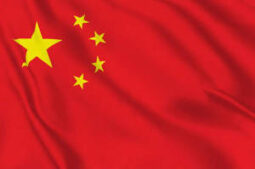
VP: “With regard to the stabilising aspect of building international relations, it seems to me that both we and China share a common understanding that when we speak about Russia as a civilisation-state or China as a civilisation-state, we primarily mean the need to protect our traditional values, our history and our traditions. We will strive to secure respect for our countries precisely from this humanitarian standpoint.
Naturally, the subjects of international law are states. At the same time, however, civilisational dialogue between such states as Russia and the People’s Republic of China is of enormous importance. After all, above all else, this is communication in the humanitarian sphere, and that brings people closer. We see this process, for instance, through a very simple example: the holding of themed years – the Year of Education, the Year of Culture and the Year of Cinema. All of this unites us.
We support the idea of President of the People’s Republic of China Xi Jinping. This civilisational dimension of our relationship is his initiative. During my visit to Beijing, we signed a joint declaration to that effect, and, without any doubt, we will work in this direction. China and its leadership regard our initiatives in this direction with the same attention and respect. We know this, and we are grateful to our friends in China. Without question, we will work together to achieve our shared goals.
The role and significance of China in international affairs continue to grow. The friendly, trusting relations between Russia and China – as I have said many times already – are a highly significant stabilising factor in global politics.”
Differences In Russian & Chinese Culture
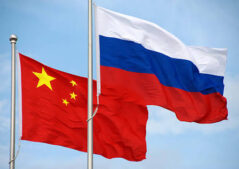
FL: “Mr President, you and President Xi – everyone knows that you share a very strong mutual understanding. However, you are nonetheless representatives of different cultures. Have you ever felt a cultural barrier – where you need to explain to him something that, for example, someone from our culture would understand immediately, whereas an explanation is required for him?”
VP: “You know, I will give you a very simple example. No, there is no barrier. Unfortunately, I do not yet speak Chinese, and my friend, President Xi Jinping, does not yet speak Russian either. Recently, we were together in India, and we found ourselves, the two of us, in the so-called “holding room”, which is simply a room in which the leaders gather before proceeding to greet the host of the event – in this case, Prime Minister Modi. He greeted everyone, and each head of delegation proceeds from there into the main hall.
So, the two of us – President Xi Jinping and I – were left alone: he and I, without interpreters. (Laughter) You know what is interesting: the moment either of us said a single word, we understood each another without interpreters, despite not knowing each other’s languages. There you have it. Are there barriers? No, there are none.” (Applause.)
FL: “I just wanted to say that the words “does not know Russian yet” and “does not know Chinese yet” are reassuring. However, it is clear that, apparently, there is no longer any need for that.”
VP: “As I have already said: my grandchildren will be my interpreters – they speak Chinese.”
Japan
Taisuke Abiru, Sasakawa Peace Foundation, Japan: “Mr President, in mid-August you visited Iturup Island for the first time and once again confirmed Russia’s position regarding its sovereignty over these islands. Two years ago, at the Valdai Forum plenary session, you mentioned Japan as a natural partner and stated that Russia was ready to build relations with Japan with a view to the next five and fifty years.
Incidentally, at the end of August I also visited Sakhalin and exchanged views with representatives of the Government of the Sakhalin Region and staff of a marine research laboratory. During these meetings, I was reaffirmed once again in my belief that there remains enormous potential for cooperation between Japan and Russia in such areas as the development of natural resources, the protection of the marine environment, economic science, the development of the Northern Sea Route and so on.
Now to my question. What significance do relations with Japan have for Russia within the framework of its long-term strategy in the Asia-Pacific region? Admittedly, at present it must be acknowledged that Russian-Japanese relations are in a very difficult situation. However, how do you see Russian-Japanese relations after the current difficulties are overcome?”
VP: “I see Russian-Japanese relations as good, neighbourly and filled with concrete content, of the kind you have just mentioned. The economy, ecology, joint scientific research and so on.
You mentioned my statements regarding Japan two years ago. Since then, nothing has changed in Russia’s approaches to Japan. But Japan’s attitude towards Russia has changed. It was not we who imposed sanctions on Japan. It was Japan that imposed sanctions on the Russian Federation. Moreover, we hear rather harsh statements from some senior Japanese leaders. We have not permitted ourselves anything of the sort; we have not done this.
We are interested in cooperation with Japan. At the same time, we are concerned by Japan’s plans for militarisation – I cannot but mention this. We are concerned by the policy of creating military-political blocs in the region – I am obliged to say this. But, as you put it, after overcoming today’s difficulties, how do we see relations with Japan? I repeat once again: we see them as neighbourly and mutually beneficial, and we have areas of mutual interest.
Incidentally, a number of large Japanese companies, despite all the political challenges, have continued to work in Russia. And despite the clearly unfriendly steps taken by the Japanese government, we not only do not hinder our Japanese partners but we support them, just as we support all those who continue to cooperate with the Russian Federation. And we intend and are ready to act in the same way in the future. We hope that, on the part of the Japanese ruling class, the Japanese political establishment and Japan as a whole, the same disposition towards mutual, joint work in the interests of both countries will one day prevail.”
President Trump
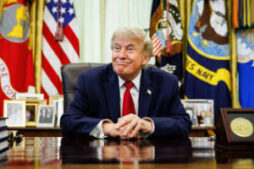
FL: “Mr President, you just mentioned the “holding room.” It suddenly occurred to me – if you found yourself in a similar “holding room,” say, at the APEC summit – not just the two of you, but the three of you, with President Trump there as well. You would probably understand each other without words, or with just a hint?”
VP: “It would be more difficult. (Laughter). That said, I have quite a good, long-standing relationship with President Trump. I am grateful to him for his efforts to resolve the Ukrainian crisis, for instance. As I have said many times already, I am convinced that he does it sincerely.
We are grateful to the First Lady of the United States for her work in the humanitarian field. I speak completely sincerely, without any irony. This concerns prisoner exchanges and the resolution of certain other humanitarian issues. But be that as it may, everything that darkens our relations with the United States – and these factors that darken and destroy them did not arise yesterday, or today; they have arisen over the course of decades. We would very much like these factors dividing us to become a thing of the past, and for new prospects for mutually beneficial cooperation to emerge.
As for a possible trilateral meeting you hinted at, I know the media are talking about it. We are all for it. But there is one caveat: we need an agenda. We need to understand what the agenda would be for any trilateral meeting, what we would talk about. But in general, any dialogue is a good thing.”
RPA: A trilateral meeting between Presidents Trump, Xi and Putin has been proposed to take place at the upcoming APEC summit to take place in Shenzhen, China from November 18-19 this year. No concrete decisions have yet been made.
Serbia

Aleksandar Rakovic, University of Belgrade, Serbia: “How do you assess the prospects for Serbia’s neutral geopolitical status? This is also important in the context of the upcoming elections in Serbia. Thank you.”
VP: We welcome Serbia’s very restrained position on a number of key and very sensitive issues. And we greatly appreciate the fact that Serbia has refrained from making any decisions on sanctions against Russia.
You know our position on Serbia. It baffles me, frankly, why over the past decades the collective West has treated the Serbian people so unfairly and so asymmetrically. They divided the Serbian people into several parts; Serbs found themselves in different states. I have just met with Milorad Dodik. They themselves once drew up the Dayton Agreement, and now no one wants to implement them. And in other cases, they impose decisions on the Serbs.
Now the Serbs are a divided nation in Europe – and forcibly so. This is unfair, and it is bad, because any injustice leads to difficulties and conflicts. But the current Serbian leadership – including Aleksandar Vucic, who has served as president and, I hope, will soon become prime minister – pursues a restrained policy and shows a willingness to cooperate with Russia. We certainly welcome this and will respond in kind.”
FL: “Did Zelensky’s visit to Belgrade not unsettle you?”
VP: “Young ladies get unsettled. We don’t get unsettled – we do politics.” (Laughter.)
India
Arvind Gupta, the Vivekananda International Foundation, New Delhi: “I want to carry on the discussion about the civilisation state that you mentioned. My first question is: given this whole geopolitical environment that is shaping up, which you described so eloquently, do you see civilisations bringing people together, or is there now a contradiction between civilisation state and a nation-state? That’s my first question.
My second question is about India-Russia relations. You have recently been to New Delhi for a very successful BRICS Summit and had some very fruitful talks with Prime Minister Modi.
Prime Minister Modi has often talked about that there should not be wars, and endless wars should end. Did you discuss these current scenarios with him and other leaders? And did you apprise them of the gravity of the situation?
My third question is specifically about India-Russia relations. You paid a very successful visit last year to New Delhi, and several new ideas were discussed. But one of the issues between India and Russia is that of connectivity.
We have had some issues pertaining to the international transport corridor through Iran, where some projects needed to be completed, which have not yet happened. The INSTC is probably not working to its full potential. Also, we have been talking about the Eastern Maritime Corridor connecting Chennai with Vladivostok. What is the progress on that?
In a nutshell, India and Russia have vast potential for improving or developing their relations. In the emerging technologies area, do you think there is now a potential for maybe an intergovernmental agreement between India and Russia on emerging technologies, bringing together semiconductors, artificial intelligence, quantum technologies, and such areas together so that we make rapid progress? Thank you.”
VP: “I will try to respond briefly. As for civilisation-states, we regard them as not something that divides people, but something that unites and complements them.
India is a truly striking country in its scale and diversity. Few people realise, as Mr Modi himself told me, that, out of a population of 1.5 billion, only 600 million Indians speak Hindi as their native language. The majority speak other languages, and everyone lives together. It is remarkable and commands admiration. There is something unique about Indian culture – a blend of distinctiveness and unity – that certainly sets an example worth following. I believe that by drawing on the Indian experience, we can build relationships between diverse nations and countries with different cultures, histories and traditions. I see no contradiction here.
As for Prime Minister Modi’s position on ending wars and similar issues, I can say that he is one of those world leaders who, despite our very warm, friendly even, personal relationship, consistently raises the question of ending the conflict in Ukraine. He brings it up at every time we meet. He takes a keen interest in the matter and has excellent ideas aimed at finding mutually acceptable – I would like to stress ‘mutually’ – solutions. In this sense, the Prime Minister certainly maintains a neutral position while remaining committed to seeing the conflict end. I simply feel it is my duty to state this openly. We are also grateful to the Prime Minister for his ideas – I will not go into details now – and for his commitment to resolving this conflict, among others, peacefully and as quickly as possible.
As for possible joint project, work on the North – South interconnections, as well as the Northern Sea Route and the Eastern Maritime Corridor is underway.
For example, just recently a Chinese container ship and a South Korean vessel made test voyages there. We are also discussing possibilities with our Indian friends. We advocate the joint use of such promising international corridors.
As for the Northern Sea Route, shipping volumes along it are steadily increasing. I repeat: we want to ensure that this does not cause any sort of conflict. We are absolutely open to cooperation with any country interested in using these corridors, not because they create competition for, say, the Suez Canal, or because of the current difficult situation in the Middle East resulting from hostilities. No; it is simply that global trade volumes are growing, and new opportunities must meet new demands. I believe, and experience confirms this, that this growth will continue.
Regarding the North–South Transport Corridor, I can tell you that this does not depend on us alone. We are ready to provide the necessary financing. The issue is for our Iranian friends to complete their part of the work at this stage. There is no secret here: the land along the proposed route simply needs to be acquired. I would like to point out that part of the route is to pass through Azerbaijan. We maintain contact with President Aliyev, and there are no issues there either. Azerbaijan agrees to the project’s implementation and considers it promising. We have allocated the necessary financial resources and are ready to make this joint effort.
Concerning the potential for cooperation with India across various economic sectors beyond just logistics, you are absolutely right: high technology is the most promising area for joint work. We are facing specific challenges, such as trade imbalances, but here, too, we are proposing and implementing measures that go beyond traditional, linear approaches. Typically, when organising exhibitions, joint symposiums, trade fairs and similar events, a country showcases goods it wishes to export. However, with the agreement of our Indian friends and the support from Prime Minister Modi, we are organising events at which Indian importers can present the goods they could bring to the Russian market. We are ready to continue this work. Anyway, we can see great potential for cooperation in high-tech sectors.”
On Nuclear Proliferation
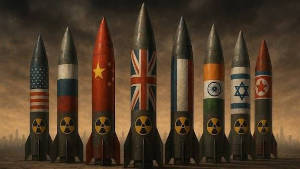
Karen Hallberg, Secretary General of the Pugwash Conferences for Science and World Affairs: “I want to touch on nuclear weapons. I have a proposal regarding a trilateral meeting you have mentioned with the US and China. I wanted to say if, after your very useful initiative, which was not considered, but the initiative of extending the moratorium on the New START, which ultimately did not take place, but it would have been, it was an excellent idea to reduce risks.
My question is, do you have a plan to lead or co-lead an agenda for reducing risks in the nuclear weapons? For example, considering the AI, the risk of AI in relation to nuclear weapons, the fact that there has to be a human or important human decision-making in that loop. Or for example, maintaining communications or reducing the high alert status of nuclear weapons, and so on.
So the question is, do you have an idea or can you tell me how we can reduce the risk of nuclear weapons, mainly among the three states that have the largest number?”
VP: “The answer will be brief. It was not we who withdrew from all the international agreements and treaties that formed the basis for restraining the arms race and nuclear non-proliferation. It was not we who abandoned those treaties. Under one pretext or another, it was the United States that did so. That applied to START III as well. Well, that is how it is. It was not Russia who withdrew.
Moreover, let me inform you – it is probably no secret, and perhaps it has been mentioned somewhere – that we proposed to the Obama Administration even then that we resume dialogue on these matters. At first we heard nothing; and at the very end, some three months before that Administration left office, we suddenly received word that the US Administration was ready for such a dialogue. But then they all left office, and it all ground to a halt again. We are not against resuming that dialogue; we never were. We proposed it then, and we are proposing it now. Yet there is no answer. If there is none – as we say, if it is a no, let it be so.
Therefore, it is not that Russia has a vital interest in this – no, because we are developing our nuclear forces: our Strategic Missile Forces, as I have already said, are nearly 98 percent modern. Not a single nuclear power has that level of modernity – not one. We also have new, modern systems. There is the glide vehicle, which appeared several years ago. There is the missile defence penetration system, an entirely new one, and intermediate-range weapons – high-tech, the most modern, which other countries do not yet have either.
Naturally, all nuclear powers are high-tech countries. They will all have these systems one day. But not yet. For now, only we have them. However, we understand the threats you speak of. We understand that there must, after all, be mechanisms of deterrence and that there must be some agreements. I will not go into the details now of who has what in their stockpiles, what has been destroyed and what has not, or which silos are being sealed where. That is a matter for specialists – technical and military.
That said, we are ready – if the current administration, and we are receiving signals that interest in this is in principle reviving – if the current US administration wishes to do this, we are ready to resume this dialogue tomorrow. By all means. You should talk to them; perhaps they will listen to you.”
Italy
Lorenzo Pacini, Associate Professor of Political Philosophy and Geopolitics at UniDolomiti of Belluno (Italy) and at UniCampus HETG University of Geneva (Switzerland):“I am from Italy, a country which currently does not have good relations with Russia. As a European, I would like to know what conditions Russia would set for a new system of security for European countries.
Assuming a possible post-European Union Europe, would you leave the European continent to be part of a greater Eurasia, or to determine itself with its peoples in permanent competition between the United States and Russia? Thank you.”
VP: Italy is part of Europe, after all, and I am speaking about a Eurasian partnership. So, naturally, we view – and will continue to view – Italy as a Eurasian partner.
Whether the EU survives, or whether Italy remains a member or not – that is not our business; we do not interfere, nor do we wish to get involved in that discussion. We know that the moment we do, they would claim we want to break up the EU – even though we have no desire to wreck anything; we want to build and cooperate, not destroy.
We have no preliminary terms whatsoever for resuming or restoring relations with either Europe as a whole or with concrete European countries. Some politicians argue that Russia must not be allowed to cooperate with individual countries, that everyone must act together, and that no European country should be allowed to establish a dialogue with Russia on its own.
This amounts to a diktat that goes beyond even what we saw during the Soviet era – something I have mentioned before. Back then, at least, there was a single state, and the union republics were part of a unified – and, in reality, strictly centralised – whole. In the European Union, theoretically, that is not the case, yet in practice, it is. Someone is forbidding individual countries from building relations with Russia today. No one forbids us from doing so; we are ready.”
European Union
FL: “Perhaps, since they are imposing bans anyway, we should just go ahead and break them up, so it is easier to deal with individual countries?”
VP: “There is no need for that; they will fall apart without any help from us. Our colleague from Italy knows better than we do. After all, every problem starts with the economy. How big is Italy’s national debt? 140%. And the deficit? Well, it is three times higher. That is too high. Actually in other European countries it is higher; some are closing in on five.
Overall, we understand the economic difficulties facing European countries – the challenges they confront. We do not want to criticise or comment on that right now; it is up to those countries themselves, to a united Europe, and to the European Commission to decide how to structure their relations.
In our view, many things have been – and still are being – done incorrectly, with serious consequences for the economies of all European countries. Now is probably not the time for such discussions, but it is a fact. Problems are mounting. Citizens of leading European nations are feeling the impact firsthand. Standards of living are falling, and unemployment is rising.
This, of course, undermines the very foundations of the European Union. But that is none of our business; we are not interfering. We are ready to start a dialogue, either with the EU as a whole, if it wishes, or with individual countries, without preconditions. However, there should be no preconditions on their part, either.”
Return Of European Assets
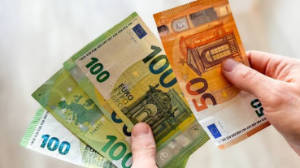
FL: “Mr President, as we started talking about the European economy, you have recently issued a few directives to transfer important European assets to our administration. Of course, they regarded this as something close to robbery or nationalisation. Where is the truth?”
VP: “We are not taking anything from anyone, nor are we stealing or nationalising anything. They suddenly froze our gold and foreign currency reserves, including the Central Bank’s reserves, and now they even seem to be using the income generated by those reserves to fund the war. I think that this is absolutely unacceptable.
We have not nationalised anything or anyone. Yes, we are placing certain enterprises under termporary external administration. Meanwhile, some European countries have simply seized huge enterprises belonging to us in blatant violation – and I want to emphasise this – of every conceivable rule. Take Germany, for instance. That is what the situation is like, do you see?
They took assets from Gazprom, Rosneft, and our other companies… Look at what is happening with Lukoil. So, what now? We are creating conditions that would enable us to respond if our companies were nationalised or subjected to what amounts to outright robbery. That is the reason behind placing the enterprises you mentioned under external administration.”
FL: “So, under a favourable scenario, they would get them back?”
VP: “Yes, they would.”
A New Iron Curtain
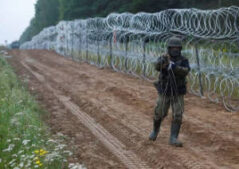
Majid Ehsan, Retired Three Star General, Pakistan Army: “My question is regarding your visualisation of a multipolar world. What is the most likely framework this multipolar world, in your view, is going to take shape? Will it be three poles with the US in the Western Hemisphere, Russia and China in the Eastern Hemisphere under a new global system of global governance? Or are we looking at, in a worst-case scenario, another Iron Curtain between the Eastern and Western Hemispheres with a Cold War?”
VP: “As for the new Iron Curtain, this isn’t us who are trying to bring down this curtain but the Western community. The West is the one doing this. The sanctions are numerous: there are thousands and thousands of them. How many sanctions are there? Several thousand sanctions against Russia. Meetings with Russian representatives are prohibited and attempts to isolate Russia within international organisations are made – all of this amounts to an attempt to bring down an “Iron Curtain”. But this time, it is not coming from our side, as it happened during the Soviet era, but from the West.
We know full well how the Soviet Union’s attempt to create such a curtain ended: in failure. Any attempt to bring down such a curtain anywhere, especially in today’s world, is bound to fail.
As for how we envision a multipolar world, it cannot be bipolar, tripolar, or quadripolar. It must be diverse and truly multipolar. Our world is, of course, far more complex than consisting of two or even three blocs. It must take into account the interests of all participants in international relations.
And, as we have said multiple times, there is a fundamental principle: the security of some cannot be achieved at the expense of the security of others. This is one of the cornerstones that we believe must underpin the future world order. We cannot yet tell what that order will look like, as I have said from this very podium, but we must strive to seek answers together. At the very least, we need to work together to find the foundations of this future world order and do so without any preconditions.”
Palestine
Seyed Mohammad Marandi, University of Tehran: “I’m very thankful to you for mentioning Dr Larijani, who was martyred in the aggression against the Iranian people. He worked very hard in the struggle against ISIS and Al-Qaeda. He was very concerned about the well-being of the Palestinian people, and he led the resistance against the aggression against our country after the martyrdom of Ayatollah Khamenei.
We will obviously defend our country, and we will emerge victorious. We recall the children of Minab who were slaughtered on the first day of war, the children of Lamerd who were slaughtered on the first day of war, and the countless people who’ve been traumatised by this aggression.
But the root of the cause is the genocide in Palestine, alongside the independence of the Iranian people. This genocide won’t stop. Every day we’re hearing about new slaughter, and the determination is to exterminate the Palestinian people. And those who oppose that extermination are now being threatened with extermination. What can be done to save the children of Gaza? Thank you.”
VP: “This is one of the most acute and sensitive humanitarian issues; as for the tragedies unfolding in Gaza, we are all fully aware of and well informed about the situation there.
I will not go into detail. The position of the Russian Federation on the Palestinian question is well known; it is not subject to any transient or opportunistic considerations – it is not. Fundamentally, the Palestinian question, if we are to speak of the possibility of a long-term settlement, must be based on all previously adopted resolutions of the UN Security Council and the General Assembly, and the cornerstone and foundation of this settlement must be the establishment of a fully-fledged Palestinian state. That is all.
As for Mr Larijani, I have already stated that, alongside all the qualifications and assessments of a purely legal nature repeatedly provided by our Foreign Ministry, I consider this to be a grave mistake. Despite everything, Mr Larijani – with whom I was personally well acquainted – was a highly constructive individual, ready to seek mutually acceptable compromises, primarily, of course, in the interests of the Iranian people.
Therefore, apart from, I repeat, all legal assessments, this is undoubtedly a grave mistake, because a figure of such calibre is needed today to seek compromises and solutions capable of bringing peace to the Persian Gulf region.
Frankly, the entire world is closely following these events and admires the courage, heroism and fortitude of the Iranian people, as well as their deep reserve, so to speak, of high-calibre personnel – both in state governance and in the armed forces, including the IRGC – individuals ready for self-sacrifice for the sake of their nation’s future.”
BRICS
B. Sharma, Major General (Retd), Strategic Expert and Former Director General of the United Service Institution of India. “My question is about BRICS. There was a very positive and Global South-centric declaration in Delhi; a number of mechanisms have also been formulated. But the main countries of BRICS have different ecosystems and perhaps a slightly different outlook.
One of the intentions that was stated was to realign the positions of different countries. So, is this going to be a yearly ritual at the top leadership level, or are you going to do a little more – to give a little more push to this great initiative?”
VP: “As I have said many times, BRICS was born in Russia. It began as a meeting of the leaders of Russia, India, and China – known as RIC – and was later joined by Brazil, South Africa, and the other countries that are members today. I have just said from the podium here that a group like BRICS can indeed be as a prototype for the future global order.
We can see that today it represents almost half of the world’s population, and BRICS’s share of the global economy is constantly increasing. This happens year after year; we can see it, and the statistics confirm it. So indeed, the most important thing is the principles underpinning the formation and functioning of BRICS, with all members being equal and no one dominating. That is what makes it appealing. However, it does not have the feature that the UN Security Council possesses: binding decisions. For the United Nations, this is generally an effective instrument and mechanism.
It is difficult to say today how BRICS will evolve within the new architecture of international relations, but it is absolutely clear that it is a useful instrument and mechanism, given the principles I have just mentioned.
Yet BRICS is not just about formal meetings between national leaders. Modern financial mechanisms are also being developed within its framework. When business representatives meet, they can find very interesting, important and promising joint projects. There is also humanitarian cooperation across various arts, which is crucial because it brings people closer together.
For instance, we proposed establishing a new investment platform within BRICS. This platform would not only help develop the economies of member states but could also operate effectively in other countries – those with rapidly growing populations and developing economies that are striving to raise their people’s living standards to global levels. This holds great promise, particularly considering the ongoing urbanisation process in these countries. Modern settlement systems capable of processing transactions between BRICS countries and their companies independently of external interference could be highly valuable and offer significant potential.
Step by step, gradually, brick by brick, all of this is helping to build a new architecture. Progress will continue in this gradual manner. There is no point in getting ahead of ourselves; it could even be dangerous. We need to address issues and challenges as they arise.”
APEC
Huiyao Wang, President,Centre for China and Globalisation: “You mentioned that you are going to APEC. We actually saw that you had a very successful summit last year with President Trump. And you had a very successful summit with President Xi this year. Of course, President Xi has just come back from the United States, where he also had a very successful summit.
So, I am wondering, you know, when you have the APEC, there can be this possible trilateral summit. Do you expect China to play a bigger role, for example, in promoting peace, making peace, or peacekeeping or as a guarantor, whatever, so that this can really facilitate the summit to be successful?”
VP: “I have no doubt the summit will be a success. As regards China’s role, first, the use of pressure, let alone resolving emerging problems through military means, has never been part of Chinese philosophy or political thought. China has always sought to resolve issues and problems through peaceful means. We see this reflected in China’s policies under the leadership of President Xi Jinping.
Can China play a role now? Certainly. This is primarily due to its growing economic and military capabilities, as well as its desire to expand the scope of free cooperation. President Xi Jinping’s Belt and Road Initiative is aimed precisely at this. We are developing this initiative alongside China, aligning it with Russia’s own initiatives, including the Greater Eurasian Partnership. We are working together, and this is yielding positive results.
As for a possible trilateral meeting during the APEC summit, well, as I have already mentioned, that is certainly possible. To a large extent, this will depend on China as the host of the event. But I repeat: meetings are always beneficial as they allow for an exchange of views and a clarification of positions. The most important thing is to single out the issues that could lay the foundation for such a trilateral summit; the key is to define the agenda for these negotiations.”
Israel

Taha Özhan, Taha Özhan, Ankara Institute, Türkiye: “Usually in Turkiye, it’s not one of the definitions, but when we look at US policies towards Russia, we say US policy is being hijacked towards Russia by mainly Europe and mainly some countries. By the same logic, we also say US policy in the Middle East has also been hijacked for decades by Israel.
You just answered Mr Mohammad Marandi’s question in the context of Israel and Palestine, the Palestinian issue. But what we have arrived at now is that Israel has attacked five countries at least, and we are experiencing a threat from Israel directly, from the ministers and other names, against Türkiye. And we are talking about more than the Palestinian issue as an Israeli problem. How do you see the Israel problem in the near future?”
VP: “Concerning Israel, that is for the Israeli people themselves to determine. All matters concerning Israel should be decided by the people of Israel through the normal democratic electoral process. As far as I know, Knesset elections are coming up soon, and Israeli voters will presumably have an opportunity to express their views on this matter.
As regards the Palestinian issue, I have said this before, and I will repeat it: it can only be resolved through the establishment of a fully-fledged Palestinian state.
As for the idea that US policy toward Palestine is dictated by Israel, I would venture to say that this is hardly the case. I am aware of Türkiye’s position on these issues. However, the current US leadership is guided primarily by its own national interests. Knowing President Trump, I have no doubt about that. The question of who influences whom, and how those interests are weighed, is an entirely separate matter.
The same applies to the influence of European countries on US policy toward Russia. Obviously, they are NATO allies, so they inevitably influence the US position to some extent. But the US leadership has its own understanding of how these relations should be structured. So yes, there is influence – almost certainly there is, and there always has been. But ultimately, the United States is guided by its own national interests, particularly under President Trump.
Incidentally, the same applies to relations between the United States and Europe. Just look at the decisions the United States is making regarding economic cooperation with Europe – ones that, to put it mildly and without offending anyone, might be described as pragmatic. We can see what is happening, and we understand it; you know what I am referring to. So yes, influence certainly exists, but the United States is guided first and foremost by its own interests.
Previously, under President Biden, I believe the US government actually exerted greater influence over Europe’s position toward Russia. However, as events unfolded, the dynamics eventually began to take on a course of their own.
Now, obviously, the major European countries are taking a far more aggressive stance toward Russia than the United States is. While the United States is seeking to end the conflict, many European countries, as I mentioned earlier, appear to be driving this aggressive approach. Faced with adverse economic trends at home, an increasingly precarious position for their ruling political classes, and changing public sentiment, they now seem to be provoking confrontation with Russia and fuelling further crises between Russia and Europe. They are doing so precisely in order to justify preparations for war and to rally as many supporters as possible around themselves, thereby enabling them to remain in power.
The logic is very simple. I am convinced that this explains a significant part of the reasoning behind the European countries’ conduct toward the Russian Federation. However, I think it goes too far to claim that some outside force dictates US policy in one area or another.”
Artificial Intelligence

FL: “Mr President, you have mentioned national interests. In your speech, you addressed the matter of artificial intelligence in detail. As we know, it is being gradually introduced in many spheres of life, for example, in the military sphere, as you have mentioned. Some kind of artificial intelligence is also emerging in politics. Would it perhaps formulate national interests more precisely than people in the near future, calculating what the country needs based on vast amounts of data?”
VP: “You know, my colleagues and I discussed this topic yesterday, and here is the conclusion we drew: the potential of artificial intelligence is enormous. It is undoubtedly a tool that will transform every aspect of human life in the coming years. And it is developing so fast that it is difficult to predict the consequences.
Yet, experts estimate the number of connections between elements of knowledge in artificial intelligence at five trillion, whereas the number of corresponding connections in the human cerebral cortex – in the human brain, I repeat – is estimated at roughly one thousand trillion. Do you see? Five trillion on one side – in artificial intelligence – versus one thousand trillion in the human brain.
Furthermore, artificial intelligence consumes many times more energy than the human brain: tens, perhaps hundreds of times more, or even beyond that. The human brain consumes a mere 20 watts, while artificial intelligence requires nuclear power plants to be built nearby, the use of hydroelectric power stations, and so on. Gas, oil, fuel oil – everything is used.
However, artificial intelligence has its own advantages: it has access to a vast body of active knowledge and delivers the desired result more quickly. Therefore, artificial intelligence can and should be used as a tool in human hands, at least for the time being. Ultimately, final decisions must rest with humans. I believe that combining human capabilities with a tool like artificial intelligence will yield the greatest results.
We must therefore maintain an ongoing dialogue with the people who will be using artificial intelligence. At the same time, it would be highly beneficial to establish rules governing the use of this technology in a timely manner, in the interests of all humanity.”
FL: “Do you use chatbots or neural networks?”
VP: “I use the Presidential Executive Office, which makes use of everything humanity has come up with.”
United Nations Reform
Richard Sakwa: Richard Sakwa, University of Kent, England: “You mentioned the United Nations earlier, and you also said that some of its criticism is valid. But at the same time, you mentioned some ideas of reform, which has been stuck for many years.
At the moment, there are 54 major wars going on in the world. The divergence between the ability of the United Nations to deal with them and the increasing chaos in the world seems to be getting larger and larger.
Is it not time now perhaps for the permanent members of the Security Council and the alternate members and some other members to maybe do some sort of demarche, some sort of extra UN congress-conference to break the blockage on United Nations reform?
We have been talking about it for a long time. Multipolarity is not the answer as such. It needs a legal normative framework which the world has agreed on. So how do we move forward with the United Nations change to improve global governance?”
VP: “We already have a well-known answer to this question, and unfortunately, I have nothing new to add. Reform of the United Nations is possible solely on the basis of broad consensus. Of course, one could explore various ways of addressing the issue, such as by convening a conference, but that would accomplish very little without first identifying and agreeing on the directions for reform that can actually be implemented.
I have heard many different proposals on this matter. The important thing for us is not to lose sight of what is fundamental. And what is fundamental, strange as it may seem? First, the permanent members of the Security Council have the right of veto. Is that a good thing or a bad thing? You know, when the founders of the United Nations agreed on this arrangement, they proceeded from the assumption that the veto (however archaic it may appear) would help prevent conflicts between major military powers from escalating into open war. If a member exercises its veto, the proposed action cannot go ahead. But the very fact that an action can be blocked creates the conditions for a modus vivendi. That is precisely the point. And there is a certain logic to it.
Second, there are mechanisms for enforcing decisions of the United Nations, including through the use of armed force. The key point is simply to ensure that such decisions are approved and authorised by the UN Security Council, rather than being taken unilaterally by one country or a group of countries, as happened in the case of Serbia and Yugoslavia. What is required is to ensure compliance [with these principles].
Why, then, did everyone – pardon the expression – flout these UN principles? Because no one wanted to listen to Russia’s stance. They did not even bring the matter before the United Nations for discussion as they knew that Russia would veto any such decision concerning Serbia. So, they chose to act by circumventing Russia. But there must be no circumventing one another. Every effort must be made, however difficult it may be, to find solutions together.
At the same time, as I have already said, certain aspects of the UN’s decision-making mechanisms do appear archaic. Above all, there must be adequate representation for the countries that make up the majority of the world’s population – I am referring to India, the African countries, and others. That is obvious. India has a population of 1.5 billion and a rapidly growing economy. How could it be otherwise? So, we need to work together to find solutions to these issues.”
Northern Sea Route
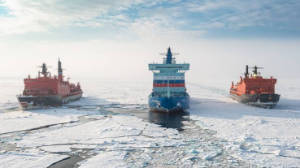
Feng Shaolei, Director, Centre for Russian Studies, East China Normal University: “Mr President, Thank you very much for your presentations today. I believe history is not over yet. The trials of history must not be forgotten, especially when we have such astute historical figures as Egon Bahr, as you pointed out. I believe this is crucial. That is precisely why, even though we are meeting today amid a very difficult, indeed terrible, situation, we must not miss this historic opportunity. Just recently, I read the address you delivered four weeks ago at the Eastern Economic Forum.
One particular detail caught my attention. You mentioned that, during your trip, a tiger suddenly appeared on the road right in front of your car. It did not leave, but simply wagged its tail. It seemed to me that the tiger was in a good mood.
It would seem to me that joint border management between Russia and China is improving, and the environment is gradually being protected. I believe this also gives tigers a chance to roam freely back and forth. Here is my question: what are the key factors and most significant trends shaping the development and opening up of the Far East and the Arctic, including the Northern Sea Route?
Compared with Russia’s previous strategies and policies in this area, this presents a tremendous historic opportunity for both neighbouring and distant countries, including China. As Chinese Vice Premier Ding Xuexiang said, we intend to cooperate more closely with our Russian partners.
I would like to ask for your assessment of these major, long-term historical processes involved in the development and opening up of the Far East and the Arctic.”
VP: “First of all, I would like to welcome you and say that it is a particular pleasure to see you. After all, Shanghai is a sister city of my hometown, St Petersburg. We have always enjoyed a special relationship with this wonderful city, and I hope that it will continue to develop.
As for the tigers, you may know – or, if not, I can tell you – that I have been working on tiger conservation for many years. I was the one who initiated the so-called Tiger Summit in St Petersburg, a major international conference on the subject.
It seems that the tiger that stepped onto the road in front of our car, running ahead and wagging its tail, must have known – or perhaps been informed – that there was no threat. After all, I work to sustain the tiger population, and we have seen results: the tiger population in Russia has grown significantly, as have the populations of snow leopards and certain other rare animal species.
Regarding our cooperation and our efforts to develop the Far East, they are goal-oriented and have been ongoing for multiple years. It is true about Eastern Siberia, the Far East and the Arctic. We have established there an effective and efficient system of preferences for both domestic and foreign business, for our potential current and future partners and investors.
Incidentally, the Chinese companies are among the most actively operating in the Far East. The Government Commission is about to consider a decision on one of Russia’s and the world’s biggest copper deposits, and chances are that the decision will be positive. The deposit is in Siberia, and Chinese investors will also be able to join.”
RPA: We discussed this potential investment here. VP: “Concerning the Far East: As I said we have built an entire system of preferences, and effective January 1 next year – which is an unique decision for us – we are blending all the previously established mechanisms into a single one that will operate across the entire Far East: both in the port of Vladivostok, these territories and so on.
For our citizens … The mortgage rate in the country is 16–17% while in the Far East it stands at 2%. The birth rate in Vladivostok is higher than the national average which creates very good, favourable… They still have a great deal of issues to be solved, very many. But overall, the goals we set are being achieved. We are trying to streamline the course of the Far East economy towards solving issues of hi-tech nature.
We have supported our aviation enterprises and those that used to manufacture exclusively military aviation equipment. Nowadays they also produce civilian aircraft.
We have built there one of Russia’s biggest shipyards – Zvezda, which is building a fleet of superships that even the Soviet Union did not produce. We have launched the production of LNG-tankers and super large civilian ships customised for operating in the Arctic. We are aware that our Chinese friends are also interested in this domain.
We have built a space launch complex in the Far East, and it is already operational, launches are being made. We are developing this complex, and a city has grown next to it.
We have built there two major enterprises in the field of gas-to-chemicals and petrochemistry. Their products – they are extremely sought-after on the world market – will primarily go to the market of the People’s Republic of China.
Everything of this has been agreed upon and everything has been worked out in advance. This only brings benefits to both our friends in China and our Russian companies.
We have many other areas associated with the development of the Far East. Still, I also consider development of the intellectual area, the higher school important, very important. We have built there a new federal university, a multidisciplinary one. We are developing there a branch of the Academy of Sciences, which is dealing with marine biology. And all of this may and should be a subject of our joint work and activity.
Finally, we are building one of the largest cultural centers in Russia there, which will include branches of the Hermitage, the Russian Museum, the Bolshoi Theater and the Mariinsky Theater of St Petersburg. I am sure that this will be a very attractive place not only for the Far East and Eastern Siberia residents, but also for all our neighbors in that region. And a venue for cooperation will open there as well.
For example, several years ago I went to a theatre, which already worked – we are building now another one, but I went to the running theatre – a lady ballet dancer there addressed me in English. I said, “Where are you from?” She answered: “From the United States.” I asked, “What are you doing here?” – “I work. I like it here; the level is good, so I came here.” We can also work with our Chinese friends in the museum affairs and in the theater business. We have already started such work. I have already mentioned cooperation in the humanitarian sphere. So, the field of activity is enormous.
As for the use of the Northern Sea Route – I have already said today that a Chinese container ship made a test passed via the Northern Sea Route. I am sure that we will begin our joint work and will actively use the Northern Sea Route in the interests of Russia and the People’s Republic of China.”
Russian Economy
FL: “Mr President, once we started speaking about the economy: the Far East is really great, but the overall economy – despite the amazing resilience we have demonstrated, which has been acknowledged by the world – but let’s face it: the situation is not getting better, and many people notice that taxes are going up, so are the prices, and the business environment is not improving. To cut it short, the military political crisis comes at a price. What’s there in store for us?”
VP: “Speaking at the Duma last night, I said in broad strokes – and in view of our format it does not seem reasonable to go into details – that the key thing is that the Russian economy and its financial system show robustness. The macroeconomy is absolutely stable.
Yes, there are issues, there are problems we need to address. Who hasn’t them? If we take a look at any region of the world, all of them have problems of some kind. It is also true about Europe we are talking about. What’s happening there? Just a short while ago, they used to be prosperous. Look at the Federal Republic of Germany which was considered to be a wealthy and prosperous country. What is the current situation there? They have a public debt of 120%, Italy’s debt is 140%. The budget deficit is over 3%, around 3.8 to 4 and above, whereas in the United States, the budget deficit is 5.8%. This is their budget deficit, a debt. Meanwhile, the Russian Federation has a public debt of 17%. Italy’ public debt is 140%, whereas ours is 17%. The Russian budget deficit this year is around 3%, and I am sure that next year it will be 2%.
Indeed, we had issues with inflation, we kicked the economy into high gear and it got overheated. However, we intentionally decided to cool it down even though we realised what it would lead to… It was clear to everyone that if the Central Bank raised the interest rate, it would lead to shrinking investment. These were indeed the outcomes. The key thing for us is not to overcool the economy. Everyone is speaking about that; everyone is arguing with the Central Bank. Debates are okay, and this discussion is useful. Yet we had a double-digit inflation of 10.5% last year whereas today it stands at a little over 6%, nearly a half of what it was. Is this a result? It is. Is it positive? But of course. In other words, we do face some challenges but we are overwhelming them. That’s why macroeconomic metrics say that we have a healthy economy while the financial system and economic institutions operate in a well-balanced way.
The main sectors of the economy – yes, with all the challenges, but they exist and keep operating. And in Europe, for example, what has happened to the automobile industry? It is in deep crisis. Their enterprises are closing. Soon, we will all be driving Chinese cars. Whether it is good or bad, I don’t know, but they are cheap and good quality. They say the scale of car manufacturing in China is bigger than necessary. But what exactly do they mean by “bigger than necessary”? As long as demand in the market is high. Well, make your own cars cheaper and better quality. We have always been taught that the market will set things right. And it has: you can buy cheap but good. Their car industry [in Europe] is going through tough times, as are the metallurgical and associated industries, as well as the chemical industry, pharmaceuticals and everything related.
Yes, we do have our own difficulties, but not of the same scale as in the eurozone. I have already commented on the state of affairs in finance. So, yes, there are challenges and we see them but we can also handle them.”
FL: “We won’t all be driving Chinese cars?”
VP: “We are already driving Chinese cars.”
FL: “But not everybody.”
VP: “Yes, like the rest of the world. Except unlike this so-called civilised world, we have not chosen the path of administrative restrictions or sanctions. We negotiate. With our Chinese friends, we look for opportunities to increase their imports to the Russian market. We do the same with our [Indian] friends. And you know the curious part? We can see the returns, the positive effect. For example, the share of Russian industrial products in the Chinese market is constantly growing. Our Chinese friends meet us halfway; they look for opportunities and they find them. We try to do the same with India. When there is a positive dialogue and willingness to find a solution, we always accomplish that.”
Russia-Africa Relations
Godwin Gondwe, Tumaini University, Tanzania: “Africa and Russia have had a relationship which has experienced its ups and downs. So my question is: are there new areas of cooperation that your government intends to pursue with Africa?“
VP: “You know, the modern world is developing so rapidly and vigorously that some new opportunities always emerge, including with Africa.
But the crucial thing I want to point out, and which we discuss with our colleagues, is that Africa is a continent with great prospects. Its population is very young and constantly growing. All African states will certainly strive for this growing young population to improve its living standards. That, obviously, creates conditions for investment and cooperation.
The most important thing I want to say is something we talked about with our colleagues yesterday: we want to work, we work and will continue to work with Africa, but not for the same goals pursued by the colonisers – not to profit and steal from Africa, but to develop together. There are certainly areas for cooperation, and we will cover them at the upcoming Russia-Africa summit.”
RPA: The upcoming Russia-Africa summit will be held in Moscow from 28-29 October.
Switzerland
Roger Koppel, Managing Editor, Die Weltwoche, Switzerland:“My question is first, how do you see Switzerland at the moment? Why did you punish one of our great companies, Nestlé, which resisted many calls in Europe to withdraw from Russia but still stayed here in spite of the criticism?
And what is your general advice to small countries to survive in this very difficult world of competing big powers? And to conclude, thank you very much for Russia’s great contribution in 1815 at the Congress of Vienna to establishing Switzerland’s neutrality.”
VP: “You know, on Nestlé, we do not actually punish anyone; we simply respond to actions taken against us. I believe – though I do not recall the specific details right now – that is all there is to it. Certain decisions were made in relation to the Russian Federation, and the Russian Federation responded accordingly; there is nothing more to it. We are not attacking anyone, nor are we taking anything away from anyone.
You also made another very important point – about moral imperialism and Europe as a graveyard of empires. Perhaps that is why so many in Europe want to finish off the Russian Empire, which ceased to exist long ago? But apparently, they are not aware of that. I want everyone to know.
Now, as for small countries – and Switzerland in particular – and what advice one might offer them: You know, I am far from being in the business of giving advice. After all, it is not a country’s size that matters, but those who govern it and take the decisions. What matters is how responsibly they serve their own people’s interests and how capable they are of pursuing an independent, sovereign policy. Look at how, under external pressure, Switzerland was stripped of one of its key advantages in the global financial system – essentially, banking secrecy was abolished. And just like that, Switzerland ceased to be an attractive hub of the global banking system.
Or perhaps you are referring to neutrality – we certainly welcome neutrality. But if that is the case, Switzerland should have refrained entirely from imposing any sanctions against Russia. That is what neutral status implies – not just in words, but in deeds. Why did Switzerland do this? What did it gain? Nothing at all. Nothing; it simply lost its status – that’s all there is to it.
Therefore, this is not merely advice but a call to action: fight for your sovereignty, independence, and genuine neutrality. It seems to me that everyone who upholds such genuine neutrality stands to gain. The same goes for countries that can take advantage of the genuinely neutral position of certain states, using them as platforms for seeking agreements and settling acute international and interstate conflicts.”
Ukraine
FL: “Does Ukraine’s neutral status remain one of our objectives?”
VP: “Yes, because when it gained independence, Ukraine adopted a declaration – I would remind everyone of this, as it was on the basis of that declaration that it became independent. The declaration states that Ukraine is a neutral state. From the outset – from the very first steps in building the post-Soviet space and the new Russia, we always took it as a given that Ukraine was a neutral state. But then, all of a sudden, they included the goal of NATO membership in their constitution. That is a completely different matter, not least for the security of the Russian Federation. And that is also one of the reasons for the conflict that is still ongoing.
Incidentally, the situation along the line of contact is evolving rapidly. Over September alone, Russia brought 1,301 square kilometres under its control. That is two and a half times more than in previous months. And the pace of troop advances is accelerating.
Of course, we would like to bring this to an end as quickly as possible. Through peace negotiations, specifically. What is needed is to stop accusing Russia of not wanting these talks. Instead, responsible decisions must be made based on the realities on the ground – both within Ukraine itself and by its sponsors in the West, primarily in Europe today.”
Ukraine Conflict Update
Rick Sanchez, American journalist: “My question is this. You’ve talked about Minsk; you were ready to deal. You’ve talked about Istanbul; you were ready to deal. We’ve talked about Anchorage; you, I think, had a deal or a compromise that you were all but ready to agree to.
And in all of those instances, you seem to be turned down. At the time, it could be argued that the war or conflict in Ukraine was a tie or a stalemate, right? Now, right, the situation in Ukraine is very different. As you just explained, 2.5 times more territory being gained than we’ve seen in previous months. Most military experts – not Vladimir Putin, but most military experts – say that right now Russia is winning the war.
So, my question is basically one that just comes to mind: given that scenario, given how many times, sir, you have been turned down, and given what’s going on right now in this conflict, why should you negotiate?”
VP: “After a question like that, one might not even need to answer. It stems from a certain excessive naivety that is traditional in Russian politics – and an optimism about the future.
As for the Minsk agreements, they were difficult for our partners and for Ukraine, it is true – that is a fact. I will not go into the details right now, but I will state the main thing. What certain provisions essentially said was that if Ukraine were to join NATO, the southeast of the country would have the right to secede. That is a very rough summary, but that was the gist of it. There was Article 9, and so on – I will not get into that now; it would take too long. But evidently, neither the Ukrainian leadership, which ultimately came to power in a coup, nor their Western sponsors liked this. And so, they effectively ditched the Minsk agreements altogether.
Moreover, leading European politicians stated outright that they never intended to implement the Minsk agreements. That said, I do think that some of them – even though Ms Merkel said “we did not intend to” – actually hoped that a peaceful resolution could be reached. I will not go into the details now; it does not matter. The important thing is that no one actually implemented them.
We reached an agreement in Istanbul – we truly did. And I am stating this as a fact, not something I made up. The signature of the head of the Ukrainian negotiating team is right there – he initialled those agreements. That means, on the whole, Ukraine was satisfied with them. There were further details to discuss, but the fact that he signed off on them implies general acceptance. After all, he did not act on his own; he surely did so by agreement and with the approval of the head of the regime. Yet, they abandoned this course of action at the insistence of their Western partners. Later, that same official, who led the negotiating team in Istanbul, said quite explicitly at a news conference: “Johnson, the former British Prime Minister, came and talked us out of it.” So, he talked them out of it. Moreover, he said that “had we agreed back then, the war would have been over by now.”
Now, Anchorage. Certain proposals were made to us, and I said we needed to consider them. I came to Anchorage and said we were ready to accept the proposals from the United States. Those were not our proposals discussed in Anchorage but those of the United States. And I came there to say we would accept them. But that time, the US side said they wanted to think. Clearly, the issue is serious, so we did not push them.
As regards your question, I will say something very delicate that I believe I have never publicly said before. We hear things like: “You are winning this war; you have done this and this. Isn’t this enough?” It is not even about a piece of land. Around 11 percent remains under Ukraine’s control in the Donetsk People’s Republic. What I will say next is important. Ukraine’s highest officials claim they will be able to hold this remaining 11 percent in the DPR for a year and a half. Europe claims Ukraine will be able to hold it for two years. We believe that they will cede it much earlier, considering our troops’ pace of progress, which I have just mentioned – they are moving faster, I want to point out. Here is a question: if these territories will inevitably be lost, is there any point in holding on to them – and in sacrificing people, their safety and their lives?
We’ve been told: “You are already winning, haven’t you gotten enough?” It is not about a piece of territory. It is about people. The fact is we need to create conditions not just for peace but for a lasting peace for many years. We need security guarantees not only for the part that we agree with – there are many proposals, including those from President Trump and some difficult decisions for us. But overall, we understand that we are moving in the right direction.
If the other side and its Western sponsors – whose money it is constantly embezzling, as everybody knows now, and yet they put up with it to make Ukraine fight against us – agree to conditions that are also acceptable to Russia, then it would be better to end this situation, prevent any further losses on both sides and proceed to humanitarian agreements concerning the Russian language and other matters such as the treatment of the Orthodox Church.
The international community remains silent while horrendous things are happening to this church: the clergy are being murdered, people are being thrown out of churches, and the churches are being seized. But there’s silence as if nothing is going on. Why? Because this situation is also exploited by the Western sponsors – the Europeans in this case – to resolve the issue of conclusively tearing away the territories and people from Russia and creating conditions in which it would be impossible for us to co-exist peacefully in the future.
All these elements must be excluded, and we are ready to begin these talks and finish them as soon as possible, but – and it goes without saying – on terms that are acceptable to the Russian Federation and the people of Russia.
But it looks like the other side simply has no interest in suspending the hostilities. They did send us a tentative proposal to resume. It wasn’t us who suspended the talks but the Ukrainian side. Recently, in view of the situation on the battlefield, they sent us a tentative request to resume the negotiations. We said OK, after the State Duma elections. The election was on September 20. On the 21st, we are ready to start the talks.
And what did they do? They won’t hold their own elections, and they won’t let us hold ours – they tried to sabotage them: on September 19 and 20, they attempted to break through Moscow’s anti-aircraft defence. They launched over 1,600 drones towards Moscow, continuously striking polling stations in other Russian regions. Six people were killed during the election campaign and because of the never-ending strikes on our polling stations by Ukraine – those were members of election commissions, including a chair of an election commission. Their homes were targeted specifically. To say nothing about the number of injured people. And yet, despite the threat, our people queued up to vote.
I think it is yet another miscalculation on the part of those who allowed the war to happen. They believed our society would crumble, our economy would collapse, our financial system would be crushed; but the outcome came as a surprise to them. They did not expect this degree of consolidation and courage on the part of Russian society, nor the stability of Russia’s financial system and the economy.
Anybody can make a mistake, but only an idiot would insist on it. If they see they’re mistaken, they should somehow change their approach. We are ready for peace talks, but, again, with due consideration for the national interests of Russia and the Russian people.”
FL: “Mr President, and if we make a mistake, are we ready to change our approach?”
VP: “Yes, and we do, by all means. I’ve told you that the American side proposed a way out of this crisis. Initially, we said no, we need to consider it. Then I came to Anchorage and changed my stance. I said I agree. So, we do change it.”
A Future Approach

FL: “Mr President, we have been working here for over three hours. How are you doing?”
VP: “I’d say it’s time to go home.” (Laughter.)
FL: “If I may, I would like to ask you one more question. You mentioned it in your remarks, and it has come up more than once in our conversation – the topic of historical territories and the role of history in general. You often speak about this, both with your foreign colleagues and here in Russia too.
History is a vast universe where essentially, you can find anything, even about one particular country. Appealing to it is slippery ground, because sometimes it’s one thing, sometimes another; some point applies to one thing, others to another. Yet, unfortunately, there may well be more conflicts like the one in Ukraine, not just one or two. You suggest changing approaches. Perhaps this approach needs adjustment, too? Should we avoid invoking history for every disputed political issue?”
VP: “It is not about history. It is primarily about the present, of course. And when I – or we – relate current events to history, that matters, of course. But present developments are more important. That is why I spoke about the persecution of the Church in Ukraine, and about the Russian language being banned there – something unheard of anywhere else in the world. Russian people, who developed this territory, including the Black Sea region, are designated there as a non-titular ethnicity. That is what concerns us; that is where we stand.
And if historical events have shaped the current situation in a way that demands a response from us, we naturally recall the past and how it came about. But our primary concern is what is happening today – and, above all, what is happening to the people.”
FL: “Mr President, the Valdai Club certainly enjoys the incredible privilege of meeting with you regularly, not only to learn your views at a given time but also to watch, through them, the history around us take shape. We are very grateful to you and hope this tradition continues. Thank you very much.”
VP: “For my part, I would like to thank the moderator – Fyodor, thank you very much – as well as all our colleagues who, despite the challenges of the present day, continue to show interest in the events unfolding within and around our country.
I hope that our discussions are meaningful. What we discuss here is heard not only in our country or yours but also in other nations, especially those that influence the course of events in one way or another.
I would also like to extend special thanks to everyone in the hall. Why? Because the people here are, for the most part, experts interested in our country – in Russia. We find this particularly gratifying; it is a special privilege for us. It is wonderful that you are here and thank you very much for your interest in Russia. We are always at your disposal and ready to talk; we hope this interest will not wane but only grow stronger. Let me wish you every success. Thank you very much.”