
 Русский





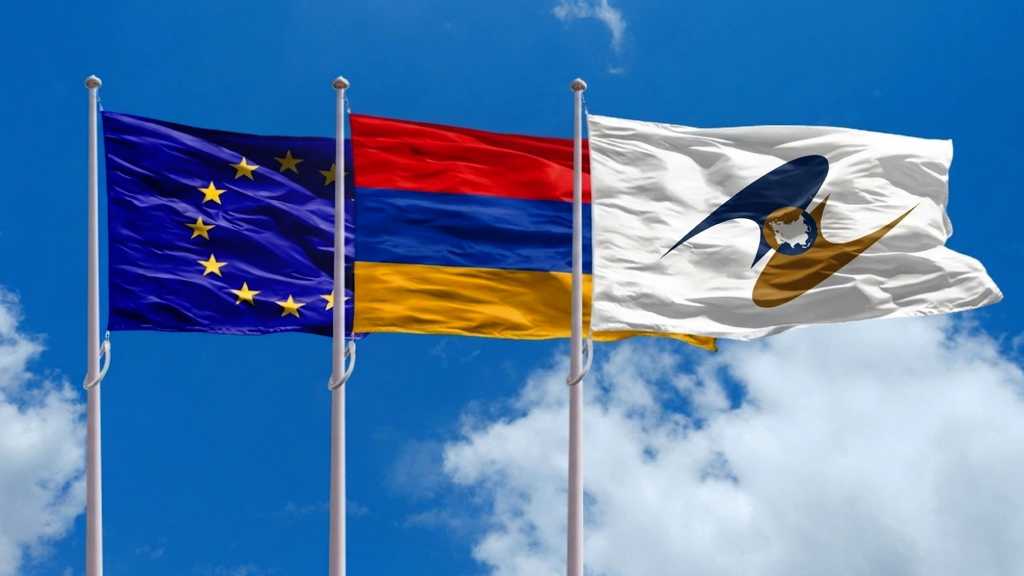

Russian President Vladimir Putin has spoken with Armenian Prime Minister Nikol Pashinyan over the phone to discuss the May 29 meeting of the Supreme Eurasian Economic Council in Astana, the Kremlin said. The conversation took place on Monday (June 1).
Putin also conveyed birthday greetings to Pashinyan. A congratulatory telegram had been sent to him earlier.
Armenia’s political and trade position has become somewhat uncertain in recent months as the country, a full member of the Eurasian Economic Union, has also begun accession talks to join the European Union. It cannot be a member of both.
While it is not uncommon for politicians to look to two sides of a coin to extract maximum benefits of both, the Armenian leadership appears to be playing this situation to a highly dramatic degree, and this is proving unsettling amongst the Eurasian Economic Union membership, who are seeking clarity.
Armenia has also stated it ‘has no intention’ of leaving the Eurasian Economic Union—a contradictory statement. To that end, it has been suggested that Pashinyan hold a national referendum to choose between the EAEU and EU—however, Pashinyan has rejected this. It appears a classic case of playing one against the other. However, this also runs the danger of destabilizing the country.
Here we list the pros and cons of Armenia’s choices:
European Union
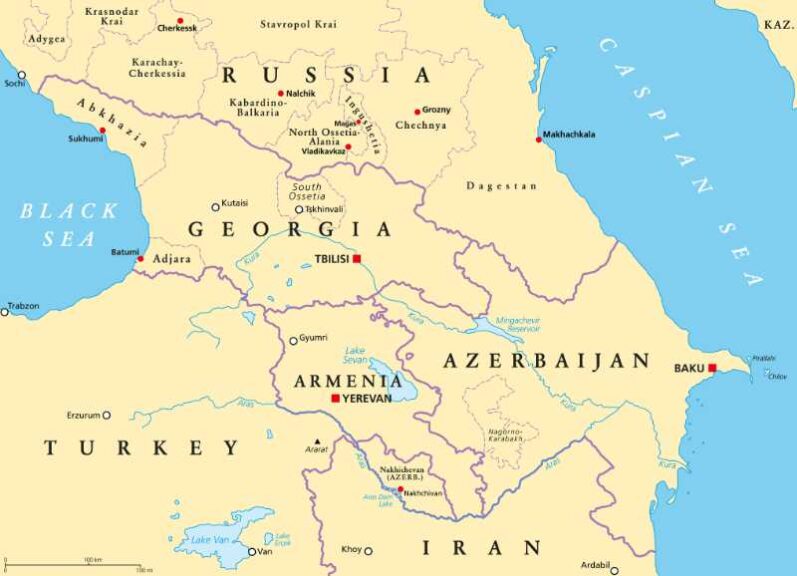
Armenia does not have a border with the EU and is landlocked, meaning logistics problems and reliance on third countries (notably Türkiye and Georgia) would be a cost and potentially future political issue when conducting trade. Yerevan and Ankara do not have particularly close relations, for example. There are also energy issues, with the EU likely to demand that Armenia cease purchasing Russian energy and buy instead from other sources—such as Türkiye. This would move Yerevan’s political dependency away from Moscow and towards Ankara, which is not part of the EU.
According to the Armenian Statistical Committee in 2025, Armenia’s trade with the EU amounted to $2.5 billion, or 11.7% of its total trade. Armenia’s exports to the EU in 2025 were approximately $667 million.
Eurasian Economic Union

Armenia does not have a border with any Eurasian Economic Union nations, including Russia, however it does have borders with countries that have their own free trade agreements with both Russia and Armenia, which include zero-tariff transit agreements. These are Azerbaijan and Georgia.
Russia permanently abolished export duties on the supply of petroleum products, gas, and diamonds to Armenia in 2013. Additionally, the price of gas has been fixed at a favorable level on multiple occasions. As of 2025, the share of Russian gas in Armenia’s total consumption was approximately 82%. The remaining 18% is accounted for by Iranian gas, which is supplied through the Gas-for-Electricity program.
Armenia is currently in the process of negotiating with Rosatom to build a nuclear power plant in order to diversify its energy structure.
According to national statistical services, Armenia’s trade with the EAEU reached $8.2 billion in 2025, while its total global trade reached $13.2 billion. This indicates that trade with the EAEU accounts for 38.5% of Armenia’s total trade.
In 2025, Armenia’s exports to the EAEU countries amounted to $3.2 billion, with $2.9 billion going to the Russian market, which is more than three times the volume of Armenia’s exports to the EU. Armenia’s imports from the EAEU countries amounted to $5 billion, with $4.87 billion coming from Russia.
Political Pressures
However, Yerevan has been facing political pressure from the West as concerns its trade with Russia and has been threatened with secondary sanctions. This has had a deflating effect on Armenia’s economy, which, according to the World Bank, saw a 2025 decrease in both exports (a decline of 36.1%) and imports (23.6%), the first annual decline in both indicators since 2020. These political pressures mean that Yerevan is caught in something of a vice—and its leaders are making placating noises to Europe to prevent any further sanctions exposure.
On the other hand, Yerevan’s position is untenable to the Eurasian Economic Union, which has significant development plans ahead of it—including transport corridors requiring tens of billions of dollars of investment. The Supreme EAEU council has also issued an ultimatum—Yerevan must choose which way it intends to go or the EAEU may suspend Armenia’s involvement later this year. In signs of intense diplomatic displeasure, Russia recalled its Ambassador two days ago. Imports of fruits – a major Armenian export – have been suspended.
Potential Outcome
Yerevan is caught in a trap here, resulting in difficulties whichever way it turns. Should it spurn the EU, Brussels is likely to react with further sanctions pressures, including in trade, banking, and finance as well as freedom of movement. It is also likely to ramp up social media noise against the incumbent government. Social disorder is likely to break out as the internal politics fracture and a pro-EU faction starts to make its presence felt.
However, if Yerevan chooses to go towards the European Union, it will lose its largest trade partner. The EU is unlikely to be able to make up the trade difference in the short term, while imports from the EU will be more expensive than the EAEU produce. Prices would rise, and inflationary pressures would result, while the dependence on cheaper Russian gas would over time be replaced by more expensive solutions.
Armenia is between a rock and a hard place. While its politicians have been flip-flopping between pro-Russia and pro-EU, stances, often within days, it appears that this situation cannot continue indefinitely.
While the European Union would see any move towards Armenia becoming a member as a political win, Yerevan should be mindful that the accession process itself can take years. In this scenario, while it would possess various temporary or interim agreements, Armenia would be highly unlikely to join as a full member anytime soon, leaving it in limbo as further moves towards Europe would almost certainly result in expulsion from the EAEU. Perhaps more seriously, it would impact Armenia’s trade connectivity to the East—and access to the Caspian Sea. Investment into Armenian transport infrastructure eastwards and to and from Asia would dry up.
For the EAEU itself, Armenia is a relatively minor player—its trade with Belarus, Kazakhstan, and Kyrgyzstan is minimal, while Russia’s economy is substantial and can withstand the loss. The real question being asked of Yerevan is, does it believe its economic future is to the East, or does it believe it is to the West? As regional geopolitics crumbles, it can no longer sit on the fence. Yerevan is being forced to decide, and its economic analysts should look at where future growth and development are likely to be. Of note should be the large number of pending EAEU free trade agreements as well as the future economic development of the EU compared with economies such as India and China.
There is the possibility of an off-ramp. Armenia’s economic minister, Gevorg Papoyan, said on June 1 that “the Armenian prime minister and the Russian president had a warm conversation today—all the issues will be resolved. These are technical matters, and I think that they will be resolved after June 7-8. I think that a quick solution will be found for all of these issues after our parliamentary elections.” Whether those usher in a return to EAEU normality or a further push towards the EU however remains to be seen.