Русский








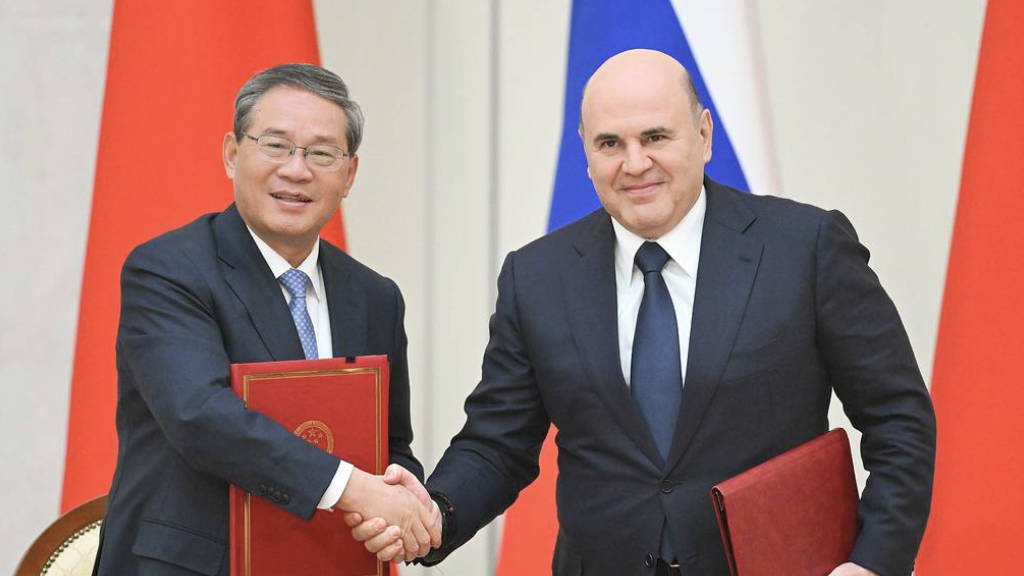

Russian Prime Minister Mikhail Mishustin and Chinese Premier Li Qiang have concluded the 31st regular meeting between the two countries’ heads of government by signing a joint communique at an official ceremony. Two rounds of talks were held at the Boris Yeltsin Presidential Library in central St. Petersburg.
They discussed the comprehensive partnership and strategic cooperation, prioritizing trade, cultural ties, and joint projects in energy, industry, agriculture, transport, and education, with over 90 such projects underway. In general terms, they emphasized the strategic importance of the partnership between Moscow and Beijing and identified several areas for further deepening and broadening cooperation.
The main issues resulting from their talks are as follows:
Northern Sea Route Development & Food Security

Mishutin said that Russia and China are broadening the use of the Northern Sea Route as a new global transport route with a focus on cooperation to ensure food security for both countries.
He said, “In the transport sector, we are increasing bilateral cargo transit, expanding the capacity of crossing points on the Russian-Chinese border, and broadening the use of the Northern Sea Route as a new global transport route. The two sides are focused on the interaction in agriculture and the provision of food security for Russia and China. Trade in agricultural products increased by more than a third in the first nine months of this year compared with the same period of 2025.”
Agricultural trade between Russia and China amounted to US$11 billion in 2025, up 21% from the previous year. In particular, agricultural products and food worth approximately US$8 billion were exported from Russia to China, compared with US$6.4 billion in 2024.
He added that “Domestic goods under the ‘Made in Russia’ brand have proven their high quality and are gaining popularity in China. We need to expand the range of mutual supplies. There is demand for this from our countries’ citizens.”
Fuel Pellets

Trial supplies of fuel pellets from Russia to the Chinese market are planned for November 2026, and the export opportunity resulted from negotiations with China on lifting restrictions on pellet imports, Russian Economic Development Minister Maxim Reshetnikov said after the Mishustin-Li meetings.
He said that “We are starting trial pellet supplies to China in November-what we agreed on last year-to remove barriers there. What was the problem there? They perceived pellets as garbage, while we see them as fuel. We reconciled this and negotiated. And now they also have many of their own requirements and so on; they changed them gradually. Now the first delivery should take place.”
He said that the opening of the Chinese market is a sensitive issue for Russian timber industry companies. Reorienting exports of fuel pellets toward Asia became particularly acute after the introduction of sanctions by European countries, which until 2022 were the main export market for this product. President Vladimir Putin issued instructions in March last year to work on lifting restrictions on pellet supplies to the Chinese market.
Market participants said in 2026 that they had begun making small one-off pellet supplies in agreement with individual Chinese provinces but pointed to the need to ensure conditions for mass supplies in order to avoid the accumulation at production sites of sawdust, which is formed as a by-product of wood processing and from which the pellets are made.
Pellet production in Russia grew 16.6% in 2025 to 1.309 million tonnes. Fuel pellet output declined 0.1% to 792,000 tonnes in January-August 2026, although in August the decline was 32.6% year-on-year, to 84,000 tonnes.
Gas Pipeline

Russia and China could finalize agreements on a major new gas pipeline by the end of the year, Russian Deputy Prime Minister Aleksandr Novak said on Wednesday (October 21), in a potential breakthrough that would significantly expand Moscow’s energy exports to Asia.
Speaking after the talks between Mishustin and Li, Novak said the planned Power of Baikal pipeline was among the issues discussed. “Our companies-Gazprom and China National Petroleum Corporation-are negotiating a second route for gas supplies from Russia to the People’s Republic of China,” he said. “We are waiting for our companies to complete commercial negotiations and hope they will reach the relevant agreements by the end of the year.”
Russia already supplies gas to China through the Power of Siberia, a 3,000-kilometer pipeline launched in 2019. It carries gas from the Chayandinskoye field in Yakutia and the Kovyktinskoye field in Irkutsk Region through Russia’s Far East and across the border near Blagoveshchensk, connecting to a Chinese network extending toward Shanghai. Its annual export capacity is 38 billion cubic meters (bcm), with deliveries reaching 38.8 bcm in 2025.
The planned Power of Baikal, previously known as Power of Siberia 2, would open a major new energy corridor. The 2,600-kilometer pipeline is designed to deliver up to 50 bcm annually from Russia’s Arctic gas fields on the Yamal Peninsula to China via Mongolia, including the Soyuz Vostok transit pipeline.
Unlike Power of Siberia, which draws gas from eastern Siberia, the new route would tap western Siberian reserves that previously supplied Europe, giving Moscow a major new outlet for gas following the collapse of much of its European market. Novak said the project was renamed Power of Baikal to distinguish it from the existing pipeline and reflect its planned route along the southern shore of Lake Baikal. The precise route remains subject to final commercial agreements.
Together, the two pipelines would give Russia a combined nominal export capacity of around 88 bcm annually to China-roughly 80% of the 110 bcm combined capacity of Nord Stream and Nord Stream 2, built to supply Russian gas to Europe via the Baltic Sea.
Gazprom and CNPC signed a legally binding memorandum on the project in September 2025, envisaging deliveries of 50 bcm annually over 30 years. A final supply contract, however, was not signed. Pricing is a key sticking point, with media reports suggesting Beijing is seeking rates close to Russia’s domestic prices, while Moscow has pushed for more commercially favorable terms. President Vladimir Putin said last year that pricing would follow a market-based formula similar to that used for European supplies, stressing that there would be “no charity” on either side.
The expansion comes as Russia accelerates its energy pivot toward Asia in light of Western sanctions and EU efforts to phase out Russian supplies. Before the Ukraine conflict escalated in 2022, Europe was Russia’s largest pipeline gas market, with Gazprom providing around 40-45% of the bloc’s total gas imports. Deliveries subsequently plunged as Brussels pursued alternative suppliers and imposed successive sanctions on Russia.
China has subsequently emerged as Russia’s largest pipeline gas customer, with Power of Siberia reaching its full contracted capacity and further export routes also under development.
Unlike oil, which can be redirected by tanker, pipeline gas requires extensive infrastructure, making Power of Baikal a key project in Moscow’s efforts to replace lost European demand.
Additional Russia-China Agreements

Mishustin and Li also concluded a package of cooperation agreements spanning economy, trade, aerospace, science, technology, and education. A “China-Russia Years of Education” program was identified and approved. Additional new development drivers were also agreed upon, taking in frontier industries, specifically highlighting artificial intelligence (AI), biotechnology, and the digital economy.