
 Русский




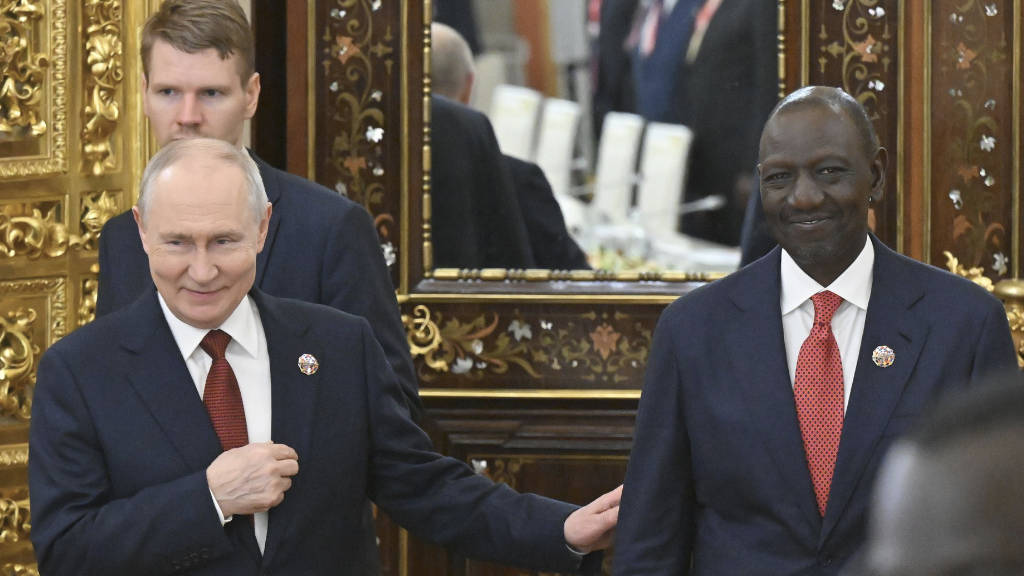
The Russian President, Vladimir Putin has met with William Samoei Ruto, the President of Kenya during the 2026 Russia-Africa Summit.
On the Russian side, the meeting was attended by Deputy Prime Minister Alexander Novak, Deputy Chief of Staff of the Presidential Executive Office Maxim Oreshkin, Deputy Chief of Staff of the Presidential Executive Office – Presidential Press Secretary Dmitry Peskov, Presidential Aide Yury Ushakov, Ambassador Extraordinary and Plenipotentiary of the Russian Federation to the Republic of Kenya Vsevolod Tkachenko, Minister of Agriculture Oksana Lut, Minister of Economic Development Maxim Reshetnikov, Deputy Foreign Minister Georgy Borisenko, Deputy Defence Minister Vasily Osmakov, Chief of the Main Directorate of the General Staff of the Russian Armed Forces – Deputy Chief of the General Staff of the Russian Armed Forces Igor Kostyukov, and Deputy Chief of the Main Directorate of the General Staff of the Russian Armed Forces Andrei Averyanov.
This is what they had to say:
Vladimir Putin: “Mr President, friends, good afternoon, we have worked very productively together today, and now we have an opportunity to discuss our bilateral relations. Diplomatic relations between our countries were established in 1963, and we are now approaching a significant milestone: the 65th anniversary.
We maintain regular political dialogue at various levels. I remember that your predecessor attended the first summit in Sochi in 2019, and Kenya has since taken part in all three events. Exchanges of visits by the heads of our foreign ministries are underway, and contacts between our parliaments are maintained on a regular basis.
We are interested in further developing trade and economic cooperation with Kenya. I would like to note that from January to August of this year, our trade turnover has doubled. This is a positive trend, and it must be maintained. Supplies of Russian agricultural products have increased. I would like to emphasise that Russia is one of the leading exporters of fertilisers. And, of course, we must certainly do our utmost to maintain this positive momentum.
Fruitful cultural and humanitarian ties are also being maintained. We assist in training Kenyan specialists and are gradually increasing the state scholarship quota for your young people, who, as far as I understand, study in Russia with great enthusiasm. A total of 70 state scholarships have been allocated for civilian specialities for next year.
Kenya regularly hosts performances by Russian cultural ensembles. In December last year, the Russian Ballet academic theatre performed, in June, the Khokhloma ensemble, and in September, the Rossiya ensemble. Furthermore, just a month ago, the Day of Russian Culture was held in Nairobi. Kenyan performers also take part in international music competitions in Russia.
We share common positions on a number of key international issues, including strengthening the central role of the UN, the importance of complying with its Charter, and the building of a polycentric world order.
The UN has an office in Nairobi, and we support the further strengthening of your country’s role in the work of this global organisation. It is the only UN headquarters located in the Global South. Nairobi has even earned the unofficial status of the world’s environmental capital. We are very glad to see this, and it is being achieved in large part thanks to the efforts of the Kenyan people themselves.
Historically, our country consistently advocated the establishment of a UN office in Kenya. We support its strengthening, the intensification of negotiation processes and the hosting of secretariats for new environmental mechanisms and agreements there.”
Ruto: “Mr President, First, to say a very big congratulations for holding this summit, and for the hospitality extended to me and my delegation – we sincerely appreciate it. And as you have said correctly, diplomatic relations between our two countries have existed since 1963. And just to mention, Russia was the second country in the world to recognise Kenya’s independence. And that is why we have a very big Russian Embassy near our Department of Defence.
We have trade relations that extend to many products. And, as you have said, fertiliser is a major export from this country. We export tea, coffee, flowers – some directly, some indirectly through Amsterdam and other routes. I recall that we have a trade imbalance in favour of Russia, but it is an opportunity for us to look at what other avenues we can look at.
You have said correctly that this summit provides us an opportunity to explore opportunities between Kenya and your great country. We have just signed five memoranda of understanding – five instruments – between our two countries. One of them is on economic cooperation, and that provides an opportunity for economic cooperation between Kenya and Russia. And I will explain to you shortly that there are real economic opportunities for us to discuss, especially because we believe that the economic opportunities presented to Kenya give a win-win opportunity for both Russia and Kenya.
We have just established a national infrastructure fund that provides opportunities for investment both by the public and the private sector in some of our key infrastructure projects: the airport, the Port of Mombasa, road infrastructure, rail infrastructure. There are real opportunities for investment – these are commercially viable opportunities that can be looked at.
I think there is also an opportunity to discuss fertiliser, along the lines of local manufacture by Russian companies, or blending, using products from different parts of the world, especially with Russian companies. We also believe that there is an opportunity in energy generation.”
Kenya’s Economic Development
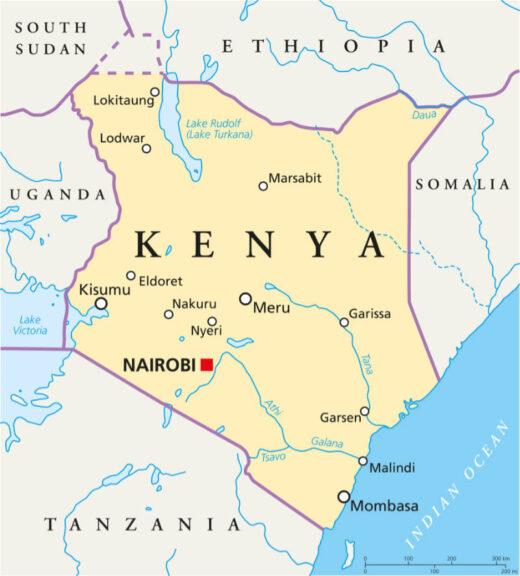
Kenya is strategically located on the east African coast serving as a link between the Indian ocean and the heart of Africa. Kenya’s population of 54.2 million covers a territory of 582,646 square km, while Kenya’s GDP (PPP) stands at US$436 billion, with GDP per capita (PPP) US$8,040, and a medium ranked Human Development Index. The 2026 forecast for GDP growth is 4.6%.
The agricultural sector provides the majority of Kenyans with a living. Crop production (food and industrial), horticulture, livestock, fisheries, and forests make up this sector. In addition to agricultural products, Kenya’s horticultural sector and tea are the most important. Other export items include textiles, coffee, tobacco, iron and steel products, petroleum products, and cement.
Kenya is a signatory to the African Continental Free Trade Area (AfCFTA), which aims to create a single market for goods and services across Africa, eliminate tariffs on 90% of goods, and boost intra-African trade. The agreement supports Kenya’s efforts to diversify exports and strengthen its ties with other African nations. As a member of the East African Community (EAC), Kenya also benefits from a customs union that allows for the free movement of goods, services, and people among the EAC member states. Kenya is also part of Common Market for Eastern and Southern Africa (COMESA), a regional trade bloc that promotes economic integration, free trade, and the free movement of people within the region. Apart from its African trade agreements, Kenya enjoys free trade agreements with Argentina, Bangladesh, Bulgaria, China, Hungary, India, Iraq, Netherlands, Pakistan, Poland, Romania, South Korea, and Thailand.
Russia, Kenya Bilateral Trade & Investment
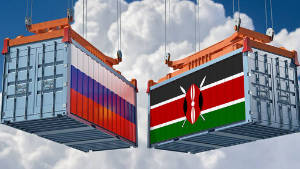
A Russian trading house opened in Nairobi in August last year. In terms of overall trade, Russia-Kenya trade reached US$380 million in 2025. However, Putin noted that this had doubled during the first 8 months of 2026. If that trend continues, bilateral trade will leap to US$760 million for the full year. Russian exports make up about 80% of this trade mix, sending grain, fertilizers and other agricultural products to Kenya, while Kenya exports coffee, nuts, spices, fruits, and vegetables to Russia, with some produce, such as fresh flowers, routed via Amsterdam.
During the Russia-Africa summit, the two sides also signed five new bilateral accords, focusing on expanding agricultural exports, tourism, direct business partnerships, joint investment and transport, most notably the issue of direct flights in order to boost Kenya’s tourism sector.
