Русский





Russian President Vladimir Putin has said that Russia and Qatar are among the world’s largest producers and exporters of natural gas, and global energy market stability depends on their coordination. He was speaking at the Gas Exporting Countries Forum (GECF) in Moscow.
At the forum, Putin said the main problem right now is the disruption in gas supplies, saying that “large amounts of supply dropped out of the market in a short period, but demand did not go anywhere. This means it is necessary to explore optimization of transport routes, taking into account the geographical location of forum member countries, with the help of mutual operations among us. A set of measures is being implemented to diversify and increase the trade turnover. Although it is modest in absolute size, it nonetheless grew, growing by 10%. Investment cooperation is developing; Qatari investment agencies have equity stakes in a number of Russian companies, including Rosneft and VTB; partnership relations are developing with the Russian Direct Investment Fund; and humanitarian contacts are expanding.”
Putin also said bilateral cooperation between the countries is “steadily developing, a substantive political dialog has been established, and the Russia-Qatar intergovernmental commission is operating.”
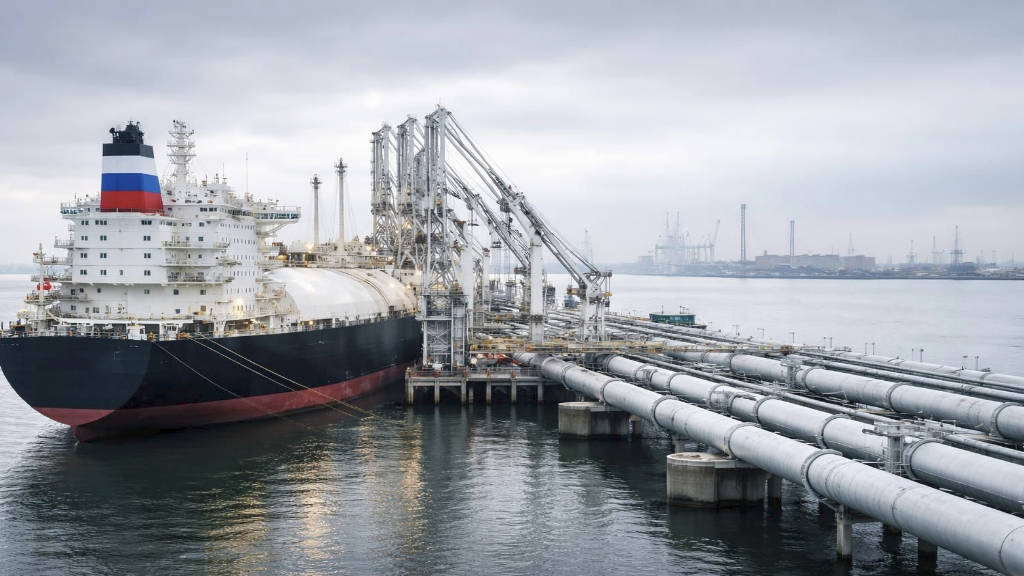
Qatar, the world’s second-largest producer of liquefied natural gas (LNG), is unable to ship it to world markets due to the closure of the Strait of Hormuz. Qatar had a 9% share of the European LNG market in 2025, when the European Union, which plans to ban imports of Russian LNG as of the start of 2027 and imports of Russian pipeline gas as of October 2027, imported 146 billion cubic meters, according to the Acer energy analytic business.
Qatar shut down LNG production at its plants, which have the capacity to produce 77 million tonnes per year, as a precaution in March after the start of the U.S. war with Iran, and declared a force majeure on gas deliveries to customers. That has now been extended to the end of this year. In addition, Qatari LNG capacity of 12.8 million tons per annum (MTPA) of production has been damaged as a result of the US-Iran war and will take up to five years to restore.
Qatar also planned to launch the first LNG train as part of the North Field East project, which calls for building four trains with an annual capacity of 8 million tonnes each, at the end of the year. However, QatarEnergy head Saad Al-Kaabi said in September that the launch of additional trains will depend on the situation in the Strait of Hormuz and that the company cannot deliver equipment for new trains due to problems in the Strait of Hormuz. Production at the North Field and South Field, with another two trains of 8 million tonnes per year each, is expected to begin in 2028.
The situation suits the United States, which is the world’s largest producer of LNG. Russia is second, followed by Iran, China, Canada, and Qatar. In terms of LNG exports, the United States is the world’s leading exporter, followed by Russia, Qatar, and Norway.
The situation does not suit the European Union at all, which has imposed sanctions on buying LNG from Russia and cannot currently purchase from Qatar. US LNG shipments to the EU have almost quadrupled between 2021 and 2025, while prices have tripled in 2026 at the same time that EU storage is at a record low. This suggests that the real target of the United States war in Iran is actually an economic goal to force Europe into buying long-term LNG supplies from the United States.