
 Русский







Russia and Tanzania are preparing to sign an agreement to promote and protect investments, Economic Development Minister Maxim Reshetnikov said during a videoconference with Tanzania’s State for Planning and Investment Minister Kitila Mkumbo.
Reshetnikov said that concluding the investment promotion and protection agreement, also known as a ‘Bilateral Investment Treaty’ (BIT) which is underway, would provide a favorable environment for companies from both countries to operate. BIT provide state guarantees for investments made in each others countries, as well as specific tax treatment incentives, usually involving the services sector.
Mkumbo said that Tanzania is ready to expedite preparing the document in order to have it signed by May or June 2027. Reshetnikov said that “We see potential for further growth in trade. We are interested in Tanzanian coffee, tobacco, avocados and nuts. We are prepared to promote investment projects for the production of agricultural goods within Tanzania, primarily fruit. There is also the possibility to increase supplying fertilizer, sunflower oil, wheat, and veterinary vaccines.”
They two Ministers added that the meeting placed special emphasis on developing tourism, whose key driver has been establishing direct flights. There is already a tangible tourism result – the number of Russian tourists visiting Zanzibar has more than tripled between July and October 2026 compared to the same period last year.
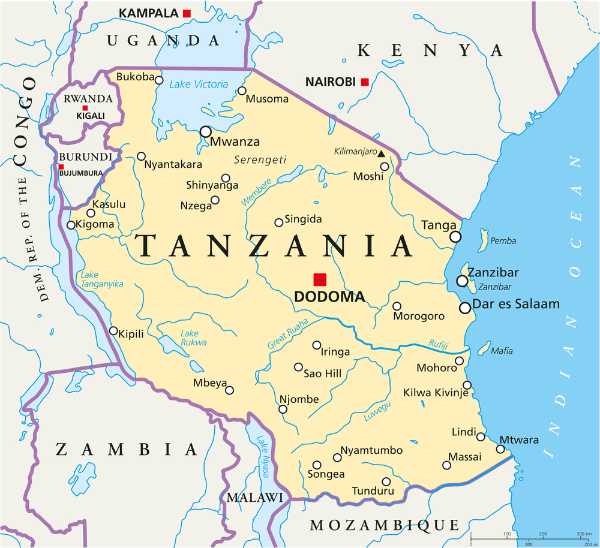
For Russia, Tanzania is important due to its geography. It has a number of ports, which make the country a convenient entry point deep into the African continent and ideally could help Moscow facilitate greater trade with several countries simultaneously, especially when considering an East African extension to the North-South Transportation Corridor. A Russia-Tanzania Business Council was created in January.
Tanzania’s economy is heavily based on agriculture, which accounts for about 25% of GDP, provides 85% of all exports, and half of the national employment. Global warming is creating sustainability problems. Maize is the largest food crop, followed by cassava, sweet potatoes, beans, bananas, rice, and millet, while sugar is the largest cash crop, along with cotton, cashews, tobacco, coffee, sisal, and tea.
Industry and construction are growing components of the Tanzanian economy, contributing 24% of GDP, and include mining and quarrying, manufacturing, electricity and natural gas, water supply, and construction. The majority of the country’s mineral export revenue comes from gold, accounting for 80% of the value of these exports.
Andrey Avetisyan, Russia’s ambassador to Tanzania, has identified the country as having attractive potential as a trade hub to develop Russian trade with Africa and beyond and stated last year that “Tanzania has access to the Indian Ocean and is located on the routes to the south of the continent or to Southeast Asia. In addition to this favorable geographic location, there is political stability and the Tanzanian government’s focus on attracting foreign investors. Tanzania is very attractive for us to create a major trade hub to further develop the Russian presence on the continent.”
He pointed out that there are two possible forms of cooperation. One involves the construction of a deep-water port in Bagamoyo, located near the country’s largest city and financial hub of Dar es Salaam. The second is to use the existing ports in Tanga, Mtwara, and Dar es Salaam. Avetisyan said that “all three ports have been recently modernized and are capable of handling vessels of all sizes and drafts. The port facilities include modern quay walls and necessary unloading equipment, and storage facilities are available. Anything related to Tanzania’s ports attracts foreign investors.”
Tanzania is interested in Russian investments in agriculture, mining and manufacturing, real estate, agricultural processing etc. Presently there are not many investors from Russia in Tanzania, but those who poured money did so into tourism, telecommunications, and mostly agriculture. The Tanzanian side also eyes geological exploration and mining, tourism, energy, and information and communication technologies. Tanzanian leadership also hopes that as the country that possesses large resources of gas, Russia is interested in investments in this field too, which would enable Tanzania to become a net gas exporter.
One of the most significant joint projects is Rosatom’s participation in the development of the Mkuju River uranium deposit, located 470 kilometers southwest of Dar es Salaam and one of the largest in the world with reserves of 152 million tons of ore. In July 2023, Russian Ambassador to Tanzania Andrey Avetisyan announced that Rosatom’s subsidiary, Mantra, is completing the construction of a uranium ore processing facility and preparing for the launch of a pilot project. The pilot plant was put into operation on July 30, 2025. At the pilot-industrial operation stage, it is designed to produce 5 tons of uranium oxide (yellow cake) per year. The main industrial complex is currently under construction, and its commissioning is scheduled for 2029. The plant’s design capacity is up to 3,000 tons of yellow cake per year.
Russian corporations are also interested in developing the Tanzanian LNG and maritime transport and logistics sector in the Indian Ocean. At a meeting of the intergovernmental commission, Russian Minister of Economic Development Maxim Reshetnikov said that Gazprom is interested in implementing comprehensive gas projects in Tanzania, from production to distribution. The company is ready to supply natural gas, LNG, and petrochemical products, as well as technologies and equipment for gas production, processing, transportation, and distribution. NOVATEK has also expressed its readiness to participate in natural gas exploration and production projects in Tanzania.
Russia-Tanzania Bilateral Trade

In May this year, the Russian transport group FESCO carried out the first export shipment to the port of Dar es Salaam in Tanzania. The group delivered containers with plastic products and spare parts for equipment from Novorossiysk via the Indian port of Nava Sheva. The transportation was organized as part of the regular FESCO Indian Line West (FIL-W) shipping line, with an average travel time of about 45 days. In the import direction from Tanzania, it is planned to deliver tea, coffee, and other cargo. Upon arrival in Novorossiysk, containers can be transported to various regions of Russia using FESCO’s railway and road solutions.
In terms of bilateral trade, tobacco raw materials and tobacco substitutes, coffee, tea, spices, and fruits play a key role in Tanzania’s exports to Russia. Russian exports consist of grains, fertilizers, aluminum, and pulp and paper products.
Currently, the volume of bilateral trade between Russia and Tanzania is about US$400 million, of which 85% is accounted for by Russian exports.
Tanzanian President Samia Suluhu Hassan, and Russian President Vladimir Putin noted during their meeting in Moscow last month that Russia and Tanzania have the potential to double their trade turnover in the short term.