 Русский




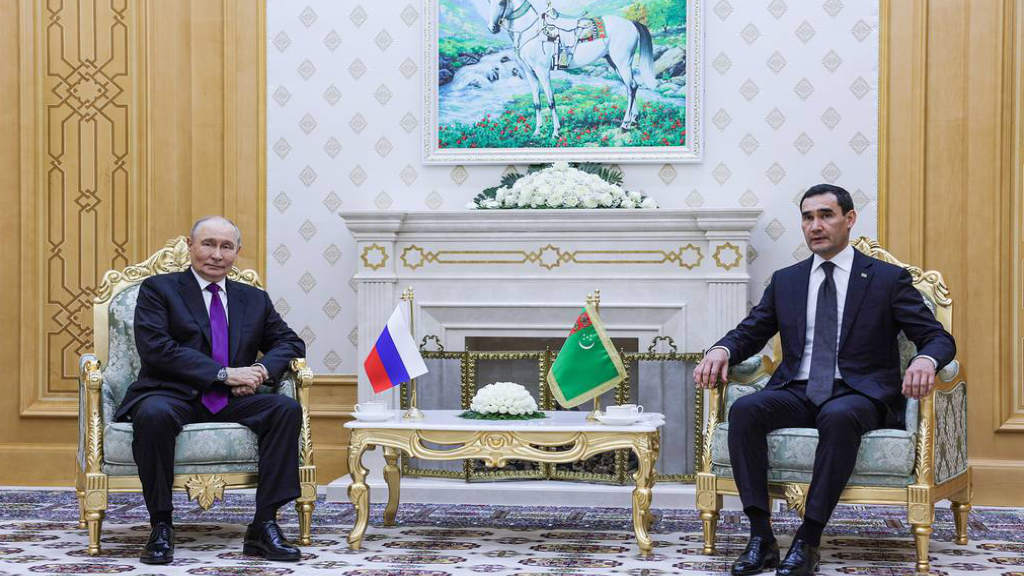
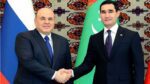
Russian President Vladimir Putin has arrived in Turkmenistan on a working visit as part of the Heads of State of the Commonwealth of Independent States (CIS) and has met with Turkmen President Serdar Berdimuhamedov.
A Kremlin statement said “Following an official dinner, Putin held a bilateral meeting with President of Turkmenistan Serdar Berdimuhamedov. They discussed key current issues concerning the dynamically developing bilateral Russian-Turkmen relations.”
The two leaders met at the Avaza complex, a national tourist zone on Turkmenistan’s Caspian coast, located near the city of Turkmenbashi.
Turkmenistan is not a full member of the CIS however cooperates under essentially the same protocols as a member state but as an ‘associate’ country. Effective CIS members include Azerbaijan, Armenia, Belarus, Georgia, Kazakhstan, Kyrgyzstan, Russia, Tajikistan, Turkmenistan, and Uzbekistan.
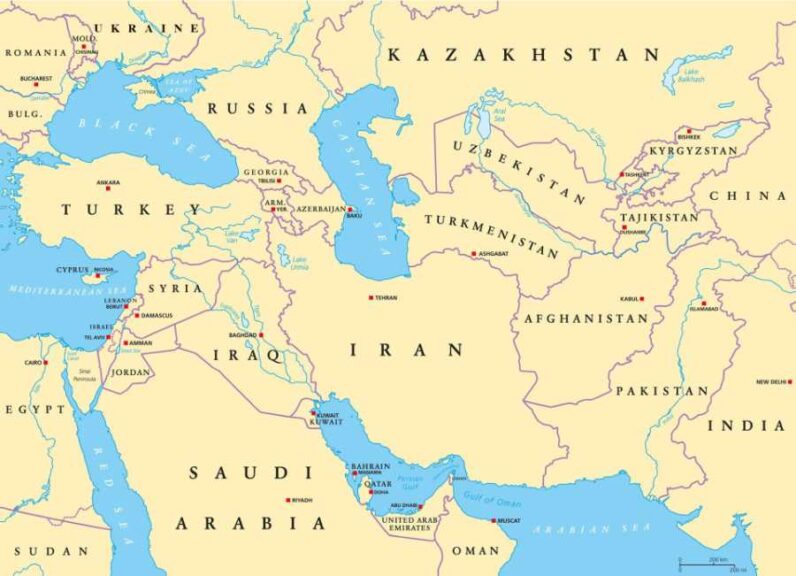
Turkmenistan is strategically positioned along the “Middle Corridor,” which serves as a crucial trade route between East and West and especially so given the developing INSTC routes between Russia, Iran and Central Asia via the Caspian Sea.
The country’s economy is largely driven by its vast natural resources, with a strong emphasis on energy and agriculture. With the world’s fourth-largest natural gas reserves and significant oil resources, relies heavily on these industries. The government is encouraging foreign investment in these sectors as well as renewable energy, particularly solar and wind. Agriculture also plays a vital role, with cotton being a staple, along with wheat, vegetables, fruits, and livestock products for domestic use and export. Infrastructure development is as Turkmenistan’s strategic location on key trade routes connects Asia to Europe.
Turkmenistan is not highly active in free trade agreements but participates in various economic cooperation frameworks. It has a Trade and Investment Framework Agreement (TIFA) with Central Asian countries like Kazakhstan, Uzbekistan, Tajikistan, and Kyrgyzstan, aiming to boost trade and investment in the region. Turkmenistan also has a bilateral investment treaty with Russia. In 2024, Turkmenistan signed a deal with Uzbekistan to create a free trade zone in the Shavat-Dashoguz region, promoting cross-border trade with favorable customs and infrastructure.
Energy remains an important component of the relationship, although Russia is no longer the main destination for Turkmenistan’s natural gas exports. The two countries have also been developing transport cooperation, including routes linking Turkmenistan with Russia and other markets through the Caspian Sea. Discussions have included the Volga-Caspian Canal with an outlet to the port of Turkmenbashi and the eastern bypass of the Caspian Sea within the International North-South Transport Corridor.
At the political level, Moscow and Ashgabat cooperate through the UN, CIS, the Caspian littoral states and the Central Asia-Russia format. In September 2026, Turkmenistan said preparations were underway for the 14th meeting of the bilateral intergovernmental commission, with the agenda covering trade, energy, transport, finance, industry and other areas.
With a population of 7.5 million and a 2025 GDP (PPP) of US$191 billion, Turkmenistan’s GDP per capita (PPP) stands at US$19,313. The country is on course to see a GDP growth rate of 6.3% for 2026.
Regarding bilateral trade with Russia, turnover increased by 35% in 2025 to reach about US$2.5 billion and has been experiencing growth of about 10% during 9M 2026. The overall trend in Turkmenistan-Russia bilateral trade has been susceptible to geopolitical headwinds however is likely to improve as logistics connectivity and infrastructure projects become increasingly operational. Both governments have pledged to double trade by 2030.
Most of the bilateral trade is focused on agricultural products, with Turkmenistan exporting fruits, vegetables, cotton, and flax to Russia. The key product is tomatoes, which are highly valued in the Russian market and are considered some of the best in Central Asia. Melons, watermelons, grapes, pomegranates, and other seasonal fruits are also exported. Russian exports are more diversified and related to the needs of Turkmenistan’s economic modernization. The key categories include medical equipment and supplies, fertilizers, construction machinery and equipment, special equipment, energy equipment, industrial machinery, tools, and chemical products.