Русский





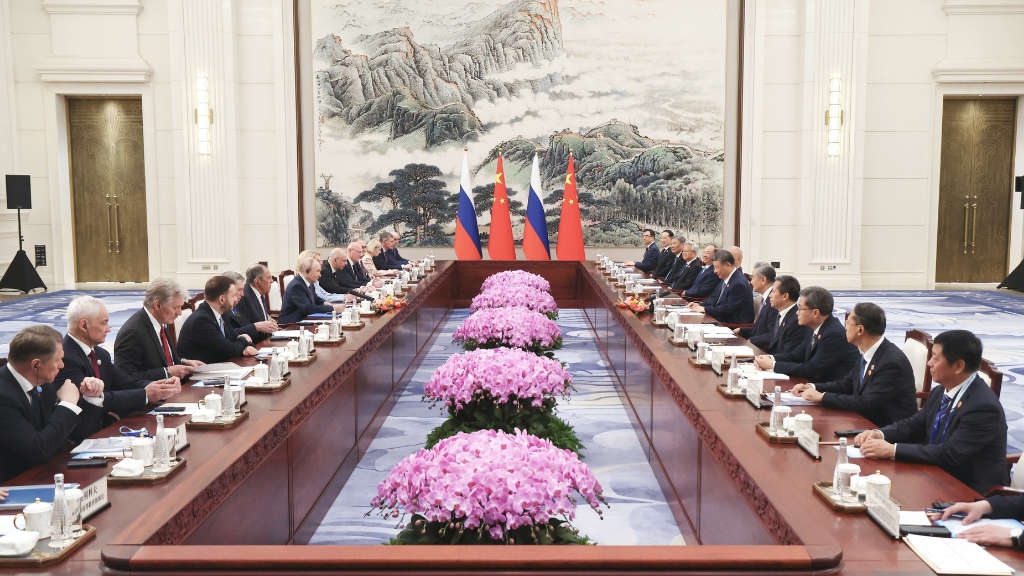
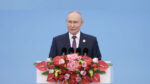
Presidents Vladimir Putin and Xi Jinping have held talks in Shenzhen, with the talks focused on prospects for strengthening the comprehensive partnership and strategic cooperation between the two countries, as well as international and regional issues.
The talks with Xi continued over a working breakfast. Foreign Minister Sergei Lavrov and Presidential Aide Yuri Ushakov joined the meeting on the Russian side. This is what they had to say:
Xi Jinping: “Mr President Putin, my dear friend, welcome to Shenzhen for the APEC Economic Leaders’ Informal Meeting.
It is highly symbolic that this is our third face-to-face meeting since the beginning of this year and our 50th meeting since 2013, including both in-person meetings and videoconferences.
This year marks the 30th anniversary of the establishment of the Chinese-Russian partnership and strategic cooperation, as well as the 25th anniversary of the signing of the Treaty of Good-Neighbourliness and Friendly Cooperation. Under our firm leadership, Chinese-Russian relations have remained as steadfast as a mountain in the face of all the challenges facing the world. They have broad prospects and are not swayed by transient shifts in the international situation. They bring greater stability and certainty to a turbulent and chaotic world and serve as a model for a new type of relations between major powers, characterised by equality, mutual respect, good faith and mutually beneficial cooperation.
Looking ahead, we must continue to move forward with determination and courage, unlocking the enormous potential of our bilateral relations and enriching their substance.
It is important to maintain our focus on practical work, persevere in our efforts, deepen our multifaceted cooperation through concrete action and firmly shoulder the responsibilities incumbent upon major powers, helping to shape a multipolar world and promote the democratisation of international relations.
We will take part in the 33rd APEC Economic Leaders’ Informal Meeting. We are ready to work together with Russia and other members of the wider Asia-Pacific family to open up broad prospects for the region and promote its prosperity, joining hands to build an Asia-Pacific community.
Thank you.”
Vladimir Putin: “Mr President, my dear friend, I am sincerely pleased to meet with you in Shenzhen. I think it is no coincidence that you chose this city as the venue for the meeting of delegations from the APEC economies. This beautiful, rapidly developing city is undoubtedly a symbol of China’s prosperity.
We know well that, until quite recently, the population here was relatively small. Today, Shenzhen is one of the world’s largest metropolitan areas, developing at a remarkable pace. We congratulate you on this achievement. It is an excellent example to follow.
Speaking at the CEO Summit earlier today, I noted that the Asia-Pacific region accounts for 36% of the world’s population, 50% of international trade and 60% of global GDP. We share a common goal: to ensure peace and prosperity in the Asia-Pacific region. We will work, as you yourself like to say, shoulder to shoulder for the benefit of the peoples of Russia and China.
This year, we have indeed held a number of productive meetings – in Beijing in May, in Bishkek and, subsequently, in New Delhi. We have a good schedule of contacts. Our cooperation is making steady progress on the basis of the Treaty of Good-Neighbourliness and Friendly Cooperation, signed a quarter of a century ago.
Our relations are developing positively, and I would like to take this opportunity to congratulate you on the successful convening of the Fifth Plenary Session of the 20th Central Committee of the Communist Party of China. It has, without doubt, set the course for the future development of the People’s Republic of China.
Bilateral trade has exceeded the US$200 billion mark for several years running. That was the goal we set ourselves not so long ago. And all indications suggest that this year we will not only reach that level again but also see solid growth in bilateral trade.
We are also pleased with the substantive dialogue taking place in research and innovation. Transport connectivity is developing, and cooperation in the humanitarian sphere has intensified. This has undoubtedly been facilitated by the visa-free regime introduced at your initiative. Tourist flows have increased by as much as 43%.
Our cross-years have proved their worth and are producing good results. This applies in particular to the Cross-Year of [Russia-China Cooperation in] Education for 2026–2027, which you and I officially launched in Beijing in May this year. Shenzhen is home to the Russian-Chinese Joint University, established by agreement between us ten years ago on the basis of Lomonosov Moscow State University and Beijing Institute of Technology. I have an opportunity to visit it today.
A number of major cultural projects are also under way. Last week, for example, the Moscow Seasons festival opened in Shenzhen, attracting considerable interest among the city’s residents. I hope it will be of interest to everyone.
The Russian-Chinese foreign policy tandem is working steadily and productively. Despite the challenging geopolitical environment, we continue to take a constructive approach to shaping a fairer multipolar world order. We are truly delighted to be here among friends. Thank you very much.”
Bilateral Trade
China’s GDP has grown by 4.6% during 2026 to date. If maintained over the full year, this adds another US$920 billion to the size of the Chinese economy. This figure is highly pertinent to the bilateral trade picture as both countries traded US$245 billion during 2025 – suggesting that there is considerable room for growth.
In terms of bilateral trade, 2026 has produced significant bilateral development in the acceleration of trade between Russia and China. According to China’s General Administration of Customs, merchandise trade between the two countries reached US$242.485 billion during January-October 2026, compared with the same ten-month period of 2025, an increase of US32.1%.
Russian exports to China increased US31.5% to US$133.225 billion, while imports from China expanded 33% to US$109.260 billion. Russia therefore has a bilateral merchandise surplus of approximately US$23.97 billion.
These figures demonstrate that trade expansion is occurring in both directions rather than being driven exclusively by Russian commodity exports. This Russia-China growth rate of 32.1% exceeds the expansion of China’s overall international trade and its trade with the European Union and United States and reflects the growing importance of the two countries’ interconnected energy, industrial and transport supply chains.
For Russian exporters, China provides a major destination for petroleum, natural gas, coal, metals, chemical products and agricultural commodities. For Chinese manufacturers, the Russian market provides commercial opportunities in automobiles, industrial machinery, electrical equipment, electronics, construction machinery and consumer products.
The corporate landscape supporting these commercial sectors includes Russian companies such as Rosneft, Gazprom, NOVATEK, RUSAL, Norilsk Nickel, PhosAgro, Uralchem, Severstal and NLMK, alongside Chinese industrial and energy companies including CNPC, Sinopec, CNOOC, Sany, XCMG, Zoomlion, Sinotruk and Weichai. These companies represent important sectoral participants in the wider bilateral commercial ecosystem.
An additional indicator of the importance of the Russia-China corridor is the relationship between bilateral trade and Russia’s overall Asian exports. Russia’s January-September 2026 US$242.5 billion bilateral trade with China is a substantial proportion of Russia’s US$277.5 billion exports to the entire Asian region.
The commercial significance extends beyond the immediate exchange of finished products. Industrial machinery imports support production, vehicle assembly, construction and infrastructure development, while Russian energy and mineral exports provide raw materials for Chinese industrial consumers. This creates a two-way supply relationship connecting energy producers, manufacturers, logistics operators, distributors and industrial customers.
Summary
Putin and Xi are known to get along both personally and professionally. While their comments did not reveal much we don’t already know, it is obvious that the China-Russia bilateral ties are highly complimentary and are continuing to grow. Both leaders also mentioned the need for global affairs to move towards a multi-polar, instead of a uni-polar platform lead by the United States, with the trilateral summit with US President Donald Trump indicative that American thinking may also be following this path. The fact that the Europeans are not present at the APEC summit is geographical, not political and not too much should be read into their absence.
Most of the discussions at Shenzhen will have revolved around trade issues, resolving bottlenecks, tariff matters and related issues to further smooth their trade capabilities. China has a Free Trade Agreement for example with the Eurasian Economic Union; however this is deployed on an ‘as need’ basis rather than a set of written tariffs and is therefore flexible but does require constant attention.
With bilateral trade rapidly increasing, the passage ahead for continuing trade growth is also likely to be substantial and impressive.