
 Русский






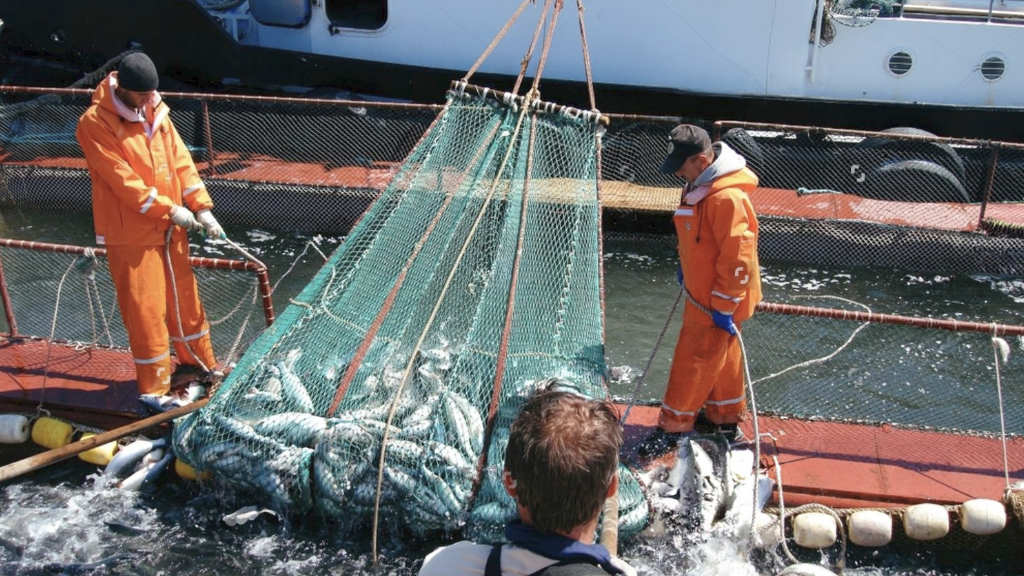

The 29th China Fisheries & Seafood Expo (CFSE), was held in late October 2026 in Qingdao, providing a major platform for Russian seafood producers to expand their commercial presence in China and develop new international partnerships. Russia is on course to export over US$4 billion worth of fish products to China in a market worth US$25 billion in imports last year. This article explains how Russia is developing this Chinese export sector.
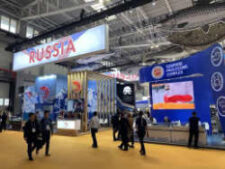
Russia marked its tenth consecutive year of participation with its largest national pavilion among the exhibition’s 27 country and regional pavilions, bringing together more than 60 domestic companies across an exhibition area exceeding 1,600 square metres. The Russian delegation presented a broad range of products, including pollock, cod, crab, fish roe, processed seafood and aquaculture feed, while pursuing cooperation with Chinese importers, processors, retail chains and logistics operators.
The expo brought together 1,620 exhibitors from 50 countries and attracted 47,528 professional visitors from 149 countries, according to Russian industry reporting. For Russian participants, Qingdao was not simply an opportunity to showcase seafood products but a business platform for negotiating supply arrangements, developing value-added processing, accessing Chinese distribution networks and strengthening the logistics infrastructure supporting exports to Asian markets.
Russian Deals
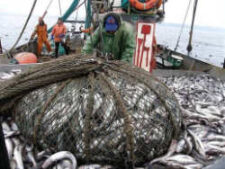
Russian companies presented fishing, crab harvesting, seafood processing, fishmeal, aquaculture feed, shipbuilding, logistics and marine technology. The Russian pavilion was the largest among 27 national pavilions, reinforcing Russia’s position as a major supplier in the Chinese seafood market.
The commercial results were supported by a substantial expansion in bilateral trade. Russian aquatic-product exports to China reached approximately US$3.32 billion in January-September 2026, increasing 53.1% year on year and already exceeding the approximately US$3.2 billion achieved during the whole of 2025. Russian Federal Agency for Fishery representative in China Sergey Mikheyev projected full-year exports of about US$4.2 billion. This makes the Qingdao agreements particularly significant: they connect an expanding export market with direct distribution, processing, product development and aquaculture-production partnerships. The most significant outcome of Russia’s tenth consecutive participation was the expansion of commercial cooperation beyond conventional frozen-fish exports.
The Strategic Anjoy Foods Agreement Creates A Direct Pollock-Processing Channel
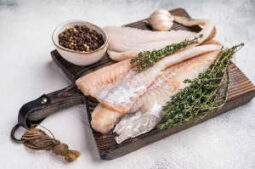
The most important company-level agreement was signed between Russia’s Russian Fishery Company and China’s Anjoy Foods Group. The strategic cooperation agreement provides for direct supplies of high-quality Russian pollock surimi, eliminating intermediary stages and establishing a traceable supply chain extending from fishing operations to Chinese consumers. The cooperation covers technical exchanges, product-quality specifications, logistics coordination, demand forecasting and joint marketing. Its significance lies in linking Russian pollock production with China’s food-processing and distribution industries rather than relying exclusively on sales of frozen raw fish.
Anjoy’s manufacturing and domestic distribution capabilities provide a potential route for integrating Russian surimi into processed seafood and prepared-food categories.
RFC’s joint stand with exclusive distributor the Pacific Rim Group attracted more than 15,000 visitors during the exhibition. The company also conducted business-to-business negotiations with Chinese, Japanese and South Korean representatives. The agreement was accompanied by an industry business breakfast dedicated to expanding the consumption of Russian pollock roe in China. The Pollock Catchers Association has been developing pollock-roe products with Chinese technologists and processors since 2023, adapting formulations and product formats to Chinese culinary preferences. Industrial samples were presented at Qingdao, moving the initiative beyond general market promotion towards commercial product development. The combination of surimi supplies and roe-based products creates two distinct value-added channels: industrial processing ingredients and consumer-oriented seafood products.
Chinese Retail Chains Open Distribution Channels For Russian Exporters
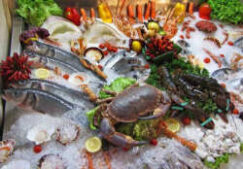
A particularly important business programme involved a Chinese retail delegation organised with the Marine Stewardship Council. Eight Chinese companies participated, including five major retail chains: Hebei Huiyou, Qingdao Aeon Dongtai, Hubei Yasheng, Chengdu Ito-Yokado and Tianhong. Their combined turnover exceeds US$3.5 billion, while their networks comprised more than 300 retail outlets. It is important to note here that developing the Chinese market requires attention to detail on a regional China basis, and that each of these retail chains cover specific areas of China. There are very few truly national retailers in China, mainly due to its huge size.
A representative of the China Chain Store & Franchise Association also participated. The delegation examined products from the Russian Fishery Company, North-West Fishing Consortium, Russian Crab Group, Sigma Marine Technology, Koryakmoreproduct, Fosforel, FOR Group and Krayrybakkolkhozsoyuz. Discussions covered supply opportunities, particularly pollock roe, processed seafood and products suitable for retail distribution. The significance is commercial rather than simply promotional: Russian producers are engaging directly with retailers whose combined business scale provides access to established Chinese consumer markets.
Russia’s Regional Exporters Secure International Business Contacts
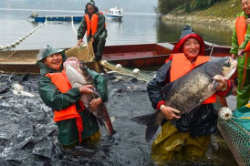
Primorsky Territory achieved one of the strongest regional results. Eight companies participated in the collective exhibition organised with assistance from the Primorsky Regional Export Support Centre. During the three-day event, they held negotiations with representatives of more than 100 companies from 12 countries: China, Japan, South Korea, Vietnam, Canada, Turkey, Singapore, Indonesia, Malaysia, Ecuador, Chile and Peru.
Chinese purchasers showed particular interest in cleaned squid fillets, Pacific cod, herring, flounder and other products with higher processing content. The negotiations demonstrate the value of regional export platforms: smaller fishing enterprises can access international purchasers through a shared exhibition presence rather than having to establish independent overseas sales networks.
The involvement of Japanese, South Korean and Southeast Asian buyers also gives Primorye’s companies opportunities to diversify distribution beyond China. The national pavilion brought together companies from Kamchatka, Primorsky and Khabarovsk territories, Sakhalin, Murmansk, Novosibirsk and Irkutsk regions.
Among the principal participants were Russian Fishery Company, North-West Fishing Consortium (SZRK), Russian Crab Group, Antey Group, Okeanrybflot, Dobroflot, Kamchatsky Meridian, Sigma Marine Technology, FOR Group, Koryakmoreproduct, Fosforel and Krayrybakkolkhozsoyuz. Fish Man of Novosibirsk and Food Team were among the processors represented through the broader Russian export showcase. The Russian Export Center coordinated the Made in Russia collective section, covering frozen and chilled fish, seafood, fishmeal, salmon roe and canned products.
Astrakhan Aquaculture Feed Enters The Chinese Market
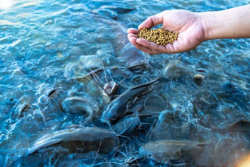
Another important commercial development involved Astrakhan-based Rybnye Korma, a resident of the Lotus Special Economic Zone. Following its Qingdao contacts, the company secured an initial export arrangement for a trial shipment of specialised high-energy aquaculture feed to a Chinese producer specialising in black caviar. The product consists of pellets beginning at 1.5 millimetres, with nutrient content reaching 36%, designed for intensive cultivation of valuable fish species.
The Astrakhan facility began operating in 2024, initially supplying sturgeon and trout feed to domestic producers in Murmansk, Karelia, Dagestan and Krasnodar Territory. Its move into China therefore represents a transition from domestic import substitution towards specialised exports of aquaculture technology inputs.
The Chinese partner also expressed interest in visiting the Astrakhan plant to inspect its production capabilities. The commercial importance extends beyond one trial shipment: specialised feed influences fish growth, production efficiency and ultimately caviar yields. Russia is therefore beginning to position its aquaculture industry as a supplier of production inputs as well as harvested fish and seafood. The wider industrial expansion supports this development. Russian aquafeed output reached approximately 74,700 tonnes in the first half of 2026, up 61.5% year on year. Annual production projections range between 160,000 and 200,000 tonnes. This growing domestic manufacturing base provides a potential foundation for further specialised exports, particularly to Asian sturgeon and trout producers.
Three Cooperation Tracks: Processing Equipment, Vessels & Raw-Materials
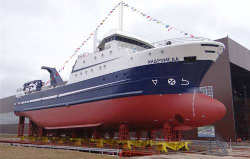
A separate Memorandum of Understanding was signed by a representative of a Russian region – the Kherson Region – and a major Chinese supplier of integrated technological solutions and equipment for the food and processing industries. The region was represented in Qingdao by Yury Shibaev, Head of the Fisheries and Aquaculture Department at the Ministry of Agro‑Industrial Complex of the Kherson Region
The memorandum covers three practical areas: Chinese equipment supplies for fish-processing facilities, potential joint production of small fishing vessels on regional territories, and Chinese purchases of fish raw materials from local producers. It establishes a preliminary framework for cooperation rather than a completed investment project. Its significance is the combination of equipment procurement, local manufacturing and raw-material purchasing within one prospective industrial relationship. If implemented, these arrangements could support regional processing capacity and create additional demand for locally harvested fish.
Qingdao Port – Russia Logistics Cooperation
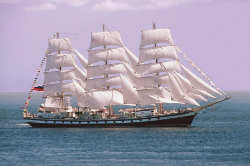
Logistics cooperation was another important outcome, with Expo Solutions Group CEO Ivan Fetisov held negotiations with Qingdao Port International. The meeting coincided with the arrival in Qingdao of the Russian Federal Agency for Fishery’s training sailing vessel, the frigate Pallada.
The discussions produced an outline plan for joint work during 2027, covering fish-product processing, transshipment and logistics involving Russian enterprises. The proposed cooperation is particularly relevant to exporters handling frozen seafood and other products requiring reliable port infrastructure, cargo handling and coordinated onward distribution. Expo Solutions Group also continued discussions with Liaoyu Corporation and the China Aquatic Products Processing and Marketing Alliance (CAPPMA). Both sides indicated interest in expanding the participation area of Chinese companies at Seafood Expo Russia 2027 in St Petersburg. These contacts provide a reciprocal exhibition and business-development channel: Russian companies gain access to Chinese buyers in Qingdao, while Chinese processors and suppliers receive opportunities to expand their presence in Russia.
International Business Programmes & Company-Level Partnerships
The Russian pavilion’s programme included the Russian Pollock Roe Business Breakfast, organised by RFC together with Sigma Marine Technology and the Pollock Catchers Association. Discussions focused on adapting pollock roe to Chinese cuisine, developing ready-to-eat products and expanding e-commerce distribution.
Gai Shi Food demonstrated pollock-roe ice cream, while Hainan Nanyang Food presented three varieties of low-temperature-cured roe, including a Hainan pepper-flavoured product. Weihai Weidao Food, which has more than 20 years of cooperation with Russian harvesters, also expressed its readiness to support market development.
On 29 October, RFC organised the International Golden Pollock Award ceremony, recognising five Chinese commercial partners. Joysun received recognition for pollock surimi sales, Poweron for expansion into new product categories, China Starfish for expertise in head-and-gutted fish filleting, Henderson for fishmeal sales, and Weihai Weidao for supporting the quick-service restaurant market and developing fillet business with McDonald’s. The awards recognised existing commercial relationships and market-development contributions, rather than representing five newly signed contracts.
Together with the business breakfast, they demonstrated how Russian suppliers are developing partnerships across processing, distribution, food service and consumer marketing. The Russian Fish House restaurant added a practical product-promotion component. Chefs prepared pollock and salmon dishes alongside tom yum, spring rolls with orange aioli and Russian pancakes served with pollock roe in an Asian-inspired presentation. This programme introduced Russian seafood to buyers through applications relevant to Chinese and wider Asian food consumption.
Russia’s Export Performance: Pollock, Cod & Crab Underpin Expansion
The commercial expansion at Qingdao coincided with exceptional growth in Russian seafood exports. An analysis by the Russian Fishery Shipowners Association (FSA), published on 20 October using Chinese customs statistics, put Russian fish-product export revenue at US$3.57 billion in January-September 2026, compared with US$2.33 billion in the corresponding period of 2025, an increase of 54%.
The FSA breakdown illustrates the scale of individual product markets. Pollock exports increased 22% in volume to 565,500 tonnes, while revenue rose 69% to US$1.0697 billion. Cod shipments increased 20% to 72,700 tonnes, generating US$581.5 million, up 71%. Haddock exports reached 19,500 tonnes, with revenue increasing 42% to US$131.6 million. Crab remained another major export category. Live crab shipments increased 21% to 33,000 tonnes, generating US$965.4 million, up 34%. Frozen crab exports rose 51% to 5,300 tonnes, with revenue reaching US$108.3 million, an increase of 93%.
Combined exports of pollock, cod and haddock generated approximately US$1.78 billion, while crab contributed around US$1.07 billion. These figures explain the commercial importance of the Russian pavilion’s emphasis on processed pollock, crab products and direct relationships with Chinese food manufacturers.
International Expansion & Future Exhibition Commitments

Cooperation at Qingdao extended beyond China. Venezuela confirmed plans to maintain its national pavilion at Seafood Expo Russia, while South Korea’s K-Fish programme planned to expand its exhibition presence. Brazil and Ecuador also expressed interest in participating in the St Petersburg exhibition. Russian companies, meanwhile, began preparing for their first participation at Seafood Show Latin America 2027 in São Paulo.
The leadership of Belarusian National Biotechnological Corporation (BNBK) also discussed joint promotion of products and technological solutions with Expo Solutions Group. These discussions extend cooperation into biotechnology and industrial solutions associated with fisheries and food production. The next China Fisheries & Seafood Expo will take place on 27-29 October 2027, marking its 30th edition. Russian organisers intend to expand the national pavilion further. Chinese companies are also expected to increase their participation at Seafood Expo Russia 2027 in St Petersburg, creating opportunities for reciprocal business engagement.
Summary: A Shift Towards A Globally Integrated Fisheries Trade
Russia’s participation in Qingdao produced three particularly important commercial developments: the RFC–Anjoy Foods strategic agreement, the Astrakhan Rybnye Korma trial export arrangement and the Kherson fisheries-processing memorandum. These were complemented by port-logistics planning, retail supply negotiations, more than 100 international business contacts involving Primorye’s eight companies, and expanded cooperation with Chinese processors and industry associations.
The exhibition’s importance therefore extends beyond the immediate value of individual agreements. Russia is developing commercial relationships across the entire fisheries supply chain, from harvesting and fishmeal production to surimi manufacturing, roe processing, aquaculture feed, retail distribution and maritime logistics.
Russia is not only exporting fish, it is inserting itself into the Russia-China supply chain by investing in joint venture ship construction, port logistics, distribution and additional services and products such as fish production additives for the local market. This is an increasingly sophisticated industry-wide development. Exports now include added value in the Russian strategic marketing mindset.
With seafood exports to China projected at over US$4 billion in 2026, the next stage will depend on converting exhibition negotiations and preliminary arrangements into recurring supply contracts, processing partnerships and expanded distribution. The tenth consecutive year of Russian national pavilion participation has consequently delivered a broader commercial platform: one connecting the Far Eastern fishing industry, northern fisheries, regional processing facilities and specialised aquaculture manufacturers with Chinese consumers and international seafood markets.
This article was provided by M. Jahan, an analytical reporter for Russia’s Pivot To Asia. Contact: info@russiaspivottoasia.com