 Русский







Meetings have taken place at the headquarters of the Eurasian Economic Commission under the chairmanship of the EEC Minister for Trade, Andrey Slepnev, dedicated to identifying trade barriers and promising spheres of cooperation with China. At present, China has a trade agreement with the EAEU; however, this is non-preferential and tends to be used only under specific circumstances. The EAE is looking at a more permanent arrangement covering multiple products.
The meeting was part of preparations for the sixth meeting of the Joint Commission established in accordance with the Agreement on Trade and Economic Cooperation between the Eurasian Economic Union and China. Representatives of state bodies, associations, and companies from various branches of the EAEU member states participated in the event.
Slepnev said that “the main goal of our meeting is quite pragmatic: in connection with the approaching routine meeting of the Joint Commission on the agreement on trade and economic cooperation between the EAEU and China, to look at the status of our relations, look at what hinders our work, and what issues can be introduced into the agenda for their promotion.”
He said that China acts as a key trade partner of the EAEU, accounting for 36% of all EAEU trade turnover last year and exceeding 40% so far during H1 2026. This makes a significant contribution to the economic growth of the EAEU, the dynamics of exports and settlements in national currencies, the development of transit and land routes, and high requirements applicable to the stability of supplies of sensitive goods.
During the event, participants discussed China market access and potential spheres of cooperation, including veterinary and sanitary measures, technical and climate regulations, protection of intellectual property, development of transport corridors, e-commerce, and support of trade transactions.
Slepnev added after the event that “Summing up the result of today’s meeting, it can be stated that the issues of trade digitalization, technical regulations, sanitary and phytosanitary measures, technical barriers in trade, financial support of exports, transport corridors, and supply chain safety must be in the focus of attention of our work with our Chinese partners.”
The event results, designated barriers, and proposals will be used both during the preparation of the agenda of the sixth meeting of the EAEU–China Joint Commission and in general in the further work of the EAEU on developing trade and economic cooperation with the Chinese side.
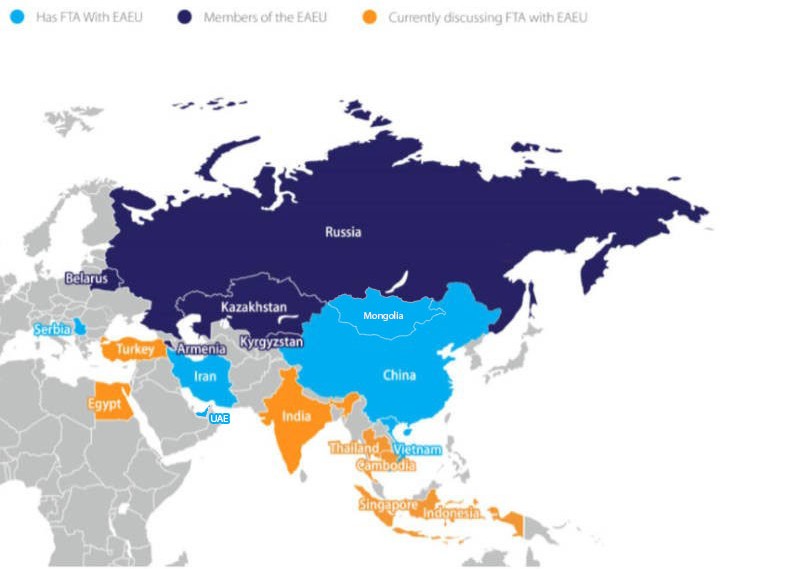
The EAEU fills the geographic space between Eastern Europe and Western China and includes Armenia, Belarus, Kazakhstan, Kyrgyzstan, and Russia. It has full free trade agreements with Indonesia, Iran, Mongolia, Serbia, the UAE, and Vietnam and is negotiating deals with Egypt and India.