Русский




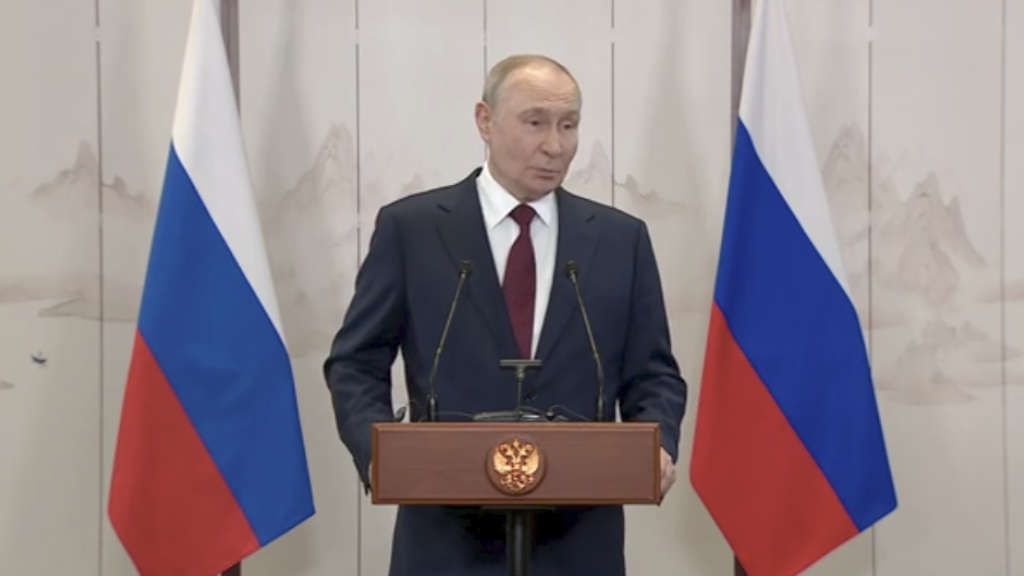

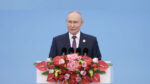
The Russian President, Vladimir Putin, gave an extensive press conference and Q&A session following the APEC summit in Shenzhen. This covered numerous topics including Putin’s comments on the Trilateral Summit with Presidents Trump and Xi, comparisons with Yalta, his overall impressions of APEC Shenzhen, several questions concerning Ukraine and negotiations with Europe, nominating Trump for the Nobel Peace Prize, European Security Architecture, Ukraine joining the EU, the recent discussions with the Presidents of Finland & Norway, the recent attacks on the Crimea bridge, the potential for AI Joint Ventures with China and the US, the possibility of him attending the next G20 and reform at the ICC, WTO and United Nations.
We provide the questions as Q, Putin’s responses as VP and our additional comments as RPA. This article is of high interest to anyone involved in Russian geopolitics and trade and the impact on Europe and Asia.
VP: “I suggest we skip opening remarks and go straight to your questions. Please.”
Q: “Nikita Korzun, NTV. Your trilateral meeting with Xi Jinping and Donald Trump looks absolutely historic. But do you think it was historic in essence? What did you discuss, and what will happen next?”
VP: “Nobody knows what will happen next. Only God knows that. However, I would really want it to have a continuation, at least because in terms of comparing notes, in a number of key areas, we have reached if not an agreement, then a mutual understanding. This primarily concerns its historical significance and the like. There have never been such meetings before. We have held the first meeting, which has opened a new page in the history of diplomacy.
As for what we discussed, by and large, the topics of our meeting did not differ much from those raised at the plenary session. However, since our three countries are permanent members of the UN Security Council, we talked about its reform, a possible reform of the UN and about increasing its potential. All of us agree that this should be done, and that the operation of this universal organisation should be adjusted to modern realities.
We talked about security matters in the broad sense of the word, about preventing the proliferation of weapons of mass destruction, nuclear weapons. We talked about issues pertaining to freedom of navigation. We support compliance with all norms of the international law of the sea. We discussed some issues related to the activities of certain organisations, such as the International Criminal Court, which is clearly overstepping its mandate and making political rather than legal decisions. By and large, all sides are in agreement on that.
We also discussed several other issues. You know, what I liked about that meeting, and what made an extremely positive impression on me, is that after we made our official statements, which we prepared in advance, in the presence of media representatives and your colleagues, we held an open discussion. I even think that none of us expected that. However, the President of China, who initiated this meeting, managed to create an atmosphere in which we freely exchanged views on several issues of mutual interest. It was probably the most interesting element of the meeting. Our discussion was held in a completely open and very candid atmosphere. It helped us understand each other better, and I think that this created conditions for future arrangements, no matter whether we do this in the same or in a different format. Overall, it was a very useful meeting.”
Q: “Good evening. Pavel Zarubin, Rossiya TV channel. You have known Mr Trump for nearly ten years now. We first saw the two of you meet at the G20 summit in Hamburg in 2017. Those meetings were typically followed by major, significant statements, yet they yielded no real results, often leading only to new sanctions instead. Even during Mr Trump’s second term, after the meeting in Anchorage too, the situation has been, to put it mildly, far from straightforward. In your view, is the current United States even capable of reaching agreements, and would they actually honour such agreements if they were to be concluded?”
VP: “You know, we are watching the situation closely. Members of the media, your colleagues who cover politics, are analysing this too, and they can see that the domestic political situation in the United States, and the country’s political system itself, is far from simple; one might even say it is rather complex. There are many checks and balances in place – various mechanisms designed to maintain a balance of political power. So, from the outside, things might appear inconsistent or not quite how we would like them to be.
But the most important point is this – and I have no doubt about it – President Trump is genuinely committed to resolving conflicts, including the conflict in Ukraine, and he is sincerely interested in improving bilateral relations across a range of areas, including, of course, the US-Russia relationship, which matters to us.
Naturally, we are observing developments. Of course, we would prefer to see things move faster and function more effectively. But we must deal with realities as they are, and we hope that this positive disposition will endure.
I mentioned this during our recent discussions in a multilateral format, and I can repeat it now. After all, we did work with President Trump during his first term. We did not work with him afterwards, once he left the presidency in 2020. Yet, both then and now, we share certain commonalities in our approaches – specifically regarding what are termed “civilisational values.” In that sense, there is something that, if not exactly uniting us, at least points to a certain alignment of views.
For instance, we were just discussing the issue of democracy – but what is democracy, really? Is it the liberal order that certain groups have sought, and continue to seek, to impose upon the entire world, fashioned according to their own template? Is that what democracy is? Or is it, in fact, a liberal attempt to monopolise power, a liberal dictatorship? What is it, exactly?
Reaching a common denominator – let alone fully implementing any agreements reached – is no simple task. Nevertheless, the general resolve of those we are engaging with today gives us reason to maintain a positive outlook. It is better to have some form of agreement, even if it is not fully realised, than to have no agreement at all.”
Q: “Zou Yun, with China Media Group. Regarding this historic meeting with President Xi and President Trump, what is the issue, or the issues, that you believe have achieved the greatest progress? And how do you understand the significance of the four proposals put forward by President Xi for global major powers to work together and save our global peace? And also, how would you describe the role of China in achieving those outcomes?”
VP: “In this instance, China’s role has been decisive, as it was President Xi Jinping who initiated this meeting, which has clearly been a success. I would like to reiterate that this was largely because the President of the PRC succeeded in creating a relaxed setting for an open discussion. Furthermore, he set the tone for this frank exchange, in that he acted not only as the host of the meeting itself but also as the one who suggested having this open dialogue. In my view, this is very important as it lays the groundwork for further engagement – not only for the exchange of information, but also for preparatory work on certain decisions, perhaps in a different format. But this format is, in my view, timely and successful, given, as I have already mentioned, that China, Russia and the United States are permanent members of the United Nations Security Council and, as such, international security depends to a considerable extent on us.
Therefore, I would like, firstly, to congratulate the President of the PRC on the success of his event, which proved highly productive, and secondly, to thank him for his initiative. I am confident that all the issues – and I have just named the topics that were tabled for discussion – were addressed promptly, and the very fact that they were discussed, and that common ground was found in order to resolve them, is undoubtedly positive.”
Q: “Anastasia Savinykh, TASS News Agency. Mr President, have our starting positions at the talks on European security become tougher than the proposals you advanced in 2021, which the West rejected? Will we demand any compensation from the West for the damage caused to Russia because of sanctions and strikes on our infrastructure with Western weapons? Is there any consensus on the territorial issue and ceasefire, or have the negotiations on this track hit a stalemate?”
VP: “Speaking about our demands and so on, we have not formulated them in such great detail. But it is certainly a legitimate question, because some people are trying to blame absolutely everything on us.
During my conversations with President Trump and discussions in the trilateral format, I reminded all sides how it all began. Regarding the Ukrainian crisis, it began with the coup d’etat in Kiev. It began with the military operation the new regime launched in the south-eastern regions of Ukraine which had not recognised the results of that coup.
We spent eight years – full eight years – trying to settle that crisis in south-eastern Ukraine. And all these eight years the Kiev regime conducted military operations there. It actually launched a war in south-eastern Ukraine. They publicly stated through their top officials, as all of you probably remember, that they do not intend to implement any peace agreements. Only after that did we recognise the new republics, the Donetsk and Lugansk republics, which were not recognised at that time.
Incidentally, I would like to once again recall that the people who have lived in these territories and acted in full compliance with Article 1 of the UN Charter. They did so in full compliance with international law. Only after that, and even then, not right away – actually, eight years after that – did we recognise their independence, signed an agreement on mutual assistance with them, and started providing assistance to them within the framework of our interstate agreement. This is how the conflict began.
It wasn’t us who started the war. We did not start any war at all. However, hostilities had been ongoing there for eight years: a war, in effect. We are simply trying to bring it to an end by providing assistance to the states that we did not recognise at first, but have now recognised, and with which we have concluded mutual assistance treaties. I reminded our colleagues of this today.
As for the demands, life moves on. There are certain issues or certain demands on our part that may be irrelevant today. Nevertheless, we have discussed these problematic, as I see it, issues and we remain ready to continue working through them with our partners via the appropriate channels.
As for compromises, of course there are compromises. How could there not be? They were proposed by the American side, and we accepted them exactly as they were presented, including during the talks in Anchorage. So, these compromises do exist, and we have supported them. The question is whether the other parties to the conflict – Ukraine and, in this case, its European sponsors – are prepared to accept them. In other words, do they want to reach an agreement to end hostilities, to end the war, by peaceful means or not? Judging by what we see at the moment, they don’t. But we shall see. Everything flows, everything changes. Perhaps they, too, will eventually realise that it is better to accept these compromises now than to face the reality later that they will have to accept anyway.
As I have said before, one can get the impression that the current authorities in Kiev have no desire to see an end to the hostilities, because that would immediately mean having to hold elections. They might retain power, perhaps, through blatant manipulation. However, it is highly unlikely that the current rulers in Kiev – the present regime – will be able to retain their power and, with it, the sources of income they derive from the war: plundering the national wealth that belongs to the people of Ukraine and siphoning off Western aid. That source of income would dry up. Therefore, they have no incentive to agree to put an end to hostilities or to create conditions for a lasting peace; indeed, as I have said before, a permanent peace, a peace that looks to the future. That is precisely what we are striving for. But if the Ukrainian authorities and their sponsors come to recognise these realities, then I believe the compromises we have been discussing, the ones I have mentioned, can be reached.”
Q: “Ivan Blagoi, Channel One. What would you say to those politicians in the West who are currently watching the news and are scared by the prospect of a new Yalta?”
VP: “Politicians, if they are true politicians, do not simply watch the news. Of course, they take a look to keep abreast of the news agenda. But, by and large, politicians should be making the news, not simply watching what is happening on the international stage.
As for a new Yalta – what was so bad about Yalta? Indeed, what was wrong with it?
Firstly, Yalta enshrined the victory over Nazism. I would not be against that. I believe it would be right to enshrine the victory over neo-Nazism, so that we can speak of eradicating the very ideological roots of xenophobia, Russophobia and other phobias, and of eradicating everything connected with collaborationism during the Second World War and collaboration with Hitler and his regime. What is wrong with that? That is the first point.
Secondly, after all, it was following Yalta that the conditions were created for the establishment of the United Nations. And for 80 years, thanks to those agreements, the world has largely lived without major global military upheavals. Yes, there are many regional conflicts, and they are underway now, but there are no global upheavals. And that is thanks to the agreements reached at Yalta. What is wrong with that?
And, finally, at Yalta, no one carved up the world. I want to emphasise this, and I want everyone to understand it. At Yalta, there was no division of the world into spheres of influence; Yalta simply reflected the realities that had taken shape after the Second World War. And what was to be done back then? Continue the war, or what? At Yalta, the realities were acknowledged, and in today’s conflicts, too, the realities will have to be accepted.”
Q: “Yelena Shiryaeva, Mir TV channel. At the summit in Shenzhen, which is one of the world’s technology hubs, as we were able to see, much was said about the development of the digital economy and artificial intelligence. Did you reach any agreements with the leaders of the United States and China on launching joint projects in this area? And what place does Russia now occupy in the race to develop these technologies?”
VP: “Your question sounds rather anxious. When people speak of a race, they usually have in mind an arms race, although, of course, artificial intelligence and its development open up a range of opportunities and pose a range of threats.
We have also discussed this during our trilateral meeting today, and there was general agreement that we need to address certain aspects of the use of artificial intelligence so as to ensure that it does not pose any security threats. That is true.
As for Russia’s position, we have companies that are clear leaders in this field, not only in our country but also internationally, actively expanding their operations in many countries around the world. We have a great deal to offer and share with our partners, and all AI-related technologies are developing rapidly in Russia.
For example, you know that Sberbank and Yandex are both very active in this field, along with other companies that are increasingly stepping up their efforts.
We have a global competitive advantage in this area, and I want to emphasise that: a global advantage. As I mentioned earlier today, during the APEC session… Actually, during the trilateral meeting rather; the development of artificial intelligence and data centres requires enormous amounts of energy. According to international organisations, by 2030, which is just around the corner, data centres around the world will consume as much energy as all of Japan does today. And Japan is a highly developed country in terms of technology, industry and its economy as a whole.
In this respect, Russia has a distinct advantage because we are a global leader in the development of nuclear technologies for peaceful purposes. Of the approximately 36, or 33–35, nuclear power plants currently under construction abroad, around 30 are being built by Russia’s Rosatom. We are quite simply the undisputed leader.
When it comes to small nuclear power plants, we are the only ones actually building them. We have already built some for ourselves. As you know, they are operating in the North, and two more platforms are currently being made. Many countries want to do this, and many say they are ready, but no one apart from us has actually done it yet.
We also have vast, world-class reserves of hydrocarbons, including oil, gas and coal, as well as enormous hydropower potential. And, of course, we have renewable energy sources, such as solar power and others. We have all of these resources, and we are actively developing them. In this sense, Russia has significant competitive advantages, which makes us an excellent partner for the many countries seeking to develop artificial intelligence, which, is, in fact, practically everyone. So, we have already developed strong technological capabilities. I have mentioned two companies working in this field. So there are substantial, objective opportunities for cooperation, and we are fully prepared to pursue them.”
Q: “Ilya Yezhov, RIA Novosti. I would like to ask you about the APEC summit. The event is taking place in Shenzhen, and you have had a very packed schedule. How would you assess this forum? What are its main outcomes? And, perhaps, you could share what you consider to be the major result for Russia? Thank you very much.”
VP: “First of all, we have all had the chance to get to know Shenzhen. It is an obvious success story for the People’s Republic of China – such colossal progress over the course of 40 years. It is essentially a megacity born – and not just any megacity, but a hub for intellectual and high-tech development. We congratulate our Chinese friends on this achievement.
As for the outcomes, first, I want to say that our work within the APEC framework is of great importance to us. A few years ago – I mentioned this today – we set ourselves a target of 40% growth in trade with the region; it has now exceeded 60%. We set that target well before the difficult events involving Ukraine. Why? Because this part of the world is developing rapidly, and we have natural partners here. The events in Ukraine and the so-called sanctions imposed against Russia – which are illegitimate and contrary to international law – have only accelerated this process. So this is significant for us.
We consider the outcomes to be positive, as we did more than just discuss topics which are of interest to all the participating countries – or, more accurately, all the participating economies. Twenty-one economies took part in today’s event, representing the entire region.
And it is crucial that we have once again reaffirmed the fundamental principles of economic relations. These include freedom of economic relations, ruling out restrictions of any kind, freedom of navigation – which we also discussed – and so on.
If we manage to put these principles into practice – at least here, within this region – it will undoubtedly serve as a major factor for the development of the global economy and for the Russian Federation.”
Q: “Stanislav Vlasenko, Zvezda TV channel. The term “European security architecture” is being heard increasingly frequently. What do you personally think this new European security architecture looks like? Does it mean NATO returning to its 1991, 1997 or 2021 borders? How do you envision it? And is it possible that Russia might have to sacrifice something? Or are we not going to sacrifice anything at all?”
VP: “We are not going to sacrifice anything. What we intend to do is seek compromises. I believe compromises are quite possible. As I have already mentioned in response to an earlier question, life changes. Therefore, it probably makes no sense to try to return to the situation that existed in the early 1990s, just as it makes no sense for some of our negotiating partners to try to push us back to positions that we will never return to. I mean, among other things, territorial issues. Everyone must proceed from the realities on the ground. This is true both for us and for those with whom we are trying to reach agreements to resolve various crises, including the one in Ukraine. Consequently, there can be no question of making any “sacrifices.”
Compromises are certainly possible. You know, I see no insurmountable obstacles to reaching agreements. You mentioned compromises. Well, we are prepared to make them.
The other participants in this process simply need to recognise the realities on the ground and, for their part, be willing to make compromises as well. That is it. I see nothing particularly complicated about this. All that is required is political will.”
Q: “Yelena Mukhametshina, Vedomosti newspaper. Following today’s talks, has it become more likely that you will accept President Trump’s invitation to attend the G20 summit?”
VP: “Yes, we discussed this. I am very grateful to President Trump for the invitation. He raised the subject again during our bilateral contacts, during our bilateral meeting and even after the trilateral talks had concluded.
Of course, I have to consider the situation here at home first and foremost. I do not always feel quite at ease if I make frequent trips abroad. Nevertheless, I am very grateful to Donald [Trump] for the invitation. That is the first point.
Secondly, and I will be quite frank with you, the Americans keep urging us to mend our relations with Europe. But we were not the ones who severed those ties in the first place. This “political blabber” needs to stop. What is all this talk about us “attacking” Europe? Everyone knows perfectly well that we have no desire to go to war with Europe. What nonsense! That is the first thing.
And there is another related point. First, we need to establish some kind of dialogue with them, and only then engage with them, including at international forums such as this one. Otherwise, instead of reaching agreements or finding solutions, everything could descend into the kind of horse-trading that is entirely inappropriate for an economic organisation.
I will think it over. We will see. We have taken no decision thus far. But in any case, I want to thank the American side for the invitation. Regardless of whether I attend, Russia will be represented by a high-level delegation.”
Q: “Aisel Gereykhanova, Rossiyskaya Gazeta. When we resumed the trilateral dialogue with Ukraine and the United States, we stated that we wished to discuss post-war security guarantees. Why discuss them when the conflict is at its peak and seems far from resolution?”
VP: “Do you know what the essence of the matter is? It is security for both Russia and Ukraine. We acknowledge that Ukraine has a right to security, just as Russia has – it is simply that no one wants to discuss Russia’s security. And that is a matter of considerable importance to us, to put it mildly.
I must refer you back to 1991, when we were promised that there would be no eastward expansion of NATO. The then Secretary General said that Russia could be absolutely certain of one thing: that NATO would not advance a single step to the east. Incidentally, it was a representative of the Federal Republic of Germany who held the post of Secretary General – I do not remember his name, but that is not important. Yet we were deceived then, and so it began – five or six waves of expansion. Ultimately, they reached Ukraine.
After all, why do we keep drawing attention to the coup d’état in Ukraine? One may judge President Yanukovych’s record in any possible way – incidentally, he had agreed to hold early elections in just under three months’ time, but he was against Ukraine joining NATO. He was toppled in a coup d’état, and immediately the notion of Ukraine joining NATO emerged. And what was there in 2008? A decision was taken to open the door to NATO for Ukraine.
And, incidentally – I have already spoken about this more than once – when Ukraine gained independence, its Declaration of Independence stated that Ukraine was a neutral state. Then suddenly – bang! – came the push for NATO accession. Both on the part of NATO and on the part of Ukraine itself after the coup d’état.
But we repeated this a thousand times: wait, there is no need for this, this is unacceptable to us. Forgive the breach of etiquette, but they could not have cared less about our opinion, because they believed that there was nothing left to discuss with Russia and that all that was needed was to pressure us. So they pushed matters to the point where this pressure led to military action and to war. Are we to blame for this? No. Those who did this and pursued such a policy are to blame. They simply do not want to admit it, and probably never will.
But everyone will have to proceed from the realities I have outlined and, on the basis of those realities, I hope, we will reach an agreement after all – we will be able to do it.”
Q: “Steve Rosenberg, BBC News. Regarding the trilateral meeting: what exactly are we witnessing today? Is this the emergence of a new global security architecture, the first step towards a new world order, or simply a well-staged photo opportunity with three leaders at a table?
And on the declaration that was adopted – the “Declaration Toward Peace” – I believe I heard you say that the United States, Russia, and China share a joint responsibility for maintaining international peace and security. Yet Russia continues to strike Ukraine – which seems contradictory. So, following today’s talks and this declaration, are you prepared to end the war? And did Donald Trump urge you to do so during today’s talks?”
VP: “Let’s start with the first part of your question. Was this just a photo opportunity, or the beginning of some new framework? It’s neither. It was not merely a photo op – it was a serious, collaborative effort. Is it the beginning of a new framework? Not yet. But as I have already said – and our partners in today’s meeting broadly agree – there is a consensus that this is a useful format.
Could it continue? Perhaps. But this format does not set out any grand, overarching objectives, nor does it seek to compel others to accept our decisions. Its purpose is to find solutions that are mutually acceptable to the three of us, primarily regarding security. If those solutions prove acceptable to other members of the international community, we would, of course, welcome that. That said, we did not agree to meet regularly in this format; so it is not a new framework – at least, not yet. At the same time, it would be wrong to dismiss it as a mere photo opportunity, because the discussion was both useful and substantive.
Now, regarding our strikes: did you happen to notice the strikes on the Crimean Bridge – a purely civilian piece of infrastructure? How could you have failed to notice it? I would ask you to look into this. Take, for instance, the 40-day operation announced on June 4, targeting Russian energy infrastructure and our tankers. Are those not strikes? They most certainly are – and significant ones at that. So to suggest that this is solely a Russian initiative would be, at the very least, incorrect and inaccurate.
Now, on negotiations – including those concerning Ukraine: yes, the President of the People’s Republic of China and President Trump have spoken of an interest, shared by China, the United States and, indeed, by the entire world, in bringing the conflict in Ukraine to an end. Russia, too, is interested in ending the conflict. I assure you, we have no desire to continue this armed conflict.
However, the issue today does not lie solely – or perhaps even primarily – with us; it lies with the Ukrainian side. Let me reiterate: if they truly want to end the conflict, they should agree to the compromises that were proposed by the Americans even before the Anchorage talks. We accepted those terms; now, it is up to Ukraine.
Ukraine says: we will hold the remaining 10% of Donetsk People’s Republic territory for some time. But even if they manage to hold it for a while, only to eventually lose it anyway, is there any point in clinging to that 10% at all costs? It is a blunt but entirely legitimate question.
So this is not just a matter for us; it is also a question concerning the regime that has established itself in Kiev – a regime whose origins can be traced back to the coup d’etat. Yet even with these people, we remain open to dialogue.”
Q: “Pavel Minakov, Interfax news agency. My question concerns the trilateral talks on a settlement in Ukraine involving the United States and the Ukrainian side. Recently, American negotiators stated that the next round would take place in the near future. Has a date been set for the next round? Will there be a place for the Europeans at these talks, and if so, in what format? Is the three-point plan recently published by Jared Kushner acceptable to the Kremlin, and to what extent?”
VP: “First of all, I would rather not comment on the plan at this stage, as any plan is a subject for discussion. As for the timing, we have not set any dates. We are ready to continue this dialogue, but no specific dates have been fixed.
As for European participation in these talks, the American side has been insisting – indeed, insisting – that we agree to their involvement. Yet every day we hear what European leaders are telling us: war, war, we must prepare for 2030. We are not planning to attack anyone, so what exactly is there to prepare for by 2030? Yet we hear it all the time from them. Is that normal? I think not.
Nevertheless, we understand that discussing security issues, including European security, without the Europeans is pointless. Why do I say this now in connection with Ukraine? The answer is very simple: because one of the key components of a settlement, in the view of the Ukrainian side, is ensuring its security. And we agree: just as Russia’s security must be ensured, so too must the security of Ukraine itself. That is true. The question is how it should be ensured.
Therefore, we accepted the proposal from the American negotiators – the proposal that Ukraine’s security should be embedded within pan-European security. What is wrong with that? What is behind the hysteria we are now seeing in certain European capitals? What is wrong with Ukraine’s security being embedded within European security?
It is clear that discussing Europe’s security without Europe would be rather strange, would it not? We are not against it, but we need to understand what Europe would bring to the table. That is why, through diplomatic channels, we invited the Europeans to Moscow to define their position. After that, we will decide on the format in which to continue the dialogue with Ukraine.”
Q: “Andrei Kolesnikov, Kommersant. Mr President, you have stated that you believe Donald Trump sincerely strives for peace. I wonder if Russia might finally nominate him for the Nobel Peace Prize?”
VP: “You know, we have discussed this half-jokingly. But let’s not forget that the Nobel Committee’s funds originated from Nobel’s business dealings in Russia. The initial source of that wealth came from his business projects in Russia. He was involved in oil, alongside other projects. And then came the noble act: he set up a fund, and today that fund distributes money to its laureates. And people no longer stop to think that this money is originally of Russian origin – they want no trade or economic ties with us, yet they are happy to receive the money and cash it in through the Nobel Committee.
So, I do not know whether today’s Nobel Peace Prize holds much value. Especially since, in my view, there have been cases where decisions were clearly made for political reasons rather than on the strength of a particular nominee’s genuine contribution to international peace and security.
I question whether it is even worth striving for these days. We are ready to work in that direction. You are aware that we have our own awards, overseen by a committee of highly esteemed individuals who make impartial decisions – on specific matters in the fields of international peace and security and humanitarian activity.”
Q: “Alexander Yunashev, Life. At the trilateral meeting, you discussed, among other things, reforming the ICC and the UN. And what about other organisations? For example, the WTO, which Xi Jinping proposed.”
VP: “We did not discuss reforming the ICC. You know, as I understand our friend and the President of the China, WTO reform means that the existing rules must be observed. For a very long time they have been nullified, and in fact no one pays any attention to them. They are not used as tools in international trade. That is damaging, because it undermines the entire system of international trade relations.
One of the tools intended to protect the norms developed within this international universal organisation is arbitration. Unfortunately, our Western partners are blocking the normal functioning of this body and will not allow disputes to be resolved within this organisation.
In fact, for many, many years now, the WTO’s activities have been paralysed. I do not think we need to change anything substantively; we just need to ensure that all the norms written, set out and recorded there are actually fulfilled.”
RPA: The US-Russia-China Trilateral did express dissatisfaction with the ICC, and especially Trump – but not reform – none of these countries are signatories to the body and are not members. Putin’s reference to the WTO is also a reference to it being completely bypassed by the use of unilateral sanctions. Trade disputes are supposed to be heard at the WTO before a collective decision is made as regards any infringement. Yet both the United States and European Union in particular have ignored this step, despite being signatories to the WTO itself. This is why Russia refers to sanctions and tariff increases as ‘illegal’ – because they have not been agreed by the WTO.
Q: “Valery Sanfirov, Vesti FM radio. Mr President, 25 years ago, you were in China for the APEC Summit, where you met with the President of the United States before flying overnight to Tajikistan. Now you are once again in China for the APEC Summit and are again flying overnight to Tajikistan to discuss certain issues. Is it Afghanistan again?”
VP: “It is simply a coincidence. Not long ago, as you are aware, Mr Rahmon was in Moscow, but we were working within the framework of the CSTO – the Collective Security Treaty Organisation – and the schedule was such that there was no opportunity to discuss other matters of bilateral importance to us.
They concern, first and foremost, Afghanistan, among other issues. As you saw, our government delegation led by Deputy Prime Minister Alexei Overchuk visited Afghanistan, and I would like to brief Mr Rahmon on the results of that visit and on the prospects we see for developing cooperation on the Afghan track.
As you know, we maintain our 201st Military Base there, which, in my view, is a real and effective guarantor of security in the region. We need to discuss this subject – that is, security issues, including the continued operation of this base.
Finally, there is a matter of our bilateral relations. There are many issues to address. Our trade and economic ties are developing at a steady pace, and there are promising large-scale joint projects. All this will be the subject of our meeting in Dushanbe.”
RPA: We cover the Putin-Rahman meeting in Dushanbe here.
Q: “Anton Zolotnitsky, Izvestia. Mr President, during the summit, you held bilateral talks with the President of China. We are actively cooperating across various spheres, and our trade is growing. The day before, you visited the joint Russian-Chinese university. We are also making films together. A trailer for the new Russian-Chinese film, Black Silk, a sequel to Red Silk, was recently released. What is the main issue on the agenda of our bilateral relations?”
VP: ”First of all, as both President Xi and I have said on numerous occasions, we say that Russian-Chinese relations, or the Russian-Chinese tandem, as we put it, is one of the cornerstones of the modern system of international security. It is a major factor of containment and global balance. Those are not empty words; it really is true. It is a key sphere of our collaboration.
Second, there are also our economic ties. Last year, our trade turnover reached a record high of US$240 billion. I think we will report a new record this year, reaching US$280 billion. This is an impressive sum, and it continues to grow.
Furthermore, we are implementing major joint projects in energy and logistics. As you know, the first Chinese vessel passed through the Northern Sea Route. We are ready to expand this project.
Incidentally, I told our APEC partners that we are ready to develop business contacts and implement such projects with all countries interested in working with us in that area.
Speaking about the humanitarian sphere, the tourist flow has grown considerably. You know, you can easily learn about this by speaking with people. It is a good way for them to promote small and even medium-sized businesses, and get to know each other better. The two-way tourist flow is growing rapidly. I see this as yet another achievement.
And lastly, culture and art. You mentioned Red Silk, and the upcoming release of Black Silk. There are ongoing exchanges between our leading concert groups, musicians and theatres, not to mention the cross-years of education, culture and so on. This brings people much closer together and increases the level of trust between nations.”
RPA: The trailer to the film Red Silk can be seen here and for Black Silk, here.
Q: “Gleb Ivanov, Argumenty i Fakty. Mr President, you recently spoke with the Prime Minister of Norway and the President of Finland, and following that conversation they discussed the need to pursue peace in some form and to hold negotiations with Russia – the President of Finland said as much.
Nevertheless, quite recently Finland barred Russian athletes from entering their country to take part in competitions. It might seem a small matter, but it comes precisely at a moment when negotiations appear to be gathering pace… Something does not quite add up. How do you view such actions by the Finnish authorities?
My second question is also related to this. We have heard a great deal from Western countries about the need to observe international rules – that international organisations exist, that they take decisions, and that those decisions must be followed. The Court of Arbitration for Sport ruled that our athletes should be admitted to competitions, yet these Western countries now refuse to comply.”
VP: “My comment is very simple. Regarding our telephone conversation with the President of Finland, our partners did indeed indicate, albeit in general terms, that dialogue should be pursued in some form, and so on. Yet the subsequent actions, including in the sphere of sport – the refusal to allow our athletes to take part in international competitions – are a step in the opposite direction. This is inconsistent, and it erodes trust. What else can one say? Naturally, this immediately spills over into another sphere – politics. How can dialogue be conducted when the level of trust is not rising but falling?
As regards the failure to implement decisions of the Court of Arbitration for Sport, that is worse still. It amounts to a disregard for the norms of law – in this case, the norms of international sports law. It is a blatant violation of the Olympic Charter and a step towards dismantling Olympism as a whole. Sport, like art, should unite people. But apparently some do not want such unity; they seek instead to escalate tension and conflict in the regions of their activity and responsibility, and perhaps elsewhere too.
It sometimes seems to me that without a change of political elites in certain European countries, nothing can be done to achieve a full normalisation of relations. At the same time, we see that the people of these European countries and their public organisations do not want the plans we now hear about in certain European capitals to be carried out; they do not want militarisation, and they do not want any wars, especially with Russia.”
Q: “Margarita Simonyan. You spoke about nobility, and this is actually the question that, by our reckoning, is uppermost in the minds of our subscribers and viewers at the moment.
You mentioned Nobel’s noble gesture. Shortly before his actual death, Nobel read about himself that he had died. Some of the obituaries said that the villain who had invented dynamite was dead. He was deeply upset and thought that he had to do something to change the way humanity thought of him. And so he came up with the idea of the Nobel Prize.
People are asking about what we are doing now. We have taken a much tougher line against Ukraine, but even now we are not being as tough as we could be. Trump himself said just two days ago – you probably saw his remarks – that we are acting much more moderately than we could. Is this what our nobility consists of: the fact that we only ever respond to their actions? They attacked our oil refineries, and we retaliated. Today, you said something that I think will make people across our country very happy: after their attack on the Crimean Bridge, we will no longer try to reach any kind of agreement with them; we will strike back even harder.
So is the fact that we are not being as tough as we could be an expression of that genuine Russian nobility, the same quality that was evident during the Great Patriotic War – that the wolfhound is in the right, but the cannibal is not? Or are there other considerations behind it? For instance, you mentioned the Almighty at the beginning of the news conference, the only one who knows what the future holds. What if He decides that all of this will eventually belong to us? Why, then, should we be destroying what is ours? That could happen, couldn’t it? And I am not talking just about Donbass.
People are asking about this a great deal. Why is it this way?”
VP: “This is not a question of nobility, although nobility is a fine quality, and there is nothing wrong with it. But the considerations here are primarily pragmatic. Above all, we want to preserve at least some possibility of reaching a peace agreement. That is the main consideration. However, we will always respond to the actions of the other side, which is hostile in both the literal and figurative senses of the word.”
Q: “Valentin Alfimov, Komsomolskaya Pravda. Mr President, my question also concerns the strike on the Crimean Bridge. It will be out of service during the repairs. But there are millions of people there. How will we supply them with food?”
VP: “As I have already said, we did not use the bridge to transport military goods or petroleum products. We transported them via other routes. We will now use those routes to deliver other cargo, and food products too. Is there any other way? We will need to increase some shipments.
Incidentally, we have always said that there must be an overland connection between Crimea and the rest of the Russian Federation, because the Kiev regime kept saying that it wanted to destroy the Crimean Bridge. We have established an overland route through the Zaporozhye and Kherson regions, and we will continue to expand our presence there, including in response to the strikes on the Crimean Bridge. This should be clear to everyone. We will also strengthen the protection of that overland route, the Novorossiya route.
This is no easy task. In a way, it even resembles the Road of Life across the ice of Lake Ladoga during the war. We have sustained losses there. Most of the victims have been civilian drivers. They are heroic people. We will do everything in our power to protect them and the route, pushing the enemy further away in that area, as well as in other areas, and creating security zones along our border. This will be one of the consequences of the attacks on the Crimean Bridge. Also, I believe that rail traffic across the bridge has resumed.”
Q: “Hassan Nassr, Russia Today. Mr President, you recently said that the security zones being established in three regions would not be on the agenda of peace talks. Does this mean that Russian forces will remain there until the end of the special military operation, and these territories will be able to join Russia in the future?”
VP: “You know, for now, we regard them as security zones. But people live there, and we will do everything we can to ensure that they have the same living conditions as in the other territories of the Russian Federation. At least, that is what we will strive for. As for how this could be formalised legally, that is a separate matter that will require painstaking work by our lawyers.”
Q: “Alyona Nefyodova, Izvestia. Kiev has not stopped its attempts to join the EU, which is becoming a military-political bloc more than an economic alliance. How likely do you think it is that Ukraine will join the EU in the near future? Has Moscow’s attitude to this issue changed in light of the bloc’s transformation?”
VP: “There has been no visible transformation so far, but there is a striving towards this goal. You are absolutely right, this is a serious challenge and a serious issue for us. As for economic cooperation, if the people of Europe want to feed Ukraine, that is their business. As for whether Ukraine’s full membership in the EU is realistic at this point, that is a matter for the EU and Ukraine themselves. But potential military cooperation in any form is, of course, an issue to which we must pay particular attention.
What is actually happening? We keep saying that the deployment of any troops in Ukraine is unacceptable to us. What do Europeans reply? They say they want the war to end, following which they will immediately dispatch troops [to Ukraine]. What does this mean? They are actually telling us that they will not allow peace to be restored in Ukraine. That is what they mean. We need to address this.
That is why we have invited EU representatives to come to Moscow to discuss all these issues, including matters related to the security of Ukraine, Russia and Europe as a whole.
We must wrap up now. Thank you very much.”