Русский




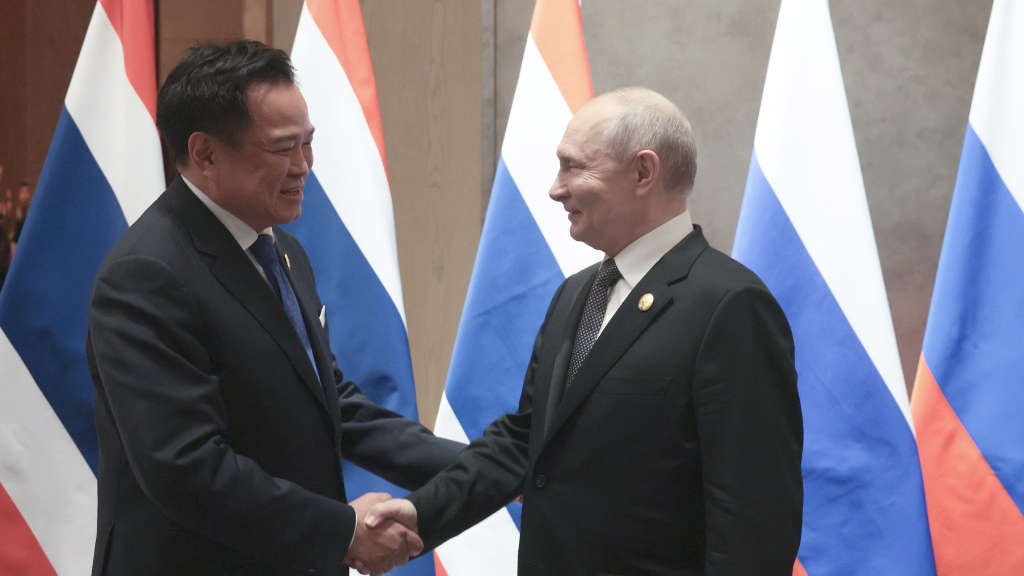

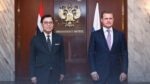
The Russian President, Vladimir Putin, met with the Prime Minister of Thailand, Anutin Charnvirakul on the sidelines of the 2026 APEC Summit in Shenzhen. Both sides had significant trade delegations.
Taking part in the meeting on the Russian side were also Foreign Minister Sergei Lavrov, Deputy Prime Minister – Minister of Finance Anton Siluanov, Deputy Prime Minister Dmitry Chernyshenko, Deputy Chief of Staff of the Presidential Executive Office Maxim Oreshkin, Deputy Chief of Staff of the Presidential Executive Office – Presidential Press Secretary Dmitry Peskov, Presidential Aide Yury Ushakov, Minister of Defence Andrei Belousov, Minister of Economic Development Maxim Reshetnikov, Minister of Energy Sergei Tsivilev, Minister for the Development of the Russian Far East and the Arctic – Russian Co-chair of the Joint Russia-Thailand Commission on Bilateral Cooperation Alexei Chekunkov, Special Presidential Representative for Investment and Economic Cooperation with Foreign Countries, CEO of the Russian Direct Investment Fund Kirill Dmitriev, First Deputy Governor of the Central Bank Vladimir Chistyukhin, Chairman of the Management Board of NOVATEK Leonid Mikhelson, Director General of the Russian Export Centre Veronika Nikishina, and Chairman of the Delovaya Rossiya National Public Organisation Alexei Repik.
This is what they had to say:
Vladimir Putin: “Mr Prime Minister, friends, I am pleased to meet you again. We last met during the Russia–ASEAN Summit in Kazan in June. Thailand is our long-standing partner. Next year, we will mark the 130th anniversary of the establishment of diplomatic relations. We are determined to continue developing multifaceted interstate ties.
Contacts between our governments, parliaments and foreign ministries are being actively maintained. Bilateral trade is growing. In 2025, trade turnover increased by 2.3%, and in January–August of this year it grew by 37.4% compared with the same period last year. That is a good result.
There is considerable potential for mutually beneficial cooperation in energy, transport, logistics, agriculture and investment. The Joint Commission on Bilateral Cooperation is called upon to facilitate progress in these areas.
Cultural and humanitarian contacts are developing. This year, a number of events were successfully held in Thailand as part of the Russian Seasons festival. We traditionally pay close attention to education. For the 2026–2027 academic year, Thailand has been allocated 50 state scholarships, and around 109 young Thais are currently studying in Russia.
Thailand is also very popular with Russian tourists. In 2025, almost 2 million Russians visited Thailand. In the first nine months of this year alone, that figure has already reached 1.3 million.
Our representatives coordinate their positions at various international and regional forums. We cooperate constructively within APEC and as part of the Russia–ASEAN dialogue partnership
Mr Prime Minister, we welcome your country’s participation in the activities of BRICS as a partner state since 2025.
Our relations are developing across a wide range of areas. I am pleased to be able to discuss today the opportunities created by what we have achieved so far, and to talk with you and your colleagues about what we must and certainly will do together in the near term. Thank you very much.”
Anutin Charnvirakul: “Thank you very much, President Putin. It is a great pleasure that I can see you again for the second time within this year. And I am thankful for your time that you allow us to come and meet you even at this late hour.
Since we met, I have seen many more development and collaborations between our two countries. Recently, I have received many business executives from Russia by myself, and I also had a long conversation with your Deputy Prime Minister who visited Thailand about six weeks ago. We understood each other, and we would want to see at least a bigger volume of trade between our two countries, because we still have big room to expand.
It is very surprising that, given the capability of our two countries, our trade value remains – I would say – still very low. We hope to find ways today to improve this.”
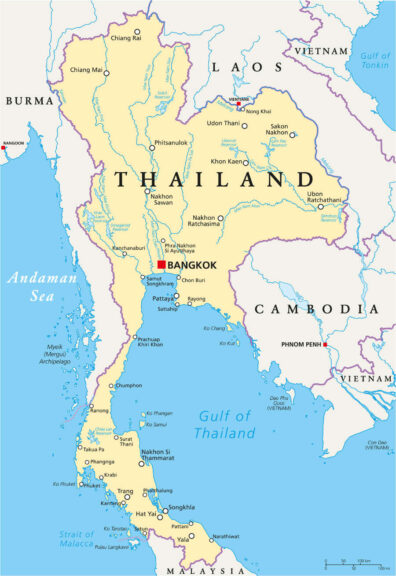
A member of ASEAN, Thailand has a diverse economy with key industries that drive its growth. Agriculture remains important, with Thailand being one of the world’s top exporters of rice, rubber, seafood, and tropical fruits. The manufacturing sector is also strong, particularly in electronics, automotive, and textiles. Thailand is a major producer of electrical appliances, computer components, and vehicles, especially commercial ones. Tourism is another significant part of the economy, attracting millions of visitors each year, which supports hotels, restaurants, and other service industries. In energy, Thailand mainly relies on natural gas for electricity but is working on increasing renewable energy sources. Looking to the future, Thailand is focusing on industries like next-gen cars, smart electronics, medical services, and biotechnology, with plans like the Eastern Economic Corridor (EEC) driving growth in these areas.
Thailand is also a member of the Regional Comprehensive Economic Partnership (RCEP), which went into effect in early 2022, and is the most recent of Thailand’s 14 free trade agreements with 18 nations. Thailand is also negotiating FTA with the Bay of Bengal Initiative for Multi-Sectoral Technical and Economic Corporation (BIMSTEC) Free Trade Area; the Thailand-European Union Free Trade Agreement; the Thailand-Pakistan Free Trade Agreement, the Thailand-Turkiye Free Trade Agreement. From January 1st, 2025, it became a BRICS Partner nation.
Thailand has an area of 513,120 sq km and the population of 71.5 million. It has a GDP (PPP) of US$1.98 trillion, a GDP (PPP) per capita of US$27,724 and a 2026 forecasted GDP growth of 2.4%.
Thailand holds a strategic position in Southeast Asia for Russia, acting as a gateway to the broader ASEAN region, and notable for being the regions second largest economic power. Recognizing this, Russia inaugurated a consulate in Phuket in July 2023, underscoring its keen interest in bolstering trade relations with the country, which is also popular with Russian tourists, some of whom establish small businesses.
Thailand, along with numerous other Southeast Asian nations, has refrained from imposing sanctions on Russia, acknowledging its role as a crucial trade partner. Furthermore, Russia plays a central role in Thailand’s foreign policy, which is increasingly focused on diversifying its international relationships. However, despite these dynamics, the bilateral trade between Russia and Thailand has experienced a substantial decline which has not been caused solely by the conflict in Ukraine but rather illustrated the overall challenges – distance and the lack of viable trade routes that Russia is facing in redirecting its trade focus towards Asia.
Russia-Thailand Bilateral Trade
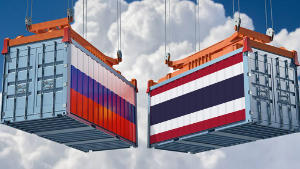
Russia typically traded with Thailand via the Suez Canal, but military activities in the Red Sea have made this route unworkable for the time being. Instead, Russia is looking to expand its Eastern Maritime Corridor via Vladivostok to India and Southeast Asia to include Thailand’s ports. There is the will – Russia’s Agroexport Centre suggests that Russian agricultural exports have the potential to increase by a multiple of five times. Similarly, Thai products such as canned coconut milk and other condiments, as well as seafood such as prawns are now finding their way into Russian supermarkets.
Bilateral trade between Thailand and Russia has accelerated sharply in 2026, rising by 25% to 37.4% year-on-year during the first eight months of the year. According to figures cited ahead of the October 2026 Russia-Thailand Investment Forum, trade turnover reached US$1.55 billion in January–August 2026 (up from roughly US$1.7 billion across all of 2025), while Russian authorities reported a 37.4% jump in trade value over the same eight-month span. If maintained, bilateral trade will reach US$2.32 billion for the year.
Russian exports to Thailand have surged, growing by 71.3% in the first half of 2026 and up to 76%-90% in January-August 2026-led by aluminum, light distillates, wheat, copper ores, potash fertilizers, and fur/raw hides. Imports from Thailand into Russia grew by roughly 20%, featuring electronics, fruits, and nuts.
At the second Russian–Thai Investment Forum in Bangkok in October 2026, business leaders and chambers of commerce identified prospective investment projects valued at over US$4.1 billion to US$4.6 billion. Russian foreign direct investment in Thailand has reached US$1.15 billion.
At the Thai Prime Minister Charnvirakul’s meetings with Russian President Vladimir Putin, they discussed bilateral ties, with Anutin urging early talks on a free trade agreement between Thailand and the Eurasian Economic Union (EAEU). If this is ratified, there will be significant growth in bilateral trade. A timeframe for this can be reasonably expected for late 2027 early 2028.