 Русский




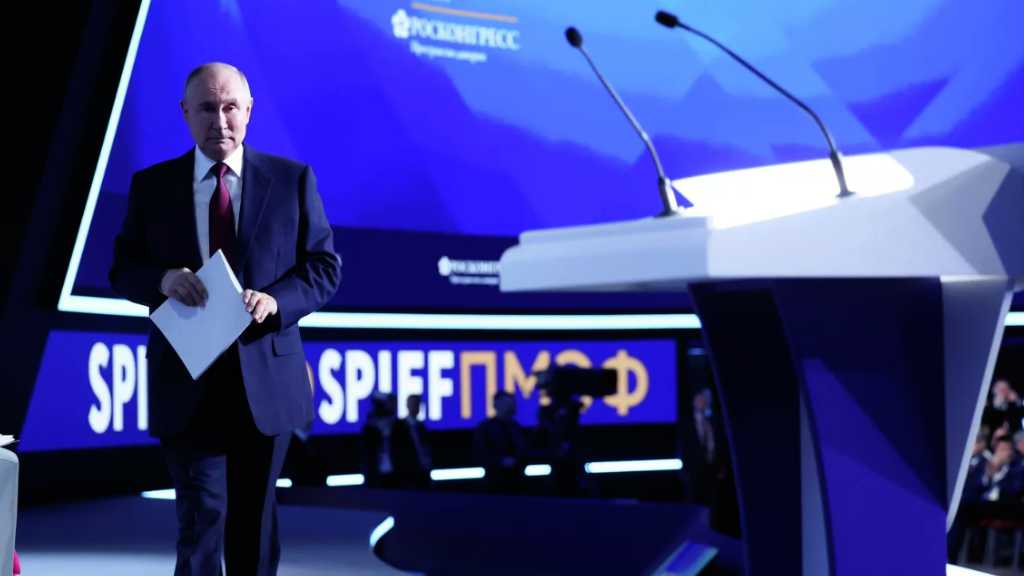

The Russian President, Vladimir Putin, has given his annual speech at the St.Petersburg International Economic Forum (SPIEF), an event designed to showcase Russia’s economic development and investment opportunities. He discussed Russia’s perspective on current global affairs, developing Eurasia, sanctions, global and Russian economics, the meaning of sovereignty, and Russia’s own development plans. Putin’s comments are prefixed VP, ours as RPA.
VP: “Good afternoon, ladies and gentlemen. It is a real pleasure to see such a distinguished audience here. The President of Uzbekistan and I were just comparing notes. He remarked that the hall is full – which speaks to the level of interest that the St Petersburg International Economic Forum generates. I would like to welcome all participants and guests.
Russia and St Petersburg are once again hosting executives from leading companies, business leaders, and experts – this year from more than 130 countries – all here to expand business contacts and forge new ties.
The unrivalled and appealing nature of the St Petersburg Forum lies precisely in the opportunity to engage in free dialogue on matters that are of interest to entrepreneurs, entire industries, and even entire countries. We remain open to everyone interested in engaging with our country and is ready to pursue equal and mutually beneficial cooperation. We are convinced that this particular approach where partners hear one another, understand their partners’ interests, and identify common solutions represents a harmonious path of development and makes it possible to respond to the serious challenges facing the modern-day world.”
RPA: Note that when Russia hosts events, even if there are critical (and even rude) remarks, Russians do not walk out of meetings. This is in contrast to events held elsewhere, even at the United Nations and other global stages, where the mass walk-out of politicians and delegates when a Russian delegate is due to address the audience has become an unfortunate (and insulting) trend.
A Global Overview From Russia’s Perspective
VP: “We are witnessing turmoil in the energy markets and tensions being provoked in certain regions, primarily in the Middle East, and how the short-sighted EU bureaucracy policies are being implemented to the accompaniment of aggressive rhetoric and leading to Europe continuing to lose its standing in the global economy, while also undermining regional and global security. In fact, European elites are inciting chaos and are trying to embroil ever more countries into it.
These processes did not arise all by themselves; they are the result of the world undergoing the largest structural transformation in decades. This transformation is not a transition from one phase of a cycle to another. We are witnessing a change in the paradigm of global development.”
I would like to bring your attention to what came before. For decades, the global development model was built around a limited number of financial centres, technological solutions, insurance and logistics hubs, credit rating agencies, and reserve currencies. This construct was presented as universal and supposedly suitable for everyone, and, above all, as supposedly neutral. In reality, however, it was increasingly used as a tool to exert political pressure and promote unfair competition, where settlements, technologies, logistics, or even access to information could be cut off at a moment’s notice in order to punish those who chose to act in their own national interests. In essence, it was a deliberately created system of dependency and resource extraction.
Today, the overwhelming majority of countries see this, as do entrepreneurs, banks, manufacturing companies, farmers, and transport operators. It has become clear that investment plans and business development steps may face serious risk where the external infrastructure on which they rely could be used against them. Therefore, countries are beginning to develop their own technological solutions, create their own supply routes, and build their own institutions.”
RPA: Putin refers to an irreversible shift in the global economic center of gravity, and with it, political power — away from the old Western-centric order toward a multipolar configuration. He is saying that the current turbulence in global affairs is not an anomaly but a predictable consequence of this transition from a ‘vertical’ model of dominance to one in which multiple centers of growth coexist and compete on more equal terms.
VP: “Russia is experiencing these transformations firsthand. Although pressure on our country persists, the changing global landscape has also created greater room for manoeuvre. New partnerships are emerging, new financial and technological solutions are being developed, and access to promising markets is expanding. Against this backdrop, Russia views global change not only as a source of challenges but also as a tremendous opportunity. To make the most of these opportunities, we seek to act swiftly and pragmatically.
Let me reiterate: the roots of today’s global turbulence lie in the ongoing transition from a vertical, hierarchical model – one that primarily served the interests of a limited number of states – to a far more complex, distributed, and multipolar international order. What does this mean in practice? Above all, it means that the geography of economic growth is changing, with new centres of development emerging across the countries of the Global South. And, colleagues, as you can clearly see for yourselves, this is not a political slogan; it is an objective reality. In these countries, populations are growing, the middle class is taking shape, industrial capacity is expanding, and domestic markets are developing. As a result, new cities, roads, ports, energy infrastructure, and digital networks are being built. At the same time, these nations are establishing their own financial institutions, educational systems, and scientific and technological centres.
In this context, I would like to emphasise that the world becomes more equitable when economic growth is distributed more broadly and opportunities become available to billions of people who have long remained on the periphery of the global economy. It is very important that these new centres of growth seek to shape their own development paths, increase their share of value creation, and build their own brands, standards, and capabilities.”
RPA: Putin stating that the status of global development itself is changing. Business and capital are gravitating toward regions offering more dynamic prospects, while the focus of world trade and finance continues to migrate. This rebalancing is ultimately making the international system ‘more just’, because economic growth is now reaching a broader array of countries rather than remaining concentrated in a handful of traditional powers.
VP: “If you look at the global GDP dynamics of the last five years, you will see that almost half of its annual growth, 49%, is accounted for by BRICS countries, whereas the contribution of the so-called Group of Seven is estimated at 18%. To put this into perspective, between 2021 and 2025, the global economy expanded at an average annual rate of 4.1%. Of that growth, 2 percentage points were generated by the BRICS countries, compared with only 0.8 percentage points contributed by the G7. Today, the BRICS share of global GDP, measured in purchasing power parity terms, stands at approximately 40%, while the corresponding figure for the G7 is below 29%. By this measure, BRICS surpassed the G7 as early as 2020, and the gap has continued to widen ever since.
RPA: A simple, yet perhaps disturbing economic message for the West, based on actual data. It is in economic decline in global influence, while the BRICS and Global South are in the ascendency. We see a major factor in the West’s decline as being a significant refusal to even acknowledge this change, rendering any attempts to understand or deal with this situation even harder to manage. This leads to Western political frustration and more chances of political conflict manifesting itself in increasingly inappropriate ways – such as the announcement that the EU will stop issuing tourist visas to Russians. Russian civilians have nothing to do with the political conflicts currently underway and will anyway simply take their vacations elsewhere. Europe will also lose that income – Russians’ spent nearly US$50 billion on trips abroad last year
VP: “This trend is expected to continue increasingly in favour of the BRICS countries. The reason is straightforward: economic growth rates in the BRICS economies are already higher than those of the G7 and are projected to remain so in the years ahead. By the end of the current decade, annual economic growth in the G7 countries is expected to average no more than 1.5%, while the BRICS economies are projected to expand at an average rate exceeding 4%. This is not something we made up. It is the data from the IMF and the World Bank – international institutions.”
RPA: These are the IMF figures Putin is referring to, in terms of GDP growth for 2025: Brazil: 2.3%, China: 5%, Egypt: 4.5%, Ethiopia: 9.3%, India: 7.7% Indonesia: 5.1% Iran: 0.6%, Russia: 0.6%, Saudi Arabia: 4.5%, South Africa: 1.5%, United Arab Emirates: 4.8%.
These compare with 2025 GDP growth rates of 0.9% for the EU, 2% in the United States and 1.4% for the United Kingdom. The stand out performers within the BRICS group are China, India, and Indonesia, while the Middle East results may take a hit for 2026. Nonetheless, the EU results are also expected to remain moribund during this year. It is useful to note that logistics plays a part. In creating barriers to Russia, Europe in particular has not just cut itself off from cheap energy supplies but also made the infrastructure logistics more time consuming and expensive.
Developing Eurasia
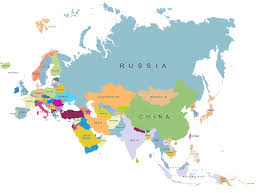
VP: “Naturally, businesses are drawn to places where growth is more dynamic and where there are greater opportunities to expand production and sales. As a result, the centre of gravity of global trade — and, with it, the global financial system — will continue to shift. In fact, that shift is already under way, and the trend is set to continue.
For many years, the principal flows of goods, capital and information passed through a small number of Western infrastructure hubs. Even when goods moved from one Eurasian country to another, payments, logistics, insurance and arbitration often relied on institutions located in third countries. This created additional costs and fostered political dependencies.
Today, international trade is becoming more effective, as direct shipments without intermediaries are growing, national currency payments are developing, and new corridors are opening. In Eurasia, these include the North-South Corridor, the Trans-Arctic Route, and links running through the Caspian region, Central Asia, the Black Sea, and the Far East. All of these projects and logistics routes are defining features of today’s economy and, importantly, of future development.
To give you an example of the global trade system ceasing to be Western-centric, I want to note the following. Over the past 25 years, the BRICS share in global merchandise trade has more than doubled. Last year, the BRICS accounted for almost 25% of global exports. This indicator continues to grow steadily, as does trade within BRICS itself, which now exceeds US$1 trillion annually.
A particularly important role in these processes is being played by what might be called “connector countries”. These countries link markets, technologies, financial flows and business cultures. Their role extends far beyond simple transit or transportation through a particular territory. What matters most is their ability to ensure trust and provide efficient logistics, reliable payment mechanisms, legal certainty and technological compatibility.”
RPA: It should be noted that the countries of the Commonwealth of Independent States (CIS) and Eurasian Economic Union (EAEU) fill the geographical space between the Eastern European Union and Western China. They have been engaging in massive digital infrastructure investments in road and rail, to the extent that driverless vehicles can cross borders between them. A seamless transition for goods delivery throughout Eurasia and into China is now taking place and is helping accelerate trade, manufacturing and economic development. That is not the case with the European Union, where no such arrangements exist for example between the EU and the UK, a primary market.
VP: “An example of what is taking place is Uzbekistan. Their President is with us today. He is the leader of a country that is one of the centres of economic growth. Its population is growing fast; industrial plans are being fulfilled; its agricultural and energy potentials are growing, as is the domestic market. At the same time, Uzbekistan is an essential link between Russia, Central and South Asia, China and the Middle East. There will be more examples of countries whose own development is enhanced by, and benefits from, their links with other centres of the emerging multipolar world.”
RPA: Uzbekistan has a population of 38 million (more than Poland, and similar to California) while its 2025 GDP growth was 7.7%. It is a member of the Commonwealth of Independent States, is preparing to join the Eurasian Economic Union and is a BRICS Partner nation.
VP: “The same is true of our another of our Presidential guests, from Tanzania – which is playing a similar role in East Africa.”
RPA: Our recent overview of Russia-Tanzania trade and development is here. The CIS nations are looking to expand the International North-South Transport Corridor south into east Africa.
On Sanctions
VP: “I would also like to draw your attention to another important trend: the architecture of global trade is gradually moving away from the principles that originally underpinned the World Trade Organisation. Since the beginning of this century, the number of bilateral, regional, and mega-regional trade agreements has increased nearly fourfold.
Why is this happening? The erosion of the World Trade Organisation was set off by the very authors of this organisation: the Western nations, to be more precise. When it benefited them, they promoted the WTO, they invited other countries to join. But once the West started to lose in this competition, universal and common rules for trade introduced by the WTO lost their appeal to them. Instead, they adopted unilateral restrictions and so-called sanctions. By doing so, Western countries effectively sidelined the mechanisms of the World Trade Organisation and undermined confidence in these institutions. And when trust disappears, an institution no longer functions as intended. Businesses and governments inevitably begin looking for alternative solutions. These alternatives take the form of bilateral and multilateral trade agreements.”
RPA: The WTO has been effectively bypassed as an organisation in global trade. Dispute resolutions from the West are now carried out not by any WTO arbitration dialogues but by the simple task of issuing sanctions without the need for any discussions. In contrast, Russia continues to develop free trade agreements at a time when the West has effectively abandoned the practice.
VP: “One more point. As I have already noted, the sanctions and, basically, the theft of Russia’s international reserves have had an irreversible effect on the positions of the world currencies, the US dollar and the euro. This is an objective reality that cannot be ignored. Today, every country – let me stress, every country without exception – understands that, like Russia, it could at any moment lose access to assets lawfully held in dollars or euros, as well as to Western financial and payment infrastructure.
We recognise that this ultimately boils down to the issue of unfair competition. The specific pretexts may vary, and they can always be found. In Russia’s case, it was the conflict in Ukraine. In other instances, it may be developments in the Middle East, conflicts in Africa, or even a country’s stance on LGBT-related issues. A justification can always be found. But the underlying problem remains the same: this is unfair competition.”
RPA: The freezing of Russia’s sovereign assets in Europe is being keenly watched by other countries with assets based in the EU. Some have already been moving capital assets away. If this political situation deteriorates further, increasing numbers of Central Banks may move reserves out of Europe to safer havens. Political risk is now a major international issue and has overtaken financial risk as the decision making financial point as to where fund diversification and safe havens should be placed and recognised. The developed financial markets in Asia such as Hong Kong and Singapore are likely to be primary alternatives: both remain with their legal basis centred on established British laws. Despite the 1997 handover to China, Hong Kong retains separate legal and economic systems from mainland ‘communist’ China until at least 2047 under the 50 year ‘One Country, Two Systems’ principle.
We are likely to see an exploration at the very least of sovereign funds being transferred away from political problems in the EU and manifesting themselves in havens in the east. This exodus, in our opinion, will only grow. The Euroclear lawsuit has become a testing ground of financial sovereignty, safe harbours, and legal credibility – and safety – of national sovereign assets. The need for Europe to fund Ukraine is undermining its own standing as regards global fiscal risk analysis.
Economics
VP: “Incidentally, confidence in the West is also being undermined by the state of its public finances, reflected in rising government debt and persistent budget deficits. In 2025, public debt in the eurozone reached 81.7% of GDP. The highest levels are well known: Greece stands at 146% of GDP, Italy at 137%, France at 115%, and Belgium at 108%. By comparison, Russia’s public debt remains at approximately 16.4% of GDP. In fact, during a meeting with the heads of major news agencies yesterday, some experts cited a figure of 15.8%. In any case, the difference is simply not comparable.
The budget deficit of the European Union in 2025 stood at 3.1% of GDP. The highest deficits are recorded in countries such as Poland (7.3%), Belgium (5.2%), France (5.1%), and the United States (5.9%). In Russia it is 2.6%. It may increase by the end of this year, but I believe it will still remain lower than in other industrialised countries.”
RPA: Russia’s low debt-to-GDP ratio provides short-term resilience against Western economic because the state does not depend on international credit markets, sanctions cannot easily trigger a standard sovereign default, giving Moscow the fiscal breathing room to sustain its economy. In contrast, Eurozone governments have built up high debt through oversized welfare states, chronic deficits, repeated crises, and heavy reliance on central bank money creation, topped by high energy prices.
VP: “Such a situation is fraught with a new surge in inflation for Western currencies, as was the case in 2021–2022, when prices in the euro area and in the United States rose by 14% in two years. Clearly, given the circumstances countries around the world are taking their assets out of the West and shifting to payments in national currencies, increasingly using alternative payment systems, and expanding the role of digital financial assets, including central bank digital currencies.
In its trade relations with its key partners, Russia uses national currencies as the primary means of payment. Thus, the share of the ruble in our export transactions is currently standing at 65%, or almost two thirds.
Importantly, the world needs modern, flexible and responsible financial architecture without risks, prohibitions or barriers, but with incentives for sovereign development. Its instruments must reduce costs, speed up settlements, and expand access to financing, and, of course, ensure proper counteraction to tax evasion, fraud and money laundering. Naturally, this must always be given special attention.”
RPA: What this means is that the West is already borrowing against future income and is struggling to keep to budgets. It already has significant debt. While Western media frequently state that the Russian economy is ‘collapsing’ – with very low debt levels and budget overruns at half the Western levels, it is the West, not Russia that has cause for concern. These existing levels of debt and budgetary excess are not sustainable. High debt also acts as a strategic constraint for the Eurozone. As European nations allocate significant portions of their annual budgets merely to service the interest on existing debt, they have less financial flexibility to address emerging challenges.
VP: “Historically, the West has been regarded by other countries as a source of technological development, but we are seeing a major transformation here as well. Over the past 25 years, BRICS countries have significantly increased their high-tech exports; they now account for over a third of global supplies, which indicates a shift in technological leadership around the world. This is happening gradually, but it is happening.
For example, China holds the largest number of patents in AI, where Russia also has excellent prospects. India is a leading player in the IT industry. It accounts for a significant share of the global software market. Russia holds strong positions in the pace of adoption of digital platforms, online marketplaces, and financial solutions, as well as municipal services, healthcare and education which improve the quality of life for people in Russia and in dozens of countries around the world, where they successfully compete with their foreign counterparts.
We also lead in a complex field such as nuclear energy. Over 80% of NPP construction projects on the global market are implemented with the participation of Rosatom.”
RPA: While Western media often labels Russia as a ‘gas station’ – holding 80% of all current global NPP developments is an even higher level of dominance. The West largely abandoned nuclear power, with this trend accelerating after the Japanese disaster at Fukushima. However, technologies have improved since then with Russia a global market leader – in what has become again a source of green, clean energy that abides by ‘green’ commitments. The West has been left seriously behind in this and will remain reliant on hydrocarbons for decades to come. This is especially bad news for Europe as its hydrocarbon reserves are negligible and it must import.
VP: “We also have significant engineering and technological capabilities in managing the water energy balance, which is becoming increasingly important in Asia, Africa, and indeed throughout the world. Technological progress is the most important factor in global transformation. Experts identify three key technologies of today and tomorrow that are capable of making a difference in people’s lives, business operations, and public administration.
What are they? First, artificial intelligence, which can process massive amounts of data and make the best decisions available across virtually all areas. Second, autonomous systems, which dramatically increase productivity and transform entire sectors of the economy. Finally, third, platform-based solutions, which allow market participants to exchange information and conclude transactions directly, in real time, and in an automated manner.”
On Sovereignty
According to forecasts by researchers and specialists, the countries or groups of countries that possess a full set of their own technologies in AI, autonomous systems, and digital platforms will become powerful centres of sovereignty in a multipolar world. Without these technologies, genuine sovereignty will be unattainable in principle.
Possessing an independent technological base is critical for countries with large populations, vast territories, and distinctive cultures. Such countries cannot act merely as users of foreign-made solutions, because in that case they risk becoming objects of control by external platforms. And how those platforms are used is another matter.
In essence, major countries – true civilisations – face a historic choice: either they create their own platform and technological ecosystems, or they become a digital periphery. There should be no illusions about this. Foreign services may initially be user friendly, but over time the cost of such dependency will inevitably become apparent.
Russia has learned one such lesson. We have seen certain software providers walk away from the market, payments get blocked, and interference in commercial relations ensue. Therefore, we will strengthen our own critical infrastructure and cooperate and engage only with the partners who respect mutual obligations.”
RPA: Serious warnings – to Europe in particular, but Asia, the Middle East, Africa and Latin America – maintaining sovereignty and what this means. The use of sanctions is often described – especially in Europe – as a form of punishment. In Russia, they are viewed as symptoms of loss of sovereignty and discussed as the perpetrator’s loss of identity. For example, while SWIFT is based in Europe, the United States holds the keys. While the EU froze hundreds of billions of dollars of Russia’s money, the United States froze a minimal amount. Even at SPIEF – while no official European Union delegations attended – the Americans did.
VP: “We have gained such experience over many years in our relations with the People’s Republic of China which is Russia’s truly strategic partner. Our economic cooperation covers virtually all areas, including high-tech sphere, transport, mechanical engineering, and, of course, energy.
As I have said before, a country’s position in the global economic system and its claim to global leadership depend on its ability to ensure its own sovereignty. It is no exaggeration to say that the race for sovereignty has begun – and it is gaining momentum.
This is not just about resisting external pressure or protecting national interests. It is also about the quality of the state, the economy, and society. Sovereignty means being stronger and, I emphasise, smarter – managing resources more precisely and investing more effectively, including in technological development.
True sovereignty demands efficiency. It is not a licence to do things expensively, slowly, or inconveniently. On the contrary, we must act with maximum initiative and maximum efficacy across all areas of our work. We must produce faster, thereby increasing revenues for the state, for business, and for our citizens.
In these tense and challenging conditions, Russia continues to strengthen its sovereignty – not by isolating itself, but by expanding its circle of partners.”
RPA: Putin appears to be the only major contemporary global political figure able and willing to enunciate what ‘sovereignty’ actually means and is able to illustrate how it can be eroded.
Russian Development Plans
VP: “Meanwhile, global economic momentum is currently subdued. But I can remind you of the task set for the Russian Government – starting next year, we must return to sustainable growth rates in the domestic economy.
That can only be achieved under one condition: by increasing capital investment and launching a new investment cycle. Between 2021 and 2024, investment in Russia grew by nearly 38% in real terms, though last year, of course, it saw a decline.
I want to stress that launching a new investment cycle is a key task for our economic authorities, and investment growth is a crucial indicator of their effectiveness. It is important that economic growth be balanced, supported by domestic demand, and combined with a further reduction in inflation, which has already slowed significantly and continues to fall. I believe I mentioned yesterday that inflation is forecast to approach 5.2% this year.
My colleagues and I regularly discuss economic issues. I should point out that the dynamics of industrial production, GDP, and consumer activity in Russia are positive. Despite all the problems, industrial production grew in April.
Industrial production in Russia grew by 1.9% in April, including manufacturing, which grew by 3.1%. Retail added 6.5%. Our GDP grew by 1.3% in April, and by 0.2% over the period from January to April.
What would I say about all this? Of course, we hear criticism from all sides – that we have lost momentum. Yes, but we have fallen only to the level that the eurozone countries have been experiencing for the past few years. And now we are on the upswing.
Most importantly, we have preserved the fundamentals of our macroeconomic policy. I am confident that this will ensure continued forward progress. These trends must be consolidated, while our country’s position in the world and its sovereignty must become even stronger.
In this regard, I would like to share several thoughts on the kind of sovereignty Russia needs.
First, as I noted earlier, a sovereign economy is built on the full-cycle implementation of technologies and the use of advanced solutions that simplify business operations, automate processes, increase labour productivity, and improve the overall efficiency of the economy. This is especially important in such areas as defence and security.
Russia has made significant progress in the development and adoption of digital platforms across all sectors of the economy. We are also witnessing rapid growth in e-commerce, which is expanding by approximately 30% annually. Our country ranks among the global leaders in this field. This, among other things, reflects the quality of Russian platform solutions, which benefit both domestic producers and foreign suppliers.
Today I have already mentioned our friends and partners in Uzbekistan. Let me give you an example. In 2023, the value of Uzbek goods sold through the Wildberries platform (Ed: Russia’s equivalent of Amazon) amounted to US$418 million. That was in 2023. By 2025, that figure had reached nearly US$1.5 billion, and this year it may exceed US$2 billion.
What does this mean in practice? It means that producers of a wide range of goods, including small and medium-sized enterprises, are gaining easy access to the Russian market through this platform. In fact, they are not only entering the Russian market but also reaching consumers in other countries through our platform. The volumes are growing, businesses are operating efficiently, people are earning good incomes, and small and medium-sized enterprises are developing successfully. All of this is being achieved through modern logistics systems, with taxes and customs duties being properly paid. This is something we can only welcome.
As a result, turnover has already increased 3.5 times and continues to grow, including through access to consumers throughout the Eurasian Economic Union and in partner countries, for example, the rapidly developing markets on the African continent. This is what our platform infrastructure makes possible.
Today, this Russian platform provides businesses with access to nearly half a billion potential customers worldwide, and that number continues to increase. In this way, Russian platform solutions are becoming a genuine driver of economic growth and development for our partners.
Apart from trade, the transition to a platform-based framework has been affecting the transport sector, finance, logistics, tourism, as well as healthcare, education, the media sector and other domains. Of course, we need to generate greater momentum to move towards a platform-based approach to developing various sectors by introducing artificial intelligence and autonomous systems.
We have already adopted a national Strategy for Artificial Intelligence Development. I ask the Government to prepare similar national strategies for autonomous systems and digital platforms.
I suggest that we discuss the topic of ecosystems for a platform-based economy at the Future Technologies Forum, which is scheduled to take place in early 2027. I also ask for an inter-agency working group to be formed under the Presidential Executive Office’s supervision to oversee preparations for this forum.
The second point I wanted to highlight is that people, the knowledge they have, their skills and their ability to master advanced technology and create breakthrough goods, services and shape entire market segments – all this has an immediate and defining bearing on sovereignty, both today and tomorrow. It goes without saying that people who have these professional skills must get adequate compensation for their work.
Only high living standards and generous salaries can make our country competitive and enable it to succeed on the demographic front, and to have excellent talent who can be confident about their professional careers and their future.
Russia has one of the lowest unemployment rates among industrial countries. It is equal to about 2.2% of the working population. This is a very robust result compared to other developed countries. For comparison, Japan is catching up to us with an unemployment rate of 2.5%, while this indicator for India is 4.2%, the United States has an unemployment rate of 4.2%, and the eurozone stands at 5.9%.
Over the past five years, salaries within the Russian economy increased by over 30% in real terms. I am referring to real wages, which means that the inflation rate is taken into consideration. Of course, this is a high growth rate.
Let me emphasise once again that any further increases in wages must be primarily driven by higher labour efficiency, as well as increased manufacturing efficiencies based on the latest technological solutions as developed by our excellent engineering schools.
Labour mobility is a separate matter. It consists of enabling specialists to find relevant and well-paid jobs at new enterprises in other regions of the country that need talent more than others, while their companies belong to emerging strategic sectors committed to making high value-added products.
As you know, young people graduating from educational institutions or during their senior years at universities and other higher education institutions are more prone than anyone else to move around the country. In order to empower them to start their professional careers, we agreed to set forth laws governing internships by introducing obligations for employers. We also agreed to update the apprentice contract so that it corresponds to present-day reality.
I know that the amendments to the Labour Code have been drafted. I ask the Government and the State Duma to adopt them faster.
Thirdly, it is evident that the sovereignty of a nation as expansive as Russia is defined not solely by the strength of its capital or a few major industrial centres. It is crucial that each region attracts investment, creates high-quality jobs, and develops both its production capacity and its urban environment.
Finally, in conclusion, I would like to emphasise once again that a strong and sovereign country cannot be isolated. As I have said many times, recent experience has demonstrated that we need to produce critical goods domestically and to strengthen infrastructure that is essential for national security, business development, and improving the quality of life of our citizens. At the same time, we must continue to strengthen ties with foreign partners, expand cooperation, and promote cross-border projects.
We will continue implementing plans to increase the capacity of our road and rail networks, including the development of our high-speed rail system, the expansion of seaport capacity and the development of the Trans-Arctic Transport Corridor as a major global transport artery. We will continue developing our merchant and icebreaker fleets, building tankers and vessels of various classes. Our goal is to rank among the world’s top ten countries in terms of the total deadweight tonnage of the national merchant fleet.
A strong domestic logistics, production, technological, and financial infrastructure, together with a predictable business environment and the development of human capital, constitute powerful competitive advantages in the global economy. These are the foundations for successful cooperation with countries and investors interested in partnership, those who seek to build mutually beneficial alliances with us, invest in Russia and in joint ventures, and invite Russian companies to take part in joint projects.
I am confident that events such as the St Petersburg International Economic Forum make a significant contribution to this broad and important effort and help all of us achieve new successes in advancing the prosperity and wellbeing of our countries and peoples.
Thank you for your attention.”
Summary
Putin’s speech was pragmatic, however also carried warnings about how sovereignty will be measured in the future – and what Russia intends to do to preserve its own independence and national identity and structure. Of note is how Russia has been able to absorb sanctions and is now using them to increase its sovereign strength – the direct opposite of the West’s intentions. The three main issues are the status of the economy and the importance to live within means – with some shocking examples of what is happening in Europe and comparisons with Russia. It is becoming obvious that one economic model isn’t working while the other, although hindered somewhat – remains intact. These are sobering observations for the West.
Another was the continuing development of Russian infrastructure and its key infrastructure reach to both neighbouring countries and into markets in the Middle East and Africa. In this instance, Russia is essentially following its own version of China’s ‘Belt & Road Initiative’ – a combined excellence in domestic transport and infrastructure – and the developing of this as outbound investments into key strategic markets. This is especially good news for the continuing development of Central Asia and Eurasia as a whole – although Western Europe has cut itself off rather from all this – just as it did from China’s BRI.
Finally, the text that made all the headlines in Europe was not Putin’s speech to SPIEF, it was Zelensky’s open letter to Putin. That can be read here. We provide it as a classic example of the complete gulf that separates strategic thinking in Europe – and the strategic thinking in Russia. Readers may evaluate which is the more intellectual, researched and balanced in opinions.