
 Русский




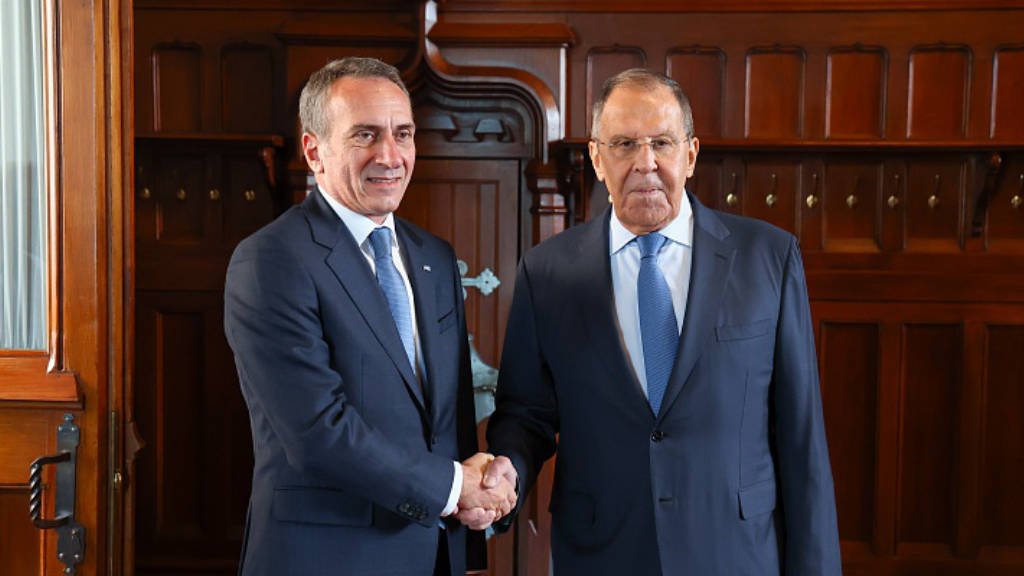

The Russian Foreign Minister, Sergey Lavrov, has meet with Oleg Bartsits, the Foreign Minister of the Republic of Abkhazia, in Moscow.
Abkhazia is a small, independent country, situated on the south Caucasus on the eastern Black Sea. It has a population of about 245,000 and was formed following the brief 1992-93 war with Georgia and subsequently partitioned off from the latter.
This is what Lavrov had to say:
“We appreciate your assistance with the Russian State Duma elections. The majority of Abkhazian population hold Russian citizenship. They were actively involved in the election campaign. Of course, we are grateful for the unwavering solidarity in the special military operation. Abkhazian volunteers are making an important contribution to our common cause. We value this and will always cherish it.
Our bilateral relations show a progressive dynamic, the key event of 2026 being the meeting between Presidents Vladimir Putin and Badra Gunba on May 9 in Moscow. During the meeting, they agreed to expand our bilateral cooperation and identified specific socioeconomic and humanitarian projects. That sets us up for practical work, with our ministries coordinating our actions as per our presidents’ executive orders.
Today, we will talk extensively about our joint work on the international stage. There are some notable initiatives like the renovation of the Sukhum Embankment, hot meals in schools, and a new hub for the We Are Together NGO. These projects fully reflect our current reality, affinity, and friendship between our peoples.
We see a significant cooperation potential in investment, as demonstrated by the First Abkhazian International Economic Forum. We will continue developing this area. It is gratifying that in 2025, our mutual trade grew by 16%, which is an excellent result.
Abkhazia is a popular destination among Russian tourists. The number of tourists to your country has grown by 40% in 2026. President of Abkhazia Gunba said he would like to see five million tourists in the republic annually by 2030. We will certainly do all we can to help you achieve this target and we hope this will come to fruition. Of course, infrastructure investment and security measures will be required. We will provide assistance to the development of independent Abkhazia across the board without exception: in its domestic development, external links, and coordination on the international stage.
We will go over the entire agenda and later, during lunch with our colleague from South Ossetia Akhsar Dzhioev, we will discuss topical international issues and regional security, including the international discussions on South Caucasus. This is a format that requires our constant attention. I believe this meeting today is taking place at the right time.”
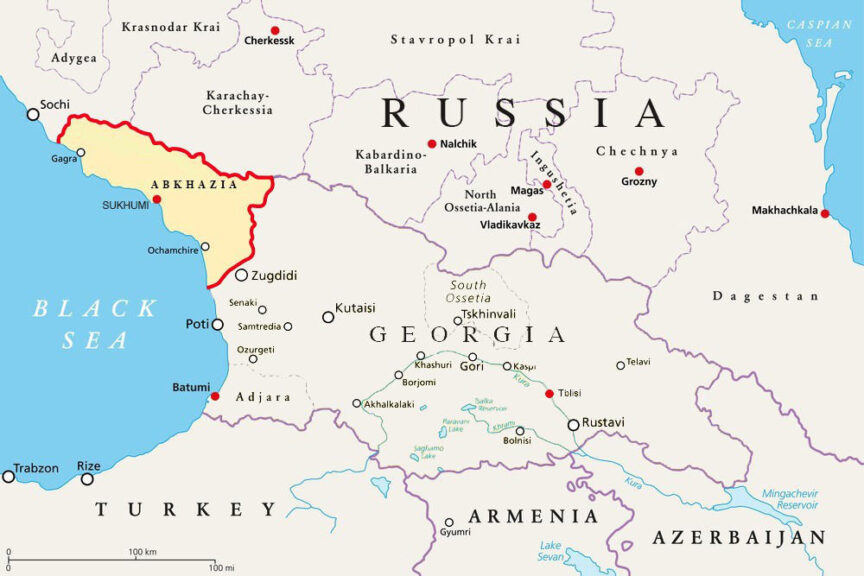
Abkhazia 2025-2026 Economic Performance

Abkhazia has limited publicly available economic data, especially for specific measures like GDP at purchasing power parity (PPP), annual GDP growth, and GDP per capita. Because it is primarily recognized by Russia and a handful of other countries, global financial institutions like the IMF and World Bank typically exclude Abkhazia from official GDP databases. Consequently, its economic statistics are based mostly on regional estimates and Russian financial and customs data, rather than standardized PPP metrics that allow comparison with other nations.
However, according to President Badra Gunba, during 2025 Abkhazia’s nominal GDP grew by more than 30%, indicating that the total GDP for the year was in excess of US$1 billion for the first time.
Budra also mentioned that over 61% of total revenues are now generated from domestic sources – with Russian tourism being a major factor in this increase.
Abkhazia’s economy also includes agriculture, tourism, and energy, with significant support from Russia. Key sectors involve small-scale farming, food processing, and electricity, often dependent on Russian subsidies and infrastructure. Currently, Abkhazia is negotiating with Russia to build a gas pipeline to support new power plants, aiming to reduce its recurring energy shortages. The region has a roadmap for energy with Russia, including an annual ‘social flow’ of electricity provided at no cost to Abkhazia, funded by the Russian budget.
Abkhazia’s trade is limited primarily to Russia, with which it has a free trade agreement allowing the export of goods. This supports Abkhazia’s small-scale trade by eliminating tariffs on goods to Russia, its main trade partner. Additionally, Abkhazia has limited trade arrangements with a few other nations that recognize its independence. However, due to restricted international recognition, Abkhazia lacks access to global free trade zones and agreements, significantly limiting its economic engagement beyond its immediate region.
The bilateral trade relationship with Russia has seen notable increases in recent years, rising from US$275.5 million in 2021, to US$549 million in 2025, or about 60% of Abkhazia’s total GDP.
While in the past Abkhazia has depended heavily on Russian financial support, with its economic development constrained by the region’s lack of international recognition and its limited institutional infrastructure, this support is shifting from grants and loans to more practical commercial support, with much of this from the tourism dynamics – accounting for an estimated 40% of Abkhazia’s GDP – and therefore the private sector rather than direct state support, an issue that will be pleasing to both Moscow and Sukhumi.
Apart from the tourism sector, Abkhazia exports alcohol (61.32%), woven apparel (27.00%), and edible fruits and nuts (5.45%) to Russia. Abkhazian brandy and wines are especially sought after on the Russian market. Russia exports mainly energy and industrial construction equipment.