Русский




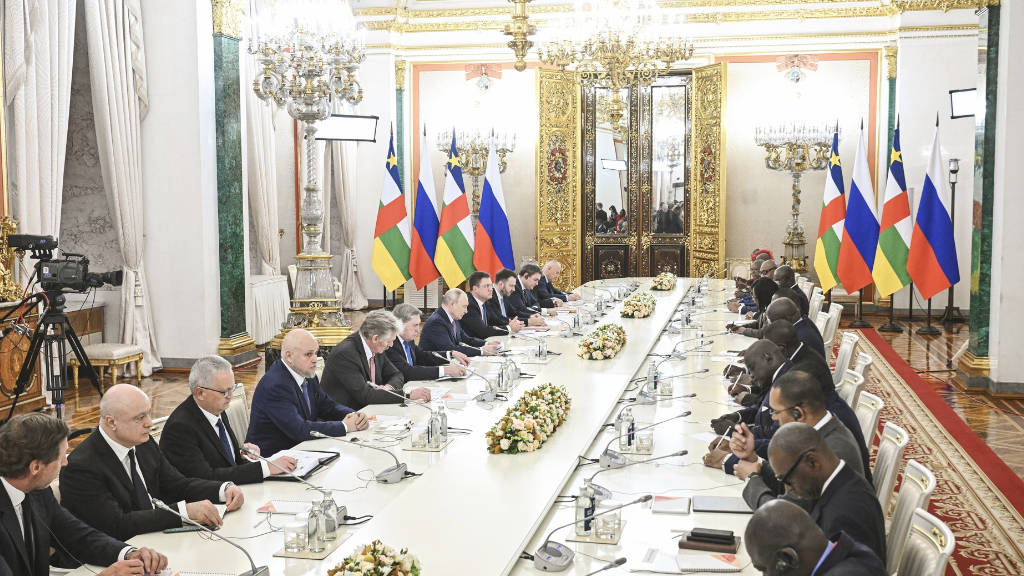
The Russian President, Vladimir Putin has met with Faustin-Archange Touadéra, the President of the Central African Republic on the sidelines of the 2026 Russia-Africa Summit.
On the Russian side, attending the meeting were Deputy Prime Minister Alexander Novak, Deputy Chief of Staff of the Presidential Executive Office Maxim Oreshkin, Deputy Chief of Staff of the Presidential Executive Office – Presidential Press Secretary Dmitry Peskov, Presidential Aide Yury Ushakov, Ambassador Extraordinary and Plenipotentiary of the Russian Federation to the Central African Republic Alexander Bikantov, Minister of Industry and Trade Anton Alikhanov, Minister of Economic Development Maxim Reshetnikov, Minister of Energy, Russian Co-Chair of the Russian-Central African Intergovernmental Commission for Trade, Economic, Scientific and Technical Cooperation Sergei Tsivilev, Deputy Foreign Minister Georgy Borisenko, Deputy Defence Minister Vasily Osmakov, Chief of the Main Directorate of the General Staff of the Russian Armed Forces – Deputy Chief of the General Staff of the Russian Armed Forces Igor Kostyukov, Deputy Chief of the Main Directorate of the General Staff of the Russian Armed Forces Andrei Averyanov, Chairman of the Business Council for Cooperation with the Central African Republic, Chairman of the Board of Directors of OKTO Group Alexei Tolokonnikov.
This is what the two Presidents had to say:
Vladimir Putin: “Mr President, Friends, I am pleased to welcome you once again. First of all, I would like to thank you for attending the Russia–Africa Summit. You have now participated in all three summits, including in Sochi and St Petersburg.
We highly value your personal attention to strengthening the friendly ties between our countries. In December, we will mark the 66th anniversary of the establishment of diplomatic relations.
There are significant, yet largely untapped, opportunities for expanding trade and economic ties, including in energy, geological exploration, transport and logistics. In September, a meeting of the Intergovernmental Commission established this year held its first meeting. We will discuss this in more detail today.
We also provide humanitarian support to your country. The number of applications from your citizens to study at Russian universities is growing. For the 2026–2027 academic year, we have increased the state scholarship quota for students from your country from 85 to 100.
The Association of Graduates of Soviet and Russian Universities has been established in your capital, and a Russian House cultural centre and a Centre for Open Education in Russian are now operating. We highly value your attention to these matters, Mr President.
Russia and the Central African Republic hold aligned positions on the international stage. We greatly appreciate your support for Russian initiatives at the United Nations and within other multilateral forums.
You are always a welcome guest here. I am pleased to have this opportunity to discuss current issues – matters we have been working on together for several years now.”
Faustin-Archange Touadéra: “Mr President, Ladies and Gentlemen, may I say once again how delighted I am to be in Moscow today. Please accept my sincere thanks for the warm and brotherly welcome you have once again extended to me and to my delegation.
On behalf of the people of the Central African Republic, I would like to thank you for the outstanding organisation of the third Russia–Africa Summit. This summit reaffirmed our conviction that Africa and Russia can build a partnership founded on mutual respect, the sovereign equality of states, and a shared commitment to delivering tangible results for the benefit of our peoples.
Mr President, you received me in March, shortly before my re-election. Together we built on what we had already achieved and took our cooperation to a new level. That commitment stands firm to this day.
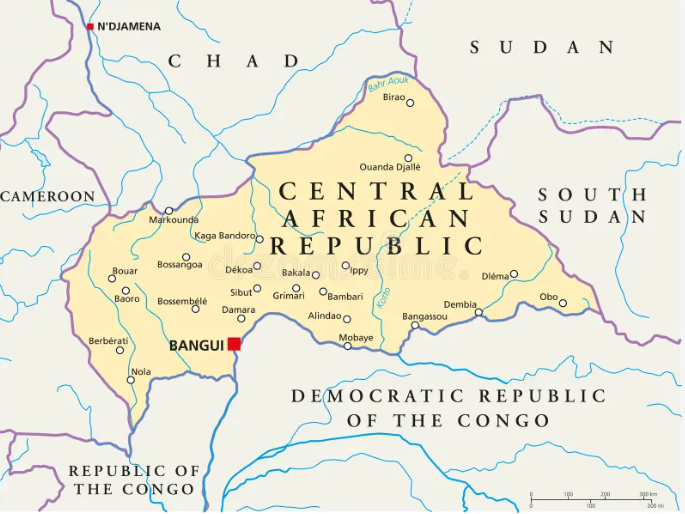
The first meeting of the Intergovernmental Commission on Trade, Economic, Scientific and Technical Cooperation was held in Bangui and marked a decisive step towards deepening our partnership.
The road we have travelled together began under difficult circumstances. In 2017, the Central African Republic was in the grip of a severe crisis. Armed groups controlled much of our territory, and our defence forces were hampered by an arms embargo imposed on our country, which limited our ability to protect our people. We therefore turned to our partners for help. The Russian Federation answered that call, with the consent of the UN Security Council, and supplied us with equipment. From early 2018, Russian instructors began arriving in Bangui to train our soldiers.
In late 2020 and early 2021, armed groups sought to seize our capital and overturn the constitutional order. I would like to pay tribute to those specialists whose help proved decisive in that struggle on the security front. Our defence and security forces succeeded in protecting our people. They are also helping us to reintegrate former combatants. More than 1,600 people are now involved in the fight against the illicit drugs trade, which poses a threat to our young people.
Step by step, we are deepening the trust between our two nations, and on behalf of the Central African people I would like to express our deepest gratitude once again. Mr President, peace is gradually being restored today.”
Russia, Central African Republic Bilateral Trade & Investment
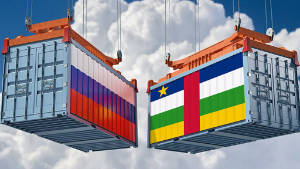
Diplomatic ties between Russia and the CAR were first established in 1992 following the African state’s independence from France in 1960. Relations developed further in later years, including military and political cooperation. The CAR maintains an embassy in Moscow, while Russia operates its diplomatic mission in Bangui. In recent years, the two countries have expanded cooperation in political dialogue, security, and the economy.
Russia established a Russia House in Bangui last year, and has begun exports of poultry as well as providing animal husbandry assistance to help improve food stock health. The partnership is centered on security, with Russia being a major supplier of arms and security personnel to the CAR. Russia primarily exports machinery, vehicles, food, and fuel to the CAR, while imports include an increasing diamond finishing trade, in addition to imports of various raw materials.
Bilateral trade between Russia and the Central African Republic (CAR) focus heavily on security cooperation, natural resource extraction, and barter arrangements rather than traditional, large-scale commercial trade. Since 2017, Russia and the CAR have operated under a localized barter-style framework where Russian entities (historically linked to private military contractors like the Wagner Group and its successor, the Africa Corps) provide security, military training, and protection for President Faustin-Archange Touadéra in exchange for access to and exploitation of local natural resources (such as gold and diamonds). Approximately 1,500 to 2,000 Russian personnel/Africa Corps members are stationed in the CAR to support government forces and guard key sites.
During the 2026 Russia-Africa Summit-CAR officials (including Energy Minister Opportune Edwige Pouninguinza-Nguelebe) sought Russian assistance to develop the CAR’s emerging oil and fuel sectors to order to cut down on heavy import reliance.
Russia-Central African Republic bilateral trade officially reached about US$30 million in 2025, with the bulk of this being Russian wheat exports. Given the barter trade, the actual values could be much higher. However, the first Russia-Central African Republic intergovernmental commission on trade and economic cooperation was held in September this year, suggesting that trade may move to a more streamlined and institutionalised platform, which should lead to a more regular and conformative trade development infrastructure.