
 Русский





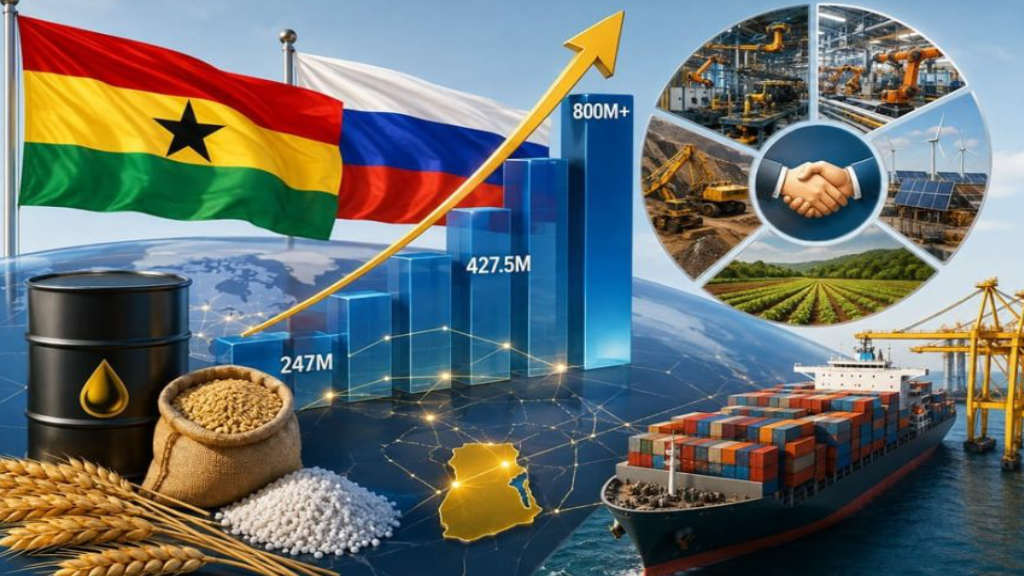

Russia’s Foreign Minister Sergey Lavrov met with Ghanaian Foreign Minister Samuel Okudzeto Ablakwa on August 17, marking attempts by Moscow and Accra to turn rapidly expanding trade into a broader economic, investment, technological and security partnership.
The timing is important Bilateral trade has risen from US$247 million in 2022 to more than US$850 million in 2025 according to Andrei Ordash, Russia’s ambassador in Accra. That is an increase of 244.13% in just three years. The question, therefore, is not whether Russia and Ghana can increase trade. They clearly can, as the growth comes as Russia seeks to deepen economic cooperation with Ghana through increased investment, technology transfer and stronger private sector partnerships.
The strategic question is whether they can change the structure of that trade. In recent years, both countries have sought to expand ties beyond traditional trade. The central opportunity is to move from a conventional commodity exchange, Russian petroleum products, fertilizers, grain and food against Ghanaian agricultural commodities and raw materials, toward Russian investment in Ghanaian production, processing, logistics, mining, energy and infrastructure. That would make Ghana not simply a growing Russian export market, but a potential West African production and distribution platform for Russian companies operating under the African Continental Free Trade Area (AfCFTA).
Given the sharp rise in trade volumes, sustained efforts to improve trade quality, diversification and facilitation could realistically lift Ghana-Russia trade volumes to US$2 billion in the near term. The Russia-Ghana Business Development Council and the Russia-Ghana Permanent Joint Commission for Cooperation (PJCC) must play key roles in fostering deeper political, economic, and cultural ties.
Lavrov-Ablakwa Talks: From Diplomacy To Economic Architecture
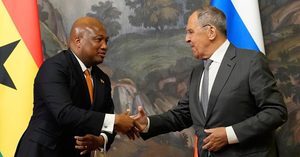
The Lavrov-Ablakwa talks covered political, trade-economic, humanitarian and international issues, with particular attention to energy, agriculture, geological exploration and mineral development. The two sides also discussed cooperation in international organizations and preparations for the third Russia-Africa Summit.
Lavrov summarized the meetings by saying “We discussed energy, including nuclear energy, as one of the promising areas for our efforts, including in the context of preparations for the Intergovernmental Commission meeting. Some tangible progress has already been made here. We also touched on geological exploration, agriculture, fertiliser supplies, information and communications technology, and much more. For our part, we certainly welcome our friends’ interest in developing contacts with Russian economic operators. We will plan appropriate steps in the near future to implement specific projects. The Government of Ghana clearly shows interest, as do many Russian investors. We also discussed this today,”
The most immediate tangible outcome was the signing of an agreement on visa-free travel for holders of diplomatic and service passports. The agreement is limited in scope, but its economic importance should not be underestimated. Ghanaian Foreign Minister Ablakwa described it as a landmark step and indicated that Accra wants to continue discussions on broader visa facilitation.
For business, the importance lies in reducing the friction surrounding government delegations, technical negotiations, investment missions and project preparation. The agreement is better understood as connective infrastructure for economic diplomacy, with the later potential to extend it for tourism purposes. Mining projects, the nuclear-energy programme, railway modernization and agricultural joint ventures all require repeated movement of officials, engineers, lawyers, investors and technical specialists. Lowering that barrier helps shorten the distance between a memorandum and an operating project.
The ministers also discussed the next meeting of the Russian-Ghanaian Intergovernmental Commission on Trade, Economic, Scientific and Technical Cooperation. This may be held in Moscow before the end of the year, with the dates to be agreed soon. This mechanism will be crucial because the relationship has accumulated enough commercial momentum to require project-level coordination rather than general political declarations.
Ambassador Ordash earlier said that one of his priorities would be to facilitate stronger business-to-business partnerships and encourage greater participation by Russian companies in Ghana’s industrialization drive, including the government’s 24-hour economy initiative. This is a national strategic program designed to transition the country from an import-dependent, raw material-exporting state into a round-the-clock, self-sustaining production and job-creation hub. The policy incentivizes multi-shift operations in key sectors to maximize capital and infrastructure efficiency.
With the latest high-level talks in Moscow, the expanding trade and economic relationship between the two countries is now poised to accelerate further. Ablakwa confirmed that Lavrov will participate in Ghana’s September 2026 restitution summit during the 81st UN General Assembly, addressing the historical injustices of colonialism, the transatlantic slave trade, discrimination and segregation, and said Moscow had agreed to support Ghana’s restitution initiative.
Ghana’s Economic Scale & The AfCFTA

Ghana’s importance to Russia is partly explained by its economic geography. With a population of more than 35 million, Ghana is already one of West Africa’s substantial consumer markets. Its GDP measured by purchasing power is estimated at US$310 billion, while per-capita GDP (PPP) is approximately US$9,000, about 20% higher than the African continental average. Ghana’s real GDP growth reached about 6% in 2025, while 2026 growth forecasts are around 4.8%. These figures matter because Ghana occupies a particularly interesting point on the African development curve. It is large enough to sustain significant domestic demand, but still has enormous infrastructure, industrial and technological gaps.
For Russian companies, that combination is potentially more attractive than a mature market where growth is slower and infrastructure is already saturated. Ghana also has something that many resource-rich African economies lack: relatively strong institutions, an established financial sector, an English-speaking business environment and access to the Atlantic. Importantly, Accra also hosts the African Continental Free Trade Agreement (AfCFTA) Secretariat. This transforms Ghana’s geographical significance. A Russian company establishing manufacturing, assembly or processing operations in Ghana can potentially use the country as a base for wider African market penetration rather than treating Ghana as an isolated national market.
The Russian Embassy in Ghana recently said that Russia and Ghana are deepening economic cooperation in nuclear energy, fertilizers and mining, with Rosatom and Ghana’s Atomic Energy Commission signing an MoU to establish a framework for future energy cooperation. Commercial relations were already gaining momentum, as demonstrated by the participation of 65 leading Ghanaian business executives in the “Made in Russia” International Forum in November 2025, where they established direct contacts with Russian companies to explore new investment and trade opportunities.
Moscow also wants to increase fertilizer supplies and support localized fertilizer production, strengthening Ghana’s agricultural sector and creating opportunities for Russian investment and technology transfer. In mining, Russia is interested in the joint development and value addition of Ghana’s gold and bauxite resources, opening space for Russian-Ghanaian partnerships and joint ventures. Strategically, Moscow sees Ghana as a gateway to wider African markets through the AfCFTA, making the partnership increasingly important for Russian investment, industrial expansion and continental market access.
The Gulf of Guinea: A Strategic Economic Advantage
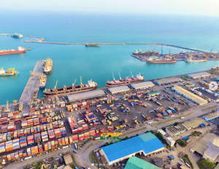
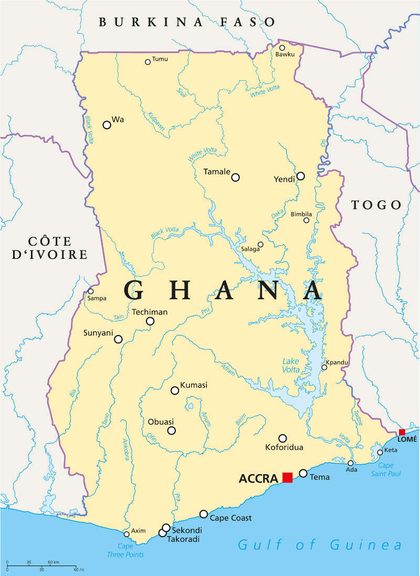
Ghana’s location on the Gulf of Guinea is increasingly important as commercial traffic, energy infrastr ucture and maritime security become interconnected. The country sits between Côte d’Ivoire and Togo and provides access to the Atlantic shipping system. The ports around Tema and Takoradi give Ghana an infrastructure base from which imported machinery, fertilizers, petroleum products and industrial inputs can be distributed inland, while processed minerals and agricultural products can move toward international markets. For Russia, this creates a different model of African engagement. Instead of attempting to reach every West African market individually, Russian companies can establish regional logistics, warehousing, assembly and service centres in Ghana and use them as a commercial base for neighbouring economies. This is particularly relevant for machinery, trucks, mining equipment, agricultural technology, fertilizers and food processing. The strategic value of Ghana therefore lies not only in its domestic demand but in its ability to become a Russian commercial gateway to the wider Gulf of Guinea and AfCFTA market.
Ghana’s Resource Base

The resource argument is even stronger. Ghana is Africa’s leading gold producer. Gold output reached approximately 5.94 million ounces in 2025, more than 23% above the previous year. Gold export earnings were estimated at about US$20.2 billion, equivalent to roughly 63% of the country’s merchandise exports. That figure alone demonstrates the scale of Ghana’s mineral economy. The country also has significant manganese and bauxite resources. Manganese production is projected at approximately 6 million tonnes in 2026, while bauxite production could reach 3 million tonnes. The oil sector remains significant through the Jubilee, TEN and Sankofa fields, while the deepwater Pecan project represents additional long-term potential.
Ghana is also one of the world’s major cocoa producers, with production for the 2025/26 season projected at roughly 750,000 tonnes. For Russia, however, the most interesting opportunity is not simply buying these commodities. It is processing them in Ghana. On December 20, 2025, the Ghana-Russia Center for Commerce and Relations signed a historic cooperation deal with Tatarstan’s Chamber of Commerce and Industry in Kazan, marking a step toward accelerating regional cooperation and economic ties between Ghana and Russia.
From Gold Exports To Mining Technology
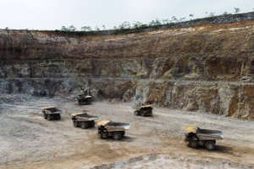
Ghana’s mining sector provides an obvious entry point for Russian engineering companies. The rapid growth of gold output has also exposed the technological fragmentation of the sector. Small-scale and artisanal producers account for a substantial share of production, creating demand for geological exploration, drilling, crushing, mineral separation, environmental monitoring and modern processing. This is where Russian mining and engineering capabilities could become more valuable than simple commodity purchases. A Russian-Ghanaian mining partnership could combine Russian geological and engineering expertise with Ghanaian mineral assets and local labour. The objective would be to create domestic processing capacity rather than merely export ore. The same logic applies to bauxite and manganese. Russia could supply machinery, engineering services, geological technologies and processing equipment while Ghana provides the mineral base and access to regional markets. This would fit perfectly with Accra’s stated objective of moving away from raw-material exports toward higher domestic value addition.
Rosatom: The Technological Partnership Anchor
The most strategically important potential project is nuclear energy. Russia and Ghana signed a memorandum on peaceful nuclear cooperation in 2015 between the Ghana Atomic Energy Commission and Rosatom. The framework provides a basis for cooperation in nuclear power, specialist training and nuclear science and technology, including discussion of potential power-generation projects and small modular reactor technologies. The economic significance extends far beyond electricity. A nuclear programme creates demand for engineers, construction services, digital systems, scientific research, technical education and long-term maintenance. For Ghana, it could provide a stable source of baseload electricity to support industrialization. For Russia, it would create a decades-long technological relationship. That is fundamentally different from selling a shipment of fertilizers or petroleum products. A potential nuclear [power project creates institutional lock-in through technology, training, maintenance and human capital.
Ghana aims to incorporate 1,000 megawatts of nuclear power into its energy mix, targeting construction initiation around 2027. The country selected Nsuban in the Western Region as its preferred site, with Obotan in the Central Region as a backup, and is currently engaging international vendor partners – including Rosatom.
Russia & Ghana’s Agricultural Trade

Agriculture provides perhaps the clearest evidence that the relationship is already moving quickly. During the first half of 2026, Russian agri-food exports to Ghana tripled in value to US$20.4 million. Between January and May 2026, Russia shipped almost 8,000 tonnes of poultry products to Ghana worth more than US$7 million, according to Russia’s Center for Agricultural Export Development. The export structure included: chicken meat and edible offal (8,000 tonnes) and turkey meat and edible offal (>50 tonnes). Poultry export volumes increased 5.6 times year on year while value increased approximately ninefold.
Overall, Russian agricultural shipments to Ghana reached almost 57,000 tonnes in 5M 2026, an increase of 2.8 times the volume recorded during the same period last year. This is strategically significant because it demonstrates that the market is not theoretical. Russian food producers are already finding demand in Ghana. The value potential of Ghana’s rice market for Russian producers stands at around US11.1 billion, according to Masamba Kah, of Moscow’s National University of Science and Technology. Speaking at a Russia-Africa agricultural event recently, he stated that “Ghana is a very promising country, and imports US$1.5 billion worth of rice a year. Ghana’s Jospong Group currently holds a market share of around US$400 million. The remaining US$1.1 billion represents the potential for Russian rice growers with their economic models and technologies.”
According to Kah, promising areas include not only rice production but also potato cultivation, as well as the export of Russian agricultural technologies to West Africa. The industry-education partnership project provides for the training of specialists and the development of joint initiatives in the agri-food sector, as well as in other fields, including IT, medicine, metallurgy and ecology.
The next step should be localization. Rather than simply exporting chicken, wheat and processed food, Russian companies could establish poultry farms, feed mills, grain storage, flour mills, cold-chain facilities and food-processing plants. That would generate Ghanaian employment while giving Russian companies local production capacity.
Ambassador Ordash said the two countries were exploring collaboration between Ghanaian institutions and Russian research centres to introduce innovative agricultural technologies that would improve productivity, strengthen food security and support Ghana’s agricultural modernization agenda. Russia is also seeking to expand fertilizer exports to Ghana, with the Russian Union of Industrialists and Entrepreneurs’ (RSPP) Dmitry Mazepin noting that Ghana imported about 100,000 tonnes of Russian fertilizers worth US$27.8 million in 2024, and that these volumes could rise further. The move reflects Russia’s growing influence in global agricultural supply chains, particularly as Ghana and Côte d’Ivoire account for over half of global cocoa production. With President John Dramani Mahama prioritizing food security and higher yields under the Agriculture for Economic Transformation Agenda, deeper cooperation in fertilizers could support Ghana’s drive to restore output and stabilize global cocoa markets.
Energy Is The Backbone Of Russia-Ghana Trade
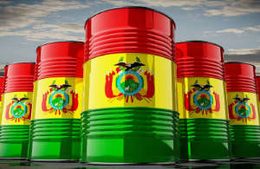
Energy is currently the single largest pillar of Russia’s merchandise exports to Ghana. According to Bloomberg, the Hellas Fighter, carrying approximately 320,000 barrels of clean petroleum products from Vysotsk, arrived at Ghana’s main oil hub in Tema in April 2026 after passing Mauritania. This makes the argument stronger: Russia is already an important energy supplier to Ghana, and the next stage is to turn that existing energy trade into a wider energy-and-industrial partnership. UN Comtrade data shows that Ghana imported US$337.06 million worth of Russian mineral fuels, oils and distillation products in 2025, accounting for roughly 73% of Ghana’s total imports from Russia, which reached US$461.65 million.
Within the energy category, petroleum oils and oils obtained from bituminous minerals alone were valued at US$304.58 million, while crude-oil imports amounted to a further US$32.49 million. The physical trade flows also demonstrate that this is not simply a statistical relationship. Shipment-level data for the February 2025-January 2026 period record more than 1,000 Russian-origin shipments to Ghana worth approximately US$477 million, with mineral fuels and oils accounting for 74.79% of the recorded imports. Tema Oil Refinery received 74.79% of the recorded shipment value, followed by other facilities and ports around Tema and Takoradi.
The largest Ghanaian importers included Bulk Oil Storage & Transportation, S.A. Energy, Chase Petroleum Ghana, Calgarth Investment and GoEnergy. This makes energy the commercial foundation of the Russia-Ghana relationship, but it also reveals the next opportunity. Russia’s role should not remain limited to supplying petroleum products. Moscow can use the existing energy trade as an entry point for broader cooperation in oil and gas services, storage, petroleum logistics, refinery modernization, power generation, nuclear energy and energy infrastructure. Ghana’s continuing offshore production from fields such as Jubilee, TEN and Sankofa, alongside its plans to expand electricity generation and industrial capacity, creates a substantial market for Russian engineering and energy technologies. At the same time, the long-standing Rosatom-Ghana Atomic Energy Commission framework creates a potential pathway from today’s fuel trade toward a much deeper Russian role in Ghana’s future energy system.
Agricultural Processing: The Next Generation Of Cooperation

On May 29, 2026, Ghana’s Tree Crops Development Authority (TCDA) signed a strategic Memorandum of Understanding (MoU) with Golden Forest Limited, a subsidiary of Russia’s EFKO Group. The agreement focuses on expanding Ghana’s shea industry, improving productivity, and increasing domestic value addition. Shea is a type of buttery oil extracted from the shea nut.
The partnership is particularly significant because it moves beyond conventional commodity trade toward local processing, value creation, technology transfer, and deeper industrial cooperation, in an industry worth an estimated US$5.5 Billion in value. The agreement involves support for women involved in shea-nut harvesting, planting shea trees in the savanna region and conducting research aimed at improving yields. It also includes educational cooperation involving Ghanaian students. This is precisely the type of partnership that can connect agriculture, technology, rural employment and trade. This is a model with great potential for a wider Russian-Ghanaian agricultural programme, matching Russian technology and capital combined with Ghanaian agricultural resources, followed by local processing and subsequent exports.
The Russian Corporate Pipeline Is Broader Than Current Trade Figures Suggest

The list of Russian companies associated with Ghana suggests that the potential relationship is much larger than the current US$800-850 million trade figure. Rosatom represents nuclear energy and nuclear science. LUKOIL is associated with Ghana’s offshore oil sector. Russian Railways and Transmashholding could contribute to railway infrastructure and rolling-stock modernization. KAMAZ has potential in heavy trucks, construction equipment and mining logistics. Uralkali can deepen fertilizer cooperation. Agricultural companies such as Miratorg, Makfa and Uvelka could expand food exports and potentially move toward local processing and distribution. The strategic opportunity is to connect these companies into a common economic architecture rather than allowing them to operate as isolated commercial projects. A Ghana-based Russian logistics and industrial hub, for example, could serve agriculture, mining, transport and manufacturing simultaneously.
Russia-Ghana Rail Cooperation

There have been discussions on Russian investment into Ghanian railways, with Russia’s Geo Services signing a development MoU with the University of Ghana to develop the Accra-Paga route. While that proposed US$12.5 billion potential deal didn’t materialize, the project has been absorbed into Ghana’s broader “Big Push” infrastructure initiative. The current priority has shifted toward developing the highly profitable Western Railway Line for mineral freight and integrating a future high-speed line directly into the Accra-Kumasi Expressway corridor. Russian railway companies and diplomats remain in discussions with Accra about these projects.
The Biggest Weakness: Bilateral Trade Imbalance

The relationship nevertheless has a structural weakness: Ghanaian exports to Russia remain far below Russian exports to Ghana. UN Comtrade data put Ghana’s exports to Russia at approximately US$44.9 million in 2025. That imbalance is not sustainable as the long-term foundation of a strategic partnership. But it also points directly toward the solution. Russia should encourage greater Ghanaian exports of processed cocoa, gold-related products, agricultural goods, shea products, processed minerals and other value-added commodities. At the same time, Russian companies should invest in Ghanaian production capacity. In other words, the trade deficit should be addressed not by forcing an artificial balance in commodity shipments but by creating new production inside Ghana. Security cooperation is becoming part of the economic relationship
Regional Security

Lavrov and Ablakwa also addressed terrorism, instability in the Sahel and security risks in the Gulf of Guinea, including piracy and kidnapping. Ghana is increasingly exposed to the spillover of insecurity from the Sahel, making regional counterterrorism cooperation an economic issue as much as a military one Moscow and Accra have signed a security cooperation agreement to assist Burkina Faso, Mali and Niger amid rising tensions.
The two governments also discussed advancing the ratification of the 2016 memorandum on defence cooperation, while Ghana raised concerns over the illegal recruitment of Ghanaian citizens into the Russia-Ukraine conflict. Lavrov subsequently stated that Ghana’s forthcoming ratification of the intergovernmental agreement on military-technical cooperation would provide additional momentum to bilateral defence relations.
The economic connection is straightforward: ports, transport corridors, mining sites and industrial facilities require security. For Ghana, Russian cooperation can contribute to counterterrorism, maritime security and defence capabilities. For Russia, a stronger security relationship can help create a more stable environment for long-term commercial engagement.
Human Capital As The Hidden Foundation Of Russia-Ghana Relations

Russia’s educational relationship with Ghana provides another strategic asset. More than 600 Ghanaian citizens are currently studying in Russia, while 120 scholarships were allocated to Ghanaian students for the 2025/26 academic year. More than 500 students in Ghana are studying Russian with Russian lecturers. University cooperation is also expanding, involving Russian institutions including Kuban State Agrarian University, Northern Arctic Federal University, Yaroslavl State Pedagogical University, Volgograd State Agrarian University, Novosibirsk State Technical University and Tomsk State University. This matters because investment projects ultimately depend on local engineers, managers, technicians and specialists. If Russia trains Ghanaian professionals who later work in nuclear power, agriculture, mining, railway engineering and manufacturing, educational cooperation becomes a direct component of industrial policy.
Mahama’s Moscow Visit Could Turn The Relationship Into A Continental Agenda
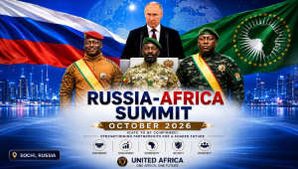
The next major test will come at the Third Russia-Africa Summit in Moscow on October 28-29, 2026. President John Dramani Mahama has confirmed that he will attend, a decision announced by Lavrov following the August 17 talks. His participation is significant because Ghana’s role extends beyond bilateral diplomacy. Accra’s position within the African Union and its hosting of the AfCFTA Secretariat give Ghana an unusually important voice in continental economic discussions. The summit is expected to develop a new framework for Russia-Africa cooperation covering 2027-2029, including trade, investment, energy, food security, digitalization, artificial intelligence, payment mechanisms and other practical areas. For Ghana, Moscow offers an opportunity to seek Russian investment in industrialization. For Russia, Mahama’s presence offers an opportunity to present Ghana as a model for a more commercially grounded approach to West Africa.
Summary: The Russia-Ghana Opportunity Is Bigger Than The Current Trade Figure
A central mistake would be to measure the future of Russia-Ghana relations solely by the next annual trade figure. If trade rises from US$850 million to US$2 billion, that would be positive but not transformational. The transformational scenario is different: a Russian fertilizer company establishes local distribution and blending; Russian food companies establish processing facilities; KAMAZ develops an assembly and service network; Russian railway companies participate in modernization; Russian mining companies provide geological and processing technologies; Rosatom develops Ghana’s nuclear-energy ecosystem; Russian logistics companies establish regional hubs; and Ghanaian commodities increasingly return to Russia in processed rather than raw form.
This would create a two-way industrial relationship. The August 17 talks matter because Moscow and Accra appear to be moving toward precisely this model. Ghana brings a 35-million-plus consumer market, Gulf of Guinea access, AfCFTA connectivity, gold, cocoa, bauxite, manganese, oil and an industrialization agenda. Russia brings energy, fertilizers, food, nuclear technology, engineering, transport equipment, mining expertise and defence capabilities.
The economic complementarities are unusually clear. The task now is implementation. If the next intergovernmental commission meeting produces bankable projects, if the Rosatom framework advances, if mining and agricultural partnerships move into production, and if the October Russia–Africa Summit converts political commitments into a 2027-2029 project pipeline, Ghana can become much more than another destination for Russian exports. It can become Russia’s West African economic gateway, a place where Russian technology and capital meet Ghanaian resources, local industrialization and the wider AfCFTA market. That is the real strategic meaning of the Lavrov-Ablakwa meeting: the relationship is approaching the point where trade growth can be converted into economic architecture.
This analysis was written by MD. Rana, an African affairs economics and geopolitical analyst for Russia’s Pivot To Asia. The author can be reached at info@russiaspivottoasia.com