Русский






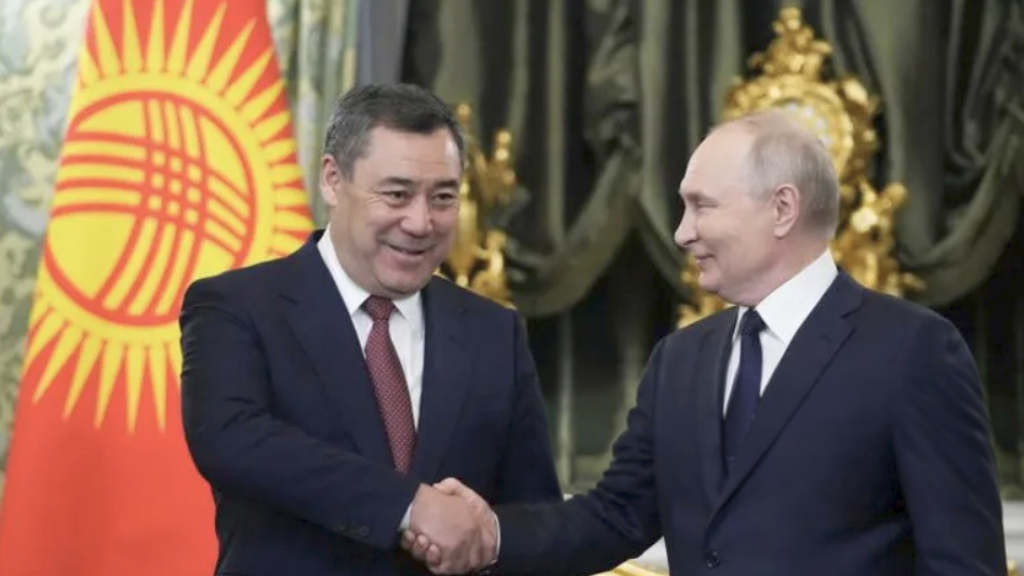

The Russian President, Vladimir Putin, and the Kyrgyz President, Sadyr Japarov, discussed investment cooperation between the two countries in Moscow on Wednesday (November 11).
Putin said that “We meet regularly. Our relations are developing successfully in all areas. Russia remains Kyrgyzstan’s leading trade and economic partner. Trade between Russia and Kyrgyzstan is growing and increased by more than 25% last year. We always have a lot to talk about in this sense. We focus precisely on our bilateral relations with respect to certain current issues and investment cooperation.”
He met with Japarov following the Collective Security Treaty Organization (CSTO) summit, which we commented on here.
Japarov said Russia is among the largest investors in Kyrgyzstan’s economy, adding that “Russia remains one of the key trade and economic partners and a major investor in Kyrgyzstan’s economy. Our bilateral trade exceeded US$4 billion in 2025 and has reached around US$3 billion over the first nine months of this year.” This suggests 2026 trade has remained static.
Japarov said that there are over 2,000 Russian-invested companies operating in Kyrgyzstan’s industry, energy, agriculture, and other sectors. He also referred to the new construction of a joint scientific center in Bishkek to study infectious diseases, a project fully funded by Russia, as an example of such cooperation.
He said, “The Russian-Kyrgyz Development Fund, which has financed around 4,000 projects with a total value exceeding US$1 billion, makes a significant contribution to implementing joint projects. I’d like to thank the Russian government for its decision to increase the fund’s capitalization this year. Our business communities are also developing direct engagement. In particular, more than 40 agreements totalling US$850 million were signed following the 7th Kyrgyz-Russian Economic Forum.”
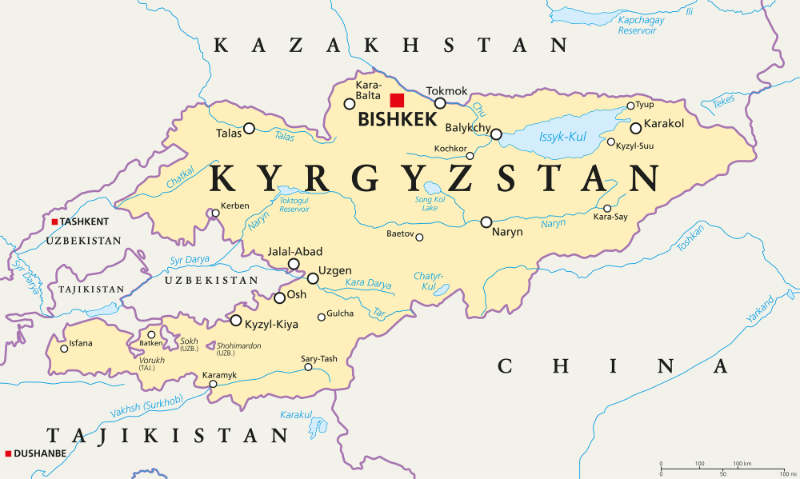
Kyrgyzstan helps serve as a link between China and the rest of Central Asia, an issue that will be enhanced when the China-Kyrgyzstan-Uzbekistan railway is operational.
The economy of Kyrgyzstan is supported by several key industries that are critical for its growth and overall development. Agriculture serves a significant portion of the population and ensures essential food security. The country is recognized for producing various crops, including cotton, tobacco, and a diverse range of fruits and vegetables. Additionally, livestock farming plays a crucial role, contributing to both domestic consumption and exports, particularly in meat and dairy products. In terms of energy, Kyrgyzstan boasts considerable hydropower potential, which accounts for the majority of its electricity generation. The government focuses on expanding its hydropower infrastructure and is exploring renewable energy opportunities. Additionally, manufacturing is being revitalized through the establishment of new facilities and technological parks, with the benefit of these being to add Kyrgyz labor and components to add value to partially completed Chinese products destined for Central Asia and beyond.
Kyrgyzstan is actively engaged in several free trade agreements to enhance its economic integration. It is a member of the Eurasian Economic Union (EAEU), which allows for the elimination of tariffs and trade barriers among member states. In June 2024, Kyrgyzstan ratified a trade agreement with Iran to bolster trade relations. Additionally, Kyrgyzstan benefits from the Generalized Scheme of Preferences Plus (GSP+), providing tariff-free access to the EU market for over two-thirds of its products, which has been instrumental in boosting exports. The Enhanced Partnership and Cooperation Agreement (EPCA) signed with the EU in June 2024 aims to strengthen bilateral cooperation in trade, governance, and environmental protection. Russian online retail investors such as Wildberries and Ozon have also established operations in Kyrgyzstan to help facilitate Chinese trade.
With a population of approximately 7.2 million, Kyrgyzstan’s GDP (PPP) currently stands at around US$76.24 billion, GDP per capita (PPP) at US$8,000, and a projected GDP growth for 2026 at over 11%.
Kyrgyzstan-Russia Bilateral Trade

As Putin and Japarov noted, Kyrgyzstan’s bilateral trade with Russia rose by 25% in 2025 and reached a total of US$4 billion-although some reports have put the figure as being higher. Both countries are aiming for a mutual trade target of US$5 billion.
Kyrgyzstan is particularly interested in expanding cooperation with Russian regions in several key areas, including the establishment of joint ventures, localization of production, technology exchange, and the involvement of small and medium-sized businesses in interregional projects. There are planned cooperations in the agro-industrial complex, pharmaceuticals, mechanical engineering, and digital technologies. These regions would include Russian Oblasts close to Kyrgyzstan, with an eye on using the CKU railway, scheduled to be completed in 2031.
The backbone of Russia’s exports to Kyrgyzstan is petroleum products: in 2025, shipments amounted to US$907 million, accounting for approximately 40% of Russia’s total exports to the republic. At the same time, Russian fuel accounts for over 90% of Kyrgyzstan’s imports of fuels and lubricants, with Kyrgyzstan receiving these under preferential tariffs.
In addition to petroleum products, Russia supplies natural gas to Kyrgyzstan via pipeline through Kazakhstan. The current supply volume is about 0.5 billion cubic meters per year. According to the Kazakh side, negotiations are underway to increase transit: starting in 2026, the plan is to raise volumes to more than 600 million cubic meters per year. Gazprom estimates the potential for further growth-up to 800 million cubic meters per year within two years.
Another significant export item is steel bars and rebar: in 2025, exports reached US$78.6 million in value – a lot of steel. These products are in demand in Kyrgyzstan’s construction industry and play an important role in meeting the sector’s needs.
From Kyrgyzstan to Russia, luxury cars are supplied-mainly under a re‑export scheme: vehicles are cleared through customs in the republic at EAEU preferential rates and then shipped to Russia. Agricultural products are also exported, including vegetables, fruits, and nuts.
Labor migration remains another key area of cooperation: hundreds of thousands of Kyrgyz citizens work in Russia (650,000 Kyrgyz nationals, according to 2024 Russian Interior Ministry data), primarily in the construction, trade, and services sector. Their remittances – totalling about US$3 billion per year, with over 90 % coming from Russia – remain a key source of foreign currency inflows for Kyrgyzstan, comparable in volume to its total merchandise exports.