 Русский




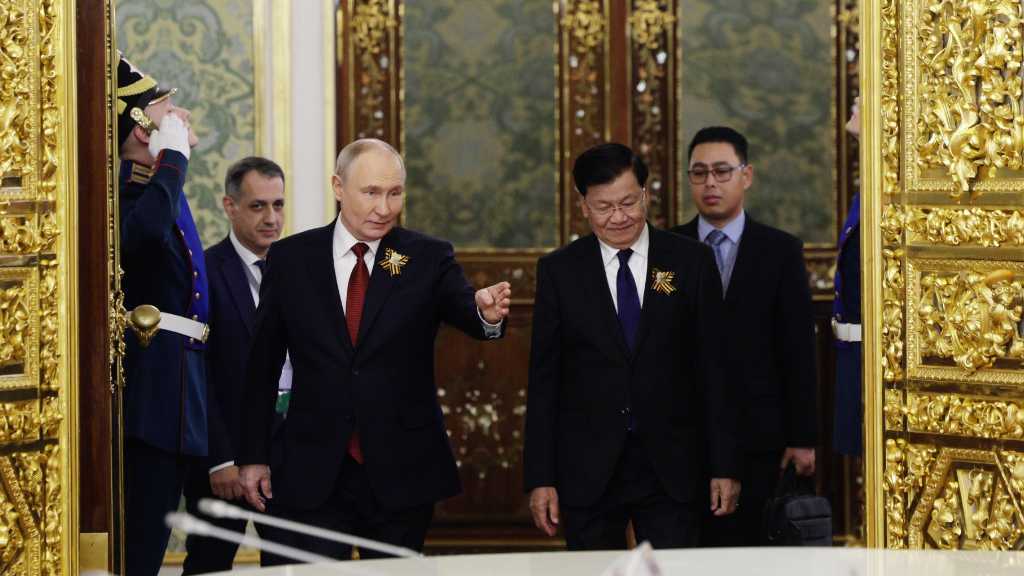

The Russian President, Vladimir Putin, has met with the President of Laos, Thongloun Sisoulith, and a government and business delegation in Moscow. Additionally representing the Russian side at the meeting were Foreign Minister Sergei Lavrov; Deputy Prime Minister Alexander Novak; Presidential Aide Yury Ushakov; Minister of Education Sergei Kravtsov; Minister of Economic Development Maxim Reshetnikov; Finance Minister Anton Siluanov; Minister of Construction, Housing, and Utilities and Co-Chair of the Intergovernmental Russian-Lao Commission on Trade, Economic, Scientific, and Technical Cooperation Irek Fayzullin; Deputy Defence Minister Vasily Osmakov; and General Director of the State Atomic Energy Corporation Rosatom Alexei Likhachev.
Putin said, “I am very pleased to welcome you to Moscow. Our meetings have become a good tradition. This is your second time at the Victory Day celebrations in Moscow, and you also paid an official visit to Russia last July.
Let me once again congratulate you on your re-election as president. I am confident that your extensive political experience will continue to help you effectively address Laos’s socioeconomic development goals and pursue a constructive course in international affairs. We appreciate that Russia was your first destination for an international visit in the new presidential term.
Our relations are founded on friendship, mutual respect, and trust. Last year, we marked the 65th anniversary of diplomatic relations between our countries.
We are also seeing positive momentum in bilateral trade. Last year, trade turnover doubled compared to 2024 levels. Although the overall volume remains relatively modest, the trend is encouraging. The intergovernmental commission continues to play an important role in advancing trade and economic cooperation.
We are actively cooperating on the international stage. New opportunities for partnership are opening up now that your country has become a partner of the Shanghai Cooperation Organisation. I know that your visit has a very busy programme, and I am confident that your stay in Russia will be both productive and rewarding.”
Sisoulith said, “I would like to express gratitude for the warm reception given to me and our delegation. I am very glad to meet you again following our meeting in Moscow in July and last October at the 25th summit of the Shanghai Cooperation Organisation held in China. The Lao side is ready to continue our talks intended to expand the Russia-Laos interaction for significant practical results. We are ready for mutually beneficial cooperation.”
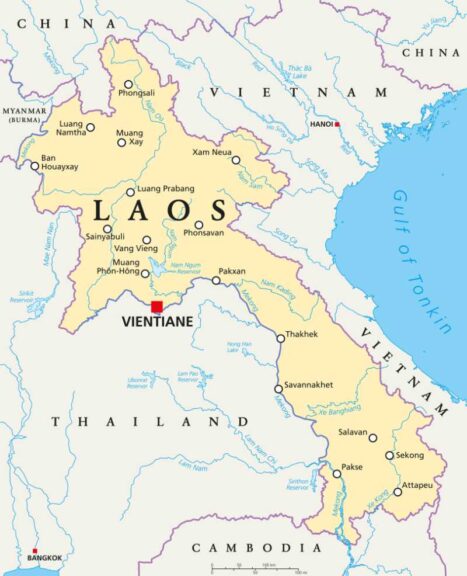
Laos is strategically situated in Southeast Asia, and although it does not enjoy sea access, it nevertheless links several regional ASEAN countries.
About 85% of people in the population work in agriculture, making it primarily an agricultural nation. 90% of the arable land is planted to rice, which is the primary crop. Peanuts, cotton, tea, tobacco, corn, sweet potatoes, and sugarcane are also grown. Lao industry tends to suffer from a lack of adequate equipment, although the mining sector is relatively advanced. The primary sources of GDP are the exploitation of gypsum, copper, tin, gold, and oil. Trading and catering services make up the majority of the service industry. Telecommunications equipment, trucks, metal constructions, rolled metal goods, and hydraulic turbines are the primary imports.
Through its membership of ASEAN, Laos increasingly trades with its ASEAN neighbours as well as China. Laos has also been given Generalised System of Preference (GSP) status by multiple countries, including Belarus and Russia, while Kyrgyzstan and Tajikistan also grant Laos goods tariff-free protection. In 2016, a Trade and Investment Framework Agreement was struck between the United States and Laos. It also has additional bilateral agreements with Argentina, India, Kuwait, Mongolia, North Korea, and Turkiye. In January 2022, Laos became a member of the Regional Comprehensive Economic Partnership (RCEP).
Laos has an area of 236,800 sq km and a population of 7.7 million. It has a GDP (PPP) of US$98 billion, GDP per capita (PPP) of US$13,269, and an expected 2026 GDP growth of 4%.
Trade between Russia and Laos reached US$41.6 million in 2021. However, like neighbouring Cambodia, bilateral trade has decreased mainly due to sanctions, the complexities of reaching the Laotian markets, and Russia’s trade emphasis concentrating on China and Vietnam.
According to the Russian Foreign Ministry, in 2024, the trade turnover between the two countries increased by 65% and reached US$23.8 million. In 2025, the trade turnover between Russia and Laos doubled compared to 2024. As a result, it reached an estimated US$47.6 million in 2025. Russian President Vladimir Putin noted that the overall trade volume remains modest but shows positive dynamics.
Laos does pick up some manufacturing investments from neighbouring countries such as Thailand and China, and it also has a developing tourism industry. Bilateral trade is typically energy produce from Russia and agricultural products such as fruits from Laos. The country is largely mountainous as well as being landlocked, which creates serious obstacles to the development of land infrastructure. In recent years. Russian‑Lao negotiations on transport issues have intensified. An important stage is the participation of Russian Transport Minister Roman Starovoit in bilateral discussions with his Laotian counterparts, with Russian companies able to offer Laos comprehensive solutions: engineering and construction of railway infrastructure, including alarm and communication systems; supply, modernisation and maintenance of rolling stock; and management and operation of railway systems. Here, such companies would compete with China’s railway engineering businesses.
Both the Russian and Laotian central banks are in discussions to involve the potential use of Russian MIR cards in Laos and to formalise ruble-kip trading, moving to sovereign currency use in trade relations. Although the trade dynamics are small, there are opportunities in the tourism sector for Russian nationals as well as smaller trade possibilities.
Meanwhile, Russia and Laos agreed at these meetings to examine the potential for Russia to deliver fuel supplies to Laos and are evaluating the logistical possibilities for the initial export. With Laos landlocked and unreachable by sea, Russia would route shipments through Vietnamese ports.
Laos has been reeling from one of the worst fuel crises in its recent history, triggered by the Middle East conflict and its knock-on disruptions to global supply chains. The country imports around 97% of its refined fuel from Thailand, leaving it acutely exposed when supplies tightened earlier this year.
At the height of the crisis in mid-March, more than 1,000 of Laos’ 2,538 petrol stations had shut, long queues formed across Vientiane, and diesel prices more than doubled. Vietnam stepped in as an emergency supplier, committing 50 million litres of fuel and agreeing to allow Laos to transit petroleum from third countries through Vietnamese territory, the same corridor Russia is now considering for its planned deliveries.