Русский




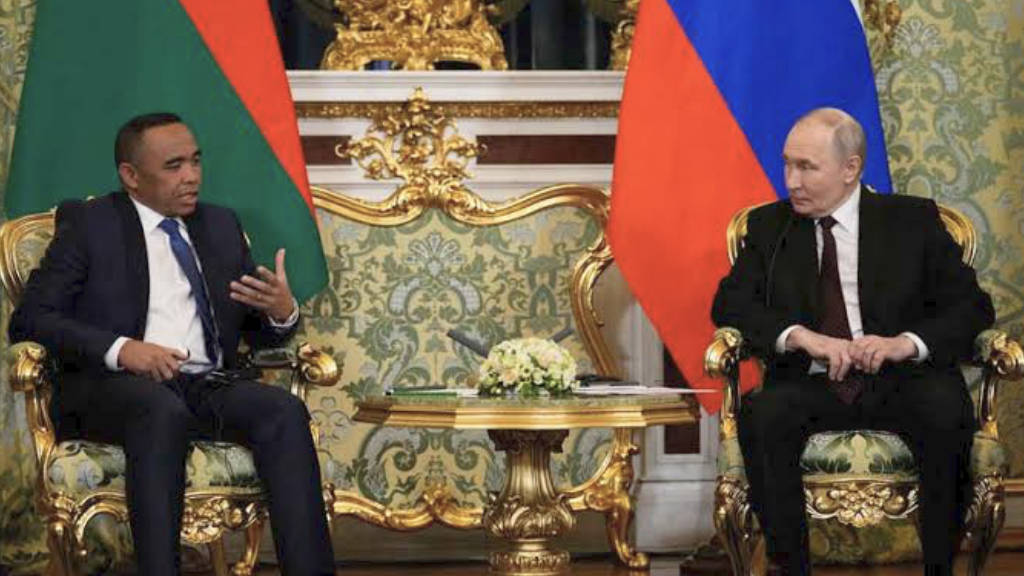

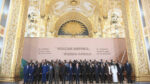
Russian President Vladimir Putin met with Michael Randrianirina, the President of Madagascar, during the 2026 Russia–Africa Summit.
Taking part in the meeting on the Russian side were Deputy Prime Minister Alexander Novak, Deputy Chief of Staff of the Presidential Executive Office Maxim Oreshkin, Deputy Chief of Staff of the Presidential Executive Office – Presidential Press Secretary Dmitry Peskov, Presidential Aide Yury Ushakov, Minister of Economic Development Maxim Reshetnikov, Head of the Federal Service for the Oversight of Consumer Protection and Welfare Anna Popova, Deputy Foreign Minister Georgy Borisenko, Deputy Defence Minister Vasily Osmakov, Deputy Minister of Finance Ivan Chebeskov, Chief of the Main Directorate of the General Staff of the Russian Armed Forces – Deputy Chief of the General Staff of the Russian Armed Forces Igor Kostyukov, Deputy Chief of the Main Directorate of the General Staff of the Russian Armed Forces Andrei Averyanov, and member of the Russian Union of Industrialists and Entrepreneurs (RSPP) Board Bureau Oleg Deripaska.
This is what they had to say:
Vladimir Putin: “I would like to thank you once again, Mr President, for taking the time to attend the third Russia–Africa Summit. Russia’s relations with the continent are developing very successfully, at a steady pace and to a high standard.
We have long-standing friendly ties with Madagascar. Next year, we will mark the 55th anniversary of the establishment of diplomatic relations.
Our talks in Moscow in February gave a strong impetus to strengthening cooperation between Russia and Madagascar across a broad range of issues. The potential for bilateral trade and economic cooperation is, of course, far from exhausted. Trade turnover remains rather modest in absolute terms, but it is gaining momentum, and the trends are positive.
We also attach great importance to developing cultural and humanitarian ties: 5,000 students from Madagascar have received an education in Russia. In April, the University of Antananarivo signed a cooperation agreement with St Petersburg State University, and in June, a memorandum of understanding was signed between MGIMO University and the Ministry of Foreign Affairs of Madagascar. I know that you have been awarded the honorary title of Professor at the Russian Presidential Academy of National Economy and Public Administration. I would like to congratulate you on this.
I would also like to note that in April, the Russian Orthodox Church was granted legal entity status in Madagascar. I would like to thank you for this decision. This is an important development, considering that there are more than 1,500 Russian Orthodox parishioners on the island.
We also regard your country as an important partner in shaping a multipolar international order, a balanced and equitable system of international relations. We are ready to expand our cooperation at international forums, primarily, of course, at the United Nations.
Today, we have an opportunity to discuss any issues concerning our bilateral relations that are of interest to you.”
Michael Randrianirina: “Mr President, first of all, I would like to thank you for the warm welcome extended to me and my delegation. I would also like to express my appreciation for the excellent organisation of this third summit, which demonstrates the importance Russia attaches to its partnership with Africa.
I am also grateful for this opportunity to exchange views on the prospects for further strengthening the friendly relations between Madagascar and Russia. Today’s meeting gives us an opportunity to discuss practical steps towards implementing our joint projects and maintaining the momentum that will contribute to strengthening our partnership in the long term. I also welcome the opening of the Russian House in our country. The cultural institution began operations earlier this year following an agreement between Rossotrudnichestvo and the African Initiative.
Mr President, we would like to transform our 54 years of friendship into a partnership that delivers tangible results. To this end, we need to elevate our relations to a new level. Our previous meeting in February of this year marked a new stage in the development of our relations. Today, I would like to review the progress we have made so far and discuss the next steps in our joint work.”
Russia-Madagascar Bilateral Trade & Investment
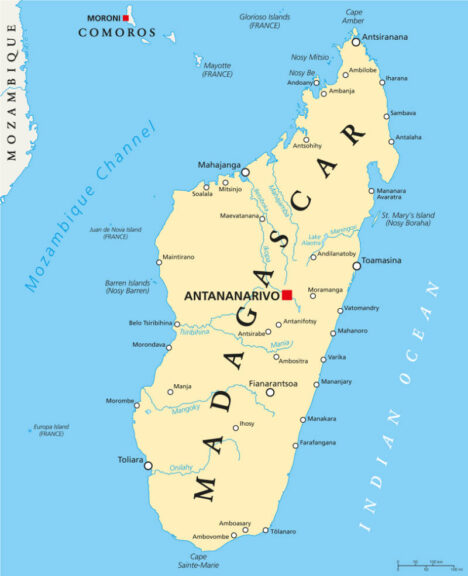
Madagascar is a signatory of the African Continental Free Trade Area (AfCFTA), which eliminates tariffs on 90% of goods, fostering intra-African trade and industrialization. Madagascar is also a member of COMESA and SADC, which promote economic integration and reduced trade barriers within Eastern and Southern Africa. The country adheres to international trade standards as part of the World Trade Organization (WTO), benefiting from access to global markets. Madagascar is a founding member of the Indian Ocean Commission (IOC), focusing on regional cooperation for trade and development.
With a population of about 32 million, Madagascar has a GDP (PPP) of around US$57 billion, a GDP per capita (PPP) of US$2,877, and projected GDP growth of 4% in 2026.
According to the Federal Center for Agroexport, Russia has resumed wheat exports to Madagascar after an almost complete halt in 2025. In the first five months of 2026, Russia exported more than 30,000 tons of wheat to the island, worth over US$7 million. As a result of this, agricultural trade between Russia and Madagascar rose 80% in January–September 2026 compared with the same period last year, according to data from Russian Agriculture Minister Oksana Lut and Gaëtan Ramindo, Madagascar’s Minister of Agriculture and Food Sovereignty.
The two Ministers signed an interministerial memorandum of understanding on agriculture. The document provides for stronger trade and economic ties and scientific and technical collaboration, as well as the development of bilateral agricultural cooperation. The scientific and technical part of the talks covered artificial insemination of farm animals. They also discussed supplies of sheep and goat breeding stock and genetic material from Russia.
Wheat remains Russia’s main agricultural export to Madagascar. Imports from Madagascar include cocoa beans and spices: cloves, vanilla, cinnamon and cinnamon tree flowers. Lut said that Russian exporters are ready to increase supplies of grain and flour. She also noted their readiness to expand exports of oils and fats and mineral fertilizers. The resumption of wheat exports to Madagascar is important for the Russian grain industry, which is looking to expand its exports to Africa.
In May 2026, Madagascar announced plans to sign a partnership agreement with Russia, which is intended to lay the groundwork for the creation of a joint economic zone and to attract Russian investors. That was followed by meetings with Malagasy Foreign Minister Alice N’Diaye in June this year, Russian Foreign Minister Sergey Lavrov said that both sides had agreed that trade and economic cooperation should be significantly expanded.
Bilateral trade is currently running at about US$500 million, with Russia exporting wheat, grain and polymers, and Madagascar exporting mainly cocoa beans, spices, and cloves.