Русский




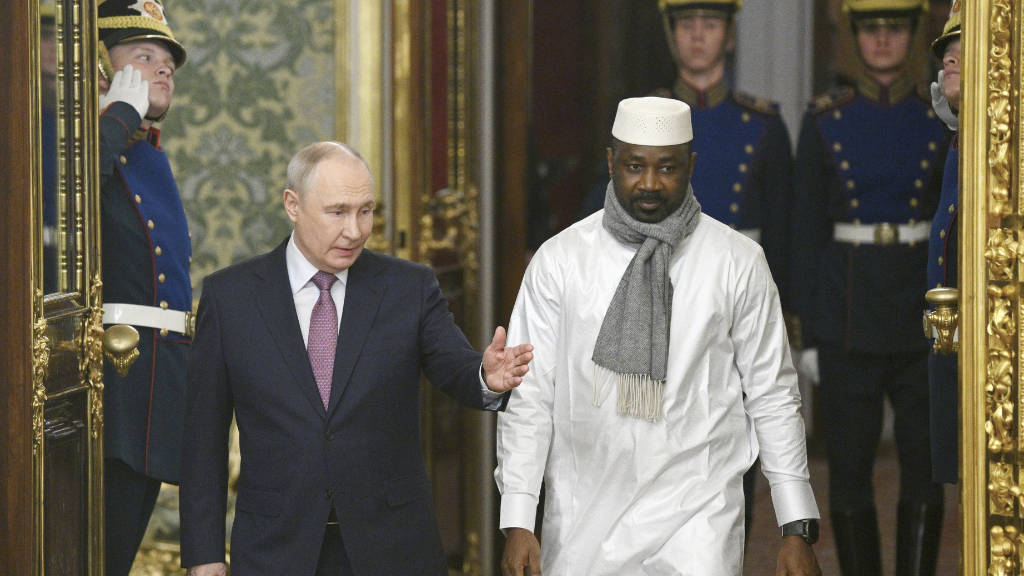

Russian President Vladimir Putin met with Assimi Goita, the interim president of Mali, during the 2026 Russia–Africa Summit.
Taking part in the meeting on the Russian side were Deputy Prime Minister Alexander Novak, Deputy Chief of Staff of the Presidential Executive Office Maxim Oreshkin, Deputy Chief of Staff of the Presidential Executive Office – Presidential Press Secretary Dmitry Peskov, Presidential Aide Yury Ushakov, Ambassador Extraordinary and Plenipotentiary of the Russian Federation to the Republic of Mali Igor Gromyko, Minister of Agriculture Oksana Lut, Minister of Economic Development Maxim Reshetnikov, Minister of Energy, Russian Co-Chair of the Russia-Mali Intergovernmental Commission on Trade, Economic, Scientific, and Technical Cooperation Sergei Tsivilev, and Head of the Federal Service for the Oversight of Consumer Protection and Welfare. Anna Popova, Deputy Foreign Minister Georgy Borisenko, Deputy Defence Minister Vasily Osmakov, Chief of the Main Directorate of the General Staff of the Russian Armed Forces – Deputy Chief of the General Staff of the Russian Armed Forces Igor Kostyukov, Deputy Chief of the Main Directorate of the General Staff of the Russian Armed Forces Andrei Averyanov, Director General of State Atomic Energy Corporation Rosatom Alexei Likhachev, Chair of the Business Council for Cooperation with Sahel Countries, Chairman of the Board of Directors of OKTO Group Alexei Tolokonnikov, and PSB Bank CEO Pyotr Fradkov.
This is what they had to say:
Vladimir Putin: “Mr President, we are very pleased to see you. We appreciate the fact that, despite the difficult situation in the region, you have found the time to attend the third Russia–Africa Summit.
In May, a fundamental intergovernmental agreement on the principles of our relations entered into force. This month, we also marked the 66th anniversary of the establishment of diplomatic relations between our countries, which date back to October 1960.
We highly appreciate your personal commitment to the comprehensive development of partnership with Russia. Trade and economic cooperation is gaining momentum. Although trade volumes remain modest, we are confident that, with the assistance of the intergovernmental commission, which began its work last year, we will be able to achieve further progress in these areas.
We also provide humanitarian assistance. Given the growing interest among young people in Mali in receiving higher education in Russia, we have increased the quota for Malian students to 300 scholarships for the 2026–2027 academic year, as you know.
We continue to develop cooperation in this area. The Russian language is becoming increasingly popular in Mali, and we are grateful for this. There are currently six centres of the Russian language and culture operating in Mali, called “Russian Space”, as well as two private Russian House partner centres. Cultural and sporting ties are also expanding.
We thank you for your consistent support for Russian initiatives at the United Nations and other international forums. We work closely together on international issues. I would like to emphasise once again that you are always a welcome guest here in Russia.”
Assimi Goita: “I would like to begin by thanking President Vladimir Putin for the invitation extended to me. I would also like to express my gratitude for the warm reception accorded to me upon my arrival in your country, as well as to my delegation, which accompanied me to Russia. This hospitality serves as a testament to the high level of friendship that exists and continues to develop between Mali and Russia.”
The meeting was then continued in a restricted format, suggesting military and security issues were discussed.
Conflict In Mali
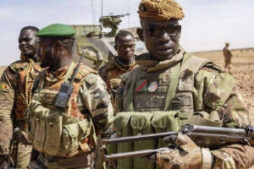
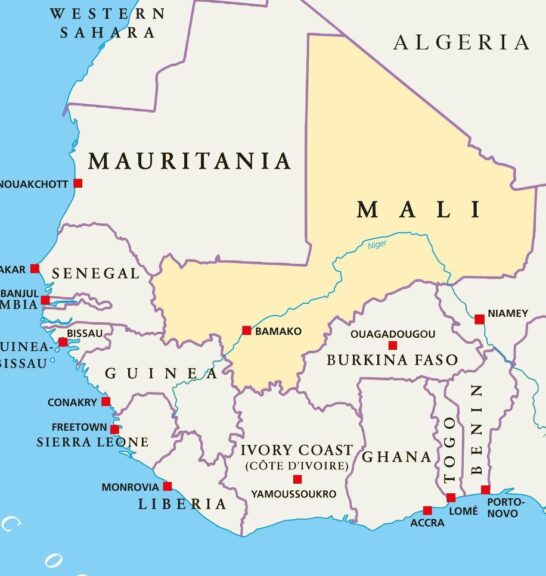
Mali has been subjected to civil unrest, strongly supported by France, aimed at regaining political control over the country. These forces have included Ukrainian military personnel and mercenaries on the European side fighting against Russia’s Africa Corps on the Malian side. Mali has described Ukraine as a ‘terrorist state’.
The current, transitional Mali government came to power after a coup in 2020 deposed the pro-Paris government. They then asked France to withdraw its troops from Mali in 2022, with the United Nations following in 2023.
The Alliance of Sahel States, whose economic ministers also met with Russian officials last week, was formed in 2023 between Mali, Niger, and Burkina Faso after they experienced similar coups in the early 2020s. It is anti-French, anti-neocolonialism and anti-ECOWAS, demonstrated with acts including the removal of French as an official language in all three countries.
Russia, Mali Trade & Investment
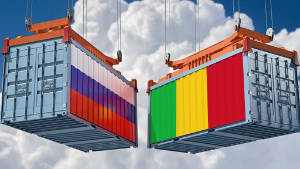
Mali is landlocked, with a growing economy primarily driven by agriculture and mining, although it does have concerns about Islamic fundamentalism, which has been fed by military support from Europe.
The country’s economy is diverse, with major industries including agriculture, which employs about 58% of the working-age population. Mali is one of Africa’s top cotton producers, and key agricultural products include millet, sorghum, rice, and maize. Cotton remains a significant export commodity, contributing substantially to the country’s foreign trade. Mining is another crucial industry, with Mali being the third-largest gold producer in Africa. Gold mining constituted around 80% of the country’s exports in 2023. The government is focused on diversifying the mining sector, with ongoing projects to develop uranium, bauxite, phosphates, iron, lithium, and manganese extraction. Despite facing challenges such as electricity shortages, the services sector-comprising finance, tourism, and retail – remains a significant contributor to Mali’s GDP.
Mali is actively involved in the international and regional trade system, relying on a network of trade agreements. The country is a founding member of the Economic Community of West African States (ECOWAS), which aims to promote economic integration, trade liberalisation, and interregional cooperation. However, in January 2024, Mali, along with Burkina Faso and Niger, announced its withdrawal from ECOWAS.
Mali is a member of the West African Economic and Monetary Union (WAEMU), which brings together eight West African countries that use the same currency, the CFA franc. Membership in the union facilitates trade and financial transactions between member countries.
With a population of approximately 24.5 million, Mali has a GDP (PPP) of around US$68.53 billion, with a GDP per capita (PPP) of US$2,840. Mali’s real GDP growth rate is projected to be 5.5% in 2026, according to the International Monetary Fund (IMF). This growth largely relies on improvements in the country’s agricultural sector and mining activities returning to normal levels.
Mali has reached out to Moscow for security assistance in dealing with Islamic insurgents, and along with the other Sahel States, has invested in both Russian satellites and military assistance and training.
Russia and Mali are cooperating in numerous areas, including gold refining. Russia’s Yadran Group, an investor in Mali’s gold mining industry, laid the cornerstone for a new gold refinery in Bamako in June 2025, with construction is scheduled to be completed by 2027, after which the refinery will go into operation and gradually achieve a design capacity of 100 tonnes of gold per annum in the first phase, with the option for expanding this to 200 tonnes per year. Yadran Group said most of the gold ore will come from Malian mining companies, although the possibility of sourcing gold from other countries in Africa’s Sahel region is also being considered. The project operator is Soroma SA, which is 62% owned by the Malian government. The other 38% of shares are controlled by Yadran Group and its strategic partners.
Another area of cooperation is in nuclear energy, with Russia’s Rosatom announcing the signing of an MoU on nuclear energy, which included collaboration between the two countries in geological exploration and mining. Mali’s Minister of Economy and Finance Alousseni Sanou reported at last year’s Russian Energy Week that Mali planned to begin lithium mining and processing with Russia.
Rosatom Renewable Energy – Rosatom’s wind energy division – is also working with the government of Mali in the construction of a 200-megawatt (MW) solar power plant near the capital, Bamako. Mali and Russia are also expanding their agricultural and industrial relations. Russia supplies critical wheat and fertilizers to help Mali maintain local food stability, while deals have been agreed to assemble Russian KamAZ vehicles in Mali and expand transport routes. That is exactly the type of ‘localisation’ investment that the current African Union Chair, Mahmoud Ali Youssou, said was required in Africa during his address to the Russia-Africa summit earlier this week.
Although bilateral trade is small at about US$80 million, this can be expected to increase as the Sahel region becomes more reliant on Russia in the wake of the withdrawal of French support.