Русский








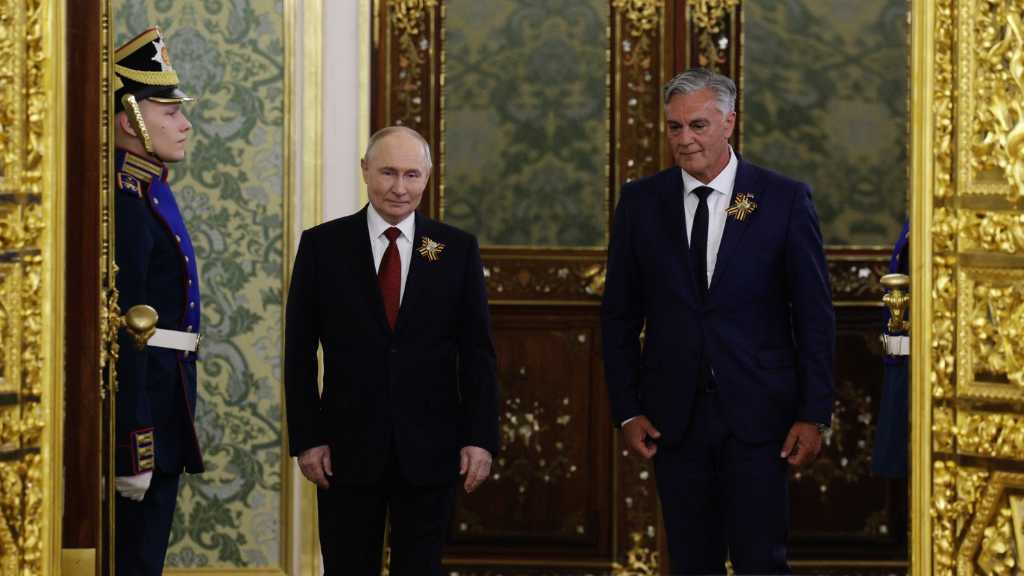

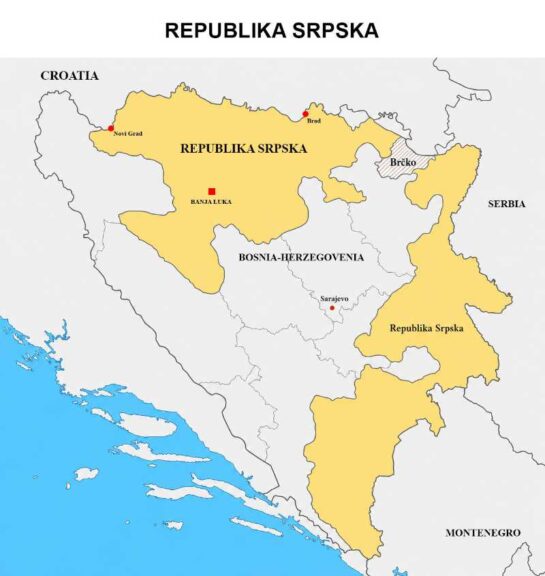
The Russian president, Vladimir Putin, has met with the president of Republika Srpska, Sinisa Karan, in Moscow. Republika Srpska is an entity (State entity) within Bosnia and Herzegovina. It was proclaimed in early 1992 in response to the Bosnian Muslim decision to secede from Yugoslavia. Its ethnic composition is about 83% Serbs, 12.7% Bosniaks (Muslim Slavs), and 2.3% Croat.
The Republika has a certain degree of autonomy in its governance and has its own national legislative body, the National Assembly, and its own administration, including a president and a government. However, the autonomy of Republika Srpska’s authorities is limited by both the constitution of Bosnia and Herzegovina and the influence of international institutions, particularly the High Representative for Bosnia and Herzegovina (BiH).
In May 2021, the ambassadors of the Steering Committee countries decided to appoint Christian Schmidt as the new High Representative for BiH. His appointment was carried out without the approval of the UN Security Council, which led to the Republic of Srpska, Russia, and China not recognising his legitimacy and exacerbated the disagreements between Republika Srpska and the central authorities of Bosnia and Herzegovina. Milorad Dodik, the former President of Republika Srpska, has repeatedly expressed his support for a referendum on the independence of the state in the context of political confrontation with the central authorities of BiH and external pressure.
Despite the fact that Russia does not recognise the independence of Republika Srpska, it supports the Republic in several key areas, relying on cultural and religious proximity, historical memory, and shared positions on a number of international issues.
In August 2025, early presidential elections were announced in Republika Srpska after the removal and sanctioning of the previous president Milorad Dodik, and Siniša Karan was elected. On February 17, 2026, he took the oath of office in the People’s Assembly of Republika Srpska.
This meeting is the first between Russian President Vladimir Putin and the new President, Siniša Karan. The Russian side was also represented by Foreign Minister Sergey Lavrov, Deputy Prime Minister Alexander Novak, Presidential Assistant Yuri Ushakov, and Anton Shalaev, Head of the Federal Agency for Technical Regulation and Metrology and Chairman of the Russian part of the Intergovernmental Commission for Trade and Economic Cooperation.
This is what the two presidents had to say:
Putin: “I would like to welcome you to Moscow on your first visit as president of Republika Srpska. I am also pleased to see here with you Mr Stevandic, Speaker of the National Assembly, as well as our long-standing friend, Milorad Dodik (previous president).
We have developed constructive and regular cooperation with Mr Dodik, and it is important that all of you are like-minded persons. The Russian side remains firmly committed to continuing productive cooperation with Republika Srpska.
Relations between Republika Srpska and Russia are rooted in centuries-old traditions of friendship and the close spiritual ties between our peoples. We share a common vision of history as well as a stance towards the situation in Bosnia and Herzegovina, the Balkans, and Europe. We jointly speak out in favour of a more just international order and the promotion of mutually beneficial cooperation free from interference in internal affairs. We will continue to foster our partnership in the political, economic, cultural, and humanitarian spheres.
We will continue to develop our partnership in the political, economic, cultural, and humanitarian spheres. And I would like to reiterate what I said when we entered this hall: the Serbian and Russian peoples, along with the other peoples of Russia, have for centuries shared especially close ties and a deep mutual understanding.”
Karan: “Thank you, Mr President, sincerely and on behalf of the entire Republika Srpska delegation and the Serbian people. Above all, the Serbian people and Republika Srpska have always remained committed to cooperation with your country. I would especially like to stress that our Republic was founded upon this historical legacy.
As you rightly noted, Republika Srpska is a historical response to suffering, created to ensure that the tragedy endured by the Serbian people is never repeated. Your support is a great honour for us – for our delegation and for the Serbian people as a whole. We are sincerely grateful for your hospitality and for the opportunity to be here in Russia.
I would also like to note that our relations have become particularly strong in recent years. We maintain regular contacts, including ongoing communication between Milorad Dodik and yourself. Our relations are particularly close and are built on mutual respect. We are united by our shared history and by the many facets of our cooperation, which have developed through our common identity and spiritual ties. In this way, we have further strengthened the sense of brotherhood and friendship between our peoples.
I would especially like to emphasise and thank you for the fact that the Russian Federation remains our most important strategic partner on the international stage. It is important to stress that this has always been the case, and we are confident that it will remain so in the future. We will continue working to build an even stronger foundation for our relations. Our partnership rests on sincere friendship, equality, and cooperation free from political conditions. This is further proof that Russia continues to support the Dayton Accords.
We are grateful to Mr Lavrov and all of your representatives, particularly those in the Russian Federation Council and within the Peace Implementation Council, for their respect for and commitment to the principles of the Dayton Accords.”
Background
In March 2024, the European Union began negotiations with Bosnia and Herzegovina on its accession to the EU, and on January 1, 2026, the EU Council imposed a ban on the transit of Russian gas through the European Union. This affected non-EU countries, including Bosnia and Herzegovina, as the region relies on Russian gas transit through European states. Banking services related to Russia were also sanctioned, as were the political and foreign policies of Republika Srpska.
Previously, Republika Srpska had expressed interest in using the Russian Mir payment system on its territory. According to the previous president, this was due to a desire to maintain unrestricted relations with key partners, including Russia. Republika Srpska authorities also sought to accelerate the construction of an additional gas pipeline from Serbia in order to increase its purchases of Russian gas without taking into account the position of Sarajevo (the capital of Bosnia and Herzegovina). The Republika Srpska government also planned to modernize its railway infrastructure in cooperation with Russia. Discussions were held on both the modernisation of existing railways and the construction of new tracks.
The leadership of Republika Srpska expressed its desire for a peaceful withdrawal from Bosnia and Herzegovina and sought Russia’s support. Milorad Dodik played a key role in these statements. However, the current president has ruled out holding a referendum on independence. Karan has stated that “This idea has never existed in the sense in which it is being talked about now.” According to him, it was created artificially and used as a pretext for accusations against the leadership of Republika Srpska. “The autonomy we are talking about is exactly the kind of internal autonomy under the Dayton Agreement. The Republika Srpska is defending its constitutional rights and fighting against having its powers taken away.”
Karan also said that the position of the EU countries would not affect the strategic dialogue between Russia and Republika Srpska. The political situation remains complex.
Republika Srpska has a population of approximately 1.5 million and is home to most of Bosnia-Herzegovina’s Serb population. It has a GDP (PPP) of around US$35 billion, with a GDP per capita (PPP) of approximately US$21,150. Republika Srpska’s GDP growth is projected at 2.6% for 2026, higher than Bosnia-Herzegovina’s 2.2% growth. Bilateral trade between Russia and Republika Srpska equated to about ₽3.8 billion (US$51.5 million) in 2025, with most of this being energy-related plus some agricultural and consumable items.
The Russian economic presence in the country is most pronounced in the oil industry sector. Russia’s state-owned company Zarubezhnjeft owns the Optima Grup company, under which the Nestro pump network, the Brod oil refinery and the Modrica oil refinery operate. Republika Srpska also plans to gasify around 20 municipalities in this entity, relying on Russian gas.
This includes the construction of a gas pipeline from Šepak, near Zvornik, on the eastern border of Republika Srpska with Serbia, where Russian gas is supplied, to Novi Grad in the north-west of the country, but the implementation of this project depends on foreign policy factors and the ability of the parties to overcome sanctions restrictions.
The construction of a new gas pipeline from Serbia and the stable supply of Russian gas, which is cheaper than that of its neighbours, could be a powerful incentive for the development of the manufacturing sector in Republika Srpska. The relocation of corporate facilities from neighbouring Croatia, which is a member of the European Union, could become a reality. Croatia is complying with EU directives and must gradually phase out the use of Russian gas by next year.
In September 2025, the third meeting of the Intergovernmental Commission on Trade and Economic Cooperation with Bosnia and Herzegovina and the Republika Srpska was held in Sochi after an eight-year hiatus. As a result, memoranda of understanding were signed to establish a legal and technical infrastructure for removing technical barriers to trade, harmonising national requirements, and promoting mutual recognition of conformity assessment procedures.
In October 2025, the Russia-Republika Srpska Scientific and Technological Conference was held as part of the Russian Industrialist International Forum and Exhibition. As a result, a strategic cooperation agreement was signed between the Association of Clusters, Technology Parks, and Special Economic Zones of Russia and the Scientific and Technological Park of the Republika Srpska, which should also boost bilateral trade.