 Русский




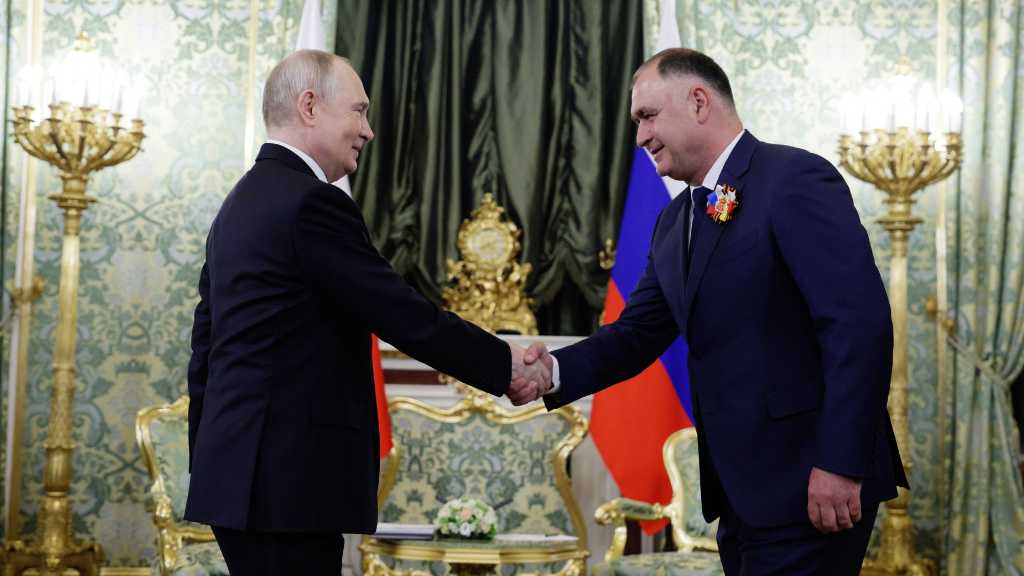

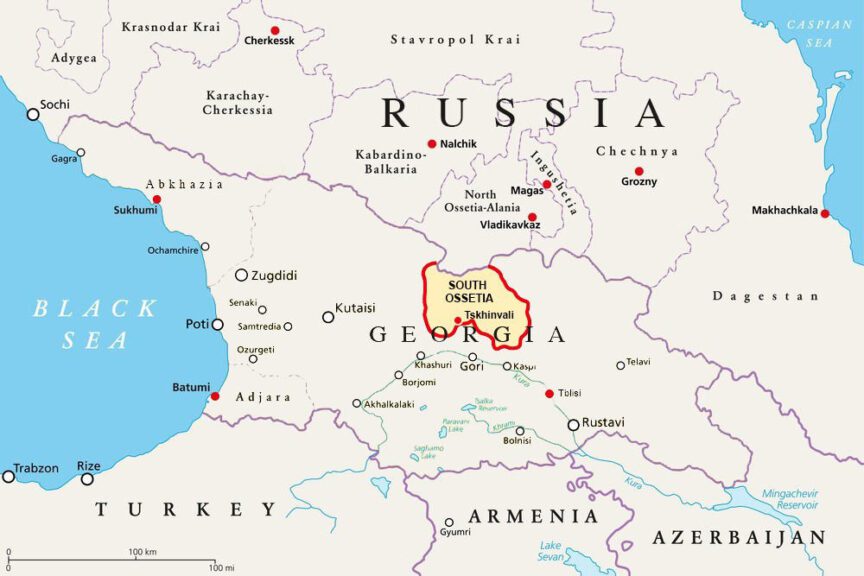
Russian President Vladimir Putin has met with the South Ossetian President, Alan Gagloev, in Moscow. South Ossetia is a partially recognized state in Transcaucasia. South Ossetia has gone from Soviet autonomy (1922) through a period of quasi-independence (1992-2008) to the declaration of independence after the 2008 war with Georgia. Its status remains controversial, with Russia, Venezuela, Nicaragua, Nauru, and Syria recognizing its sovereignty, but most countries and the United Nations continue to consider the region as part of Georgia. Russia plays a key role in supporting South Ossetia, both politically and socio-economically.
This is what the two Presidents had to say:
Putin: “Mr Gagloev, I am happy to see you. I know that Victory Day is widely celebrated in South Ossetia – and for good reason, because the Ossetian people played a highly active role in World War II and the Great Patriotic War. Ossetians ranked first in the number of Heroes of the Soviet Union on a per capita basis.
This also applies to the residents of South Ossetia. If I am not mistaken, eight out of the 34 Ossetians awarded the title Hero of the Soviet Union were from South Ossetia. Nearly half of those who went to the front never returned. These were tremendous losses, and of course South Ossetia, Ossetia as a whole, and the Ossetian people can be proud of their ancestors. This is a vivid and heroic chapter in the history of the Ossetian people.
Today, our relations are developing positively. Last year our trade turnover increased by more than 14%. We have many issues to discuss.”
Gagloev: “I would also like to express my gratitude for your decision, your support, and the funds allocated for the renovation of monuments and museums. Last year, we completed an investment programme and a programme of socioeconomic development. This year, we are launching a new investment programme and a new programme of socioeconomic development in close cooperation with the Government of the Russian Federation and the Presidential Executive Office.
Looking back at 2025, we have an absolutely positive trajectory in all areas. Regarding the humanitarian component, we have begun practical implementation of all the programmes in all fields which are in effect in Russia thanks to our colleagues from the Ministry of Culture, the Presidential Executive Office and the Ministry of Education.
The overall project is called We Overwhelmed Together, which is very emblematic because we overwhelmed together in 1945, we overwhelmed together in August 2008 in South Ossetia, and today, Russian and Ossetian brothers are standing up to our shared history shoulder to shoulder. Where there are Russians and Ossetians, there is always brotherhood.
I would like to add that today we are going to sign an alliance treaty on the deep integration of South Ossetia with Russia. The document is a testimony to our close allied relations advancing to a new level. It is meant to improve our contractual and legal framework, which will allow us to further promote our relations, primarily in trade and the economy, as well as in addressing social issues for the benefit of the South Ossetian citizens.
In 2008, after the Russian Federation protected the people of South Ossetia from Georgia’s military aggression, our two sides signed the first ground-breaking Treaty of Friendship and Cooperation.
In 2015, after seven years of bilateral relations unfolding and our states getting closer to each other, a cooperation and integration treaty was signed which gave a huge boost to integration processes in various areas of our collaboration.
I am confident that South Ossetia has proven itself over all these years as a reliable ally and a friend who does not change its convictions depending on historical situations.
Today we are making, together with you, another step towards bringing our countries and peoples closer together. I am sure that this step will initiate the reunification of the Ossetian people. That is why I am overwhelmed with a feeling of pride in being part of this great event, in the fact that I had the opportunity to take a step towards unity with Russia.”
Following the meeting, a bilateral treaty on deepening allied cooperation between Russia and South Ossetia was signed. We comment further on this below.
South Ossetia’s economy is primarily supported by small-scale agriculture, basic manufacturing, and some trade facilitated by Russia. Key activities include livestock farming, crop production, and minor food processing. These sectors are limited in scale, relying on Russian assistance for funding and infrastructure. The region also has some (Russian) tourism and forestry, but overall, its industries are underdeveloped due to political isolation and restricted access to international markets.
South Ossetia’s trade opportunities are also limited due to its partial recognition and dependence on Russian support. Since 2012, South Ossetia has entered into a free trade agreement with Russia, allowing for the free export of goods, making Russia South Ossetia’s only official trading partner. However, despite this, trade volumes remain minimal, and the practical implementation of the free trade system is still hindered by bureaucratic obstacles. The Deepening Alliance Agreement, which was signed during the meeting, is expected to improve the situation. The parties plan to create a single economic space, harmonize legal norms, and improve conditions for the free movement of capital, goods, services, and labour, akin to a Bilateral Investment Treaty yet more expansive.
Russia and South Ossetia have been implementing an Agreement on the Promotion and Mutual Protection of Investments for several years. In December 2025, additional agreements were signed to facilitate the implementation of the State programmes for the socio-economic development of South Ossetia and Abkhazia for 2026-2030, aimed at promoting economic and investment activity in the republics, including budgetary investments in infrastructure facilities and state support for investment activities. Sergey Nazarov, the Russian Deputy Minister of Economic Development said at that time that “We plan to increase the GDP of South Ossetia 60% by 2030, ensure an annual increase in their own revenues, and achieve wages comparable to those in Russia.”
South Ossetia has an estimated population of around 56,500, with about 33,000 living in the capital city, Tskhinvali. South Ossetia’s economy remains modest and heavily reliant on Russian financial aid, with estimates placing its nominal GDP at around US$70 million, translating to a nominal per capita GDP of approximately US$1,000. Since the region is not widely recognized internationally and experiences limited economic autonomy, reliable data on GDP based on purchasing power parity (PPP) is scarce. Our educated estimate would put South Ossetia’s national GDP at about US$210 million GDP on a PPP basis and a per capita income equivalent to about US$3,000. South Ossetian officials have previously stated that GDP growth rose 33% over the past five years and per capita income by over 50%. GDP growth rates – with Russia’s economic assistance – are estimated to be about 6.5% for 2026.
If the South Ossetian 2026-2030 economic plan succeeds, this could see the country achieve a national GDP (PPP) level of roughly US$336 million with a per capita (PPP) income in excess of US$50,000 per annum by 2030. While we feel the per capita level may be optimistic, we do see encouraging signs that the overall national turnover is capable of rapid development and that personal income will show signs of significant increase.
Russia’s bilateral trade with South Ossetia reached about ₽9.2 billion (US$125 million) in 2025, with Russian exports accounting for about 2/3 of this. The main imports from Russia include agricultural produce, mineral fuels, and petroleum products, while the main exports to Russia are textiles, footwear, mineral water, wine, and fruits.