 Русский




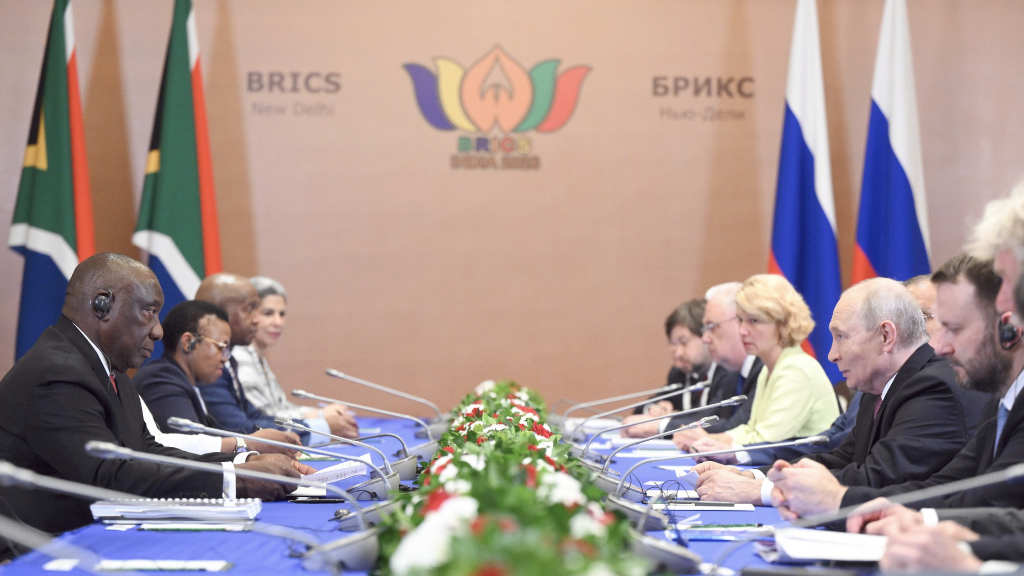

The Russian President, Vladimir Putin. has met with Cyril Ramaphosa, the President of South Africa, in New Delhi. Both were attending the BRICS summit and both had significant delegations.
The Russian delegation at the meeting included Foreign Minister Sergey Lavrov; Aide to the President Yuri Ushakov; Minister of Agriculture Oksana Lut; Minister of Economic Development Maxim Reshetnikov; Director of the Federal Service for Military Technical Cooperation Dmitry Shugayev; Chief Executive Officer of the Russian Direct Investment Fund Kirill Dmitriev; First Deputy Minister of Energy Pavel Sorokin; President of the Russian Fertiliser Producers Association Andrei Guryev, and Director General of the State Atomic Energy Corporation Rosatom Alexei Likhachev.
This is what Putin had to say:
“Mr President, friends, I am very glad to see you.
Our previous discussions also took place at the BRICS summit, in Kazan, yet we remain in constant contact – as do our respective teams. Last year, we had the opportunity to compare positions on the full spectrum of current issues with your Vice-President, who, at your instruction, participated in the St Petersburg International Economic Forum.
Relations between Russia and South Africa are developing successfully. Just last week, on September 5, we marked the 20th anniversary of our basic treaty, signed in 2006 – the Treaty on Friendship and Partnership between our states.
Political dialogue and inter-parliamentary ties are developing, with the heads of our foreign ministries maintaining regular contact. Trade may not be increasing at a rapid pace, but it continues to grow and remains at a solid level.
We have traditionally developed cooperation in the cultural and educational spheres, particularly in personnel training and education. For the 2026–27 academic year, the state quota has been increased to 100 scholarships for your young people to study in Russia.
We note the similarity of our approaches to key international and regional issues, and we are grateful for South Africa’s support for Russian initiatives at the United Nations.
Russia attaches great importance to the comprehensive development of relations with African countries as a whole. We are preparing for the third Summit Russia-Africa, which will take place in Moscow from October 28 to October 29. Among the main subjects are digital technologies, artificial intelligence, peaceful use of freedom, and food security. We expect to have a representative delegation from South Africa. I am most delighted to see you.”
Ramaphosa replied:
“Thank you very much, President Putin.
It’s always a real pleasure to see you, because that gives us an opportunity to continue to strengthen our relations and also advance the various areas in which Russia and South Africa have dealings. And I wish to thank you once again for Russia’s support for South Africa’s G20 presidency, and for your country’s support for South Africa’s priorities. Many people believe that the G20, that was held in South Africa, was very successful, and in large measure this was also due to the support that we received from Russia.
It was not an easy summit, but we were able to overcome the challenges from those who did not want to fully participate. But it was a good summit.
And I wish to convey our appreciation for the continuing significant progress in our bilateral relations. Trade obviously needs to be much better, but it is continuing in the right number of areas in which our trade relations can improve, and we need to focus on that as well.
And thank you very much for receiving our Vice President, who came to the Investment Forum. The discussions that took place there have helped to strengthen relations between our two countries, and in a number of areas we find that our two governments cooperate well.
The 18th Session of the Intergovernmental Committee on Trade and Economic Cooperation (ICTEC), which took place in Moscow in April 2025, that, too, extended our relations. It was an important opportunity to also review the progress and to identify new areas of collaboration. The appointment of South Africa’s ambassador to Moscow has been outstanding, but we will be appointing an ambassador soon.
I am honoured by your invitation to attend the Russia–Africa Summit during October in Moscow. South Africa will be represented, and we obviously are very interested in hearing from you about the developments that continue to take place in the various conflicts that are happening in the world.
And we are also grateful that we’ve been invited to participate in the Pathways to Peace International Conference that will be taking place in Canada. So we want to hear your views on that as well, because we would like to attend, to see how best we can continue advancing our relations.
South Africa will continue working with yourselves in various international forums to contribute to the broader international efforts aiming at securing peace around the world, and we know that Russia also would like to see that objective achieved.
Then we also take this opportunity to thank you for continuing to give our country support when it comes to the training of our students.”
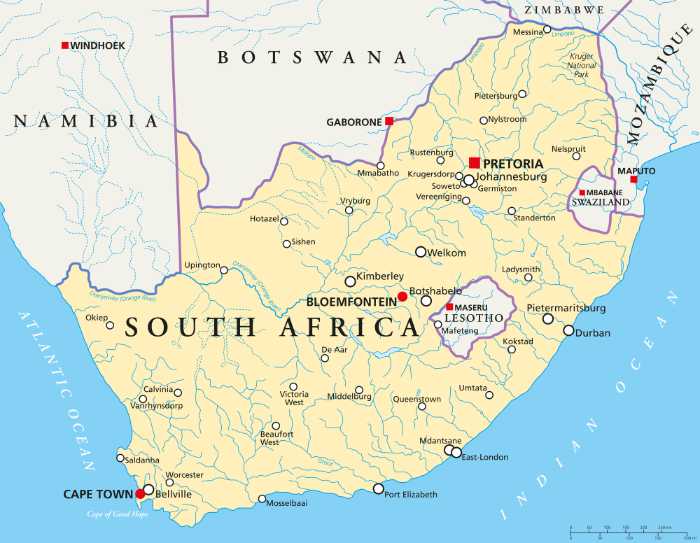
South Africa is a strategically located country on the east African coast serving as a link between the Indian/Atlantic Ocean and the heart of the continent.
Manufacturing, retail, financial services, and other industries are important contributors to South Africa’s GDP growth and the overall economy. Food processing and the manufacturing of textiles, metals, and chemicals are the main industrial industries.
Although land and water resources can be scarce, agriculture and fisheries account for a sizable amount of exports and make a substantial contribution to the local economy, particularly as employers. Numerous minerals may be found in abundance in South Africa. The nation has deposits of gold, diamonds, platinum, manganese, chromium, copper, uranium, silver, beryllium, titanium, and iron ore. Mining continues to be the backbone of the South African economy, despite the fact that manufacturing has historically created more jobs and contributed a larger share of GDP than mining. This is because mining-centered holding firms continue to invest in other sectors of the economy.
South Africa is a member of the Southern African Customs Union (SACU) as well as the Southern African Development Community (SADC) and the African Continental Free Trade Agreement (AfCFTA). It also has a preferential trade agreement (PTA) with MERCOSUR, which is made up of Brazil, Argentina, Paraguay, and Uruguay. Although the market opening’s scope is more constrained, the PTA provides more chances to boost South Africa’s export development in the upcoming years as well as a legal and institutional framework for managing the country’s trade relations with these significant South African nations. These developments mean that South Africa has very much aligned itself as a member of the Global South.
South Africa’s population is about 63 million, with a GDP (PPP) of US$1.07 trillion, according to the IMF. This is the highest in Africa. GDP per capita (PPP) stands at US$16,740. GDP growth in 2025 was slow at 0.8%.
South Africa’s 2025 trade with Russia reached about US$1 billion, growing by 8.5%, increasing partially due to the re-introduction of direct shipping routes for the first time in over 30 years. Russian tourism to South Africa is also growing.
Russian investors are looking into opportunities as diverse as gas refining, nuclear waste management, electrical equipment manufacturing, and viniculture, amongst others. Russia exports mostly wheat and fertilizers to South Africa, while in return South Africa exports mostly agricultural products such as meat and various fruits. South African wines are replacing European wines in Russian supermarkets, while South Africa’s diplomatic role via BRICS has been of great assistance in opening up Africa to Russian trade and investment. Russian accumulated investment into South Africa is estimated at being about US$1.5 billion; however, with increasing trade, it can be expected to increase.
In accordance with the attendees at the meeting, we can examine developments as follows:
Agriculture
Agricultural trade and cooperation between South Africa and Russia have continued to expand in 2026, driven by rising fruit exports from South Africa and essential fertilizer and wheat supplies from Russia.
Fresh fruit remains the cornerstone of South Africa’s exports to Russia, accounting for roughly 90% of trade value. The first major 2026 shipment arrived at St. Petersburg carrying about 1,800 tonnes of fresh table grapes from the new harvest to meet winter consumer demand.
Mineral fertilizers made up nearly 70% of Russia’s total export volume to South Africa, providing vital support for local crop production, while wheat accounted for another 20%.
Across the wider African continent, Russian agricultural exports surged in the first half of 2026, rising 35% in value to US$2.9 billion as overall volumes increased by 40%.
Military
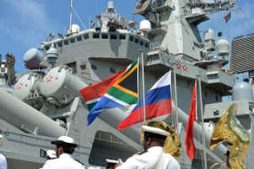
Earlier this year, South Africa participated in joint maritime manoeuvres off Cape Town alongside Russia, China, and Iran. South Africa and Russia agreed to strengthen bilateral military and land-forces cooperation during high-level talks in Moscow in July 2026. South African Army Chief Lieutenant General Lawrence Mbatha followed that with an official military delegation to Moscow in July, meeting with Russian Deputy Commander-in-Chief of Land Forces Colonel General Alexander Matovnikov. Discussions covered joint projects to enhance combat readiness, professional military education, leadership development, and training exchanges.
Energy
South Africa and Russia have advanced their energy cooperation in 2026, focusing heavily on nuclear power development and growing interest in liquefied natural gas.
South Africa and Russia signed a nuclear power Memorandum of Understanding (MoU) during the Africa Energy Indaba in Cape Town, targeting potential construction of Russian VVER reactors and localized nuclear training. The South African Nuclear Energy Corporation (Necsa) and Rosatom also signed an agreement in March 2026 to expand nuclear workforce training and student bursaries.
South Africa is reassessing international partners for its nuclear redevelopment program, with Russian and Chinese firms under consideration. South African authorities are reviewing specialised import infrastructure to integrate gas into broader industrial development and the national energy transition.
Summary
Trade and economic cooperation between South Africa and Russia continues to center heavily on agricultural exchange, strategic bilateral talks, and BRICS-level dialogues.
Officials and trade experts from both nations continue to discuss improving direct maritime shipping routes and expanding the use of national currencies for settlements.