
 Русский







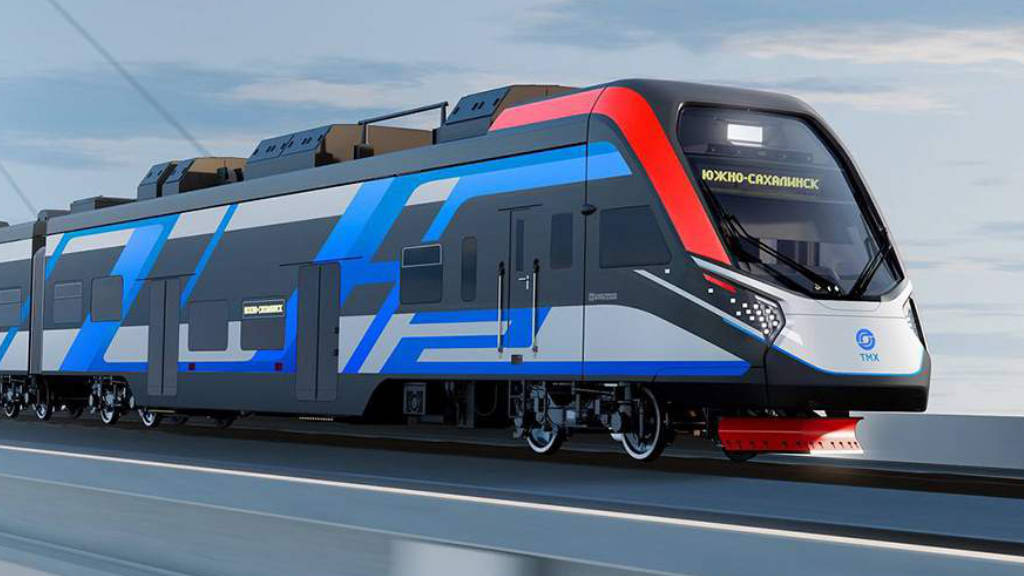

Russia’s first hydrogen passenger train was unveiled in St. Petersburg on Friday (October 16). The three-car train has a range of more than 700 km on hydrogen and 80 km on batteries. Its drive consists of four 110 kW fuel cells (440 kW in total), a hydrogen storage system, lithium-ion batteries, and a current converter in a separate booster car.
The new trains are being sent for additional testing and are expected to receive a compliance certificate and go into trial operation in 2027. Pilot operations will take place on Sakhalin Island, as part of the development of a hydrogen cluster.
Russia joins a select group of countries, including Germany, Japan, China, India and the United States, who are or will soon operate such trains.
Russian Railways (RZD) deputy CEO Ivan Kolesnikov said, “This is an innovative solution that will make transport environmentally friendly in regions with particular climatic and geographical conditions. Foremost, this refers to Sakhalin, where thermal traction is used for passenger transport. Transitioning to hydrogen transport is not just an environmental initiative but the formation of a full-fledged hydrogen economy in the region, from the generation of clean fuel to the creation of new service infrastructure. The project of the first-ever Russian hydrogen passenger train is being implemented on schedule.”
The hydrogen-powered train is being developed in a partnership between train manufacturer TMH, RZD, and the government of the Sakhalin Region and is supported by Russia’s Industry and Trade Ministry.
The TMH solution is the first of its kind in the region with a 1520 mm track gauge. The train is intended for un-electrified tracks and does not produce harmful emissions, as its exhaust is water vapour. The train is scheduled to go into operation at the end of 2027 or the beginning of 2028.
A hydrogen testing ground for developing technology and equipment as part of the Eastern Hydrogen Cluster was launched on Sakhalin in March 2024. The regional government signed a cooperation agreement on this project with state corporation Rosatom, RAOS, Gazprom and Russia’s Far East Development Ministry in 2023.
The goal of the cluster is to create a new hydrogen energy industry in the region to export hydrogen, develop end-to-end hydrogen technologies and use them domestically in energy, transport and the utilities sector.