Русский




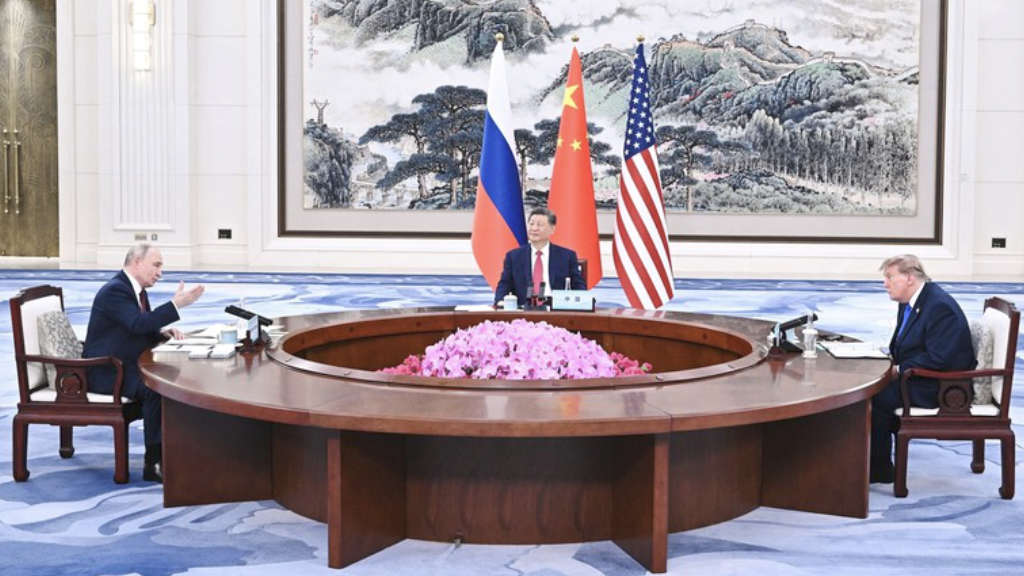
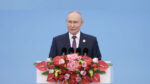
The Russian President Vladimir Putin, US President Donald Trump, and Chinese President Xi Jinping have issued a joint declaration pledging to prevent nuclear war, strengthen global security, and reform international institutions following historic trilateral talks in China.
The 90-minute meeting took place on Thursday (November 19) on the sidelines of the Asia-Pacific Economic Cooperation (APEC) Summit in Shenzhen. The declaration, released after the summit, outlines the three powers’ commitments on nuclear security, energy cooperation and reform of international institutions. Its full text follows, with our comments marked RPA:
“Xi Jinping, President of the People’s Republic of China, Vladimir Putin, President of the Russian Federation, and Donald J. Trump, President of the United States of America, met in Shenzhen on November 19, 2026. The Russian and U.S. heads of state expressed appreciation to China for hosting this historic trilateral Summit. The three heads of state had an in-depth exchange of views on the current international situation and committed to maintaining strategic stability and international security.
1. As permanent members of the United Nations Security Council, China, Russia, and the United States committed to reform the U.N. so that the U.N. can respond more effectively to global challenges and conform to its fundamental mission of international peace and security.
RPA: If followed through, the reform of the United Nations could have substantial global implications. At the Security Council level, just five countries hold votes: The United States, China, Russia, The United Kingdom, and France. Each of these has the power of veto meaning any proposal put forward can be rejected should one of these countries disagree with the contents. This now happens frequently. In addition, there are ten non-permanent members elected for two-year terms who do not have veto power. For a UN Security Council resolution to pass, it requires an affirmative vote of at least 9 out of the 15 members.
Russia’s specific positions on council expansion include:
- India and Brazil: Russia explicitly backs both nations’ long-standing bids for permanent seats, citing them as key international actors that deserve full-fledged membership.
- Africa: Russia supports granting permanent representation to the African continent, aligning its stance with framework agreements like the Ezulwini Consensus and the Sirte Declaration.
The main issue is that The United States, United Kingdom and France will not want to cede effective control of their UN status and thus far have blocked any attempt to do so – adding new members would dilute their authority. However, Trump appears to be onboard with the concept of reform. The real issue is to what degree.
2. The three countries plan to increase the production and supply of refined petroleum products for the benefit of all nations. They reaffirmed the importance of stable energy flows.
RPA: The United States, China, and Russia rank among the world’s largest refining powers. However, issues such as the Iran war, attacks on Russian facilities and sanctions have all made the production and distribution of refined petroleum problematic. This has spilled over to nearly all global economies. In Europe, for example, prices have tripled this year. No details were provided as to how these countries intend to increase production and distribution, but it appears that the end result, if manifested, will be positive, and especially so for Russia.
3. The three heads of state recognized that the principle of state consent and respect for immunities of State officials are of paramount importance, and concurred that the International Criminal Court and other similar bodies must not abuse their jurisdiction.
RPA: Trump has been highly critical of the ICC, even though it does not recognise it as an authority, while neither Russia or China are signatories to it. That hasn’t prevented the ICC investigating allegations of US war crimes in Afghanistan, and more recently, Gaza. The ICC also issued an arrest warrant against Russian President Putin. The main core issue is that the Trilateral views the ICC as politically motivated and wants Heads of State immune from actions. How the Trilateral can affect reform at the ICC is open to question as none are signatories, however it does imply that the ICC is losing influence as its wishes are ignored. Putin for example has visited several countries who are ICC members over the past two years but none have served a warrant for his arrest.
4. The three heads of state reaffirmed that a nuclear war cannot be won and must never be fought. The three countries will conduct a dialogue on reducing nuclear risks and preventing the proliferation of nuclear weapons.”
RPA:There are about 12,187 nuclear weapons globally (including stockpiled and retired warheads awaiting dismantlement) with Russia possessing 5,459, the United States 5,277, and China 620. Neither Russia nor the United States currently have a nuclear treaty to reduce numbers, although all Trilateral members have expressed the need to reduce the volumes of such weapons. The acquisition by other countries (such as Iran) of such technology will also be discouraged. We can expect a nuclear weapons reduction treaty to be agreed at some point in the future.
Analysis
All three parties have expressed satisfaction with the outcomes of the Trilateral, with Putin saying that “Russia, China and the United States can make consequential contributions to world security and stability, if they work constructively together as partners on the foundation of mutual respect, equality and balance of interests.”
There have been suggestions that the Trilateral could become a regular event, although hawks with the United States and certainly the European Union and UK will discourage this. US politics can also change with Trump losing his Presidency in January 2029. There is no guarantee that his elected successor would wish to continue the format, although Putin and Xi would be keen.
The main issue therefore is whether any of the reforms mentioned can be enacted. The merit and point of holding the Trilateral in the first place is whether it can pressurize existing global institutions to change. If not, it will descend into theatre. But if it can, and the United States can hold its position as part of this triad, the current Trilateral could develop to become a self-appointed body effectively replacing the UN Security Council.