 Русский








Scholars from Moscow State University and Russian Railways have published a study on the role of international transport corridors in the transformation of world trade. The main conclusion: in the context of geoeconomic fragmentation, international transport corridors cease to be merely infrastructure for reducing costs. They become an element of state economic security and an instrument of geopolitical competition between macroregional blocs. To that end, investments in alternative Eurasian corridors between 2026 and 2030 are estimated to reach between US$150 and US$200 billion.
The researchers, who included Vladimir Osipov, the Head of the Department of World Economy and Management of Foreign Economic Activity at the Faculty of Public Administration of Moscow State University; Ilya Lenkov, an Associate Professor at the same department; and Aleksandr Kleymenov, the Information and Analytical Department of the Design, Engineering, and Technology Bureau of the Passenger Complex, a branch of Russian Railways. They identified seven mechanisms of transport corridor influence on the geographical structure of trade.
Trade Establishment
Reducing transport costs creates new trade flows by replacing domestic production with imports and expanding exports.
Trade Reorientation
The emergence of a corridor with lower costs shifts freight flows from previous routes. Under sanctions, this mechanism forces trade participants to seek bypass routes regardless of their cost.
Production Agglomeration
Regions along corridors gain expanded access to sales markets and cheaper intermediate goods. Such regions demonstrate growth rates 2 to 3 percentage points higher than national averages.
Transformation of Global Value Chains
Global production networks are replaced by macroregional ones, bound together by a common transport and logistics infrastructure.
Institutional Integration
Developing corridors requires harmonizing customs procedures, standardizing document management, and mutually recognizing certificates. This reduces not only direct transport costs but also broader transaction costs.
Network Connectivity
The value of a corridor is determined by the depth of its integration into the transport network. A corridor connecting several macroregional blocs generates a disproportionately large effect due to network externalities.
Digitalisation of Logistics
According to World Economic Forum estimates, digitalization can reduce transport costs by 10 to 15% and delivery times by 20 to 30%. The researchers described five channels through which geoeconomic fragmentation affects the operation of international transport corridors. First is a change in the nature of risks. Sanctions restrictions, the threat of secondary sanctions, and transit blockades for geopolitical reasons have been added to traditional commercial and operational risks.
According to Lloyd’s List Intelligence, after 2022 the geopolitical risk premium in maritime transport costs on certain routes grew from 2 to 3% to 15 to 20%.
The second channel is the strategic diversification of routes. States reorient investments into alternative corridors. The Eurasian Development Bank estimates total investments in alternative Eurasian international transport corridors from 2022 to 2030 at US$150 to US$200 billion.
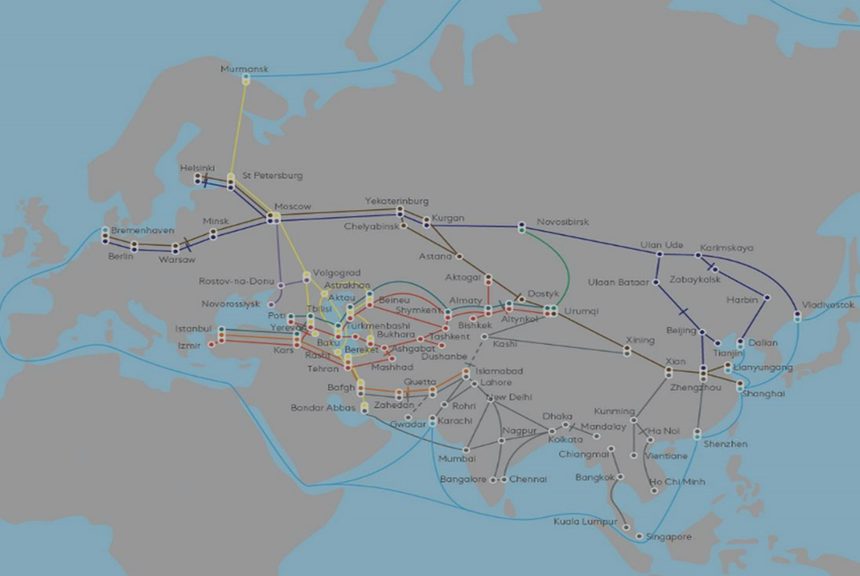
The third channel is the geopoliticization of infrastructure. Control over key corridors turns into an instrument of influence. There are several Eurasian examples of competing initiatives: the Chinese Belt and Road, the European Global Gateway, the International North South Transport Corridor (INSTC), and the Northern Sea Route.
The fourth channel is the regionalization of value chains. The share of intraregional trade in the total exports of developing countries grew from 51% in 2010 to 58% in 2023, according to United Nations Conference on Trade and Development data. Demand is growing for medium-length corridors within the Eurasian Economic Union, BRICS+, Shanghai Cooperation Organization, and Association of Southeast Asian Nations blocs.
The fifth channel is the fragmentation of institutional frameworks. Parallel regulatory systems are forming, including alternative payment systems and regional certification standards.
Increasing Cargo Turnover
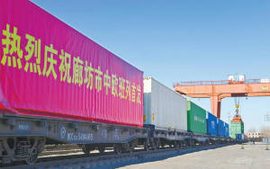
Cargo turnover along the INSTC grew by 19% in 2024, to 26.9 million tonnes. Transportation volume along the Trans Caspian International Transport Route increased by 62%, to 4.5 million tonnes. Transit growth rates along this route in 2023 and 2024 were 89% and 70%, respectively.
A pilot calculation on 2024 Eurasian trade data confirmed the direction of dependencies. Countries connected by an active transport corridor trade around 55% more intensively than comparable pairs without such a corridor. Growing geopolitical tensions reduce trade flows, while improving institutional quality and digitizing logistics increase them.
However, the focus on merchandise trade does not account for trade in services, whose share in world exports grew from 19% in 1995 to 25% in 2023, nor does it fully account for cross-border electronic commerce. Meanwhile, the development of international transport corridors affects the competitiveness of marketplaces. Reducing delivery times from 30 to 45 days down to 12 to 15 days increases conversion by 25 to 30%. Logistics costs decrease by 20 to 25%. Customs procedures accelerate from 3 to 5 days down to 6 to 12 hours.
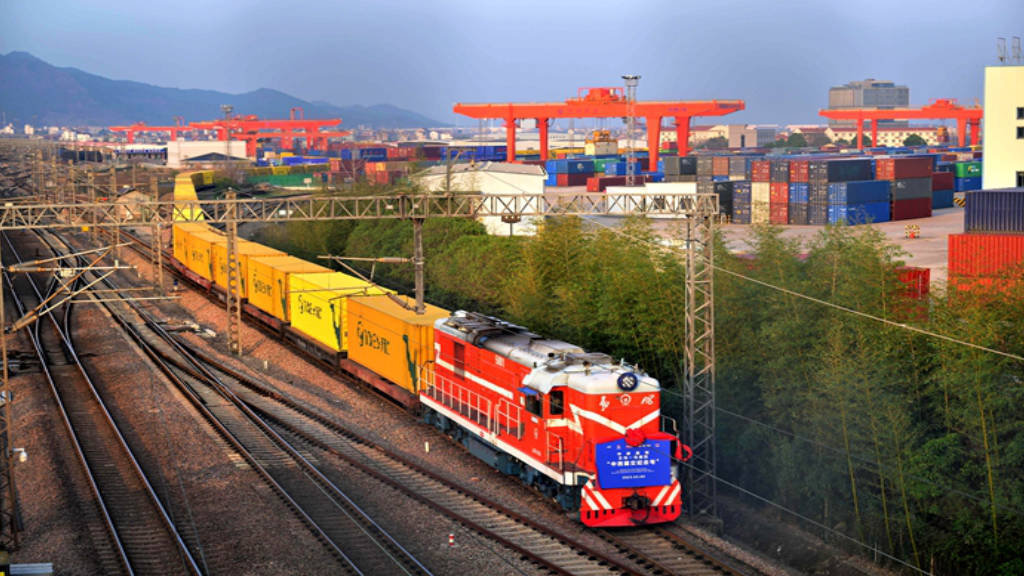
That has impacted the growth of China-Europe railway traffic. The number of China-Europe Railway Express freight train dispatches grew from 17 in 2011 to almost 17,000 in 2023.
Russian marketplaces Ozon and Wildberries also use railway routes with China. The INSTC corridor currently under construction opens up prospects for access to the markets of India and the Persian Gulf. Gulf countries. Among other limitations is insufficient consideration of the specifics of energy resources. Oil, gas, and coal account for 15 to 18% of global exports. Energy international transport corridors are distinguished by high capital intensity, heightened geopolitical risks, and the impact of the energy transition. The introduction of cross-border carbon regulation turns the carbon footprint of corridors into a competitiveness factor—which is why Russia is interested in developing green transport corridors.
Results show that the largest international transport corridors face a growing imbalance of freight flows: the balancing indicator dropped to 12%, which requires fundamentally new approaches to analytics and risk management from logistics companies. That this is taking place in Russia, China, and Eurasia rather than the European Union is a key issue looking ahead.