 Русский






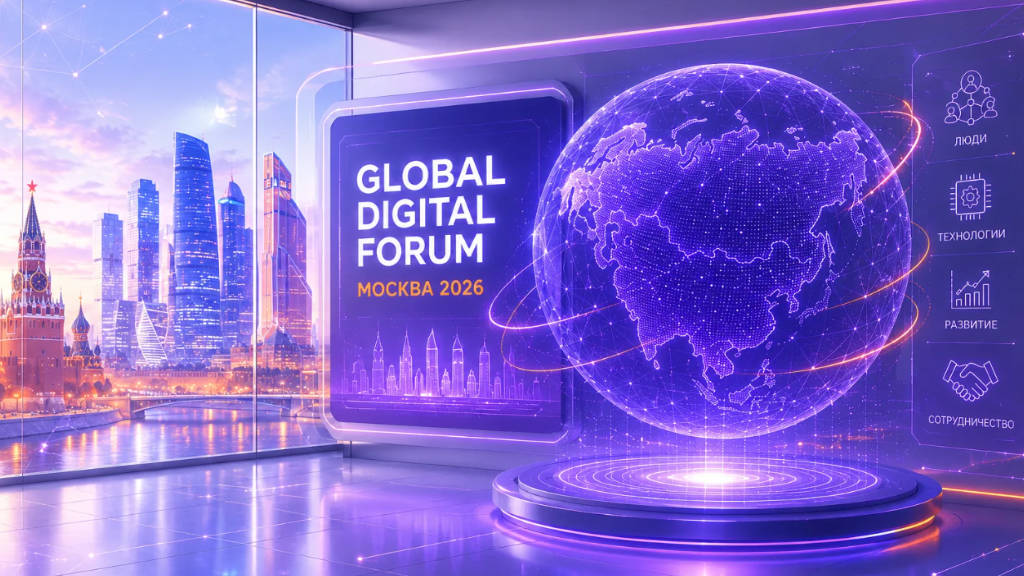

Russia’s digital industry generated aggregate turnover exceeding ₽21 trillion (US$250.5 billion) in 2025, an increase of nearly 20% year on year, while the communications-services market expanded by 13% to reach ₽2.5 trillion (US$30 billion). The country’s digital technology sector is also building international business connections, with the Second Global Digital Forum in Moscow concluding with 150 agreements and memorandums and more than 200 bilateral meetings. More than 1,300 guests attended the three-day event from October 8 to 10, including 730 experts from 111 countries, creating opportunities to explore cooperation in artificial intelligence (AI), cybersecurity, telecommunications, digital infrastructure and software.
Participating countries included Algeria, the Central African Republic, the Democratic Republic of the Congo, Ethiopia, Ghana, Namibia, Nigeria, Tanzania, and Zambia from Africa; Cambodia, Indonesia, Laos, Malaysia, Myanmar, the Philippines, Thailand, and Vietnam from ASEAN; Bangladesh, India, Nepal, and Pakistan from South Asia; Brazil and Nicaragua from Latin America; and Serbia, China, and Iran and the UAE from the Middle East.
The 150 agreements covered digital sovereignty, AI ethics, online child safety, education, research and technology cooperation. More than 20 memorandums supported the Digital Sovereignty Index, while educational and research partnerships connected Russian institutions with foreign universities and organisations. The commercial significance lies in the potential to translate these connections into technology exports, software procurement, research partnerships, training programmes, infrastructure deployment and joint ventures. The memorandums provide channels for cooperation, although their full commercial value will depend on subsequent implementation.
Russia’s domestic technology market provides the industrial context for these international connections. Telecommunications investment, network expansion, computing capacity, data centres, cybersecurity and integrated digital platforms are among the areas shaping the sector. The second event, the Digital Solutions Forum, provided the domestic industrial context. Together, the events presented Russia’s digital policy as a combination of domestic technology development and partnerships with countries seeking alternatives, additional suppliers or greater control over their digital infrastructure.
The Economic Scale Behind Russia’s Digital Strategy
At the main plenary session of the Digital Solutions Forum, Russian Prime Minister Mishustin described digital technologies as a crucial component of the national economy and linked further development to Russia’s national development goals and improvements in public services.
Telecommunications was another major component of the prime minister’s assessment. Apart from the growth in the communications-services market, the number of base stations increased by almost 9% to approximately 1 million, while 4G networks covered virtually all households. He also highlighted the programme to eliminate digital inequality: over the preceding six years, LTE mobile internet had been made available in 8,000 small settlements, with more than 1,500 additional populated areas scheduled to receive access during 2026.
These figures matter commercially because telecommunications infrastructure is a prerequisite for the wider digital economy. Cloud computing, electronic government, online education, remote healthcare, AI-enabled services and digital payments all depend on reliable connectivity. Extending networks to smaller settlements can also widen the market for telecom equipment, software, network maintenance and public-service platforms. The scale of the existing network creates demand for continuing investment rather than a one-time construction programme.
The forum’s programme reflected that shift from connectivity expansion to integrated digital infrastructure. It included discussions on telecommunications networks, computing capacity, data centres, cybersecurity, digital platforms, AI and machine learning, navigation and communications. The exhibition featured 26 partner stands, while the business programme was scheduled to contain more than 120 sessions and over 700 speakers. These are figures for the broader Digital Solutions event, not the Global Digital Forum alone.
This distinction is important when evaluating results. The Digital Solutions Forum concentrated on Russia’s domestic industrial capabilities, implementation experience and technology market. The Global Digital Forum concentrated more directly on international dialogue, cross-border partnerships and the governance questions surrounding digital sovereignty. The events were related, but their programme totals and attendance figures should not be combined into a single set of statistics.
Russia Targets US$24 Billion In State Funding for Technological Leadership
On 12 October 2026 at the Government Coordination Centre in Moscow, Prime Minister Mikhail Mishustin chaired a strategic session on implementing Russia’s nine national technological leadership projects, backed by around ₽2 trillion (US$24 billion) in federal funding over the next three years, alongside regional allocations and expected private-sector investment. The meeting reviewed progress in strengthening industrial self-reliance, expanding domestic production and creating new markets for Russian technologies.
Under the New Nuclear and Energy Technologies project, equipment production for the fuel and energy sector approached ₽1 trillion (US$12 billion), while nuclear innovation infrastructure advanced with a fast-neutron reactor plant under construction in the Tomsk Region and a training simulator launched at the Siberian Chemical Combine. In New Materials and Chemistry, 12 initiatives worth around ₽10 billion (US$119 million) were completed in H1 2026, including production of foundry binders and Novolac resins in the Sverdlovsk Region.
Under Means of Production and Automation, approximately 130 projects received state support, advancing machine tools, robotics and aircraft manufacturing technologies, including equipment for MC-21 composite wing panels and turbojet-engine blades. Support mechanisms for the bioeconomy have also been operating since January 2026, contributing to increased output and exports of products derived from animal and plant raw materials. Mishustin emphasised coordinated planning, regulatory improvements, stronger roles for general designers and qualified customers, and better corporate cooperation to connect scientific research with large-scale serial production and affordable goods for consumers.
Main Programme At The Second Global Digital Forum
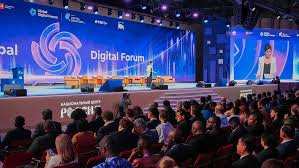
The Second Global Digital Forum (GDF-2026) took place at the Mechta complex in Moscow’s Gorky Park under the slogan “Communicate. Connect. Create.”, as part of Russia’s wider Digital Solutions programme. The three-day programme included plenary sessions, ministerial discussions, business meetings, workshops, lectures and technology presentations. Organisers reported more than 60 sessions, over 1,300 guests and 730 experts from 111 countries.
The business programme focused on artificial intelligence (AI), digital sovereignty, cybersecurity, digital government, smart cities, digital infrastructure and international technology cooperation. On 8 October, the plenary session examined global IT trends, while the roundtable Russia-Southeast Asia: E-Governance Knowledge Sharing brought together participants from Russia, Indonesia, Myanmar and Vietnam to discuss knowledge exchange, educational programmes and joint pilot projects. Other sessions explored digital twins for urban management, AI in media production, corporate domain-name protection and national approaches to digital sovereignty.
Special Programmes & Educational Events
The programme included the IT breakfast Digital Childhood Without Borders: Best International Practices for Protecting Child Safety Online on 8 October, organised by the Alliance for the Protection of Children in the Digital Environment. Participants from government agencies, technology companies and civil society in Russia, Bangladesh, Brazil and Ghana discussed online child protection and international cooperation. The forum also offered media-training activities for foreign journalists and bloggers on AI-assisted content creation, fact-checking, misinformation, social engineering and digital media platforms. On 9 October, the session Global Dialogue on AI Ethics: Expert Forum on Emerging Challenges addressed ethical questions arising from increasingly autonomous AI systems.
Digital Solutions Exhibition And “A Journey Across Russia”
The accompanying Digital Solutions exhibition showcased Russian digital products and services, including AI, software, cybersecurity, telecommunications and digital platforms. Companies represented included Rostelecom, VK, Kaspersky, MTS, Beeline, 1C and Positive Technologies. A separate exhibition, “A Journey Across Russia,” covered more than 3,000 square metres and used interactive displays to present Russia’s regions, natural landscapes, scientific achievements, space technology, shipbuilding, Arctic development and digital innovations. Together, the exhibitions gave international visitors an opportunity to examine Russian technologies and explore potential areas for commercial and institutional cooperation.
150 Agreements, Over 200 B2B Meetings: What Moscow Achieved

The Global Digital Forum’s final tally exceeded its pre-event expectations. The official programme had anticipated more than 100 agreements and deals, over 1,000 IT experts, participants from more than 100 countries and more than 50 technology companies at the exhibition. The final published figures were 150 agreements and memorandums, over 1,300 guests, 730 experts from 111 countries, more than 70 senior officials and over 200 bilateral meetings. Other pre-event publicity referred to participation from as many as 120 countries; the final highlights specifically counted 730 experts from 111 countries.
The 150-document total is the most prominent quantified outcome, but the publicly identified agreements fall into several distinct categories. These covered digital sovereignty, artificial intelligence (AI) ethics, child online safety, education, research and technology cooperation. The documents included memorandums of understanding (MoUs), cooperation agreements and accessions to initiatives, many serving as non-binding frameworks rather than immediate commercial contracts.
They include international memorandums supporting the Digital Sovereignty Index; a joint statement establishing the Global Alliance for the Protection of Children in the Digital Environment; accessions to the AI Ethics Code; educational and research cooperation agreements; and wider institutional partnerships. Some agreements involve companies and industry associations, while others concern universities, public institutions, civil society or international cooperation.
Participants also signed a joint statement establishing the Global Alliance for the Protection of Children in the Digital Environment, with support from representatives of Russia, Abkhazia, South Ossetia, Nicaragua and the Central African Republic, alongside civil-society organisations and endorsements from Tanzania and Bangladesh.
A separate event introduced new Russian and international signatories to the AI Ethics Code, although the complete list was not specified. Over 20 MoUs supported the Digital Sovereignty Index, coordinated by the Center for Global IT Cooperation with assistance from the International Digital Economies Association. Named participants included 2Health AI Limited of China, AKHILAM CONSULTING LLP of India, PAFLA and Quantum Edge of Pakistan, APAC of Vietnam, REGENERATIVE FUTURES of Malaysia, the Cambodia Blockchain Association, Myanmar Digital Economy Association, Indonesia’s AFSI and KADIN Digital Ecosystems Agency, and organisations from Algeria, the UAE, Nepal, Nigeria, Zambia, Brazil, the Democratic Republic of the Congo, the Philippines, Serbia and Namibia. Educational cooperation included an MoU between Ethiopia’s Dilla University and Moscow Technical University of Communications and Informatics on academic exchanges, joint research, internships and cultural activities. Bangladeshi institutions also signed agreements with Russian organisations concerning technology, education and research.
Other documents covered child-safe digital environments, cooperation with technology companies and media-content exchange. The conclusion is that the forum produced a substantial package of cooperation documents.
The 200 plus bilateral meetings provide a second measure of activity. They created opportunities for government officials, technology companies, universities and professional associations to identify potential partners and discuss market entry. Yet meetings are not contracts, and memorandums are not evidence of completed exports. The next test will be whether these contacts lead to funded pilot projects, software procurement, infrastructure deployment, joint ventures, licensing agreements or recurring service revenues.
This distinction is particularly relevant for Russian technology companies pursuing international markets. A framework agreement may establish the legal and institutional basis for cooperation, but commercial delivery requires procurement rules, financing, technical standards, data-protection arrangements, cybersecurity certification and a local implementation partner. The forum’s economic significance therefore rests partly on the institutional infrastructure it established and partly on the opportunities it opened for subsequent business negotiations.
Digital Sovereignty Becomes An Export Market

The second day, 9 October, featured the plenary session “Digital Sovereignty: From Resource to Export Asset.” Sergey Kirienko, First Deputy Chief of Staff of the Presidential Executive Office, said Russia was prepared to act as a full-fledged partner for other countries in digital technologies, helping them develop domestic capabilities rather than simply imposing Russian products. The emphasis linked international cooperation with the ability of partner countries to manage their own digital systems.
The economic logic is straightforward. Countries developing national public-service platforms, cybersecurity capabilities, digital identities, data infrastructure and AI applications need technology, trained personnel and implementation expertise. Cooperation can create opportunities for Russian suppliers in software, network security, cloud systems, government platforms, consulting and training. For partner countries, the attraction may lie in diversifying suppliers, adapting technology to local requirements and retaining greater control over national systems.
The Digital Sovereignty Index was one of the forum’s most tangible mechanisms for expanding this network. The Center for Global IT Cooperation signed more than 20 memorandums with foreign partners supporting the Index, an analytical initiative assessing national digital capabilities, dependencies and resilience. The study had assessed 117 countries. Its presentation placed Russia third overall, behind China and the United States, while ranking it first in the category measuring sovereignty from external influence. These are the Index’s reported assessments, not an independent international ranking accepted by all governments.
Named participants in the memorandum network included PAFLA and Quantum Edge Pvt Ltd from Pakistan; Digital Bridges from Algeria; Agile Dynamics from the United Arab Emirates; 2Health AI Limited from China; Kathmandu FinteK from Nepal; APAC from Vietnam; REGENERATIVE FUTURES from Malaysia; Cambodia Blockchain Association; Myanmar Digital Economy Association; Worklife Training Professionals from Nigeria; the Association of Islamic Fintech Indonesia and KADIN Digital Ecosystems Agency from Indonesia; Bridging Gap Solutions from Zambia; Latin American Startups Alliance from Brazil; Talentus Consulting from the Democratic Republic of the Congo; AKHILAM CONSULTING from India; GIPDEX Inc and the Asian Small Business Federation from the Philippines; KEC Group from Serbia; and Paratus Telecom from Namibia.
This geographical spread is important because the partners operate in different markets and represent different parts of the digital ecosystem. Associations and consultancies can contribute local knowledge, convene stakeholders and help identify national priorities; technology firms can potentially support implementation. The memorandums create channels for data contributions, expert consultation and methodological input into the Index. They are described as voluntary and non-binding, however, and do not by themselves establish technology purchases, investment amounts or guaranteed access to national markets.
For Russia, the network offers a possible route to longer-term engagement with emerging digital markets. For participating countries, it provides a forum for exchanging views on how to measure technological dependence and strengthen domestic capabilities. Whether this translates into commercial business will depend on subsequent projects and the degree to which the Index informs practical procurement or policy decisions.
Russia-ASEAN Digital Cooperation: Cybersecurity, E-Governance and Skills Development
The Global Digital Forum’s international programme included a Russia-Southeast Asia: E-Governance Knowledge Sharing roundtable on October 8. Participants from Russia, Indonesia, Myanmar and Vietnam discussed knowledge exchange, educational programmes and joint pilot projects. Other sessions explored digital twins for urban management, AI in media production, corporate domain-name protection and national approaches to digital sovereignty. These discussions connected technical development with practical applications in public administration, business operations and digital services.
The 6th Russia-ASEAN Dialogue on ICT Security-Related Issues, also held on October 8, brought together Russian officials, ASEAN representatives and national cybersecurity and telecommunications specialists. Discussions covered cross-border digital threats, capacity-building, personnel training, the exchange of experience, public-private cooperation and work within the United Nations framework.
Participants included Santisouk Simmalavong, Laos’s Minister of Technology and Communications; Alexander Alimov, Russia’s Deputy Foreign Minister; Alexander Shoitov, Russia’s Deputy Minister of Digital Development, Communications and Mass Media; Astana Abdul Aziz, ASEAN’s Deputy Secretary-General for the Political-Security Community; Chun Vat of Cambodia’s Ministry of Posts and Telecommunications; and representatives of Thailand and the Philippines. The dialogue offered opportunities to explore cooperation in cybersecurity, digital government and specialist training. Its longer-term economic value will depend on whether discussions develop into funded training, technology deployment, service contracts or repeat business.
Cambodia: Digital Sovereignty, Blockchain And Public-Service Technology

Cambodia’s participation connected the forum’s broader digital-sovereignty agenda with Southeast Asian technology cooperation. Chun Vat, Secretary of State at Cambodia’s Ministry of Posts and Telecommunications, participated in the 6th Russia-ASEAN Dialogue on ICT Security-Related Issues on 8 October. The dialogue brought together Russian officials, ASEAN representatives and national cybersecurity and telecommunications specialists to discuss cross-border digital threats, capacity-building and public-private cooperation. Cambodia was also represented in the Digital Sovereignty Index memorandum network by the Cambodia Blockchain Association, whose executive director is identified as Chandaravordy Lu. This gives the Cambodian participation a specific institutional and industry link, rather than merely a presence at the diplomatic level. Blockchain-related expertise could be relevant to digital identity, transaction verification, financial technology and secure information exchange. The concrete outcome is a channel for engagement with the Index and its international partner network. The broader commercial opportunity is to connect policy-level cooperation with specific projects. Cambodia’s digital development needs can potentially create demand for cybersecurity services, government platforms, digital skills and secure data systems. Russian providers would need to demonstrate suitability for Cambodian law, language, infrastructure and procurement requirements. The next stage would therefore require named counterparties, technical specifications and pilot projects rather than relying on a general memorandum alone.
Myanmar, Laos, Thailand & the Russia-ASEAN Digital Cooperation Agenda

Myanmar’s participation had a clear governmental and cybersecurity focus. A delegation led by U Min Zeyar Hlaing, Deputy Minister for Digital Development and Communications, attended the forum from 8 to 10 October. Myanmar participated in the 6th Russia-ASEAN Dialogue on ICT Security-Related Issues, serving as ASEAN’s co-chair, and U Min Zeyar Hlaing took part in the “e-Governance Knowledge Sharing” roundtable. On the sidelines, the Myanmar delegation held a bilateral meeting with Alexander Shoitov, Russia’s Deputy Minister of Digital Development, Communications and Mass Media. The two sides discussed digital government systems, cybersecurity frameworks and the development of technology-related human resources through training programmes. Myanmar’s participation also extended into the Digital Sovereignty Index network through the Myanmar Digital Economy Association, represented by its president, Aung Zayar Lwin. The association’s involvement creates a potential channel for expert exchanges and cooperation on national digital capabilities. Together, these engagements connect government-to-government dialogue, industry representation and cybersecurity capacity-building.
The regional agenda matters because digital threats cross national borders. The Russia-ASEAN dialogue addressed cooperation within the United Nations framework, the exchange of experience, personnel training and public-private partnerships. Participants included Santisouk Simmalavong, Laos’s Minister of Technology and Communications; Alexander Alimov, Russia’s Deputy Foreign Minister; Shoitov; Astana Abdul Aziz, ASEAN’s Deputy Secretary-General for the Political-Security Community; Chun Vat of Cambodia’s Ministry of Posts and Telecommunications; and representatives of Thailand and the Philippines. For Russia, these contacts can support future cooperation in cybersecurity, digital government and training. For ASEAN participants, they offer access to discussions on institutional capacity and alternative technical approaches. Their economic value will depend on whether the dialogue develops into funded training, technology deployment, service contracts or repeat business.
Iran: AI, Cybersecurity And The Prospect Of Joint Technology Ventures
Iran’s engagement took place against an established bilateral ICT cooperation framework. At the third Russia-Iran ICT Forum, held on the sidelines of the Global Digital Forum, officials and private-sector representatives discussed opportunities to expand cooperation in advanced technology. Alexander Shoitov, Russia’s Deputy Minister of Digital Development, Communications and Mass Media, said Iranian participation created opportunities for information exchange and new partnerships. He identified artificial intelligence and cybersecurity as areas with significant potential and reaffirmed Russia’s readiness to develop joint ICT infrastructure.
Iranian Ambassador to Russia Kazem Jalali emphasised strategic cooperation and the expansion of government-supported digital exchanges. The discussions also highlighted the capabilities of Iranian companies in localising IT infrastructure equipment, presenting a possible basis for joint ventures with Russian firms. Such arrangements could combine Iranian technical expertise with Russian software, infrastructure and market contacts, although no financial value or confirmed new joint-venture investment was identified in the reported account. The third forum also built on a longer institutional history. At the fifth Iran-Russia ICT Forum, held in Russia on 6-7 December 2025, Iranian and Russian technology companies signed five memorandums of understanding covering AI, cybersecurity, smart government, blockchain and fintech, regulators, technology parks and postal services. The Iranian delegation was led by Meysam Abedi, deputy ICT minister for technology and innovation. Shoitov and Abedi described the agreements as the outcome of several years of cooperation between the two countries’ ICT ministries.
Abedi called for companies to implement the memorandums and for government departments to help remove obstacles. He also proposed identifying a third-country market for jointly developed Iranian and Russian products, expressing hope that a memorandum on such a market could be signed by the sixth forum. This proposal is particularly relevant commercially: a joint market could potentially allow firms to share development costs and use complementary capabilities to serve customers beyond their home economies. The Iran-Russia case illustrates a wider challenge facing the Global Digital Forum. Existing memorandums and diplomatic support can reduce the institutional barriers to cooperation, but measurable results depend on commercial follow-through. Joint product development, shared testing, regulatory compatibility, financing and access to third-country customers would determine whether the relationship produces export revenue and sustained investment.
Africa, The Middle East And Latin America: Extending The Partnership Network

The Global Digital Forum’s reach extended beyond Asia. Its programme brought together government officials, technology specialists, researchers, international organizations and private-sector participants from Africa, the Gulf region, Europe and Latin America. The wider Digital Sovereignty Index network included partners from Algeria, the UAE, Nigeria, Zambia, the Democratic Republic of the Congo, Brazil and Namibia, alongside partners from Asia and Europe. One educational agreement linked Ethiopia’s Dilla University with Moscow Technical University of Communications and Informatics. Its areas of cooperation included student and faculty exchanges, joint research, internships and cultural exchange. The agreement provides an institutional basis for developing digital skills and research connections. The Higher School of Economics in Russia also concluded an agreement with the Central African Republic on knowledge exchange in digitalization and public administration. Technical details were expected to be settled by the end of 2026, with initial results anticipated in 2027. The arrangement could help connect Russian academic and administrative expertise with the Central African Republic’s public-sector digital development, but its results will need to be assessed against the subsequent implementation timetable.
The Digital Solutions exhibition itself showcased technologies from Russian companies and institutions, including Rostelecom, VK, Positive Technologies, Ozon, MTS, Kaspersky, 1C, Skyeng and Beeline. The wider partnership network included PSB Bank, A7, Roscosmos, the TsNIIMash rocket and spacecraft scientific centre, Ruwiki, Signaltec, TData and Petroglyph.
These organisations represent different parts of the ecosystem, from telecommunications and cybersecurity to financial infrastructure, online platforms and space technology. Their presence helps explain how Russia intends to position its digital industry internationally: not solely as a supplier of individual software products, but as a source of integrated solutions that can combine infrastructure, applications, cybersecurity and implementation expertise. Actual export opportunities will still depend on procurement decisions, local partnerships and the ability to compete on cost, reliability and technical compatibility.
Russia-China & Russia-India Digital Technology Cooperation
Russia’s engagement with China and India was reflected in discussions on digital sovereignty and international technology cooperation. Representatives of both countries were among the participants connected with memorandums supporting the Digital Sovereignty Index, an initiative assessing countries’ digital capabilities and resilience. The forum’s wider agenda created opportunities to explore cooperation in AI, cybersecurity, digital public services, data governance, technology education and digital infrastructure. As China advances its strategy of developing “new quality productive forces” and India prioritizes technological development within the SCO framework, Russia can also deepen cooperation with these countries in SCO-led technological innovation, digital industrialization, and advanced technology development.
Bangladesh: A 19-Member Delegation and an Education-Led Route to Cooperation

Bangladesh’s participation combined official representation, technology-sector engagement and educational cooperation. A 19-member delegation of IT entrepreneurs, students, education professionals and teachers attended the forum from 8 to 10 October. The delegation was accompanied by Faqir Mahbub Anam, identified in the published coverage as Bangladesh’s minister for posts, telecommunications and information technology and science and technology; Md Nazrul Islam, Bangladesh’s ambassador to Russia; and Muhammad Mukhlesur Rahman, deputy secretary at the Ministry of Posts, Telecommunications and Information Technology. Their participation placed the delegation’s private-sector and educational contacts within a wider government-to-government framework. Several Bangladeshi institutions and universities signed memorandums with Russian organisations covering technology, education and research. The potential economic pathway is nevertheless identifiable. University partnerships can support student and faculty exchanges, joint research, specialist training and the development of technical skills. Technology-sector contacts can facilitate commercial links in web hosting, digital services, cybersecurity and software. If supported by follow-up funding and institutional commitments, these relationships could help Bangladeshi firms and universities access Russian expertise while providing Russian institutions with partners in South Asia. Bangladesh also endorsed the Russia-led Global Alliance for the Protection of Children in the Digital Environment, launched on 9 October. That endorsement gave its participation a policy dimension beyond bilateral business and education contacts.
Digital Safety, AI Ethics And International Governance

A major institutional outcome came on 9 October, when a joint statement establishing the Global Alliance for the Protection of Children in the Digital Environment was signed and the alliance held its inaugural meeting. Government representatives from Abkhazia, Nicaragua, Russia, South Ossetia and the Central African Republic participated, alongside non-governmental organisations from Africa, South Asia and Southeast Asia. Tanzania and Bangladesh also endorsed the initiative. The proposed work includes research on digital threats, particularly AI-related risks; sharing experience and evaluating protection mechanisms; digital-literacy programmes for children, parents and teachers; and developing a shared online platform for research, expert materials and participant contacts. These activities could eventually generate demand for education, online-safety tools and technology services, but no commercial value was assigned to the initiative at launch. Another outcome was a signing ceremony for new Russian and international adherents to the AI Ethics Code on 9 October. The programme addressed AI autonomy, human oversight, data security and accountability for AI-driven decisions.
The wider discussion was shaped by senior Russian officials. On 8 October, Deputy Prime Minister and Chief of the Government Staff Dmitry Grigorenko addressed the plenary “The AI Race: One Set of Rules or Many?” and discussed Russia’s digital transformation and the need for an international framework for AI regulation. On 9 October, Kirienko presented Russia as a potential partner in developing other countries’ digital capabilities. On 10 October, Maxim Oreshkin, Deputy Chief of Staff of the Presidential Executive Office, argued that genuine AI sovereignty requires control over both data and infrastructure. He described Russia as close to the United States and China in these areas, while identifying microelectronics as a remaining weakness. Other discussions covered smart-city management, digital public services, quantum technologies, open-source AI models, digital healthcare, media integrity and satellite communications. The session on national services platforms compared Russia’s Gosuslugi with the Philippines’ eGovPH, which had reached 60 million downloads, more than 900 million transactions and 1,323 integrated government systems. The comparison illustrated the scale of digital government as an operational system rather than simply a collection of websites or applications.
Summary: What The Outcomes Mean For Trade And Investment
The combined results of the October events point to three potential channels for Russia’s digital economic expansion. First, the domestic market provides a substantial industrial base. Mishustin’s figures of more than ₽ 21 trillion in aggregate digital-company turnover, a ₽2.5 trillion communications-services market and approximately one million base stations show the scale of Russia’s digital infrastructure and services economy.
The development of AI, data centres, telecommunications, cybersecurity and government platforms create an environment in which Russian companies can build products for domestic use and potentially adapt them for foreign markets. Second, the Global Digital Forum established a broad international network. Its 150 agreements and memorandums, more than 200 bilateral meetings, over 60 sessions and participation by experts from 111 countries demonstrate considerable institutional engagement. The Digital Sovereignty Index memorandums and educational partnerships give that engagement identifiable structures through which further work can proceed. Third, the country-level engagements suggest that different markets may offer different routes to cooperation. Bangladesh’s participation centred on institutional, educational and technology-sector links; Cambodia’s included blockchain-industry representation and cybersecurity dialogue; Iran’s discussions built on an existing ICT memorandum framework and explored AI, cybersecurity and possible joint ventures; and Myanmar’s engagement focused on digital government, cybersecurity and specialist training. These are distinct cooperation pathways rather than evidence of a single standard commercial package.
The principal constraint is the gap between diplomatic commitments and commercial delivery. The next indicators to monitor are the implementation of signed procurement contracts, funded pilots, joint ventures, technology exports, training programmes and operational deployments. For each agreement, implementation dates and measurable deliverables will be necessary to establish whether the partnership has progressed beyond the memorandum stage. The central economic conclusion is that Moscow’s October digital events strengthened the institutional foundations for Russia’s international technology cooperation while showcasing the scale of its domestic digital industry. The 150 agreements and more than 200 bilateral meetings provide measurable evidence of engagement, while the named initiatives and country-level contacts identify possible routes into overseas markets. Their long-term commercial significance will be determined not by the number of documents signed, but by how many produce financed projects, recurring business and deployable technology in partner countries.
This analytical report was written by KP Majumdar, a geostrategic and geo-economics analyst based in South Asia whose work has been widely published by international news media and publications. He may be reached at info@russiaspivottoasia.com