 Русский




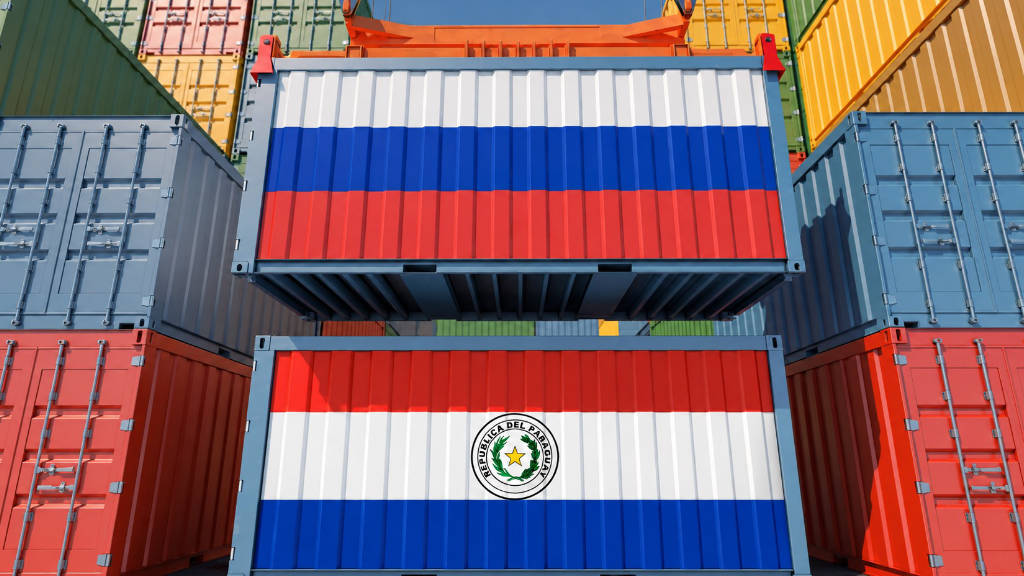

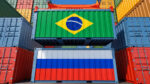
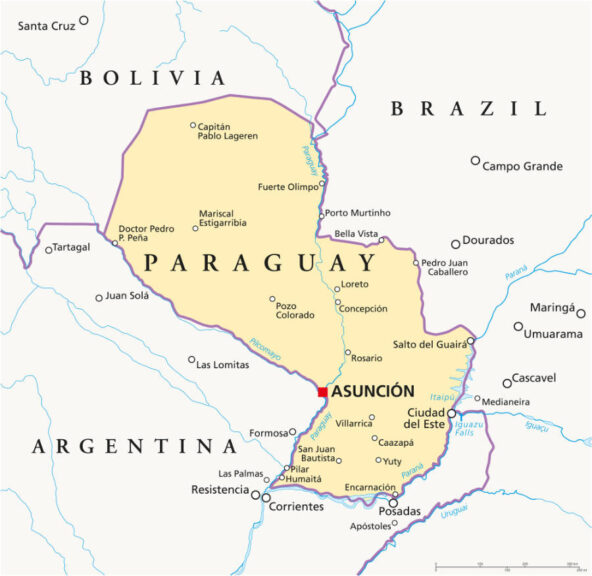
Paraguay is the smallest Mercosur partner in its trade with Russia, but that does not make it the least significant: in relative terms, Russia became a first-rate destination for its exports, and, for several years, Paraguay sold more to Russia than Argentina, an economy several times larger.
This article looks at the commercial relationship between the two countries so far this century, drawing on official statistics from the Central Bank of Paraguay and the National Customs Directorate, with a focus on its structure, its cycles, and the most recent changes.
At the turn of the century, trade was practically nonexistent. Between 2000 and 2003, Paraguay exported less than US$5 million a year to Russia (under 0.2% of its foreign sales), and imports from Russia never exceeded US$300,000. For Russia the relationship was even more marginal: in 2002 and 2003, Paraguay accounted for between 0.003% and 0.007% of its total imports.
Bilateral Trade Cycles
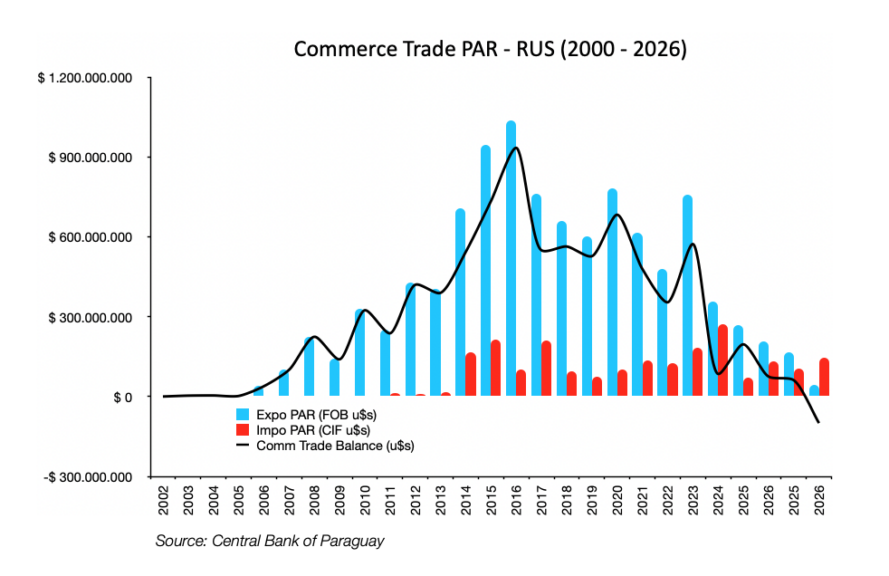
Takeoff came in 2004, led by beef: Paraguayan exports rose from US$39 million that year to US$225 million in 2006, when Russia absorbed 6.5% of what Paraguay sold to the world.
The peak came between 2012 and 2014, when exports jumped from US$709 million to US$1.038 million, accounting for nearly 11% of Paraguay’s total beef exports. Between 2013 and 2018, and again in 2021, Paraguay sold more to Russia than Argentina did. On the import side, Paraguayan purchases stopped being marginal in 2012, when they rose from US$16 million to US$165 million, driven by Russian diesel.
From 2015 through 2021, trade settled into a high plateau, with exports of between US$479 million and US$784 million a year and a balance that always favored Paraguay: +USD 947 million in 2014 and +USD 695 million in 2018, according to the Central Bank’s criterion. Between 2000 and 2025, Paraguay accumulated a surplus of around US$8 billion with Russia.
Since 2022 the picture has changed abruptly. With the war in Ukraine and the financial and logistical restrictions on Russia, Paraguayan exports fell 53% in a single year to US$356 million, with soybeans practically collapsing (-88%) and kept declining to US$165 million in 2025: 78% below 2021 and 84% below the 2014 peak. Russia went from absorbing 10.8% of Paraguay’s exports in 2014 to 1.5% in 2025. Western sanctions imposed on Russia decimated Paraguay’s exports to Moscow as Paraguayan companies sought to avoid secondary tariffs.
Imports from Russia followed the opposite path. They hit a record US$271 million in 2022 (48% more than in 2021), mostly fertilizers and fuels, and in the first eight months of 2026 they already totaled US$145 million: 66% more than in the same period of 2025 and more than was bought in all of that year (US$104 million). Over the same period, exports fell 66%, to US$45 million. The result is the first negative balance for Paraguay in the entire series: around US$100 million in the 8M 2026.
With that trajectory, annual trade averaged US$393 million between 2022 and 2025: 55% below the 2012-2021 average (US$875 million), though still above that of 2000-2011 (US$165 million).
Russia’s Imports From Paraguay
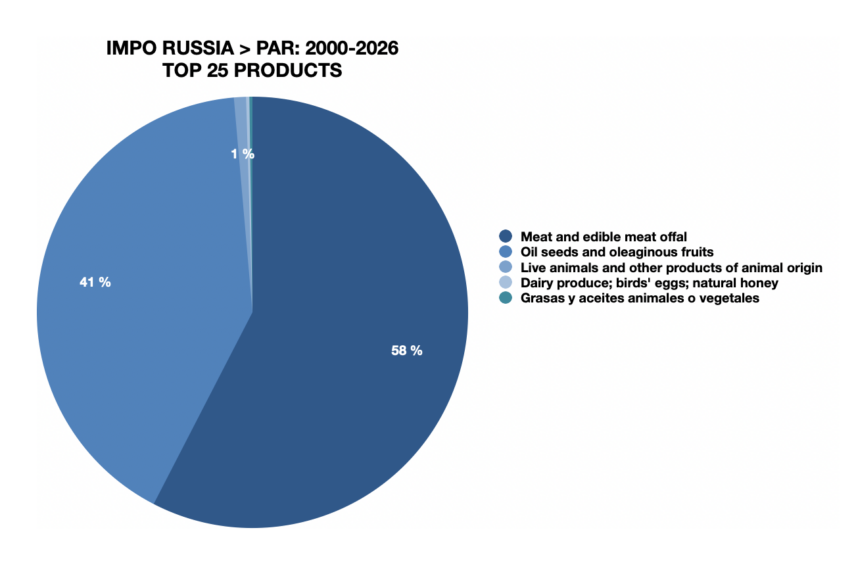
The structure of Paraguayan sales to Russia shows near-total concentration: 98.6% of what was exported between 2000 and 2026 is explained by just two categories, meat and edible offal (58%) and oilseeds, meal, and pellets (41%). The rest, which includes live animals and other animal products, dairy and fats, adds up to just 1.4%.
At the product level, concentration is even higher: a single item, frozen boneless beef, accounts for 52% of the total, and soybeans for another 40%. The top five items make up 96% of exports, and the top ten, 99%. Of the US$10.318 million Russia imported from Paraguay over the period, US$10.170 million went to meat and oilseeds.
Paraguay’s Imports From Russia

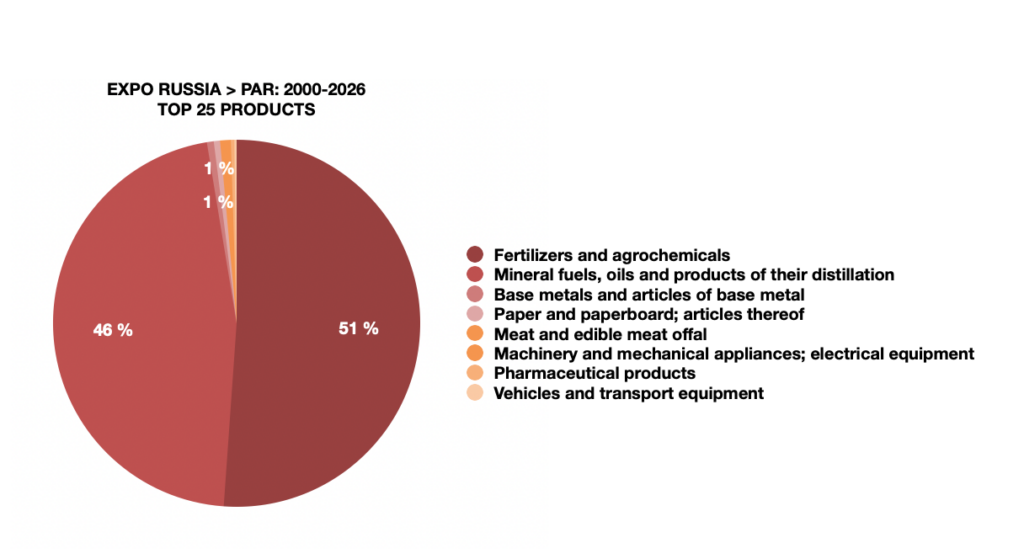
In the opposite direction, concentration is also very high, though at a much smaller volume: of the US$2.173 million Paraguay imported from Russia between 2000 and 2026 (CIF value), 94% corresponds to two categories, fertilizers and agrochemicals (50%) and fuels and energy products (45%). Metals, machinery, chemical products, and paper each add up to less than 1%.
Fertilizers, mainly potassium chloride, compound fertilizers, urea, and phosphates, grew from US$49 million in 2012 to US$126 million in 2022 and, after falling to US$28 million in 2024, rebounded: US$82 million in January-August 2026 alone, more than in all of 2025 (US$63 million). Fuels are more volatile and respond to one-off episodes, such as the diesel of 2012-2013. The top ten items account for 89% of purchases, and the top 25 for 97%.
A distinctive feature of this flow is that much of the Russian-origin merchandise does not arrive directly: in 2012 and 2013 about 70% came in through third countries, in 2023 and 2024 the share exceeded 90%, and in the first eight months of 2026 it was 72%, mostly via Argentina.
Looking Ahead
The Paraguayan case illustrates a relationship that was highly relevant for one partner and almost irrelevant for the other: at its best, Paraguay accounted for 0.4% of Russia’s total imports (2015), while Russia came to absorb close to 11% of Paraguay’s exports. That asymmetry explains why the decline of recent years is felt more strongly in Asunción than in Moscow, and why the shift in this balance is occurring in 2026, with Russia selling more than it buys for the first time in the series, deserves a close reading.
Two logics now coexist. On one hand, complementarity in inputs persists: Paraguay needs fertilizers and fuels, Russia is a competitive supplier, and purchases rebounded in 2026. On the other, the Russian market has ceased to be a relevant destination for Paraguayan beef and soybeans amid financial and logistical restrictions, reflected in the routing of a large share of purchases through third countries, and with alternatives that are widening, such as the agreement between Mercosur and the European Union.
As the series shows, the jumps in trade came with external shocks: Russian demand for beef in 2004-2006, the diesel of 2012-2013, and the Ukraine conflict. If the relationship manages to overcome the obstacles in payments and logistics, the complementarity between an input supplier and a food producer offers room to rebuild trade; otherwise, the pattern of recent years, with Russia as supplier and Paraguay as buyer, is likely to consolidate.
This article was provided by Martin Epstein, an experienced economic analyst based in Argentina. He may be reached at info@russiaspivottoasia.com