Русский








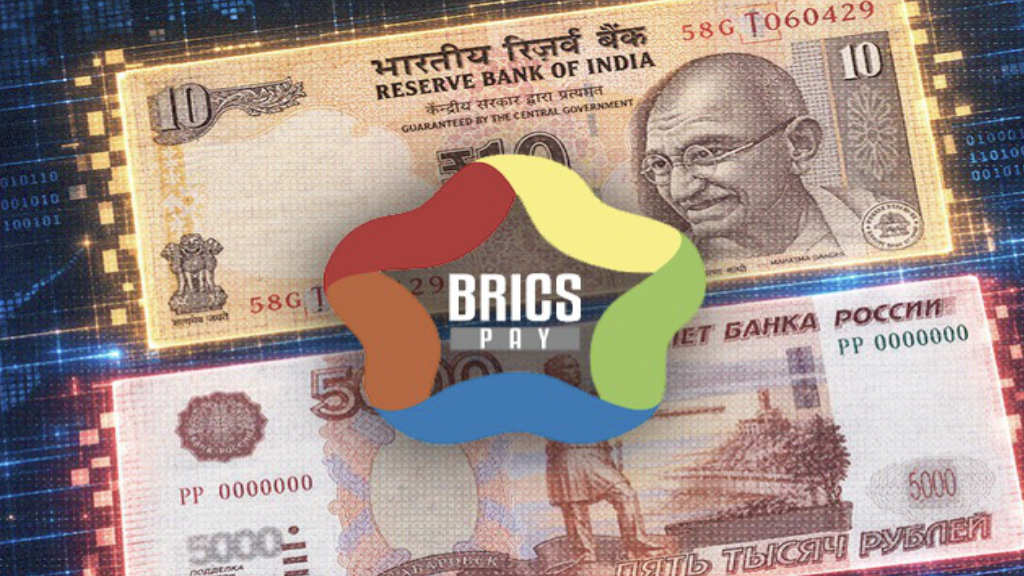

Russia’s Sovereign Wealth Fund – RDIF and India’s BRICS payments arm have agreed to develop the economic grouping’s payment project, as well as working on cross-border payment services. The agreement is between the Russian Direct Investment Fund (RDIF), and JSC BRICS Pay and was announced on Friday (September 11) during Russian President Vladimir Putin’s engagements in India.
The partners will explore ways to integrate BRICS Pay with India’s existing payment infrastructure, prepare potential pilot projects, and work toward the launch of cross-border payment services. BRICS Pay is the decentralized cross-border payment framework of the bloc and is based in Dubai. It works closely with India’s Unified Payments Interface (UPI) in Mumbai. The mobile application was developed by the Dubai-based company NB PAY FZCO, while the technical architecture (DCMS) was created by specialists at Saint Petersburg State University. The platform is designed to interconnect national and commercial payment systems of BRICS+ countries.
Cross-border payments is a priority area of financial cooperation for BRICS countries amid Western sanctions and financial exclusion, with members seeking greater interoperability between their national payment systems.
RDIF CEO Kirill Dmitriev said that “Developing modern payment infrastructure is a crucial prerequisite for the continued growth of trade and investment among BRICS nations. BRICS Pay can complement existing national payment systems and enable them to work together. The proposed system will facilitate trade and investment between BRICS countries, including through settlements in national currencies.”
BRICS Pay India, the Indian arm of the project, will coordinate with Indian banks, payment service providers, merchants, and other market participants, while RDIF will support the initiative through its investment and international partnership network.
RDIF is Russia’s sovereign wealth fund, with US$27.3 billion in assets. JSC BRICS Pay is a Moscow-based company that develops payment-processing systems and infrastructure for the project.
Dmitriev said BRICS should develop practical investment and financial mechanisms that bring its members together. BRICS bloc Finance Ministers and Central Bank Governors have asked the BRICS Payment Task Force (BPTF) to continue work on cross-border payment solutions that are faster, cheaper and more accessible. The BPTF functions as a platform for dialogue and exchange of experiences and knowledge among central bank experts, focusing on topics related to payment systems, especially the regulation of payment and settlement systems. BPTF meetings include presentations on payment systems used by central banks, aiming at shared learning, involving systems, rules, and workflows associated with payments, including fast payments, cross-border payments, and financial infrastructure.
Indian Trade Minister Piyush Goyal has called on BRICS members and partner countries to connect payment systems and expand trade in national currencies. Reserve Bank of India Governor Sanjay Malhotra said members are discussing links between fast-payment systems and Central Bank Digital Currencies CBDC).
However, achieving this will require legislation to be passed at each national level and new regulations to be issued by the various BRICS governments and Central Banks as they are not all aligned on the legality of using their own digital currencies nor using them in international trade. Here is a quick snapshot.
- Brazil does not have an official central bank digital currency (CBDC) fully in public use, but it may begin roll out of its official digital currency, Drex, later this year or during 2027.
- China has a live digital currency in active use called the Digital Renminbi or e-CNY, also known as the Digital Yuan. It is legal tender with an equivalent value to physical cash and coins. It is the world’s largest live central bank digital currency.
- Egypt does not have an official central bank digital currency (CBDC) in use yet, but it plans to launch an e-Pound by 2030.
- Ethiopia does not have an official digital currency in active use, and private cryptocurrencies remain illegal for transactions. However, The Ethiopian Council of Ministers approved a revised National Bank proclamation enabling the NBE to issue a digital birr alongside physical currency.
- India has the Digital Rupee, (e₹) in active use, issued by the Reserve Bank of India.
- Indonesia does not yet have an active central bank digital currency in general public use. Bank Indonesia (BI) is developing a Central Bank Digital Currency known as the Digital Rupiah under an initiative called Project Garuda, planned to launch in 2030.
- Iran has an official digital currency in the pilot stage called the Crypto Rial, alongside widespread practical use of decentralized digital assets for state and civilian trade.
- Russia officially launched its central bank digital currency, the Digital Ruble, for nationwide commercial and public use on September 1, 2026.
- Saudi Arabia does not have a general-use digital currency for the public yet, but it is actively testing Central Bank Digital Currencies for wholesale and cross-border settlements. It has not set a timeline or decided to launch a Digital Riyal for the general public.
- South Africa’s Reserve Bank (SARB) released a position paper concluding there is no compelling immediate need to launch a retail digital rand for the general public, despite finding it technically feasible.
- UAE has the Digital Dirham issued by the Central Bank of the UAE (CBUAE) as part of its Financial Infrastructure Transformation programme.
A retail-payment technology demonstrator was tested at the BRICS Business Forum in Moscow in 2024. An explanation of how it works can be seen here.
The initial BRICS Pay programme appears likely to revolve around developing and testing bilateral trade between Russia and India – both have their Digital Currencies in live operation and their respective national legislation in place. This is also pertinent for as bilateral trade volumes – currently about US$68 billion per annum – are expected to be given a significant boost as India appears close to signing a Free Trade Agreement with the Eurasian Economic Union.
It will also help with the on-going problem that India’s oil companies have in Russia, as Indian public sector oil firms have approximately US$1 billion in unpaid dividend income currently stuck in Russian accounts due to Western sanctions and payment restrictions. The BRICS Pay solution would resolve this.
It should also be noted that the technical issues to overcome will also help the fellow BRICS members that are not currently up to speed with Digital Currencies fast track their own development. If this happens, a replacement alternative to the SWIFT payment network from which both Russia and Iran are suspended, is likely to be in place by 2030. That liberalises global payments capabilities away from the control currently wielded by the United States and Europe, with all the implications this brings.