 Русский







The Africa Aerospace and Defence 2026 exhibition in Pretoria, South Africa, has become an important test of Russia’s effort to expand its military-technical business in Africa at a time when the Russian defence industry is operating with substantially higher production capacity. Held from September 16 to 20 at Air Force Base Waterkloof, the 13th AAD brought together the aerospace, defence and security industries around a five-day programme combining three trade days and two public air-show days. South African authorities expected more than 30,000 trade visitors and delegations from more than 50 countries, while the exhibition organiser listed more than 250 exhibitors from 30 countries; an Armscor procurement document described the event as involving more than 450 participating companies from 30 countries. The official exhibitor list included companies from South Africa, Russia, China, India, Turkey, Pakistan, Germany, France, Italy, the United States, the United Kingdom, Brazil, Uzbekistan, Canada, Japan, South Korea and other markets.
Russia entered this market with one of its broadest African displays. Rosoboronexport, part of Rostec, organised the unified Russian exposition, presenting 494 exhibits, of which 30 were military products. The scale was significant because the Russian offer covered unmanned systems, small arms, anti-armour weapons, helicopters, combat training aircraft, naval craft, air weapons and specialised security equipment rather than concentrating on one product category. The commercial message was equally important. Rosoboronexport said it was implementing or preparing more than 20 projects in Africa involving maintenance, repair and production localisation for ground forces, navies, air forces and air-defence forces. That changes the economic proposition from a conventional export model like Russia manufacturing and Africa importing to a longer industrial chain in which Russian companies can supply platforms, components, ammunition, maintenance, technical documentation, training, repair services and potentially licensed production.
Egypt’s El Alamein International Airshow 2026 & The Russian Presence
The second El Alamein International Airshow, held from 8-10 September 2026 at El Alamein International Airport in northern Egypt, brought together 250 companies from 50 countries and 135 aircraft, reinforcing Egypt’s role as a potential gateway to African and Middle Eastern defence markets. Russia mounted one of the exhibition’s largest national presences, with 35 Russian defence-industry organisations presenting more than 500 military exhibits, including over 80 individual systems and products. The Russian exposition was organised by Rosoboronexport and included major companies and holdings such as United Aircraft Corporation (UAC), Almaz-Antey Air and Space Defence Corporation, High-Precision Systems, the Design Bureau of Instrument Engineering (KBP), Machine-Building Design Bureau (KBM), Tactical Missiles Corporation and Shvabe. Kalashnikov was also represented through systems including the Lancet-E, Kub-10E/Kub-10ME/Kub-2E and related unmanned technologies. The most significant commercial development was the announcement by Rosoboronexport CEO Alexander Mikheev of the first export contract for more than 10 Yak-130M trainer-combat aircraft, providing a concrete export breakthrough for the upgraded combat-orientated version of the Yak-130.
Russia also used the show to promote its higher-end aerospace portfolio: the export-orientated Su-57E fifth-generation fighter made its African airshow debut, participating in the flying programme and appearing with advanced weapons including the RVV-MD2 and Kh-69, while the newly displayed S-71M and S-71K combined characteristics of cruise missiles and low-cost attack drones.
Other Russian systems included the Ka-52E attack helicopter, Lancet-E and KUB loitering munitions, the RUS-PE electronic-warfare system and counter-UAV technologies, highlighting Russia’s expanding focus on unmanned and counter-drone warfare. The exhibition also attracted military delegations and potential customers from countries including Sierra Leone, Tanzania and Kuwait, alongside significant participation from Egypt, Turkey and the UAE. Russia’s commercial opportunity therefore extends beyond individual aircraft contracts: the combination of combat aircraft, trainers, helicopters, loitering munitions, electronic warfare and counter-UAV systems allows Rosoboronexport and associated Russian manufacturers to offer integrated packages involving weapons, training, maintenance, spare parts and technical support. With more than 20 foreign customers already receiving Russian arms deliveries in 2026 and over 50% of the planned delivery programme reportedly completed, El Alamein provided a high-profile platform for converting demonstrations and initial contracts into broader African and Middle Eastern sales, servicing and industrial partnerships.
Drones: Russia’s New African Offer
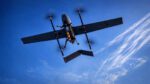
The most important technological shift at AAD 2026 was the weight given to unmanned systems and loitering munitions. Russia presented the Lancet-E reconnaissance-and-strike complex developed by ZALA, the Skat-350M reconnaissance UAV and KUB-2E loitering munition associated with the Kalashnikov Concern, the RUS-PE reconnaissance-strike system and the Orlan-10E and Orlan-30E reconnaissance UAVs produced by the Special Technology Center. This portfolio corresponds closely to a growing requirement among African militaries: comparatively inexpensive surveillance and strike capabilities that can be deployed across large territories without the infrastructure required for conventional combat aviation. The Lancet-E is particularly important to Russia’s export strategy because Moscow is marketing it as a system developed and modified through operational experience. The Russian exposition paired reconnaissance and strike functions, reinforcing the concept of a network in which target detection and engagement can be performed through complementary unmanned systems.
Kalashnikov also used AAD to present the expanded KUB family. Leonid Rokeakh, the company’s director for exports of unmanned systems and loitering munitions, said many African delegations had shown interest during negotiations. He linked the appeal to relatively low cost and ease of training and operation, characteristics particularly relevant for countries with smaller defence budgets or limited pools of highly specialised personnel. The company paid special attention to the KUB‑10ME: the system’s declared range is over 100 km, and the warhead weight is 11 kg. Such a system gives Russia an additional product between tactical reconnaissance and more expensive conventional strike platforms.
The African commercial significance is substantial. Russia is no longer marketing drones simply as individual aircraft. It is selling a chain: reconnaissance UAV, loitering munition, ground-control infrastructure, operator training, maintenance and recurring ammunition supply. That creates a potential recurring revenue stream beyond the initial equipment sale. STC added another important element. On September 18, the company confirmed that Orlan-10E and Orlan-30 systems were already operating somewhere in Africa, although it did not identify the customer countries because of contractual restrictions. STC also said several African states were interested in UAV and electronic warfare cooperation. This provides Russia with an existing operational reference base on the continent rather than relying entirely on future procurement.
Small Arms Create A Different Route Into African Markets
The second major opportunity is the Russian small-arms sector. Kalashnikov displayed the AK-19, AK-203, AK-204 and AK-15 families, as well as the shortened AK-15K and AK-19K variants, the PPK-20 submachine gun, Lebedev pistols and the Chukavin SVCh sniper rifle. The economics of this segment differ sharply from those of combat aircraft. Small arms involve larger potential quantities, shorter replacement cycles and opportunities for ammunition, optics, spare parts, maintenance and licensed production. Russia therefore complemented the firearms with Atlas, Phobos and Deimos thermal sights and the Titan thermal-imaging attachment. This turns the offer into a broader infantry equipment package rather than an assault-rifle sale alone.
The first African presentation of the modernised RPG-29M reinforced the same strategy. Rostec says the launcher is three times lighter than the baseline RPG-29 and incorporates an all-day thermal-imaging sight with fire-control functions and an expanded ammunition range. For African forces operating in difficult terrain and under conditions where mobility and night operations matter, lower equipment weight can be an important procurement consideration. The key industrial question, however, is not whether African countries can purchase Russian rifles. It is whether selected markets could eventually move toward ammunition, repair, assembly or licensed production. South African defence company Milkor provided an important signal at AAD when its CEO Jackson Mampa argued that African manufacturers need partnerships with countries such as Russia because many African industries still lack some of the skills required for completely domestic production. Rosoboronexport delegation head Denis Gizunov similarly identified production localisation and technological cooperation as central areas of Russia’s offer.
Helicopters & Aviation
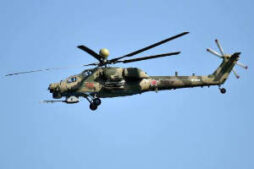
Russia’s aviation proposition at Pretoria centred on the Mi-171Sh military transport helicopter, Mi-28NE attack helicopter and Yak-130 combat trainer. The combination is economically significant because it can generate a complete aviation ecosystem. A transport helicopter requires spare parts, engines, maintenance, overhaul and pilot training. An attack helicopter adds weapons and specialist maintenance. A combat trainer creates a continuing training pipeline. Russian Helicopters, United Aircraft Corporation and other Rostec enterprises therefore potentially gain not only from aircraft sales but also from long-term service contracts.
The Yak-130 is particularly relevant because Russia has continued modernising the platform. In June 2025 the Yak-130M prototype completed its maiden flight with an upgraded sighting system, aircraft-defence suite and expanded weapons capability. Rostec said the aircraft is already used by Russia and by air forces in several African and Asian countries. The basic Yak-130 therefore provides an existing African user base that can potentially support future modernisation and training-related business. The Mi-171Sh represents another established Russian product family. The broader Mi-8/17 ecosystem has a long international operating history, giving Russia a potentially useful advantage in countries that already possess Soviet- or Russian-origin helicopters and therefore have established maintenance personnel, infrastructure and technical familiarity.
Naval & Security Equipment
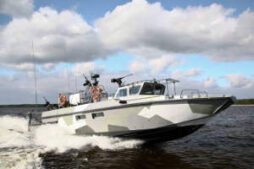
The BK-16E high-speed transport and landing craft gave the Russian delegation an entry into maritime security and littoral operations. The boat can perform command, fire-support, transport, search-and-rescue and medical-evacuation functions. Possible armament configurations include 12.7 mm and 7.62 mm machine guns, grenade launchers and remotely controlled weapon stations. For African states with extensive coastlines, river systems or maritime-security challenges, this is a different market from conventional warships. It potentially connects defence procurement with border protection, anti-smuggling operations, special forces, search and rescue and law-enforcement missions. Russia also displayed equipment for detecting explosives, hazardous chemicals, toxic substances, biological agents and narcotics. This is commercially important because it expands the potential customer base from defence ministries to border services, police, customs, emergency agencies and critical-infrastructure operators.
Russia’s Industrial Capacity Provides a New Production Base
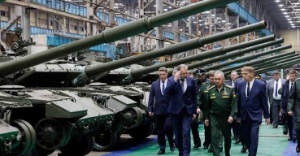
The timing of AAD 2026 coincided with a major statement by President Vladimir Putin on September 18, one day before Russia’s Arms Day. Putin said Russia’s military-industrial complex comprises more than 5,000 organisations, including major industrial holdings, small and medium-sized enterprises, design bureaus and innovation centres, employing more than 3.5 million people. He said production and supply of weapons and ammunition, including high-precision missiles and projectiles, had increased by more than 22 times since the beginning of the special military operation. Radar-station deliveries had risen almost fivefold, armoured-weapons production 2.5 times, while UAV production had increased several-fold and, for some classes, by dozens of times.
Putin also said the defence sector was meeting the requirements of the armed forces and law-enforcement agencies while producing civilian and dual-use products. He placed the export-order portfolio above US$70 billion. For African markets, the importance of these numbers is industrial rather than simply military. Higher production capacity theoretically gives Russian manufacturers more room to maintain domestic deliveries while allocating capacity to exports. It also provides a larger manufacturing base for localisation partnerships, spare-parts production and technology cooperation. Putin additionally said the state would continue strengthening the scientific and production potential of the defence industry and supporting stable industrial operations. The objective he outlined was not only military supply but also technological and production sovereignty and the development of civilian and dual-use products.
The African Market Remains Competitive
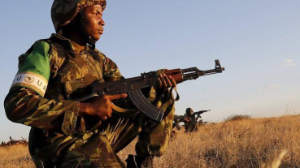
Russia is not entering an empty African defence market. SIPRI’s latest full five-year data show that African states reduced their imports of major arms by 41% between 2016-20 and 2021-25. The United States accounted for 19% of African imports during 2021-25, China 17%, Russia 15% and France 8.3%. At the same time, the African market is highly differentiated. Morocco and Algeria remain the continent’s largest recipients of major arms, while sub-Saharan Africa increased its imports by 13% between the two five-year periods. Nigeria, Senegal and Mali were the three largest recipients in sub-Saharan Africa during 2021-25. Russia’s overall global arms-export position has weakened in volume terms. SIPRI estimates that Russian major-arms exports fell 64% between 2016-20 and 2021-25, reducing Russia’s global share from 21% to 6.8%. India, China and Belarus together accounted for 74% of Russian major-arms exports during the latest five-year period. This makes Africa commercially important for diversification. Russia already had military-technical cooperation with more than 40 African countries, according to Rosoboronexport’s previous Africa-wide assessment, giving its manufacturers an established customer and service network. The potential growth area is therefore not necessarily another large single aircraft contract. It is the expansion of smaller and medium-sized recurring businesses around UAVs, ammunition, maintenance, overhaul, training, optics, electronic warfare, small arms and local production.
What Is The Russian Defence Industry Value In Africa?
A precise current dollar value of Russian defence assets, contracts or industrial projects in each African country cannot be responsibly calculated from public information. This is because SIPRI’s Arms Transfers Database measures the volume of major conventional arms transfers rather than their financial value, while Russian companies generally do not publish country-by-country contract values for sensitive military-technical cooperation. The strongest public financial benchmark is therefore the historical US$1.7 billion-plus in contract documents signed by Rosoboronexport in Central, Western and Southern Africa during 2020 and early 2021, when the company’s order portfolio covered 17 countries in those subregions. That figure should not be treated as the current value of Russian defence exports to Africa; it is a dated contract-flow figure. At the continental level, Russia-Africa trade reached US$27.7 billion in 2025, but that includes energy, commodities, machinery, food, transport and other civilian trade and therefore cannot be used as a defence-market valuation. Similarly, the Russian defence industry’s global export-order portfolio of more than US$70 billion cannot be allocated to Africa without unpublished country-level information.
A more defensible country-level picture is therefore to use SIPRI’s transfer-volume indicators rather than invent dollar estimates. Algeria remains the clearest large Russian major-arms market, with Russia accounting for 48% of Algeria’s major-arms imports in 2020-24. Egypt remains strategically important but has diversified its suppliers, and Russian deliveries have fallen substantially from their earlier peak. Morocco is now Africa’s largest importer of major arms overall, after its imports increased 12% in 2021-25, but it is not a comparable Russian market. Across Sub-Saharan Africa, Nigeria represented 16%, Senegal 8.8% and Mali 8.0% of the region’s major-arms imports in 2021-25, while China supplied 22% of Sub-Saharan African imports. This means the most meaningful Russian market opportunity is not necessarily the country with the largest total arms budget; it is the combination of existing Russian equipment stock, recurring maintenance requirements, willingness to localise, and demand for lower-cost UAV, helicopter, small arms and surveillance systems.
Where African Opportunities Are Concentrated
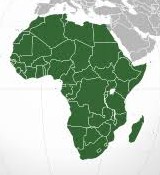
The country pattern is more differentiated than a single Africa-wide market. Algeria is the largest established North African market for Russian major arms and therefore offers the broadest potential base for aviation, armoured vehicles, naval equipment, air defence, maintenance and modernisation cooperation. SIPRI estimates that Russia supplied 48% of Algeria’s major-arms imports in 2020-24, although Russian deliveries to Algeria were 81% lower than in 2015-19, while Algeria’s overall imports fell 73% from the earlier period. Algeria’s 2020-24 imports consisted principally of armoured vehicles at 33%, aircraft at 29% and ships at 21%, creating an industrial base for Russian after-sales support even when new procurement fluctuates.
Egypt represents another major industrial opportunity, particularly in helicopters, aviation, UAVs, air defence, naval systems and maintenance. Russian Helicopters previously supplied equipment and technical capability to HFDI for Mi-8T and Mi-17-1V overhaul, with 44 helicopters covered by the repair programme, providing a concrete precedent for local MRO rather than shipment of every aircraft back to Russia.
South Africa has a different profile: it is not primarily a large Russian-weapons procurement market, but its industrial base makes it potentially important for regional maintenance, engineering, component production and technology partnerships. The Denel-Russian Helicopters arrangement specifically envisaged a Sub-Saharan Russian helicopter servicing hub.
Angola has an established Russian helicopter relationship, including Mi-24P aircraft supplied after overhaul by Russian Helicopters, making aviation maintenance and fleet modernisation a logical area for further industrial cooperation. Mali, Burkina Faso and Niger represent a different market structure: the emphasis is less on large conventional platforms and more on UAVs, loitering munitions, small arms, protected mobility, surveillance, communications, training and sustainment.
The Central African Republic also belongs primarily to the security-support and light-equipment segment rather than the large-scale conventional-platform market. In Nigeria, Senegal and other West African markets, Russian companies have a potential commercial base in helicopters, small arms, air-defence equipment, UAVs, security systems and maintenance; SIPRI reports that Nigeria accounted for 16% of Sub-Saharan Africa’s major-arms imports in 2021-25, while Senegal accounted for 8.8% and Mali 8.0%. China was the largest supplier to Sub-Saharan Africa at 22%, showing that Russian companies face an established Chinese industrial competitor rather than an uncontested market.
20 Project Areas: Maintenance, Repair, Localisation & Industrial Cooperation

Rosoboronexport’s more than 20 African projects can be understood as a broad industrial package rather than a list of 20 separately disclosed contracts. The first group concerns aircraft and helicopter maintenance, including scheduled servicing, overhaul, component replacement, diagnostics and life-extension work for Russian-origin fleets; this has an established precedent in Africa, with Russian Helicopters and South African Denel developing a regional servicing hub and with Egypt’s Helwan Factory for Developed Industries being equipped and trained for Mi-8/17 maintenance and overhaul.
The second and third areas are spare-parts supply and repair-component production, allowing African operators to hold larger local inventories rather than depend on shipments from Russia. A fourth area is technical training and certification of local maintenance personnel, while a fifth involves repair workshops and depot-level overhaul infrastructure.
The sixth is armoured-vehicle maintenance and modernisation, potentially covering engines, transmissions, optics, communications and protection packages. The seventh is small-arms servicing and ammunition support, particularly for Kalashnikov-family weapons. The eighth is UAV maintenance and technical support, including airframes, propulsion, ground-control equipment and payloads. The ninth is local assembly of reconnaissance UAV systems, while the tenth concerns loitering-munition support infrastructure, including storage, preparation, operator training and technical servicing.
The eleventh area is electronics and electro-optical systems, including thermal sights and observation equipment. The twelfth is air-defence system maintenance, where local technical capabilities can reduce turnaround time for radar, launcher and command-system components. The thirteenth concerns radar and airspace-surveillance equipment, including technical support and operator training. The fourteenth is naval equipment maintenance, including boats and associated propulsion, communications and weapons systems. The fifteenth is local support for the BK-16E-type maritime platform, potentially covering servicing and mission-equipment integration. The sixteenth is aviation weapons and guided-weapon support, including inspection, storage and maintenance infrastructure. The seventeenth is technology-transfer arrangements, under which selected production or maintenance procedures can be transferred to African industrial partners.
The eighteenth is licensed or semi-localised assembly of selected Russian systems, where commercially and legally feasible. The nineteenth is joint engineering and adaptation, allowing Russian equipment to be modified for local climate, terrain and operational requirements. The twentieth is integrated industrial partnerships, combining equipment supply, training, spare parts, maintenance, overhaul and progressively greater local production. This structure is consistent with Rosoboronexport’s statement that more than 20 projects are being implemented or prepared across the army, navy, air force and air defence sectors, with maintenance, repair and production localisation forming the core of the cooperation model. Earlier Russian experience demonstrates that this approach can create durable African industrial nodes: the South African Denel partnership was designed as a Sub-Saharan helicopter servicing hub, while Egypt’s HFDI was equipped and trained to undertake Mi-8/17 overhaul locally.
Which Russian Exporters Could Accelerate African Industrial Business?
Rosoboronexport is the principal coordinating and commercial gateway for Russia’s defence-industrial engagement with Africa. Its role is broader than the sale of individual platforms: it can assemble equipment packages, financing and contractual arrangements around long-term maintenance, training, spare parts, technology transfer and, where politically and commercially feasible, local production. This makes it the natural integrator for an African industrial strategy built around complete equipment and lifecycle-support ecosystems rather than standalone weapons sales.
Several Russian companies could then be aligned with specific African industrial segments:
- Russian helicopters could focus on the large installed base of Russian-origin helicopters in Africa, particularly Mi-series platforms. The opportunity extends beyond new aircraft such as the Mi-171Sh to overhaul, repair, spare parts, aggregates, training and technical-support centres. The company has previously estimated that roughly 600 Russian-made helicopters were operating in Africa, creating a potential foundation for a continent-wide MRO and support network.
- Kalashnikov Concern could target small arms, tactical unmanned systems and associated manufacturing. Its African proposition could combine AK-series rifles and other infantry weapons with UAV and loitering-munition capabilities. The AK-203 production programme in India, which had produced 35,000 rifles by July 2024 and was designed around technology transfer and eventual full localisation, provides a relevant precedent for this type of industrial model.
- ZALA and Special Technology Center could develop the unmanned-systems segment. ZALA’s Lancet-E and related systems could form part of a broader package, while Special Technology Center could build on the Orlan-10E and Orlan-30 ecosystem, particularly in reconnaissance, surveillance, electronic-support and maintenance capabilities. Rather than treating these as individual UAV sales, the commercial model could incorporate operator training, repair facilities, spare-parts supply and local technical support.
- United Aircraft Corporation (UAC) could address the advanced trainer and light-combat-aircraft segment through platforms such as the Yak-130/Yak-130M. The industrial opportunity would include pilot and technician training, maintenance infrastructure, simulators, spare parts and potentially longer-term technical-support arrangements.
- Almaz-Antey and High-Precision Systems could focus on air defence, radar and counter-UAV infrastructure. This segment could encompass not only complete systems but also command-and-control, radar, electronic components, maintenance and operator training.
- Tactical Missiles Corporation could support the aviation-weapons component of broader aircraft packages, linking aircraft acquisitions with compatible guided weapons and sustainment requirements.
- NPO Bazalt could participate in the infantry and anti-armour segment through systems such as the RPG-29M and associated ammunition. Its potential role is therefore complementary to, rather than separate from, the small-arms and ground-forces ecosystem developed around other Russian suppliers.
- Rybinsk Shipyard and other Russian naval-industrial enterprises could target patrol, littoral-security and maritime-support requirements. Platforms such as the BK-16E could be positioned alongside training, maintenance, communications and other maritime-support capabilities rather than marketed solely as individual patrol craft.
- Ruselectronics, JSC OPK and other Rostec enterprises could provide the electronics, communications, optics, sensors, engines and other subsystems needed to connect these individual product areas into larger industrial packages.
The broader Rostec ecosystem is therefore important because many of these opportunities overlap. Helicopter sales, for example, can generate MRO and training requirements; aircraft sales can create demand for weapons, simulators and maintenance; and UAV deployments can create demand for communications, counter-UAV systems, spare parts and local technical capabilities. Rosoboronexport can potentially combine these components into country-specific packages. Russia’s recent defence-industrial marketing activity also illustrates the breadth of the portfolio being presented to African and Middle Eastern customers.
At Egypt’s El Alamein International Airshow in September 2026, Russian companies showcased systems including the Su-57E, Yak-130M, Ka-52E, Lancet-E, KUB systems, the RUS-PE system, counter-UAV technologies and the Dan-T loitering munition. Rosoboronexport also held discussions with African and Middle Eastern military and industrial delegations at the event. This creates a broader September marketing sequence: Egypt can serve as a showcase for advanced aviation, unmanned systems and air-defence capabilities, while Pretoria can provide a platform for presenting a wider African industrial and defence proposition. The commercial objective is consequently not simply to place individual Russian platforms in African markets but to build longer-term ecosystems around them, potentially encompassing 10-20 years of spare parts, overhaul, training, ammunition, software and electronics support, and selected forms of local industrial participation.
El Alamein Opened Up A Large Middle Eastern Defence Market
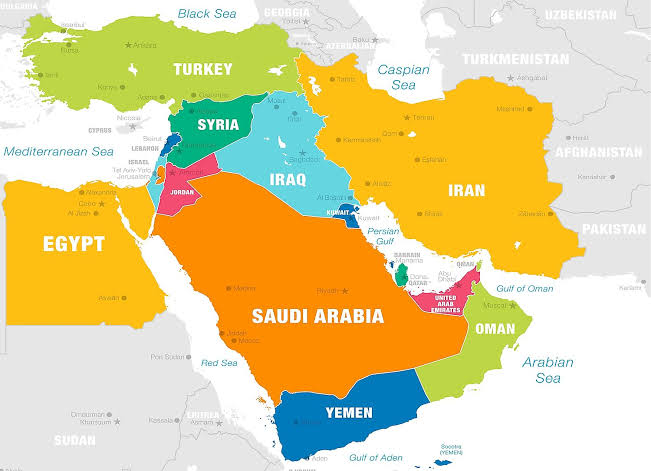
Beyond the immediate sales generated at El Alamein, the show gives Russian defence companies an opportunity to strengthen their position in a Middle Eastern market that remains one of the world’s largest defence-demand centres. Middle Eastern states accounted for 27% of global major-arms imports in 2020-24, despite a 20% decline from 2015-19, while GCC states alone accounted for 20% of global arms imports. Qatar, Saudi Arabia and Kuwait ranked among the world’s ten largest arms importers during that period, while Egypt was eighth globally.
The market is also supported by very high defence expenditure: Middle Eastern military spending reached an estimated US$243 billion in 2024, up 15% in one year and 19% from 2015, with Saudi Arabia spending US$80.3 billion, making it the region’s largest military spender and seventh worldwide. For Russian companies, the opportunity is particularly relevant in areas where regional requirements are expanding, including combat aircraft, air and missile defence, precision weapons, helicopters, UAVs, counter-UAV systems, electronic warfare, naval platforms and training. Aircraft represented 43% of Middle Eastern major-arms imports in 2020-24, ships 20% and missiles 16%, indicating substantial demand for the categories represented in Russia’s wider export portfolio.
However, the market is highly competitive: the United States supplied 54% of Middle Eastern major arms in 2021-25, followed by Italy at 12%, France at 11% and Germany at 7.3%, while Russia’s share had fallen to 4.1% in 2020-24, from 18% in 2015-19. This makes Egypt strategically useful as a regional marketing and relationship-building platform, allowing Russian firms to present integrated aerospace, air-defence, UAV and support capabilities to a market that is simultaneously large, heavily funded and increasingly diversified in its supplier base.
Summary: The Opportunity Is Lifecycle & Localisation
AAD 2026 suggests that the larger Russian opportunity in Africa lies not only in initial equipment sales but in the lifecycle industrial market that follows them. Helicopters can generate decades of demand for engines, gearboxes, avionics, airframes, overhaul and training; UAVs for ground stations, batteries, sensors, software, replacement airframes and operator support; air-defence systems for radar maintenance, missiles, electronics and technical personnel; and locally assembled small arms for ammunition, components, machining and maintenance.
This model is particularly relevant as Russian major-arms exports fell 64% between 2016-20 and 2021-25, reducing Russia’s global share to 6.8%, while Africa’s overall major-arms imports fell 41% over the same period. The opportunity is therefore less about assuming a large expansion in new weapons orders and more about converting Russia’s existing African equipment base into recurring demand through regional MRO centres, spare-parts networks, licensed production and technology partnerships. Existing precedents in South Africa and Egypt, together throughout the equipment lifecycle, while giving African customers greater domestic maintenance and manufacturing capacity. The broader Russian proposition with the Indian AK-203 programme demonstrates how Russian equipment can develop from an export transaction into a longer-term industrial relationship.
The significance of AAD 2026 is reinforced by the more than 20 African maintenance, repair and localisation projects identified by Rosoboronexport. If developed into functioning facilities, such projects could keep Russian companies involved throughout the equipment lifecycle while giving African customers greater domestic maintenance and manufacturing capacity. The broader Russian proposition also rests on a domestic defence-industrial base of more than 5,000 companies and 3.5 million employees, an export-order portfolio exceeding US$70 billion, and defence-industrial relationships with more than 40 African countries.
The resulting model can be viewed as a three-layer commercial chain: existing Russian equipment already used in Africa; newer systems such as UAVs, loitering munitions and counter-UAV technologies; and local industrial partnerships that support, upgrade and eventually manufacture selected equipment and components. The segments with the strongest potential for recurring industrial demand include UAVs and loitering munitions, small arms and ammunition, thermal optics, helicopters, combat training, counter-UAV systems, air defence, and maintenance and repair. AAD 2026 therefore points to a broader Russian approach in Africa, in which defence exports are linked to long-term equipment support, maintenance, localisation and continued industrial activity rather than being limited to the initial sale.
This article was written by I.K. Hasan, a South Asia-based independent researcher, columnist, and freelance journalist. He can be reached at info@russiaspivottoasia.com