Русский




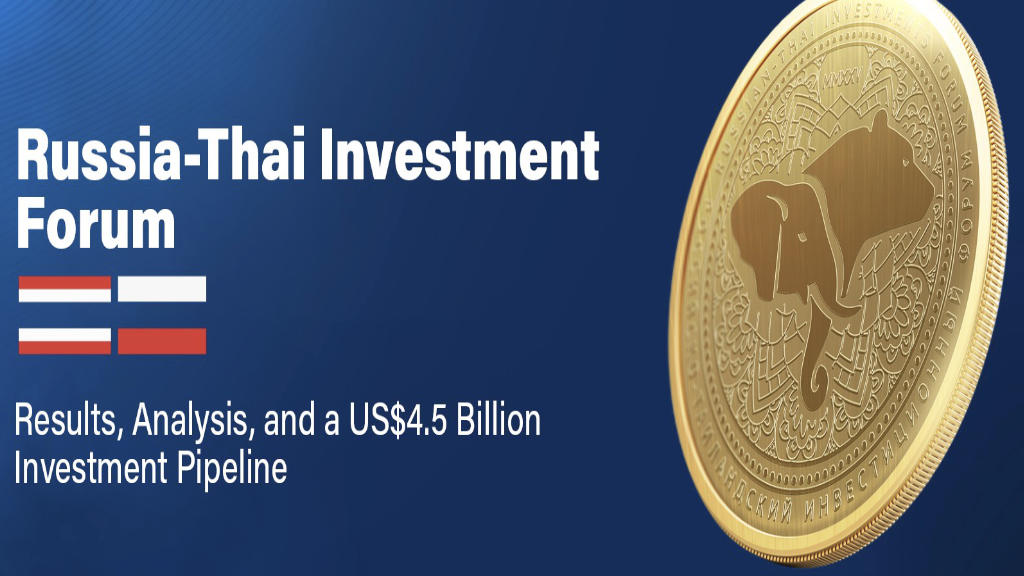

The 2026 Russia-Thailand Investment Forum has taken place in Bangkok. Organized by the Russian-Thai Business Council (RTBC) under the theme “Russia-Thailand: A New Era of Economic Partnership,” the event focused on expanding bilateral cooperation beyond traditional trade and tourism.
It put 81 investment projects valued at more than US$4.5 billion on the bilateral business agenda, bringing together opportunities in Russian manufacturing and agriculture, Thai real estate and tourism, and joint ventures designed to connect the two economies. The forum combined business-to-business meetings, sectoral sessions, regional investment proposals and discussions on financial infrastructure. Its central commercial objective was to move beyond conventional exports towards joint production, technology cooperation and investment partnerships. Business leaders from Russia and Thailand called for a strategic shift from simple trade to more integrated collaborations, including joint ventures, local production, and technology partnerships.
The project portfolio comprises 41 projects in Russia valued at more than US$4.1 billion, 35 projects in Thailand valued at US$501 million, and five cross-border partnership proposals valued at US$6.4 million. Together, the 81 projects represent an investment pipeline exceeding US$4.6 billion. The programme also brought together more than 2,000 participants and over 1,000 companies. These figures place the forum’s principal economic significance in the breadth of the opportunities presented and the effort to build the commercial mechanisms needed to implement them.
Trade Accelerates As Russian Exports Expand

The investment agenda coincided with a sharp increase in bilateral trade. Russia-Thailand trade turnover reached approximately US$1.7 billion in 2025, according to figures discussed ahead of the forum. In January-August 2026, trade rose by 25% year on year to US$1.55 billion, while Russian exports to Thailand increased by 90% to US$1.05 billion.
If that 2026 growth is maintained over the full year, Russia-Thai bilateral trade will reach US$2.125 billion. These figures underline the growing importance of the Thai market for Russian energy, agricultural products, industrial goods and consumer exports.
Russian foreign direct investment has now reached US$1.15 billion, compared with US$500.2 million in 2018. The increase of more than 130% over that period provides a second indicator of the relationship’s commercial expansion. However, the next phase depends on whether companies can convert higher trade flows into manufacturing partnerships, distribution networks and investments that generate income in both markets.
The investment figures discussed at the forum varied according to the category being measured. The 81-project catalogue places the combined investment opportunity above US$4.6 billion, pointing to a multibillion-dollar pipeline, rather than a single investment commitment or a package of completed transactions. The distinction matters: the catalogue brings together new construction, business expansion, real estate, operating companies for sale and partnership requests at different stages of development.
The Investment Portfolio: 41 Russian Projects And 35 Thai Opportunities
The investment catalogue’s Russian section covers six broad sectors: manufacturing, agriculture and food, healthcare, technology and education, commercial real estate, and tourism and resorts. Its 41 projects account for more than US$4.1 billion in potential investment. Thailand’s 35 projects, valued at US$501 million, cover operating businesses, development land, hotels and resorts, and real estate in locations including Phuket, Phang Nga, Bangkok and Pattaya. A further five cross-border proposals, valued at US$6.4 million, seek Thai partners for Russian supply, joint ventures and local production.
The portfolio is commercially diverse. It includes projects seeking new equity, proposals requiring debt financing, established businesses looking for strategic investors and development schemes still at the concept stage. This creates opportunities for investors with different risk profiles, from industrial companies able to finance new production capacity to hospitality operators interested in acquiring or expanding existing assets.
The catalogue also provides a geographic dimension to the partnership. Russian opportunities extend beyond Moscow and the country’s major industrial centres into regions with agricultural resources, mineral processing capacity, food production and industrial development programmes. For Thai investors, this offers potential access to manufacturing and raw-material supply chains. For Russian businesses, the Thai portfolio creates entry points into Southeast Asian tourism, hospitality, real estate and consumer markets.
Manufacturing: Glass, Electronics, Chemicals & Recycling

One of the largest industrial proposals is a new glass-packaging plant in Ulyanovsk Region. The estimated project cost is ₽6-8 billion (US$72-96 million), with the proposed facility producing glass bottles, jars, medical vials and ampoules. Its product range would serve beverage producers, food manufacturers and pharmaceutical companies, linking packaging capacity with several downstream industries. It would create 400-500 jobs and take three to four years to implement.
Another manufacturing opportunity is a consumer-electronics and building-utility-systems facility in Oryol Region. The project seeks US$83.7 million in external investment and envisages 150-200 jobs over a three-to-four-year implementation period. Products would include intrusion and fire alarms, intercoms, video-surveillance equipment, utility meters and access-control systems. The project concept has been developed and a land plot secured, while the regional development corporation is identified as a sponsoring organisation.
The catalogue also features a comprehensive melting and processing complex in the Staraya Kulat area of Ulyanovsk Region. With an estimated investment of US$28-33 million, it would process natural chalk into ground chalk, limestone flour and mineral powder, with planned annual production of 140,000 tonnes. The proposal would create a processing route for mineral resources into industrial inputs rather than relying solely on the sale of unprocessed material.
A more specialised proposal concerns a low-tonnage chemistry centre for microelectronics in Nizhny Novgorod Region. The planned complex would occupy approximately 10,000 square metres on a 30,001-square-metre plot and combine research and development with pilot industrial production. Its target output is more than 20 types of high-purity chemical materials, with total production of up to 10 tonnes annually. The catalogue puts the project’s total cost at US$26.3 million and external investment requirement at US$15.8 million. Construction of the research laboratory and pilot-production facilities is under way, and an equity investor is being considered.
This project has significance beyond its physical size. High-purity chemicals are specialised inputs for microelectronics, where reliable domestic supplies can support semiconductor-related production and reduce dependence on imported materials. The proposed centre would combine research infrastructure with industrial-scale testing, potentially creating a platform for cooperation between Russian chemical producers and Thai technology or electronics companies.
Environmental processing offers another investment route. A large-tyre recycling facility at Siberian Wood Chemical Plant JSC in Krasnoyarsk Territory has an estimated total cost of US$20.1 million, with US$16.7 million in external investment sought. The planned capacity is 10,000 tonnes of tyres annually. The project has progressed through preparation of its business plan and financial model, securing land, developing technical documentation and signing contractor agreements. Orgkhim Biochemical Holding Management Company JSC is the presenting organisation.
The project is designed around industrial waste recovery rather than disposal. Its implementation would connect waste management with manufacturing investment and create demand for processing equipment and technical services. The regional development framework also identifies preferential loans and leasing support as potential tools for equipment purchases.
Taken together, these manufacturing proposals illustrate the portfolio’s industrial range: packaging, electronics, building systems, mineral processing, microelectronics chemicals and recycling. Their commercial value lies in building production capacity and supplier networks that can serve multiple industries, while providing possible entry points for foreign investors, equipment suppliers and technology partners.
Agriculture And Food Processing: From Grain To Biotechnology
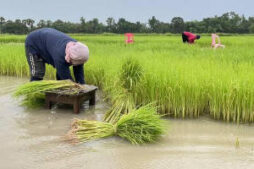
Agriculture is one of the clearest areas of complementarity between the two economies. Russia can supply grain, fertilisers, vegetable oils, seafood and processed foods, while Thailand has an established agricultural and food-processing sector and a distribution network that reaches wider ASEAN markets. The forum’s agenda therefore focused not only on agricultural exports but also on processing, food security and joint supply chains.
A proposed hop-growing and processing complex in Nizhny Novgorod Region is estimated to require ₽2.4 billion (US$28.7 million). The project would grow and process hops into pellets and extracts for breweries. Its business plan and financial model have been developed, and the proposal seeks debt financing. The projected investment return is 19.4%, with a payback period of 96 months.
The proposal is relevant to the brewing industry because it would establish a domestic supply of specialised agricultural inputs. For Thai partners, possible areas of cooperation include processing technology, equipment, ingredient distribution and commercial links with food and beverage manufacturers.
Another proposal is an integrated poultry complex in the Russian Republic of Buryatia, designed for annual broiler production of 30,000 tonnes of live weight. The facility would include a parent flock, hatchery, slaughterhouse and feed mill. It is seeking US$67 million in external investment. A separate broiler-farm proposal in Buryatia would accommodate 400,000 birds at a time, with a project cost of ₽1.1 billion (US$13.2 million). Its business plan and financial model have been developed, and the project is seeking debt financing. The stated projected internal rate of return is 30%, with a payback period of 74 months.
Dairy investment opportunities are equally varied. A proposed complex in Rodnikovsky District, Ivanovo Region, would maintain 1,960 cows for milk production, including a financing component for a farm with 1,460 dairy cows. The project has a cost estimate of ₽2.54 billion (US$23.2 million). in external investment. Design, cost-estimate documentation, a business plan, a financial model and contractor agreements have been prepared.
In Buryatia, the Tvorogovo dairy-farm proposal would build on an existing agricultural cooperative and its Simmental cattle-breeding operation. The plan envisages a modern 400-head farm and draws on existing assets: a 298-head operating dairy farm, young-stock facilities, grain warehouses, 20 vehicles and tractors, and 4,399 hectares of land, including 2,031 hectares of arable land. Its estimated project cost is ₽850 million roubles, with US$10.2 million in external investment sought.
A further opportunity is the development of an agro-industrial biotechnology park in Buryatia. Planned for an eight-hectare site, the park would provide at least 10,000 square metres of production space for companies processing plant-based raw materials. Its product range would include dry extracts, oils, powders and ingredients for food and cosmetics. Technologies identified include supercritical carbon-dioxide extraction and vacuum-pulse drying. The project cost is estimated at ₽843.6 million (US$10.1 million).
This proposal would allow agricultural raw materials to be converted into higher-value ingredients for food, cosmetics and related industries. It also envisages a mixed revenue model, combining in-house production with leasing space to resident companies. Such a structure could give investors exposure to both processing activity and the development of a specialised industrial site.
A dairy-processing complex in the Republic of Adygea offers a different investment model. The presenting company, M-Group, is described as an established full-cycle dairy producer processing more than 6,000 tonnes of milk per month. It has a network of more than 50 dairy-farm partners, a specialised milk-tanker fleet and in-house laboratories. The company is seeking a strategic investor for a new processing complex with a potential range including butter, skimmed milk, milk powder, pasteurised cream and yoghurt.
The catalogue also includes a potato-flake manufacturing plant in Nizhny Novgorod Region, intended to supply manufacturers of crisps, snacks and mashed-potato products. The proposed facility reflects the wider strategy of processing agricultural output into ingredients for industrial food production.
These projects complement the Russian export drive into Thailand. They also create possible opportunities for Thai food-processing companies to invest in Russian production, provide machinery or packaging, develop distribution agreements and establish joint ventures supplying markets in both countries.
Food Trade: New Wheat Shipments – A US$200 Million Export Target

The forum’s agricultural agenda was supported by a measurable expansion in Russian food exports. Russia resumed wheat deliveries to Thailand in 2026 after the previous shipments in 2020. During January-September 2026, Russia exported approximately 55,000 tonnes of wheat to Thailand, valued at US$11.8 million. In 2020, annual shipments had reached 313,000 tonnes worth US$66.5 million. The renewed trade therefore creates scope to rebuild a commodity flow that had previously operated at a substantially larger volume.
Seafood exports also expanded. Russian crustacean shipments to Thailand increased from 4.5 tonnes worth slightly more than US$180,000 in the first nine months of 2025 to 12 tonnes worth US$430,000 in the corresponding period of 2026. Russia also began exporting canned sardines to Thailand for the first time in 2026. The January-August shipments were reported at approximately 96-97 tonnes, valued at US$444,000-445,000.
Other Russian products entering the Thai market included chocolate and sugar confectionery, jams, fruit jellies, marmalades, grape wines, sparkling wines and bottled water. At the forum in Bangkok, Ilya Ilyushin, head of the federal Agroexport centre, estimated Russia’s annual agricultural export potential to Thailand at a minimum of US$200 million. Russian agricultural exports to Thailand totalled US$56 million in 2025, leaving a substantial gap between current trade and the stated potential.
The proposed expansion rests on several product groups: grain, fish and seafood, vegetable oils, and processed food. Across Southeast Asia, Russian agricultural exports exceeded US$500 million in 2025. The regional breakdown included more than US$200 million in meat products, US$90 million in cereals, US$50 million in vegetable oils, US$43 million in finished products and US$39 million in fish and seafood. The figures demonstrate that Russia already has export capacity across the categories that could support a wider Thai distribution strategy.
The commercial opportunity is not limited to supplying finished goods. Thai companies can work with Russian producers on packaging, processing, food-service distribution and product adaptation. Russian manufacturers, meanwhile, could use Thai processing and distribution networks to develop products for consumers in Thailand and other ASEAN markets. The investment portfolio’s dairy, poultry, potato-processing and biotechnology projects provide potential domestic production platforms that could complement this trade.
Energy Security & Industrial Power Demand
Energy was a major component of the forum’s discussions on 30 October. The session titled “The Current Energy Landscape” brought together Ilya Bychkov, director of business development for Southeast Asia at Rosatom; Lyubov Yaroshenko, head of international cooperation at En+ Group; Supachai Koonsad of the Electricity Generating Authority of Thailand (EGAT); and Bijaykumar Pandey, head of international sales and marketing at Innovek Asia. The discussions focused on energy-sector investment, engineering, technological innovation and the electricity requirements of new industrial clusters.
Thailand’s energy demand gives this agenda a significant industrial dimension. At the forum, Energy Minister Akanat Promphan said the country operates six refineries with a combined capacity of almost one million barrels per day, yet imports more than 90% of its crude oil. He also cited power requests from artificial-intelligence data centres exceeding 30 gigawatts. Gas accounts for approximately 60% of Thailand’s electricity generation, with imported liquefied natural gas supplying around 30% of that gas requirement. These figures underline the importance of supply diversification, power infrastructure and more efficient energy systems.
For Russian businesses, the agenda extends beyond commodity exports. Rosatom’s nuclear-energy and engineering capabilities, En+ Group’s international energy interests and the Thai power sector provide potential areas for technical dialogue, equipment supply and project development. However, individual opportunities must be assessed by technology, financing requirements, project approvals and commercial viability.
The energy discussion also intersected with the forum’s manufacturing agenda. Data centres, microelectronics, chemical processing and industrial automation all depend on reliable electricity. Thailand’s interest in attracting high-technology manufacturing and Russia’s search for new commercial partnerships therefore create a common interest in energy infrastructure, engineering and industrial efficiency.
Myanmar, Thailand & Russia Examine A Dawei LNG Route
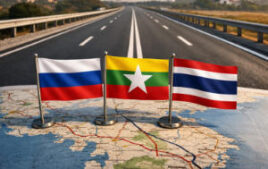
A related development emerged from separate meetings in Bangkok on 31 October. Myanmar’s Union Minister for Electricity and Energy, U Ko Ko Lwin, met Thai Energy Minister Akanat Promphan and Russian Economic Development Minister Maxim Reshetnikov in separate discussions on trilateral energy cooperation. The meetings examined the possibility of transporting Russian LNG to Myanmar and sharing supplies with Thailand.
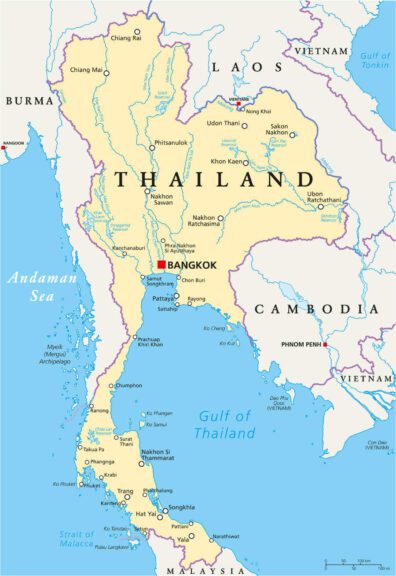
The proposed route would involve an LNG terminal in the Dawei area of southern Myanmar, supported by existing gas-pipeline infrastructure connecting the area with Myanmar and Thailand. The discussions also covered the development of the Dawei Special Economic Zone and deep-sea port as a regional trade and industrial hub. Myanmar and Russia had already signed a memorandum of understanding covering petroleum-product exports, including LNG, while Myanmar and Thailand were expected to pursue a separate memorandum on electricity and energy cooperation.
The commercial logic is based on three complementary interests: Russia seeks additional markets for natural gas, Thailand needs to diversify energy supplies, and Myanmar seeks investment for energy infrastructure and the long-delayed Dawei development. The proposal could connect fuel supply with port facilities, industrial estates, power generation and gas-based manufacturing.
This is a proposed framework, not an operating LNG corridor. The development would require investment, infrastructure planning, commercial supply arrangements and coordination across three countries. The security situation in Myanmar and the difficulties surrounding the Dawei project remain material risks for any prospective investor. Its significance at this stage is that the Russian-Thai business agenda is beginning to overlap with wider regional energy and transport connectivity.
The “Made In Russia” Pavilion Creates A Permanent Export Platform

One of the forum’s most tangible commercial initiatives was the presentation of the “Made in Russia” trade pavilion on 30 October. The Russian-Thai Business Council (RTBC), working with the Russian Export Center (REC), is developing the pavilion as part of a wider Russian-Thai Trade Platform. The RTBC was selected by the REC as the pavilion operator following a competitive process in July 2026. The platform is designed to support Russian manufacturers entering and expanding in Thailand through certification assistance, marketing, legal guidance and business-to-business introductions. The pavilion’s product scope ranges from food and pharmaceuticals to industrial machinery and technology solutions. Its launch is significant because market entry involves more than identifying a buyer. Exporters need to establish local distribution, comply with product standards, arrange labelling and certification, and maintain reliable payment and delivery channels.
The pavilion’s supporting network includes Russian institutions such as the Ministry of Industry and Trade, the Federal Service for Intellectual Property (Rospatent), the Institute for Standardization, Business Russia and the Russian Export Center. Companies named in connection with the pavilion included Abrau-Durso, Russian Crab and PetroKhleB-Kuban. Thai partners included the Thai Chamber of Commerce, the Thai Industrial Standards Institute (TISI) and the National Food Institute (NFI). Vladimir Kovalev, executive director of the RTBC, moderated the presentation.
The National Food Institute’s involvement is particularly relevant to agricultural exporters. Its role includes helping companies understand the Thai market, product requirements and the processes needed to establish production or distribution arrangements. The institute’s president, Paiyada Hanchaisuksakul, highlighted market guidance, publications, ISO training and assistance with setting up production in Thailand as areas of support.
A permanent-pavilion model would give Russian exporters a more continuous presence than a temporary trade fair. Instead of repeating initial market-entry work for each shipment, companies could develop a common platform for product promotion, partner identification and commercial follow-up. For Thai distributors, it could simplify access to Russian products and make it easier to identify manufacturers for long-term supply arrangements.
Business Russia And The Federation Of Thai Industries Sign An Industrial Cooperation Memorandum
The principal newly announced industry agreement was a memorandum of understanding between Business Russia (Delovaya Rossiya) and the Federation of Thai Industries (FTI). Signed during the forum’s business programme on 30 October, the memorandum aims to connect enterprises, promote trade and investment, strengthen business networks and encourage local production in Thailand for onward export. It was signed by Alexey Repik, chairman of Business Russia, and Pimjai Leeissaranukul, chairwoman of the FTI and the Thai-Russian Business Council.
The agreement provides an institutional basis for matching Russian and Thai companies, but its practical value will depend on the projects developed through that network. Potential areas include energy, natural resources, pharmaceuticals, infrastructure, agriculture, healthcare, digital technology, chemicals, aerospace and metallurgy. Joint production could allow Russian firms to use Thai manufacturing facilities and supplier networks, while Thai companies could gain access to Russian raw materials, technologies and distribution channels.
Repik argued that finding a buyer or supplier is only the first step in building a sustainable commercial relationship. Companies must also secure local partners, meet regulatory requirements, protect intellectual property, maintain reliable logistics and establish payment arrangements. This approach reflects the forum’s broader attempt to shift from isolated export transactions towards production partnerships and longer-term investment.
The forum also highlighted a digital-transformation memorandum between the Digital Council of Thailand and the RTBC, which had grown out of the previous year’s Phuket forum. The digital partnership adds a technology dimension to the industrial agenda and provides a possible channel for cooperation in business software, digital platforms, industrial services and technology exchange.
The distinction between a signed memorandum and a completed investment is important. The industrial memorandum establishes a framework for cooperation; it does not itself constitute a single multibillion-dollar investment contract. Its results will be judged by the number and scale of business matches, joint ventures, supply contracts and production facilities that emerge from the relationship.
Krasnodar Krai And Thailand Sign A Separate Business Cooperation Agreement
A separate regional agreement between Russia and Thailand was signed on 30 October 2026 in Bangkok, during the Second Russian-Thai Investment Forum. The agreement was concluded between the Krasnodar Krai Investment Attraction Agency and the Association for the Development of Entrepreneurship and Support of Business Ties with Thailand. It was signed by Kamila Kuptsova, director of the Krasnodar Krai Investment Attraction Agency, and Vladimir Kovalev, executive director of the Thai-business association and the Russian-Thai Business Council. The agreement establishes a direct institutional mechanism for developing commercial relations between Thai companies and businesses in Krasnodar Krai.
The agreement has a particular focus on helping small and medium-sized enterprises (SMEs) from Kuban enter the Thai market. Its provisions include facilitating direct business contacts, providing information and consulting assistance to entrepreneurs, explaining Thailand’s sectoral market conditions and regulatory requirements, and informing companies about mechanisms supporting foreign economic activity. The two organisations also intend to arrange joint working meetings, consultations, business negotiations, company presentations and participation in specialised trade exhibitions. This gives the agreement a practical business-development function: rather than limiting cooperation to regional promotion, it creates an institutional channel through which individual Kuban enterprises can identify Thai distributors, suppliers, investors and production partners.
The agreement was accompanied by a wider programme of regional commercial engagement led by Veniamin Kondratyev, Governor of Krasnodar Krai. During the forum, Kondratyev met Suriya Juangroongruangkit, Thailand’s Minister of Agriculture and Cooperatives, to discuss agricultural trade and potential expansion of Russian food supplies. The governor highlighted Krasnodar’s capabilities in grain cultivation and processing, dairy and meat production, and fruit and vegetable cultivation. He also stated that the region accounts for more than 50% of Russian wine exports and nearly 60% of champagne exports and produces and exports what he described as the world’s northernmost tea. The Thai minister expressed interest in examining the proposed range of agricultural products and discussing applicable tariffs. Thailand also offered cooperation involving digital irrigation systems, opening a potential technology dimension alongside agricultural trade.
Kondratyev also held discussions with Pimjai Leeissaranukul, chairwoman of the Federation of Thai Industries, concerning industrial exports and investment partnerships. The Russian region presented opportunities involving beach-cleaning and sand-cleaning machinery, animal-feed additives, veterinary vaccines and sera. Further industrial proposals included factories producing displays, iodine, printed circuit boards, cooling systems, power supplies, medical gloves and aircraft spare parts. Krasnodar offered potential investors industrial sites, concessional financing through the Industrial Development Fund and subsidies for establishing import-substitution production facilities. These were industrial cooperation proposals discussed during the forum, rather than additional signed factory-investment contracts.
The regional delegation also included representatives of Kuban businesses seeking direct access to Thai consumers and commercial partners. Mikhail Lelyuk of Fanagoria, the Krasnodar-based agro-industrial company, discussed plans to introduce Russian wines to Thailand. The participation of PetroKhleB-Kuban in the agricultural and food-sector programme and the Made in Russia trade-pavilion activities further connected the region’s food producers with Thai distributors and industry representatives.
The significance of the Krasnodar agreement is that it adds a regional implementation mechanism to the national business-association agreements signed at the forum. It specifically targets SMEs, export promotion, market intelligence and direct company-to-company contacts. Combined with the agricultural discussions, wine-export plans and industrial proposals, it gives Kuban a defined commercial channel into Thailand rather than leaving regional participation at the level of conference representation.
The Thai Chamber Of Commerce: Two Additional Memoranda

Separate business-association activity also produced two memoranda involving the Thai Chamber of Commerce. On 30 October, Dr Poj Aramwattananon, chairman of the Thai Chamber of Commerce and the Board of Trade of Thailand, participated in the forum alongside Dr Chanin Chalisarapong, vice-chairman of the chamber, and Kasemsit Pathomsak, vice-chairman of the Board of Trade.
The Thai Chamber of Commerce announced memoranda with the Moscow Chamber of Commerce and Industry and the Chamber of Commerce and Industry of the Russian Federation. The stated purpose was to strengthen institutional cooperation, connect business networks and create opportunities for trade and investment.
These agreements complement the Business Russia-FTI memorandum by connecting companies through additional regional and national business institutions. The Moscow agreement has particular relevance to city-level cooperation, while the Russian chamber agreement provides a wider framework for business contacts across Russia. Together, the memoranda could help match Thai companies with Russian regional producers and give Russian exporters access to Thai importers, distributors and service providers.
The Thai Chamber also raised the prospect of expanding bilateral agricultural and food trade to US$1 billion within three to five years. That is a target rather than an achieved result, but it provides a measurable benchmark for assessing future market access, product approvals, joint ventures and distribution agreements.
The sequence of agreements illustrates that the forum’s institutional outcomes extended beyond one bilateral memorandum. Business Russia and the FTI focused on enterprise connections and production cooperation; the Thai Chamber’s agreements with the Moscow and Russian chambers focused on business networking and market access; and the RTBC-Digital Council relationship addressed digital transformation.
Russian-Thai Business Council And Digital Council Of Thailand Sign Digital Cooperation Memorandum
The Russian-Thai Business Council (RTBC) and the Digital Council of Thailand signed a memorandum of understanding to strengthen cooperation in digital technologies and expand business connections between Russian and Thai technology companies during the Second Russian-Thai Investment Forum in Bangkok, held on 29-31 October 2026. The agreement provides an institutional framework for connecting the two countries’ digital-business communities, encouraging direct contacts between technology companies and identifying opportunities for joint commercial projects. Its focus includes digital transformation, technology development and the exchange of business expertise, with the potential to support cooperation in areas such as enterprise digitalisation, software, digital platforms and technology services. The memorandum also adds a digital-industry dimension to the forum’s wider investment agenda, which covered manufacturing, energy, agriculture, finance and real estate. For Russian companies seeking access to Thailand and the wider Southeast Asian market, cooperation with the Digital Council of Thailand offers a channel to engage with local technology businesses and explore partnerships. For Thai companies, the RTBC provides a counterpart for establishing contacts with Russian firms and assessing opportunities in the Russian digital market. The memorandum should be described as a framework for future cooperation, rather than evidence that specific technology contracts or investment amounts were concluded at the signing.
Financial Infrastructure: Direct Settlements, Rubles, Baht & Credit Card Payments
Financial connectivity emerged as one of the most important practical constraints on expanding trade. On 31 October, the session “Financial Infrastructure and Alternative Payment Methods” brought together representatives of Russian and Thai banks, investment institutions and financial-sector organisations to examine settlement mechanisms, national currencies and alternative payment instruments. The panel called for a jointly supervised “safe harbour” regulatory sandbox to test new cross-border payment solutions and facilitate trade. The proposal addresses the inadequacy of current payment channels, which are struggling to handle the fast-growing bilateral trade and have high transaction costs of 5-8%.
Ivan Demchenko, chairman of the RTBC, called for a dedicated banking channel modelled on the Russian-Vietnamese bank arrangement. He argued that more direct financial links could substantially expand bilateral commerce. Petr Zaselsky, chairman of the management board of ROSEXIMBANK, outlined ruble credit lines at an interest rate of 7.5%, pre-export financing, long-term credit facilities for larger companies and cross-border settlement services in Thai baht through the bank’s Planet platform. The financial discussion also examined a jointly supervised regulatory “safe harbour” sandbox. Dr Darmp Sukontasap of Thailand’s Ministry of Commerce’s Institute for Trade and Development proposed testing new cross-border payment solutions within a framework designed to let financial institutions experiment under agreed compliance rules.
Participants discussed creating a middle layer linking existing payment networks, including Thailand’s PromptPay and Russian payment infrastructure, rather than replacing the systems outright. Stablecoins and digital assets were also raised as possible complementary instruments, including a proposed tourist-payment sandbox involving licensed brokers and electronic wallets. These were proposals discussed by participants, not announcements that a new bilateral payment system had already been launched.
The business rationale is straightforward. When payments must pass through third-country financial institutions, companies face additional intermediaries, longer settlement chains and greater transaction costs. Businesses participating in the forum cited costs of approximately 5–8% in some payment arrangements. For exporters with tight margins, such expenses can undermine the competitiveness of otherwise viable transactions.
A direct or more efficient settlement mechanism could improve working-capital management, make smaller transactions more economical and encourage repeat orders. The effect would extend beyond large energy shipments to food producers, pharmaceutical suppliers, tourism operators and smaller manufacturers. A payment system that supports routine transactions is therefore as important to the next phase of trade as a large investment announcement.
Standards, Certification & Market Entry

The forum’s sessions on certification and standardisation addressed another obstacle to expanding trade: a product can be commercially attractive but still fail to reach the customer if its documentation does not meet the importing market’s requirements.
Alexey Murzenok, managing director for international trade at the Russian Export Center, outlined support for certification, standardisation, legal establishment, marketing and promotion under the “Made in Russia” brand. The National Food Institute of Thailand was identified as the main Thai partner for this work. Chanwit Yuchua, senior standards officer at the Thai Industrial Standards Institute, discussed the role of product standards and certification in industrial trade.
Diego Sala, chief executive of Siam Trade Development, highlighted the first 90 days between goods leaving the exporter and reaching retail shelves as a particularly vulnerable period. Problems can arise when certificates refer to a different product code, additional licences are overlooked or product labels do not match shipping and regulatory documents. Such discrepancies can delay shipments, generate costs or lead to contracts being cancelled.
For food, cosmetics and other consumer products, the issue also extends to claims made on packaging and marketing materials. Exporters need to ensure that product descriptions, labels, licences and shipping paperwork remain consistent before goods are dispatched.
The economic significance is substantial. If the permanent trade pavilion can coordinate market guidance and certification support, it could lower the entry costs faced by smaller exporters. A common platform would also help Thai importers identify suppliers whose products and documentation are prepared for the market. The next step is to translate this support into repeat shipments and sustained commercial relationships.
Technology And Digital Industry: From Software To Industrial Automation

The 31 October programme shifted towards emerging industries under the theme “Drivers of the New Economy”. Its agenda covered financial infrastructure, medicine and pharmaceuticals, wellness and longevity, digital platforms, creative industries, real estate, hospitality, tourism and sports.
The session on platform economics and digital ecosystems included companies and institutions such as 1C, RWB, Positive Technologies, Sber, VisionLabs, Network Advisory Team, TeC e-Business Center and True Corporation. The Digital Council of Thailand and Thailand’s Digital Economy Promotion Agency were also identified as participants in the wider technology agenda. The discussions addressed demand for business software, digital marketplaces, industrial technology and opportunities to develop solutions for third-country markets.
Nakah Thawichawatt, vice-president of the FTI’s Institute of Digital for Industry, highlighted Thailand’s transition towards industrial robotics and the need to expand the digital economy’s contribution to GDP beyond 6%. The institute represents an organisation covering approximately 17,000 manufacturers. He identified industrial cybersecurity, data protection, data centres and practical artificial-intelligence applications as areas of demand.
For Russian companies, these needs create possible openings in enterprise software, cybersecurity, machine vision, industrial automation and digital services. For Thai companies, partnerships could provide access to Russian technology developers and software suppliers, potentially enabling solutions to be adapted for Southeast Asian clients.
The commercial opportunity is not simply the sale of software licences. It includes integration, maintenance, technical training, local-language support and long-term service contracts. These activities can generate recurring revenue and establish a stronger business presence than one-off equipment sales.
Healthcare, Pharmaceuticals And The Longevity Economy

Healthcare cooperation was another major element of the new-economy programme. The session “Medicine and Pharma of the Future: Technologies for Life” examined potential cooperation in medical technology, pharmaceuticals and biomedicine. Russian capabilities discussed in the wider agenda included innovative medicines, vaccines, nuclear medicine and digital health, while Thailand’s position as a medical destination in Southeast Asia offers potential for clinical services, healthcare investment and medical tourism.
The related session “The Longevity and Well-Being Economy: People, Technology, Environment” explored the intersection of medicine, biotechnology, hospitality, real estate and digital solutions. The underlying commercial proposition was to connect Russian health technologies and biomedical expertise with Thai hospitals, wellness services and tourism infrastructure.
Potential cooperation could encompass medical equipment, pharmaceutical distribution, preventive healthcare, rehabilitation, wellness programmes and technology-enabled patient services. Thai hospitals and hospitality companies could provide service infrastructure, while Russian technology companies and healthcare providers could contribute products and specialised expertise.
The investment case depends on product approvals, clinical requirements, service quality, financing and the ability to build a sustainable customer base. The forum identified areas for cooperation, but individual projects will require their own commercial and regulatory arrangements.
Real Estate, Hospitality And Tourism Investment

Thailand’s property market was another focus of the forum. The session “A New Form of Development: Real Estate in Thailand”, held on 31 October, brought together developers, property specialists and investment representatives to examine Russian–Thai partnerships in residential development and tourism-related real estate.
Participants included Anna Larina, head of the residential real estate department at NF Group; Pasu Liptapallop, managing director of Proud Real Estate; Pratip Tangmatitham, chairman of the board of Supalai; Carlo Pobre, vice-president of Coilers Consulting Bureau; Techit Nitinara, founder of The Win Telecom; and Cholachit Vorawangso Wirakul, deputy secretary-general of Thailand’s Eastern Economic Corridor. Kirill Solgalov, chief architect of SPI Planning Group and a member of the Union of Architects of Russia, moderated the session.
The discussion addressed potential Russian–Thai development partnerships and proposals to improve the investment environment for foreign buyers. Thailand’s real estate market offers opportunities in destinations such as Phuket and Pattaya, while the catalogue includes hotels, resorts, development land and operating businesses across Phuket, Phang Nga, Bangkok and other locations.
The forum’s wider hospitality agenda also drew attention to Thai investment in Russia. One example is the Miracleon Mövenpick Resort and Spa in Anapa, operated by Thai hospitality group Dusit, with reported investment of ₽30.3 billion (US$400 million). The project demonstrates that cooperation can extend beyond Russian investment in Thailand to Thai companies operating in Russia’s tourism market.
Tourism flows provide a commercial foundation for this relationship. The forum’s materials cited 32.9 million foreign visitors to Thailand in the preceding year, including a record 1.9 million Russian tourists. Cooperation could therefore encompass hotels, travel platforms, medical tourism, wellness services, hospitality technology and targeted tourism products for visitors moving in both directions.
On 31 October, a separate hospitality session examined investment in the HoReCa sector such as hotels, restaurants and catering. The forum’s programme cited Thai hotel investment transactions worth ฿26.4 billion, (US$845.6 million), in 2026. It also identified the proposed bridge connecting Koh Samui with mainland Thailand as infrastructure that could influence tourist flows and unlock additional development opportunities.
Moscow-Bangkok Cooperation And Regional Connectivity

The forum also provided a platform for city-level economic cooperation. During the plenary session “Moscow-Bangkok: Partnership and Development” on 30 October, representatives discussed joint projects in transport, technology, industry, healthcare and digitalisation. Viacheslav Manuylov, deputy head of Moscow’s Department for External Economic and International Relations, estimated trade between Moscow and Thai companies at nearly US$1 billion in 2025.
Manuylov highlighted opportunities in urban transport, digital services, education, healthcare and tourism. The two capitals have an existing transport working group, providing a channel for technical exchange. The forum also discussed the presentation of Moscow’s urban technology solutions to Thai counterparts and the development of commercial partnerships based on joint products and technology transfer.
Alexander Shatirov, director of the Roscongress Foundation Investment Platform and the RK-Investments Foundation, discussed the role of project-matching mechanisms in connecting investors with developers. He identified 24 Moscow projects for presentation to Thai businesses, alongside a wider pipeline of nearly 4,000 projects at advanced stages of development across Russia.
The Moscow–Bangkok agenda fits into a broader pattern of interregional cooperation. The Russian portfolio contains projects in regions such as Ulyanovsk, Oryol, Nizhny Novgorod, Krasnoyarsk Territory, Buryatia, Ivanovo, Kursk and Adygea. Each offers a different combination of industrial capacity, agricultural resources, labour, infrastructure and investment requirements. For Thai investors, this creates a route to assess opportunities outside Russia’s largest metropolitan markets.
The political and institutional background is also relevant. On 14 August 2026, Thailand’s Deputy Prime Minister and Foreign Minister Sihasak Phuangketkeow and Russian Minister for the Development of the Russian Far East and the Arctic Aleksey Chekunkov co-chaired the ninth session of the Thailand-Russia Joint Commission on Bilateral Cooperation in Moscow. Discussions covered trade, investment, agriculture, energy, industry, tourism, education and climate change, as well as the proposed Thailand-Eurasian Economic Union free trade agreement.
The commission’s agenda provides the institutional context for the forum’s business discussions, including the removal of trade barriers and the expansion of market access for agricultural and food products. The proposed free trade agreement remains an important prospective mechanism rather than an agreement already in force.
Cultural And sports Programmes Extend The Business Network

The 29-31 October programme combined commercial sessions with cultural and sporting events. On 29 October, Russian and Thai junior ice hockey teams participated in a friendly match, followed by a masterclass led by Roman Rotenberg, first vice-president of the Russian Ice Hockey Federation and head coach of the Russia-25 team. Russian figure skaters also gave exhibition performances.
The “MIR” Russian-Thai Cultural Festival at Lumpini Park brought together music, art, gastronomy, contemporary products, literary displays and family activities. The programme also included the theatrical production The Thai Dictionary, featuring Russian actress Irina Starshenbaum and Thai actor and model Sean Tsindahot. A friendly badminton tournament involving business executives and professional athletes took place on 31 October. The cultural programme is relevant to the commercial agenda because it supports tourism, hospitality, sports management and consumer-product promotion. Events that introduce visitors to food, beverages, cultural products and tourism services can help businesses understand market preferences and establish contacts beyond formal conference sessions.
Summary: From Project Pipeline To Implementation
The second Russian-Thai Investment Forum produced a combination of investment opportunities, business-association memoranda, a trade-promotion platform and proposals for practical cooperation in payments, certification, energy, technology and tourism.
Its central economic result was the presentation of 81 projects with a combined value exceeding US$4.6 billion. Russia accounted for 41 projects valued at more than US$4.1 billion, Thailand for 35 projects worth US$501 million, and five cross-border partnership proposals represented US$6.4 million. The forum also brought together more than 2,000 participants and over 1,000 companies, while post-event reporting described more than 800 companies taking part in the business activities. The figures reflect different descriptions of the event’s participation and project pipeline.
The signed memoranda between Business Russia and the Federation of Thai Industries, and between the Thai Chamber of Commerce and Russian and Moscow chambers of commerce, created additional channels for business matching. The RTBC-Digital Council of Thailand relationship added a digital-cooperation dimension, while the “Made in Russia” pavilion established a platform for Russian products and export support.
The portfolio’s sectoral breadth is important. Industrial proposals include glass packaging, electronics, mineral processing, microelectronics chemicals and tyre recycling. Agricultural projects cover poultry, dairy, hops, potato processing and biotechnology. Thai opportunities include real estate, hospitality and operating businesses. Cross-border discussions extend into payments, industrial technology, healthcare, energy, tourism and regional connectivity.
The next phase will depend on the conversion of proposals into financed projects, signed supply contracts, operational joint ventures and repeat trade. For manufacturers, that means securing investment and technical partners. For agricultural exporters, it means increasing shipments, meeting standards and building distribution. For financial institutions, it means creating reliable payment arrangements. For investors, it means conducting due diligence and assessing the costs, risks and returns of individual projects.
The forum’s significance is therefore not confined to the US$4.6 billion headline figure. It lies in the attempt to build the practical infrastructure of bilateral commerce: business networks, certification support, export promotion, financial settlement mechanisms and project-matching systems. If those mechanisms deliver measurable results, Russia-Thailand economic cooperation could develop from a relationship driven largely by commodity trade and tourism into a broader partnership in manufacturing, food processing, technology, healthcare and investment
Russia exported around 55,000 tonnes of wheat worth around $11.8 million to Thailand in 9M 2026, the Agroexport federal center told Interfax, citing expert estimates.
Deliveries resumed after a hiatus beginning in 2020. That year, 313,000 tonnes of wheat worth US$66.5 million were sent to the country over the entire year.
In addition, Russia increased exports of crustaceans to Thailand – while 4.5 tonnes worth just over US$180,000 were shipped in 9M 2025, 12 tonnes worth US$430,000 were exported over the same period of 2026.
Agroexport previously said that Russia exported sardine preserves to Thailand for the first time in 2026 (96 tonnes worth US$444,000).
In 2026, Russian exports to Thailand also include chocolate confectionery, jams, fruit jellies and jelly sweets, grape wines including sparkling ones, water, sugar confectionery and other products.
This analytical report was written by PC Majumdar, a geostrategic and geo-economics analyst based in South Asia whose work has been widely published by international news media and publications. He may be reached at info@russiaspivottoasia.com