
 Русский







Uruguay, a founding member of Mercosur, maintains a commercial relationship with Russia that has a profile of its own: so far this century it depends on Russia for more than 5% of its exports and for as much as 11.7% of its imports, with trade dominated by beef in one direction and by inputs in the other. Mercosur is significant, as it has a primary role as a target bloc for developing imports and exports as part of Russia’s current Foreign Policy Concept. However, as concerns Uruguay, there has been a sustained trade deterioration since 2013.
In this article we examine the relationship between the two countries since 2000, drawing on official statistics from the Central Bank of Uruguay (BCU) and on product-level detail from Uruguay XXI, with a focus on its structure, its cycles, and the most recent changes—including after years of decline, an apparent resurgence.
Bilateral Trade Cycles & Historical Trade
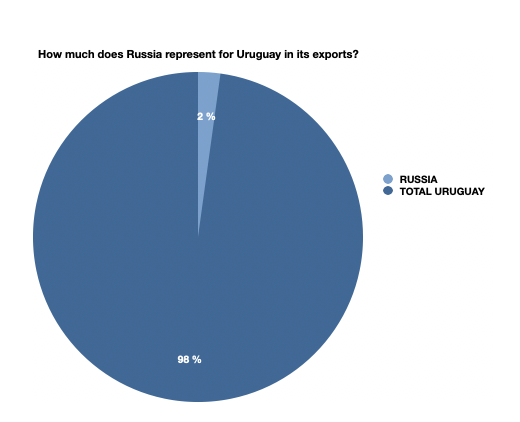
Between 2000 and 2005 the bilateral relationship was marginal for Uruguayan exports, which rose from US$6.4 million to US$38 million, but not for imports: purchases from Russia reached US$257 million in 2003, US$342 million in 2004, and US$309 million in 2005, being between 8% and 12% of everything Uruguay imported. For Russia, by contrast, Uruguay never exceeded 0.2% of its exports (2008) or 0.15% of its imports (2010).
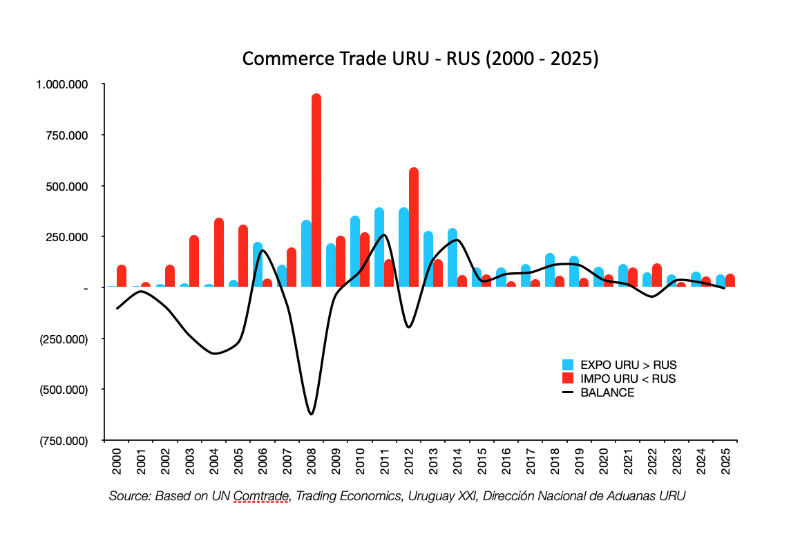
Export take-off came in 2006, led by beef: total export sales to Russia rose from US$38 million in 2005 to US$225 million, with US$195 million of this in meat, while Russia absorbed 5.6% of Uruguayan exports, ahead of China. After a dip in 2007 (US$113 million), sales climbed to US$332 million in 2008. Among the seven markets broken out by the Uruguay’s Export Agency, BCU (Argentina, Brazil, Paraguay, China, the European Union, the United States, and Russia), Russia ranked fourth in 2008 and fifth between 2009 and 2012 and outpaced the United States between 2008 and 2012.
The peak came between 2010 and 2012: US$352 million, US$395 million (the record of the series, equivalent to 5% of total exports), and US$394 million. In 2011 meat accounted for 89% of exports (US$353 million); frozen boneless beef sold at a unit value of US$4,243 per ton, compared with US$2,616 in 2006, with 76,000 tons. Between 2006 and 2012, 473,000 tons of that product were shipped, 78% of all the volume exported between 2001 and 2025.
Erratic Beef Performances

From 2013, that pattern broke down. Exports fell 29% in 2013 (US$278 million), held at US$293 million in 2014, and plunged 66% in 2015 to US$98 million. Meat went from US$287 million in 2012 to US$139 million in 2013 and US$32 million in 2015, while volumes of frozen boneless beef dropped from 65,000 to 30,000 and then to 7,200 tons.
Uruguay XXI attributes this long-term decline mainly to lower sales of beef and soybeans. Dairy cushioned part of the blow: it rose from US$56 million in 2012 to US$119 million in 2014, with 17,400 tons of butter at US$4,667 per ton, and US$111 million in 2019, when it was 4.8 times meat sales (US$23 million).
Between 2016 and 2021 trade settled onto a low plateau, with Uruguayan exports of between US$98 million and US$169 million per annum (the peak was in 2018) and a share of between 1.2% and 2.2% of total exports. Since 2022 they have fallen further: US$74 million in 2022 (35% less), US$63 million in 2023, US$78 million in 2024, and US$64 million in 2025 (preliminary), 84% below 2011 and 78% below 2014. Russia went from absorbing 5% of Uruguayan exports in 2011 to just 0.57% in 2025. In 2024, US$43 million in meat was sold (8,300 tons of frozen boneless beef, at US$2,879 per ton) and US$27 million in dairy; in 2025, US$35 million and US$22.5 million, with beef at US$4.208 per ton.
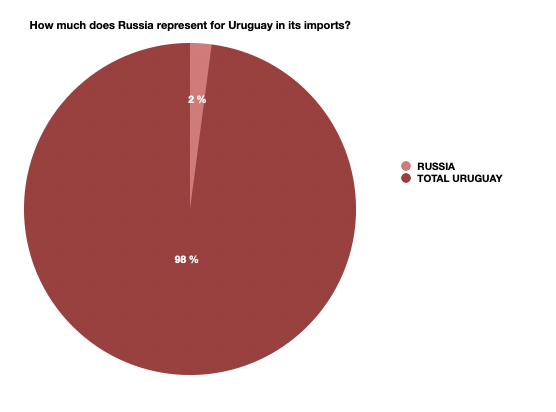
Imports from Russia followed a different pattern, made up of isolated peaks: US$257 million in 2003, US$342 million in 2004, and US$309 million in 2005, a drop to US$43 million in 2006, a jump to US$955 million in 2008 (388% more than in 2007, 10.5% of Uruguayan imports), a 73% collapse in 2009, and a new peak of US$589 million in 2012 (328% more than in 2011). This is hugely erratic trade behavior.
Those three episodes, 2003-2005, 2008, and 2012, add up to US$2.452 million, more than half of the US$4.484 million imported from Russia between 2000 and 2025. Purchases then fell to US$141 million in 2013 and US$60 million in 2014 and since then have ranged between US$28 million and US$119 million a year: US$119 million in 2022, US$28 million in 2023, US$54 million in 2024, and US$68 million in 2025 (27% more than the previous year).
On that trajectory, Uruguay ran a surplus with Russia in 14 of the 26 years (2006, 2010, 2011, 2013 through 2021, 2023, and 2024) and a deficit in the other 12; between 2000 and 2025, it exported US$3.838 million and imported US$4.484 million, leaving a cumulative deficit of around US$646 million, explained by the peaks of 2008 and 2012. Annual trade averaged US$360 million in 2000-2009, US$379 million in 2010-2019, and US$155 million in 2020-2025, 59% less than in the previous decade.
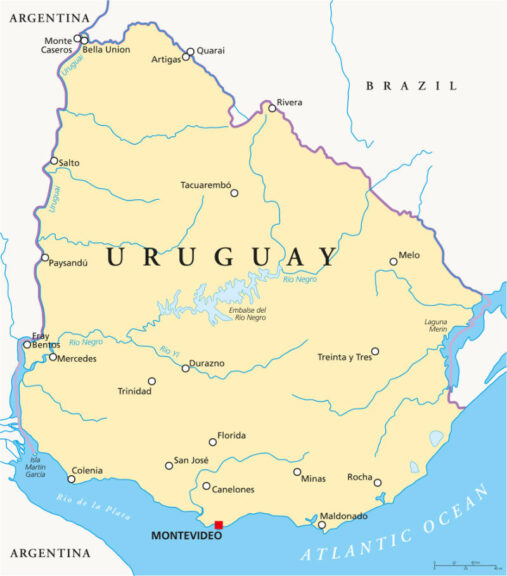
2026 Uruguay–Russia Trade

In 2026 both flows continue to fall. Between January and August, according to preliminary BCU figures, exports to Russia reached US$31.8 million (25.7% less than in the same period of 2025) and imports US$39.6 million (23.4% less). With product detail for January to September, meat sales are holding (US$26.5 million, 4% more), while dairy sales have almost disappeared (US$0.7 million versus US$17.7 million, 96% less).
The decline in bilateral trade between Russia and Uruguay has been driven primarily by severe financial barriers, logistical disruptions, and shifting geopolitical alignment following international sanctions. While Uruguay has historically maintained a pragmatic, independent foreign policy-separating commercial ties from political stances (such as voting against Russian territorial annexations at the UN)-private-sector companies in both nations face heightened compliance risks, rising insurance expenses, and tighter export-import controls. The removal of Russian banks from the SWIFT Financial Messaging System and broader international banking restrictions have made clearing and settling cross-border transactions extremely difficult, costly, and slow.
Direct shipping routes, freight insurance, and transport networks linking Russia and South America have also faced massive complications, driving up transaction and freight costs.
In addition to this, as our data indicates, trade between the two countries has traditionally relied on a very narrow basket of goods-dominated by Uruguayan agricultural exports (such as meat, dairy, and fish) going to Russia-making the overall volume highly sensitive to supply chain shocks and exchange rate volatility.
Despite the downturn, both governments have signalled a desire to stabilize and rebuild economic channels. Russian officials have emphasized restoring trade volumes ahead of diplomatic milestones, while Uruguay continues to explore institutional and regional pathways (such as potential contacts via the EAEU-MERCOSUR framework) to ease payment and logistics bottlenecks.
Russian Imports From Uruguay
Uruguayan sales to Russia have been dominated by animal proteins: between 2001 and 2025, US$3.839 million was exported (customs value), of which 63% was meat and edible offal (US$2.423 million) and 25% dairy (US$951 million). Fruit and nuts (3%), fish and seafood (2.5%), and oilseeds (1.7%) round out five categories that account for 95% of sales.
At the product level concentration is higher still: a single item, frozen boneless beef, accounts for 51% of the total (US$1.966 million and 605,000 tons, at an average unit value of US$3.248 per ton), and butter another 14% (US$523 million at 134,500 tons). Together with concentrated or powdered milk, horse meat, and hard cheeses, the top five products add up to 74% of exports; the top ten, 84%; and the top 25, 95%, out of more than 350 tariff codes. Unit values are FOB per ton and also reflect the mix of cuts and presentations, not just the market price.
Uruguay Imports From Russia
Product-level detail on Uruguayan imports is available only for 2023-2025, years in which Uruguay imported US$150 million of Russian origin: A total of 82% of all Russian imports were fertilizers and agrochemicals worth US$122.5 million, 11% mineral products (US$16.4 million, almost all bulk sulfur), and 5% prepared vegetables (US$7.5 million). Fuels, which are inferred to have weighed heavily in the earlier peaks, appear with just US$1.4 million.
The top three products, fertilizers with two or three fertilizing elements (24%), potash fertilizers (21%), and fertilizers with all three elements (NPK, 17%), account for 61% of purchases, and the top ten, 97%. Fertilizer purchases grew from US$23 million in 2023 to US$45 million in 2024 and US$55 million in 2025 (137% more in two years).
Unit values ranged from US$198 per ton for sulfur and US$352 for potash to US$522 for NPK and US$640 for fertilizers with two or three elements. For earlier years there is no product detail: the peaks of 2003-2005, 2008, and 2012 coincide with the period in which, according to an official note from 2018, Uruguay was still buying Russian oil (the BCU has recorded no such purchases since 2013), and with the Russian ambassador’s 2014 description of his country’s offer to Uruguay as “fertilizers and oil,” but this would need to be confirmed with product-level detail for those years.
Uruguay-Russia Bilateral Trade Looking Ahead

Uruguay shows a very marked asymmetry: for Russia, trade with Uruguay has never exceeded more than 0.2% of its exports or 0.15% of its imports. For Uruguay, by contrast, Russia weighed as much as 5.6% of its exports (2006) and 11.7% of its imports (2003) yet today accounts for barely 0.57% and 0.53%.
The export relationship has depended on a single product, frozen boneless beef, and that market shrank from 65,000 tons in 2012 to 4,800 in 2025, a 93% decline. Dairy took up part of the space, but it too is receding—in 2026 it almost disappeared from sales to Russia. What holds up is the meat niche, which in 2026 is growing 4% in value and is now selling at a higher unit value (US$5.284 per ton between January and September), with volumes far below those of a decade ago.
On the import side, the relationship has been reduced to that of an input supplier: Uruguay buys fertilizers and sulfur from Russia at competitive prices, with these purchases growing even as total trade was falling. For Uruguayan exporters, moreover, alternatives are widening, such as the agreement between Mercosur and the European Union. The chance to rebuild the relationship will depend on resolving obstacles in access, payments, and logistics and on a more diversified export offering than meat.
As in the rest of the bloc, the series shows jumps associated with shocks, such as the purchase peaks of 2008 and 2012 or the shift in the beef market in 2013 and 2015, with resulting volatility the rule.
Russia, however, has been considering restoring its trade and cooperation with Uruguay to previous levels. Russian Deputy Foreign Minister Sergei Ryabkov said last month at the ‘Gauchos & Authentic Uruguay’ exhibition that “our priority is to restore the volumes of our bilateral cooperation, which have dropped for numerous reasons, and to ensure its gradual development.” We are glad that the Uruguayan leadership fully shares this resolve and has been demonstrating interest in its partnership with Russia.”
That exhibition, featuring works by Uruguayan artist Luis Fabini, was organized by the Russian Foreign Ministry ahead of a celebration in 2027 of the 170th anniversary of the diplomatic relations between the two countries. It has subsequently been touring the world.
Ryabkov added that Moscow is satisfied with the dynamic of its work with Uruguay, regular meetings of the foreign ministers, and the relaunch of a bilateral intergovernmental commission. He stated that “Uruguay’s nature landscapes with open horizons and vast plains are reminiscent of the swathes of steppes in southern Russia. In the Gaucho image, one can guess hints of the features of the Russian Cossack. Our daily customs, traditions of hospitality, family tea-drinking, and the mate culture of cooking meat on live fire are surprisingly similar. This is why, more than a century ago, the traditional Gaucho habitats became the center of attracting Russian migrants who founded the city of San Javier in the steppes of the Rio Negro Department. That way Uruguay echoes in our hearts despite the geographic remoteness. It evokes something kindred in the soul of a Russian person.”
While the trade dynamic has undoubtedly fallen over the past decade, it is of consequence that the Russia-Uruguay Intergovernmental Commission has been relaunched. High-level diplomatic contacts-including meetings between Russian Deputy Foreign Minister Sergey Ryabkov and Uruguayan counterparts, as well as Foreign Ministers Sergey Lavrov and Mario Lubetkin-have emphasized restoring trade volumes and preparing for cultural and commercial celebrations leading up to the 170th anniversary of diplomatic relations in 2027.
That is represented by core sectors in agricultural produce, foodstuffs, seafood, and animal health/phytosanitary cooperation, alongside discussions around industrial cooperation, energy modernization, and transport.
There has been an impact, with bilateral trade experiencing a notable resurgence. Trade turnover grew by 70% year-on-year to reach US$123 million in H1 2025, building on a previous total of US$150.2 million in 2024.
Data for 2026 is still fragmented: there are no consolidated official trade turnover statistics for the year. Nevertheless, the available indicators point to a continued upward trend. According to the VetIS Federal State Information System, in January–May 2026, Uruguay increased its supplies of meat and meat products to Russia by 14%-to 4,900 tons-while exports of fish and seafood rose by 67% to 272 tons. In the opposite direction, Russia shipped 188 tons of regulated products over the same period, mainly fish and seafood.
Regional data also confirms the ongoing growth in agri‑food supplies. According to the Russian Agroexport Centre, Russian agri‑food exports to South American countries increased 6.5‑fold between January and August 2026, to approximately 350,000 tons, worth over US$101 million. Uruguay is listed among the recipient countries, although its exact share in this figure is not disclosed.
This article was provided by Martin Epstein, an experienced economic analyst based in Argentina. He may be reached at info@russiaspivottoasia.com